


 Download Free Sample
 Buy Now
Global Anti-aging Drugs for Dogs Market Overview
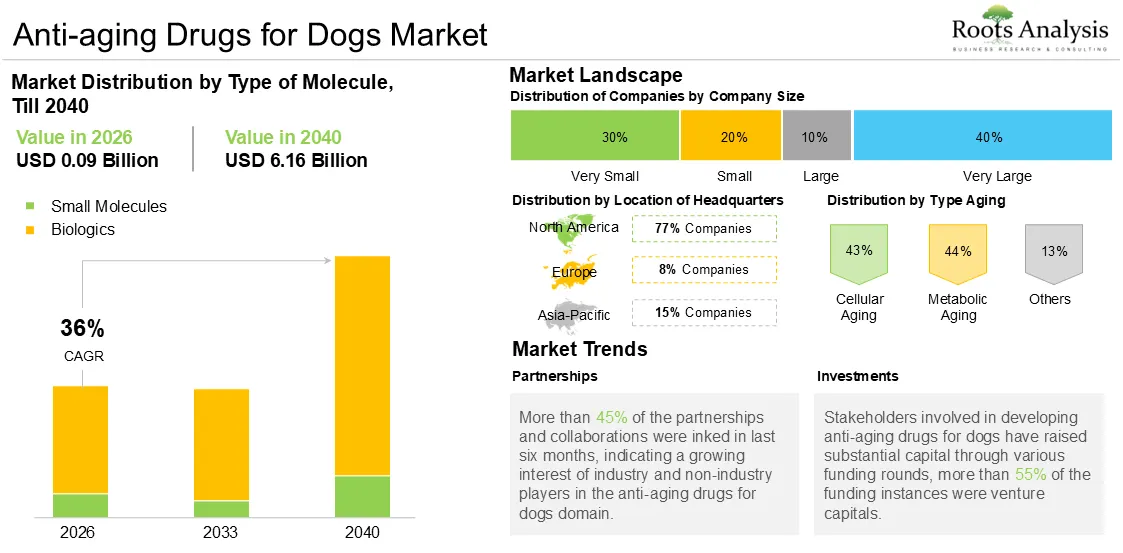
The global anti-aging drugs for dogs market, valued at USD 0.09 billion in 2026, is projected to reach USD 6.16 billion by 2040, with a 36% CAGR during the forecast period 2026 to 2040.
See What’s in the Full Report – Request Your Complimentary Insights!
Aging is characterized by a wide range of molecular and cellular changes that occur in dogs as their lifespan increases. These changes gradually result in the loss of physical and cognitive abilities and lead to increased susceptibility to diseases and mortality. The aging process in dogs is influenced by a multifaceted interplay of biological, environmental, and genetic factors. Notably, larger dog breeds tend to experience age-related changes more rapidly than small dog breeds.
Over the years, the pet dog population has increased at a substantial rate. According to the American Veterinary Medical Association, the dog population has steadily increased from 52.9 million in 1996 to 89.7 million in 2024. Also, the number of pet-owning households has increased from 31.3 million in 1996 to 59.8 million in 2024. This trend highlights the increasing demand for innovative healthcare solutions, including therapeutics aimed at extending health span or improving quality of life in aging dogs. This is driven by the pet owners’ willingness to invest in advanced healthcare to improve their dog’s overall health and well-being.
Further, it is important to highlight that the biology of aging in dogs is still a largely unexplored field, in terms of the developing safe and effective therapeutics. However, the increased pet owner spending, ongoing pace of innovation, and financial support from investors are likely to drive the anti-aging drugs for dogs market growth in the coming years. This market is a part of the broader companion animal health market.
US based Loyal Biotech is leading the way forward in this area, with its lead drug LOY-002 expected to reach the shelves by early 2026.
The anti-aging drugs for dogs industry analysis features the likely distribution of the current and forecasted opportunity within the domain across various segments, such as type of modality, type of biologics, route of administration, type of formulation, type of aging, type of canine population targeted, geographical regions and sales forecast.
We have created three market forecast scenarios, conservative, base and optimistic, to account for future uncertainties in key parameters and enhance the robustness of our model. These scenarios represent different tracks of the anti-aging drugs for dogs industry evolution.
It is important to highlight that with the rising awareness of anti-aging drugs for dogs, positive clinical trial outcomes of therapeutics that help in delaying the aging process in humans, have driven the need for safe and effective therapeutics. Further, the introduction of new legislative reforms related to anti-aging drugs in dogs is expected to gain substantial traction in the coming years.
Recent Developments in Anti-aging Drugs for Dogs Market
Several recent developments in the field of anti-aging drugs for dogs have taken place; we have outlined some of these below. These developments, even if they arose after our market report’s release, support the overall anti-aging drugs for therapeutics market trends in biopharmaceuticals detailed in our analysis.
- In February 2026, Loyal’s lead candidate LOY-002, received funding of USD 100 million through venture capital series C with the aim to advance its first longevity drug.
- In February 2026, Genflow Bioscience announced positive preliminary interim results from its SLAB (Sarcopenia and Longevity in Aged Beagles) clinical trial evaluating its proprietary SIRT6 centenarian gene therapy in aged dogs.
- In October 2025, Genflow Biosciences provided an update on its Dog Aging (GF-1004) study, a proof-of-concept clinical trial evaluating the positive safety and efficacy of its SIRT6-centenarian gene therapy for age-related decline in elderly dogs.
Anti-aging Drugs for Dogs Market Segmentation Insights
As the growing emphasis on preventive care and advancement in veterinary medicine gained attention, the global anti-aging drugs for therapeutics industry is expected to rise. Additionally, the increasing awareness of health problems associated with aging in dogs is driving the need for safe and effective anti-aging drugs.
Have Questions? Let’s Get Them Answered.
Industry Experts on Anti-aging Drugs for Dogs
Discussions with multiple stakeholders in this domain influenced the opinions and insights presented in this study. The market report includes transcripts of the following other third-party discussions:
- Co-founder, Small Company in the US
- Chief Executive Officer, Mid-sized Company in the US
- Chair and Professor, Public Research University in the US
- Professor, Public Research University in the US
- Biologist and Biogerontologist, Public University in the US
Anti-aging Drugs for Dogs Market Share Insights
Market Share by Type of Modality: Biologics Holds the Largest Share
- This segment highlights the distribution of global anti-aging drugs for dogs market across different types of modalities, such as biologics and small molecules. In 2026, the small molecules segment is likely to capture the complete share in the overall market.
- It is worth highlighting that the market for biologics segment is likely to grow at a high CAGR (38%), during the forecast period (2027 to 2040), till 2040. This is due to various advantages of biologics, such as targeted treatment and improved outcomes, positioning the growth of this segment in foreseen future.
Your Business is Unique – Why Shouldn’t Your Report Be?
Market Share by Type of Biologic: Antisense Oligonucleotides Holds the Largest Share
- This segment highlights the distribution of global market across different types of biologics, such as gene therapies, cell therapies and antisense oligonucleotides. According to our anti-aging drugs for dogs market forecast, in 2027, antisense oligonucleotides sub-segment is likely to capture the complete share in the overall market.
- This is because antisense oligonucleotides modulate age-related pathways without inducing irreversible genetic alterations. Further, the developers can easily modify antisense oligonucleotides, making them more feasible for veterinary applications.
Market Share by Route of Administration: Oral Route Holds the Largest Share
- This segment highlights the distribution of global industry across different routes of administration, such as oral and intravenous. In 2026, the oral route of administration segment is likely to capture the complete share in the overall market during the forecast period, as per our anti-aging drugs for dogs market outlook
- This is because of its convenience, ease of administration, and the likely preference among pet owners.
Market Share by Type of Formulation
- This segment highlights the distribution of global market size across different types of formulations, such as tablets and injections. By 2040, the injections segment is likely to capture maximum anti-aging drugs for canines market share (~70%).
- This is because of the higher bioavailability and faster therapeutic effects offered by injections as compared to oral supplements or other forms, making them the preferred option for managing aging in canines.
Market Share by Type of Aging: Metabolic Aging Holds the Largest Share
- This segment highlights the distribution of the global market across different types of aging, such as metabolic aging, cellular aging and others. Notably, in 2026, the metabolic aging segment is likely to capture the complete share in the overall market. This is because metabolic dysfunction primarily drives the canine aging process. Therefore, therapies targeting these metabolic pathways can effectively manage the aging process.
It is worth highlighting that the market for metabolic aging is likely to grow at a CAGR of 30%, during 2026-2040, as per our anti-aging drugs for dogs market analysis.
Market Share by Type of Canine Population Targeted: Senior Dogs Holds the Largest Share
- This segment highlights the distribution of the global market value across different types of canine population targeted, such as senior dogs, large and giant dogs and other target species. In 2026, the senior dogs segment is likely to capture the complete share in the overall market.
- This is because current drug development programs and clinical studies are focused on senior dogs, which represent the largest share of the dog population.
Which geographies show the highest potential for market growth and adoption of canine anti-aging drugs?
- As per our projections, North America is likely to capture the complete share in the overall market in 2026. This is due to the well-established veterinary infrastructure and the concentration of advanced clinical research initiatives in the region. Further, by 2026, the first drug, named LOY-002 is expected to get approval in the US.
- It is worth highlighting that the market in Asia-Pacific is likely to attain higher anti-aging drugs for dogs market growth rate (CAGR) of 41%, during the period 2029-2040.
Anti-aging Drugs for Dogs Market Key Takeaways
The “Anti-aging Drugs for Dog Market: Industry Trends and Global Forecasts, till 2040” market report features an extensive study of the current market, company competitiveness analysis, partnerships and collaborations, funding and investments, publication analysis, patent analysis and market size and future opportunities within the anti-aging drugs for dogs industry, during the forecast period.
Competitive Landscape of Developers of Anti-aging Drugs for Dogs
The current market landscape features close to 15 firms developing anti-aging drugs for dogs. Close to 30% of the anti-aging drugs for dogs are in clinical stages of development. Further, the developers are investigating 75% of the anti-aging drugs for the management of aging in senior dogs.
A number of these players are also developing veterinary vaccines, highlighting the overlap between longevity research and broader animal health innovation.
Pet Anti-aging Market Size Analysis: What is the Opportunity for Anti-aging Drugs for Dogs Domain?
The global anti-aging drugs for dogs industry size is likely to be worth USD 0.09 billion in 2026 and will reach USD 6.16 billion by 2040. In terms of the type of formulation, the tablets segment is likely to hold the largest share of the market.
Key drivers in anti-aging drugs for dogs domain include significant support from the USFDA and other regulatory authorities which are propelling the development of these anti-aging drugs. Further, the potential for canine research to translate into human anti-aging drugs drives interest from both veterinary and human health sectors. This has been supported by projects, like the Dog Aging Project which is driving the anti-aging drugs for dogs market growth.
Regional Analysis: Which Region Holds the Largest Share of the Anti-aging Drugs for Dog Market?
North America is Leading the Market
North American companies are likely to dominate the global anti-aging drugs for dogs industry by 2040, driven by the rising awareness about dog health and preventive care. Further, more than 75% of the anti-aging drugs for dogs developers are based in this region. Additionally, the advanced veterinary infrastructure in North America enables developers to conduct extensive clinical trials required to meet the stringent regulatory guidelines.
Asia-Pacific: An Emerging Growth Spot
As per our anti-aging drugs for dogs market forecast, the market in the Asia-Pacific is likely to grow at a relatively higher CAGR (~40%), during the forecast period. This is due to several factors, including growing pet population and increased spending on pet dog health.
Which key factors are driving demand for anti-aging drugs in the canine healthcare market?
The rising population of aged dogs has driven the need for advanced and effective therapeutics to modulate biological pathways of aging in dogs, which, in turn, fuels the growth of anti-aging drugs for dogs industry. Additionally, the increasing consumer awareness and need for increasing the average lifespan in dogs have amplified the demand for anti-aging drugs for dogs.
It is worth mentioning that anti-aging drugs for dogs developers are taking several initiatives, such as conducting rigorous clinical trial activities to expedite market approval procedure and incorporation of advanced technologies to develop safe and effective anti-aging drugs for dogs.
Key Anti-aging Drugs for Dogs Market Trends
How is the competitive landscape evolving, particularly regarding partnerships, collaborations, or M&A activity?
The companies involved in anti-aging drugs for dogs domain have forged several partnerships with other stakeholders in order to enhance their product portfolio. It is worth highlighting that, in the last four years, developers based in North America and Europe have inked partnerships to strengthen their capabilities in this domain.
Notably, majority of the deals signed in this domain are instances of research and development agreements, followed by licensing agreements. This is due to the persistent efforts of anti-aging drugs for dogs developers to further advance their offerings and meet the requirements of their clients.
What investment trends and funding activities are shaping innovation and expansion within the sector?
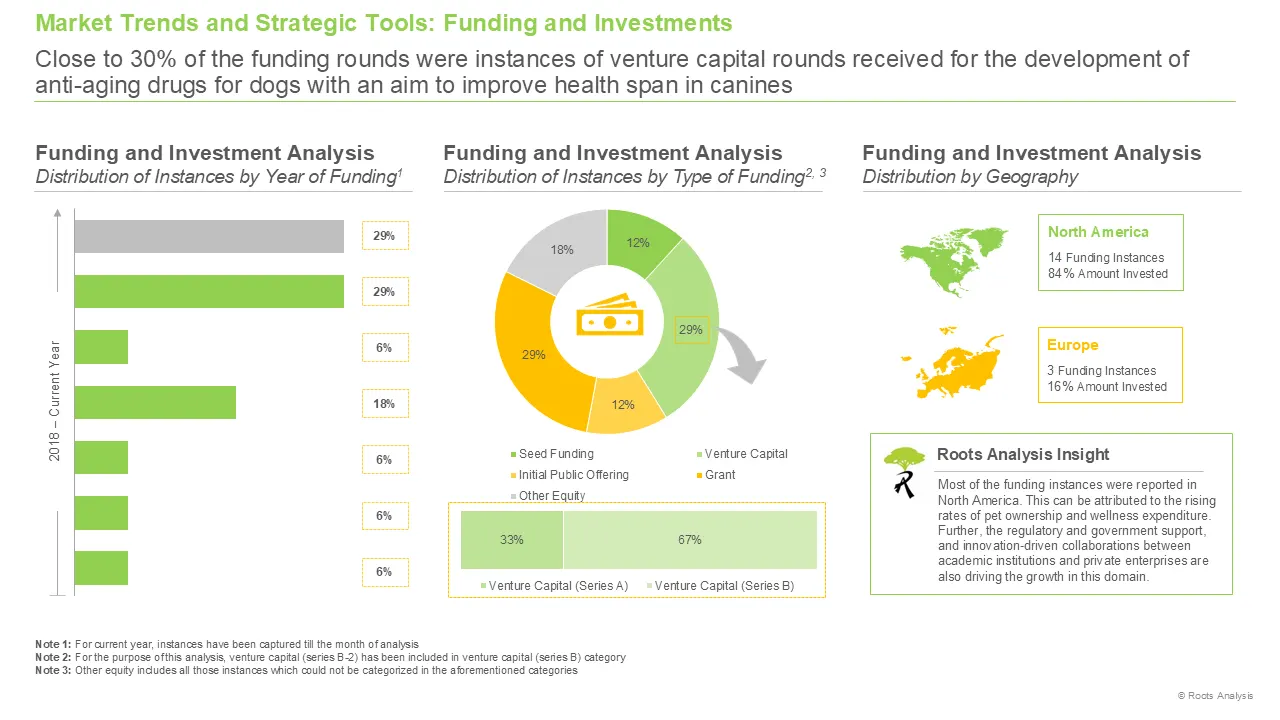
Monetary assistance from venture capitalists, and funding schemes of various public and private organizations / funds, along with assistance from regulatory authorities, have allowed anti-aging drugs for dogs developers to progress research and development in this domain. It is important to highlight that more than 95% of the total amount was raised by companies based in North America in this domain, since 2018.
Anti-aging Drugs for Dogs Domain Publications
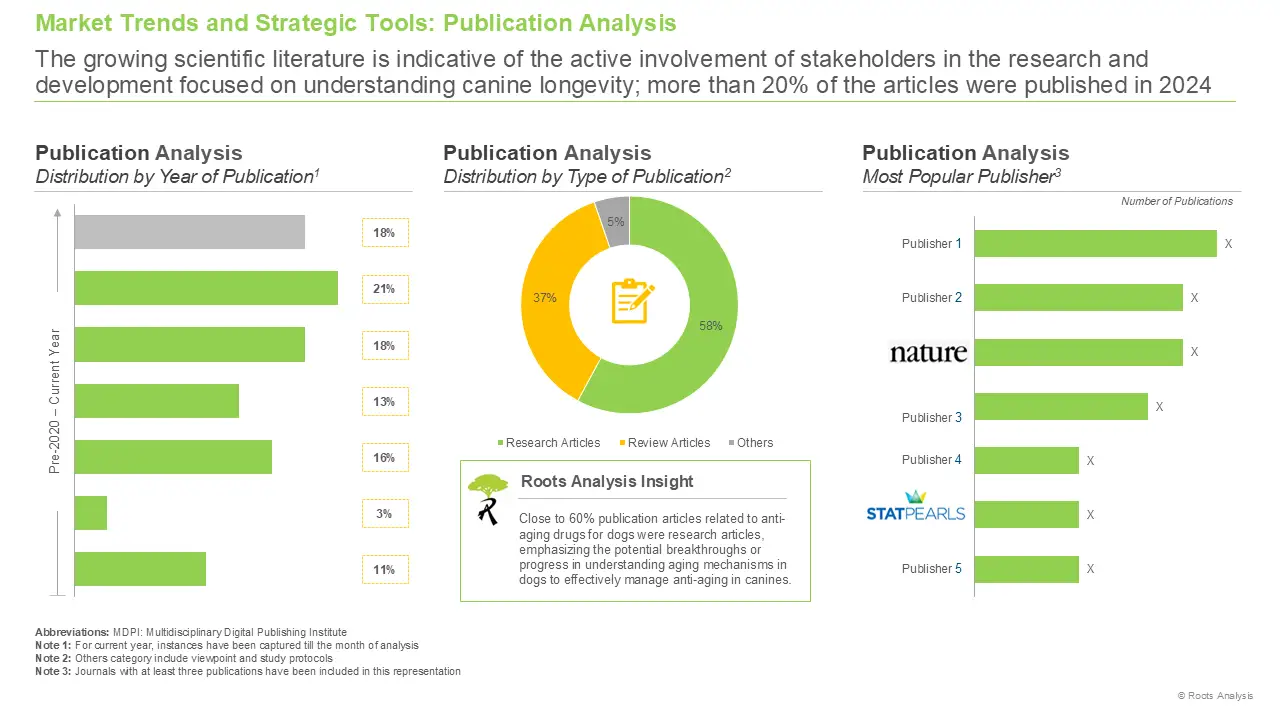
Recently, the anti-aging drugs for dogs industry has witnessed increase in scientific literature, with close to 55% of the articles published post-2022. This is indicative of the active involvement of stakeholders in research and development focused on understanding canine longevity.
Patent Analysis in the Anti-aging Drugs for Dogs Market
Stakeholders have filed various patents in order to protect intellectual property generated within the anti-aging drugs for dogs domain. It is worth noting that, close to 35% of the patents were filed / granted in North America and WIPO jurisdiction, respectively.
Unlock Deeper Insights – Schedule Your Personalized Workshop Today!
Anti-aging Drugs for Dogs Market Report Coverage
The market report presents anti aging drugs for canines market analysis, across different geographies. Amongst other elements, the market report includes:
- An Infographic Executive Summary
- Market Landscape of Anti-aging Drugs for Dogs
- Company Competitiveness Analysis
- Company Profiles
- Partnerships and Collaborations
- Funding and Investments
- Publication Analysis
- Patent Analysis
- Market Forecast and Opportunity Analysis
Anti-aging Drugs for Dogs Market: Report Attributes
| Key Report Attributes | Details | |
| Forecast Period | Till 2040 | |
| Market Size 2026 | USD 0.09 Billion | |
| Market Size 2040 | USD 6.16 Billion | |
| CAGR (Till 2040) | 36% | |
| Type of Modality |
|
|
| Type of Biologic |
|
|
| Route of Administration |
|
|
| Type of Formulation |
|
|
| Type of Aging |
|
|
| Type of Canine Population Targeted |
|
|
| Geographical Regions |
|
|
| Excel Data Packs (Complimentary) |
|
|
| Key Players Profiled | ||
| PowerPoint Presentation (Complimentary) |
|
|
| Customization Scope |
|
|


