
Lowest Price Guaranteed
Pages
185
Last Updated
August 2026
View Count
9310
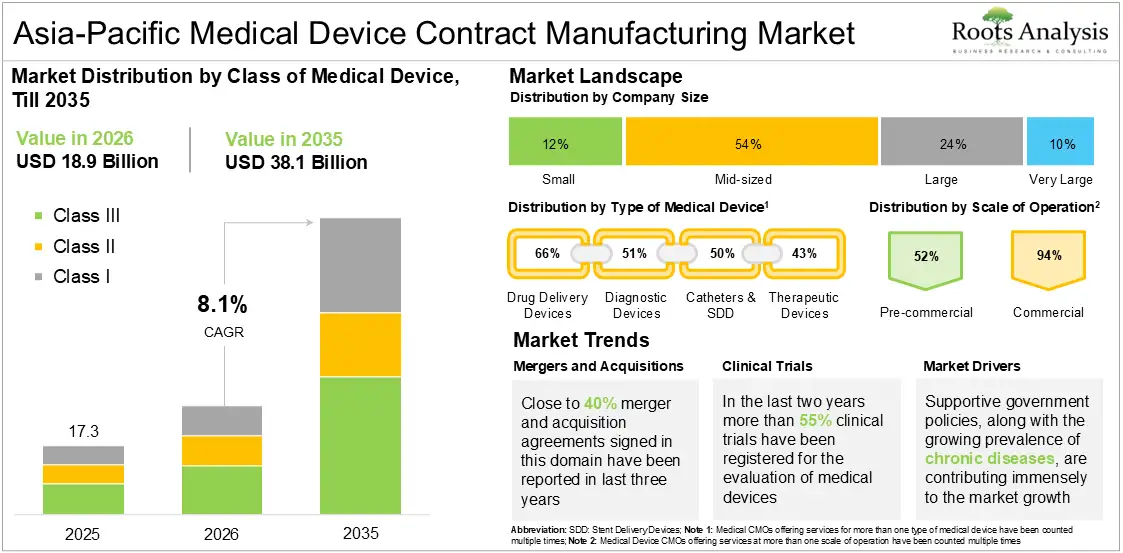
The Asia-Pacific medical device contract manufacturing market, valued at USD 17.3 billion in 2025, is projected to reach USD 18.9 billion in 2026 and USD 38.1 billion by 2035, with a CAGR of 8.1% during the forecast period from 2026 to 2035.
To learn more about this report, request a free sample copy
Medical device contract manufacturing supports innovation and commercial-scale production across the medtech industry. As devices integrate more advanced electronics, sensors, and software, original equipment manufacturers (OEMs) are outsourcing design transfer, prototyping, precision manufacturing, assembly, and commercial production to specialized contract manufacturing organizations (CMOs). This approach allows OEMs to reduce capital intensity, accelerate development timelines, and focus on product innovation and commercialization.
The Asia-Pacific medical device contract manufacturing market is expanding as the region's medtech industry, manufacturing base, and healthcare infrastructure develop. China has established itself as a major manufacturing ecosystem supported by an extensive supplier network, advanced production capabilities, and policies promoting domestic medical device innovation. Recent approvals by China's National Medical Products Administration (NMPA) also reflect the continued development of the country's medical device sector.
The region includes a growing network of contract manufacturers serving complex medical device categories, including minimally invasive devices, diagnostic equipment, cardiovascular products, orthopedic implants, diabetes care solutions, wearable medical devices, and drug-delivery technologies. Companies such as WuXi AppTec, Flex, Sanmina, and Venture Corporation provide engineering, precision manufacturing, cleanroom production, and supply chain capabilities for regional and global OEMs.
Beyond China, countries such as India, Malaysia, Vietnam, and Singapore are strengthening the region's position as a manufacturing destination through competitive production costs, skilled technical workforces, supportive policies, and evolving regulatory frameworks. Supply chain diversification and the China+1 manufacturing strategy are also encouraging global OEMs to distribute production across multiple Asia-Pacific markets. Together, these factors support the region's role as a strategic hub for medical device contract manufacturing.
| Company | Headquarters | YoE | Asia-Pacific Footprint | Core Contract Manufacturing Focus |
| Nissha | Japan | 1929 | Japan, Vietnam and Malaysia | Medical device CMO / CDMO, design support, prototyping and mass production |
| Forefront Medical Technology | Singapore | 2000 | Singapore and China | Integrated contract manufacturing for disposable medical devices and equipment |
| Racer Technology | Singapore | 1988 | Singapore, Malaysia, Indonesia and India | CDMO, OEM product development, cleanroom assembly and medical device manufacturing |
| Asahi Intecc | Japan | 1976 | China, Japan, India, Singapore, Thailand, Vietnam and Philippines | OEM / ODM medical devices, medical components and guidewire-related technologies |
| Sunningdale Tech | Singapore | 1995 | Singapore, Malaysia, China, India, Thailand and Indonesia | Precision plastic components and medical-grade manufacturing |
Abbreviation: YoE: Year of Establishment
Based on the research, the Asia-Pacific medical device contract manufacturing market is segmented by class of medical device, type of medical device, therapeutic area, company size, and leading players.
By Class of Medical Device
By Type of Medical Device
By Therapeutic Area
By Company Size
Medical device outsourcing in Asia-Pacific is evolving as CMOs expand beyond production to provide design, quality, regulatory, project-management, and logistics support.
Emphasizing this Sara E. Dyson (Vice President of Underwriting Operations and Risk Management, Medmarc Insurance) stated, "The most significant change in outsourcing over the last 20 years has been the evolution of CMOs offering solely manufacturing services to offering manufacturing services in addition to an array of services related to product design, project management, quality and regulatory, and aftermarket logistics."
Discussions with multiple stakeholders in this domain influenced the opinions and insights presented in this study. The market report includes transcripts of the following discussions:
In addition, the market report includes transcripts of the following third-party discussions:
Currently, cardiovascular disorders are expected to account for the largest share (around 30%) of the Asia-Pacific medical device contract manufacturing market. This growth is supported by the region's substantial burden of cardiovascular diseases, aging population, and growing demand for advanced cardiac devices. Cardiovascular disease (CVD) is the leading cause of mortality in Asia, and crude mortality is projected to double by 2050.
On the other hand, the other disorders segment is expected to grow at the fastest rate (CAGR) of 8.2% during the forecast period.
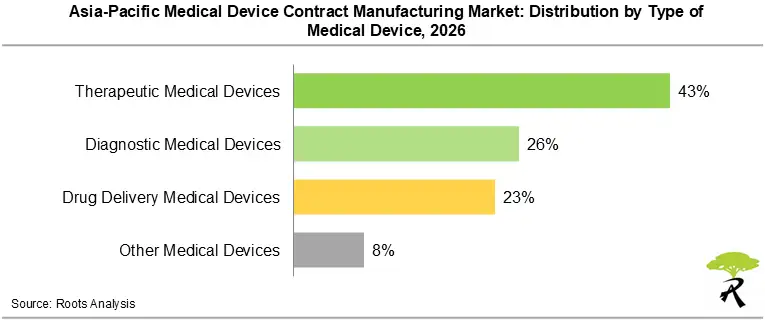
The therapeutic devices segment is expected to account for the largest share of the current market, at approximately 45%. This position reflects recurring demand for devices used in disease treatment and long-term patient management, including cardiovascular implants, drug-delivery systems, orthopedic implants, dialysis equipment, and respiratory devices.
The drug delivery devices segment is expected to witness a higher CAGR during the forecast period, driven by rising demand for self-administered injectable therapies across Asia-Pacific. Long-term treatment needs in diabetes, obesity, autoimmune diseases, and cancer are increasing demand for insulin pens, prefilled syringes, autoinjectors, wearable injectors, and other combination products that require high-precision molding, automated assembly, and large-scale manufacturing support.
Mid-sized companies currently account for the largest share of the Asia-Pacific medical device contract manufacturing market. This trend reflects a balance of specialized technical capabilities, competitive pricing, and greater operational flexibility. These companies can support low-to-medium production volumes, customized device designs, and frequent engineering changes, making them suitable partners for domestic and emerging medical device developers across Asia-Pacific.
Large companies are expected to grow at a CAGR of 7.8% during the forecast period. This growth is supported by their ability to invest in advanced manufacturing technologies, acquire specialized regional manufacturers, and establish production networks across multiple Asia-Pacific countries.
Examples of key companies profiled in this market report, arranged in alphabetical order, include Forefront Medical Technology, Frencken, MicroPort Scientific, Nipro, Terumo, UMS, Venture, and WuXi AppTec. The complete list of companies is available in the full report, which also includes an easily searchable Excel database of medical device contract manufacturers headquartered in Asia-Pacific. Additional named organizations referenced elsewhere in this report's underlying data, reflect funding and partnership activity tracked across the broader medical device contract manufacturing ecosystem, rather than endorsement relationship with Roots Analysis.
Alongside the core market report, purchasers receive complimentary Excel data packs covering the Asia-Pacific medical device contract manufacturers' market landscape, supply chain analysis, mergers and acquisitions, clinical trial analysis, manufacturers' market sizing, and opportunity analysis. The report also includes a complimentary PowerPoint presentation summarizing the key findings and offers 15% free customization upon request.
Roots Analysis is an independent market research and consulting firm. This report draws on publicly available information, primary interviews, and proprietary analysis. Roots Analysis is not affiliated with, endorsed by, or a representative of the USFDA, the European Medicines Agency, or any of the companies, technologies, or individuals named in this report. Figures are derived from primary interviews with industry stakeholders combined with secondary research and are not directly comparable to market-sizing studies published by other research firms that draw the medical device contract manufacturing segment boundary differently, for example, by including or excluding manufacturing and CDMO-adjacent revenue. All company and product names are used for identification purposes only and remain the property of their respective owners.
Clients evaluating this report alongside competing market studies should weigh how the publisher defines the segment boundary, since Asia-Pacific medical device contract manufacturing market sizing is not standardized across research firms and some studies fold in adjacent manufacturing or CDMO revenue that this report treats separately. This report, by Roots Analysis, is updated on a first-edition cadence and carries the explicit scope, methodology, and non-affiliation disclosure set out above.