


 Download Free Sample
 Buy Now
Market Outlook
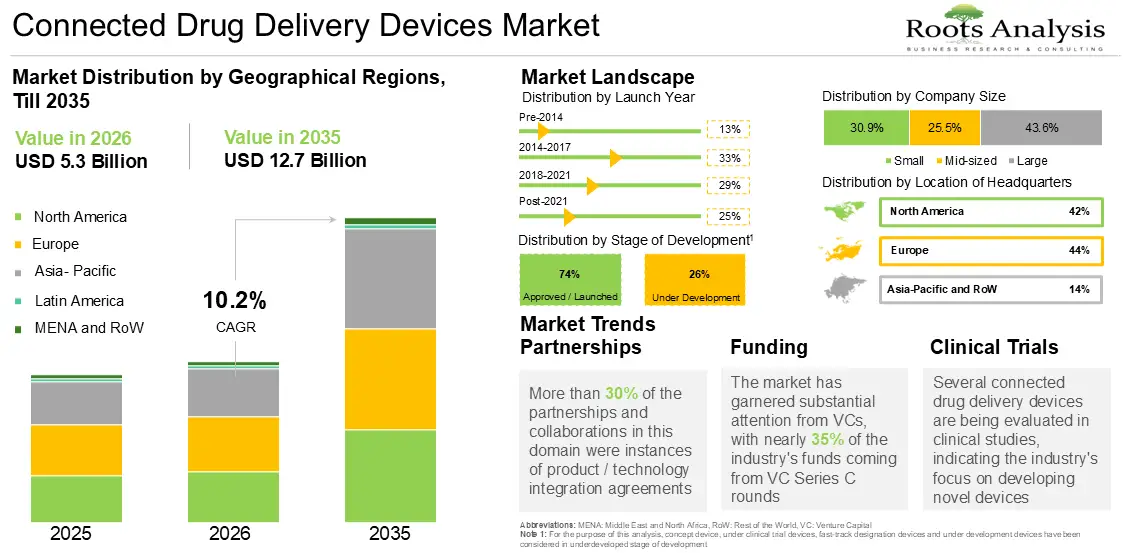
The global connected drug delivery devices market, valued at USD 4.8 billion in 2025, is projected to reach USD 5.3 billion in 2026 and USD 12.7 billion by 2035, representing a CAGR of 10.2% during the forecast period 2026 to 2035.
See What’s in the Full Report - Request Your Complimentary Insights!
Market Report: Key Takeaways
Market Size & Trends
- In terms of type of device, the connected / smart wearable injectors hold the highest share of the current market.
- With respect to mode of connectivity, connected drug delivery devices supporting Bluetooth holds majority of the current market.
- Based on the route of administration, connected drug delivery devices delivering drugs through injection captures the largest share of current market; this trend is unlikely to change in the future.
- In terms of therapeutic area, devices delivering drugs for metabolic disorders capture the majority of the current market.
- In terms of geographical regions, North America currently holds the highest market share.
Key Market Statistics
- Market Size in 2026: $ 5.3 Billion
- Estimated Market Size in 2035: $ 12.7 Billion
- CAGR (2026-2035): 10.2%
- North America: Largest market in 2026
- Asia-Pacific: Fastest growing region
Market Introduction
Over the years, poor adherence to prescribed medications remains a major challenge within the healthcare sector, contributing to disease progression, higher rates of hospitalization, mortality, and escalating healthcare costs. Research indicates that about 66% of people in the US receive at least one prescription, but nearly 50% of them do not take their medicines as physicians direct.
This widespread issue of non-adherence stems from several factors, including complex dosing schedules, limited access to medicines, and insufficient patient support. In order to address this concern, healthcare providers and technology developers are adopting multiple approaches to simplify dosage regimens, offer personalized medication schedules, and enhance patient education.
Connected drug delivery devices emerge as an effective solution as they combine conventional delivery systems with digital health technologies to enhance adherence. Smart Insulin Pens bring connectivity to pen-based delivery by recording dose information and supporting data-informed diabetes management. These devices are equipped with advanced features, sensors and have wireless connectivity capabilities that enable seamless integration with mobile applications, digital health platforms and electronic health records.
Further, connected drug delivery device enables real-time monitoring of medication usage and patient health status, supporting timely clinical interventions, personalized therapy adjustments, and automated reminders. Patient Engagement Software extends these digital workflows by supporting communication, education, adherence and active participation throughout the care pathway. By improving patient engagement and compliance, these devices not only strengthen patient outcomes but also contribute to reducing overall healthcare expenditure.
Moreover, the incorporation of add-on sensor technologies has redefined the functionality of traditional drug delivery systems, enabling their transformation into smart, connected solutions. Continued progress in telehealth integration and wider adoption of digital health tools is expected to drive sustained growth in the connected drug delivery device market in the coming years.
Market Segmentation
Based on the research, we have segmented the Connected Drug Delivery Devices Market into type of device, mode of connectivity, route of administration, therapeutic area, and geographical regions.
By Type of Device
- Connected / Smart Wearable Injectors
- Connected / Smart Inhalers
- Connected / Smart Pen Injectors
- Connected / Smart Autoinjectors
- Connected / Smart Needle-free Injection Systems
By Mode of Connectivity
- Bluetooth-enabled Devices
- Near Field Communication-enabled Devices
- Cellular-enabled Devices
- Wide Area Network-enabled Devices
By Route of Administration
- Parenteral
- Inhalational
By Therapeutic Area
- Metabolic Disorders
- Respiratory Disorders
- Autoimmune Disorders
- Other Disorders
By Geographical Regions
- North America
- US
- Canada
- Europe
- UK
- Germany
- France
- Italy
- Spain
- Rest of Europe
- Asia-Pacific
- China
- India
- Japan
- Rest of Asia-Pacific
- Middle East and North Africa
- Egypt
- Israel
- Rest of Middle East and North Africa
- Latin America and Rest of the World
- Brazil
- Argentina
- Other Countries
Want Information on Specific Region / Segment?
Connected Drug Delivery Device Market Key Insights
What are the Key Drivers for Connected Drug Delivery Devices Market Growth?
- Growing Prevalence of Chronic Disorders: The burden of chronic diseases, such as asthma, diabetes and hypertension is rising across the globe. According to a study published in Preventive Chronic Disease, around 130 million people currently have at least one chronic condition in the US. Chronic diseases often require long-term management and treatment, involving complex medication regimes and regular health monitoring to prevent complications. As a result, several players are actively involved in the development of innovative drug delivery devices / monitoring solutions to address unmet clinical needs, promote self-administration of medications and enhance patient outcomes. For instance, in 2025, Ypsomed received the USFDA clearance of SmartPilot, an add-on sensor integrated with the YpsoMate device, to facilitate self-administration of various medications.
- Increasing Adoption of Digital Health Technologies: Driven by rising health awareness, the adoption of smart healthcare devices and wearables has undergone a surge in the last few years. The integration of these technologies (such as easypod handheld injector, Dana Diabecare RS smart wearable injector, and eBreathie Smart-Inhaler) in the medical domain facilitates continuous monitoring of patient health as well as promoting data-driven decision making; this further reduces the burden on conventional treatment centers. It is worth noting that these smart devices support virtual consultations and encourage greater involvement of patients in managing their own health-related outcomes.
What are the Main Challenges for Market Growth?
- High Developmental Costs: Manufacturers incorporate advanced sensors and software to create connected or smart drug delivery devices, which leads to high developmental costs. Further, these devices necessitate extensive research and development, vigorous testing and validation, and compliance with stringent regulatory guidelines. Moreover, scaling up of the production involves complex supply chains for electronic components, specialized assembly lines, and cybersecurity validations, further increasing the overall cost expenses and creating barriers for new entrants.
- Cybersecurity: Internet of things-enabled devices raise significant data privacy and security concerns, as continuous internet connectivity and integration of sensors, software, and communication modules expose them to potential cyber threats and unauthorized access. Compromised monitoring software or configuration settings may allow malicious manipulation of dosage data, device functionality, or patient records, posing serious health and safety risks. Therefore, incorporating multi-layered cybersecurity frameworks, end-to-end data encryption, secure authentication mechanisms, and frequent firmware updates is critical to minimizing vulnerabilities, ensuring data integrity, and maintaining patient trust in connected healthcare systems.
Pay Only for What You Need – The Best Way to Optimize
Recent Developments in Connected Drug Delivery Devices Market
- In January 2026, West Pharmaceutical entered into an agreement with AbbVie to sell the manufacturing and supply rights for its SmartDose 3.5mL On-Body Delivery System, along with associated facilities, for USD 112.5 million.
- In September 2025, ViCentra raised USD 85 million in a Series D funding round led by Innovation Industries. This capital will support scaling manufacturing capabilities, advancing regulatory approvals, and accelerating commercialization of Kaleido 2 insulin patch pump.
- In March 2025, SHL Medical and Kindeva Drug Delivery entered into a collaboration with the aim to provide fill-finish and pre-validated final assembly services for the Molly autoinjector platform at Kindeva's facilities in Bridgeton and Maryland Heights, Missouri.
- In June 2025, Beta Bionics entered into a product integration agreement with Abbott to integrate its iLet bionic pancreas with Abbott's future dual glucose-ketone sensor, enhancing diabetes management by monitoring glucose and ketone levels continuously.
Your Business is Unique – Why Shouldn’t Your Report Be?
Industry Experts on Connected Drug Delivery Devices Market
The market for connected drug delivery has a transformative future and is likely to remain progressive in the coming years.
Shaul Eitan (Former Chief Executive Officer, Avoset Health), stated that, “In my opinion, devices that are capable of improving treatment outcomes and decreasing hospital admission rates with speedy patient recovery can be expected to be in demand in the foreseen future. Moreover, the demand for connected devices is also dependent on the type of drugs / therapies intended to be delivered, the target therapeutic area and affordability.”
Discussions with multiple stakeholders in this domain influenced the opinions and insights presented in this study. The connected drug delivery devices market report includes transcripts of the following discussions:
- Senior Director, Global Strategic Marketing, Medical, Large Company, US
- Co-Founder and Chief Executive Officer, Small Company, US
- Chief Executive Officer, Small Company, US
- Chief Executive Officer and President, Mid-sized Company, US
- Chief Executive Officer, Small Company, Italy
- Vice President and Chief Scientist, Large Company, Israel
- Director of Global Communications, and Former Vice President of Strategic Partnerships and Business Development, Mid-sized Company, US
- Former Chief Executive Officer, Small Company, US
- Former Director of Front-end Innovation and Head of Connected Health, Large Company, US
- Former Vice President, Marketing and Alliance Management, Mid-sized Company, US
- Advisor of Strategy and Business Development, Small Company, US
Have Questions? Let’s Get Them Answered.
Market Share Insights
Which Type of Device Accounts for the Largest Share in the Connected Drug Delivery Device Market?
- In 2026, the connected / smart wearable injectors segment occupies the highest market share, and this trend is unlikely to change in the coming years, as per our connected drug delivery devices market forecast.
- This is due to the rising prevalence of chronic conditions and the continuous efforts of stakeholders to integrate advanced features. These advancements facilitate improved monitoring, bolster patient adherence, and enable real-time data sharing with healthcare providers.
Regional Analysis: Which Regions are Showing the Fastest Growth in Connected Drug Delivery Devices Industry?
North America: Dominating the Market by Securing Highest Share
According to our projections, North America is likely to capture majority of the connected drug delivery devices market share in the current year. However, the market in Asia-Pacific is likely to grow at a relatively faster pace till 2035. The growth is being propelled by increasing number of biopharmaceutical start-ups, high research and development activity for novel drug delivery solutions, and rising device approvals for different disease treatments in this region. For instance, in March 2025, MiniMed™ 780G System received updated class III approval for the full kit in Australia.

Which Mode of Connectivity Holds the Highest Connected Drug Delivery Devices Market Size?
- In 2026, the connected / smart devices supporting Bluetooth are likely to occupy a higher connected drug delivery devices market size in the market. Further, this segment is likely to witness a significant growth rate during the forecast period.
- This is due to the fact that Bluetooth connectivity is easy to establish, readily available on all smartphones and functions without the need for any supplementary devices.
Which Route of Administration Accounts for the Largest Share of Market?
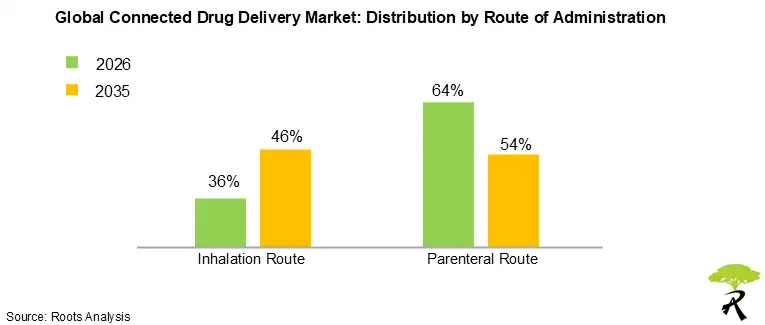
- As per our connected drug delivery devices market analysis, in 2026, the parenteral segment occupies a higher market share among other drug delivery routes, owing to the fact this is a preferred route for the administration of biologics and high-value therapies targeting chronic diseases.
- The inhalation segment is likely to grow at a higher CAGR during the forecast period, this is due to simplicity, flexibility, and pain-free nature of drug administration via this route, along with its capacity for sustained localized therapeutic action.
What is the Market Opportunity for Connected Drug Delivery Device that Deliver Drugs for Treating Metabolic Disorders?
- Based on the connected drug delivery devices market analysis, the metabolic disorders segment is likely to occupy the highest market share. This dominance is primarily due to the rising prevalence of diabetes, which is one of the leading causes of death across the globe.
- Moreover, we anticipate the market for devices delivering drugs for treating autoimmune disorders segment to witness a higher CAGR during the forecast period.
Unlock Deeper Insights – Schedule Your Personalized Workshop Today!
Scope of Connected Drug Delivery Devices Market Report
| Key Report Attribute | Details | |
| Historical Trend | Since 2020 | |
| Forecast Period | Till 2035 | |
| Market Size 2026 | $ 5.3 Billion | |
| Market Size 2035 | $ 12.7 Billion | |
| CAGR (Till 2035) | 10.2% | |
| Segments Covered |
|
|
| Key Players Profiled |
(A complete list of players captured is available in the report) |
|
| PowerPoint Presentation (Complimentary) |
Available | |
| Customization Scope | 15% Free Customization | |
| Excel Data Packs (Complimentary) |
Available | |


