Automated Aseptic Sampling Systems Market by Mode of Analytical Operations (On-line Operations, At-line Operations and Off-line Operations), Intended Workflow Supported (Manufacturing, Research and Development, and Other Workflows), End Users (Pharmaceutical and Biopharmaceutical Companies, CROs and CMOs, and Other End Users), and Geographical Regions (North America, Europe, Asia-Pacific, Latin America, and Middle East and North Africa) - Trends and Forecast 2026-2035
Automated Aseptic Sampling Systems Market Outlook: USD 564 Million by 2035
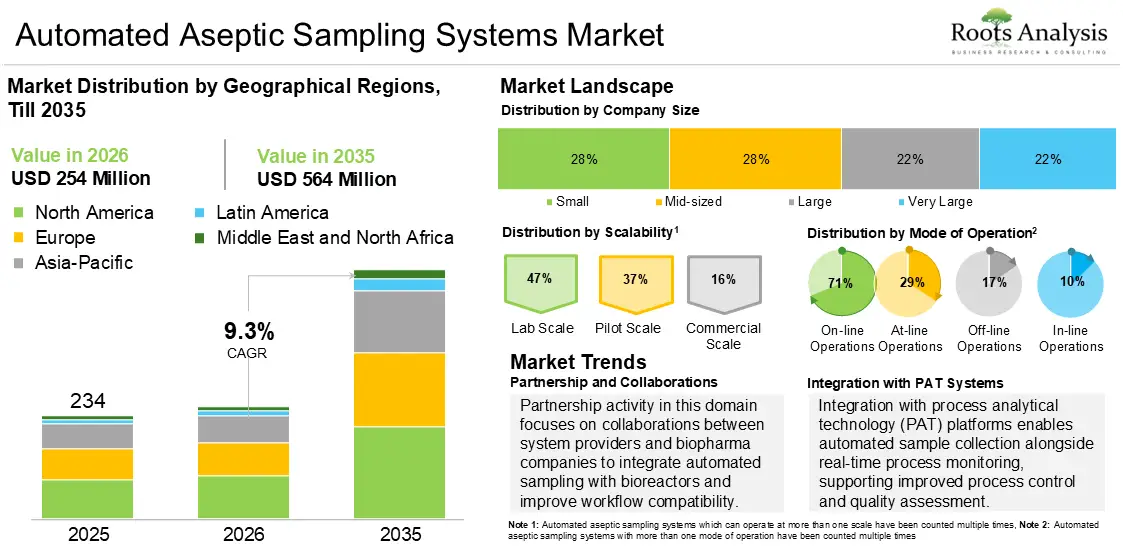
The global automated aseptic sampling systems market, valued at USD 234 million in 2025, is projected to reach USD 254 million in 2026 and USD 564 million by 2035, with a CAGR of 9.3% during the forecast period 2026 to 2035. The market growth is supported by rising biologics and advanced-therapy manufacturing, stronger contamination-control expectations, wider adoption of single-use and closed bioprocessing technologies, and demand for more frequent process data. Automated sampling systems can reduce manual interventions, standardize sample withdrawal, and connect process sampling with analytical workflows while helping manufacturers maintain aseptic integrity and process consistency.
See What's in the Full Report – Request Your Complimentary Insights!
Market Report: Key Takeaways
Market Size and Trends
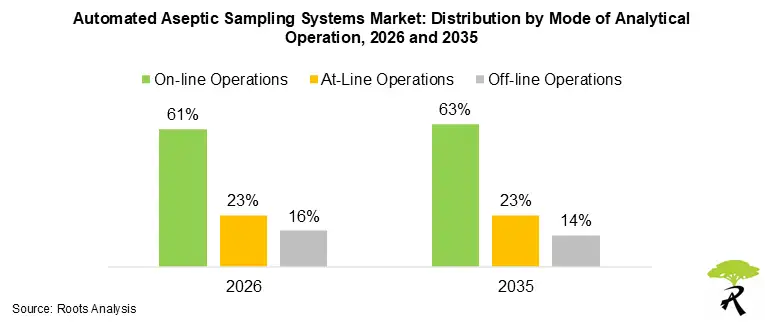
- On-line operations hold the largest share, accounting for more than 60% of the market by mode of analytical operation.
- Manufacturing workflows hold the largest share by intended workflow supported, reflecting demand for continuous bioprocessing, real-time monitoring of critical process parameters and product quality attributes, and lower dependence on manual sampling during commercial biopharmaceutical production.
- Pharmaceutical and biopharmaceutical companies currently represent the largest end-user segment and are expected to remain the leading adopters as they expand automated, contamination-controlled and PAT-enabled manufacturing workflows.
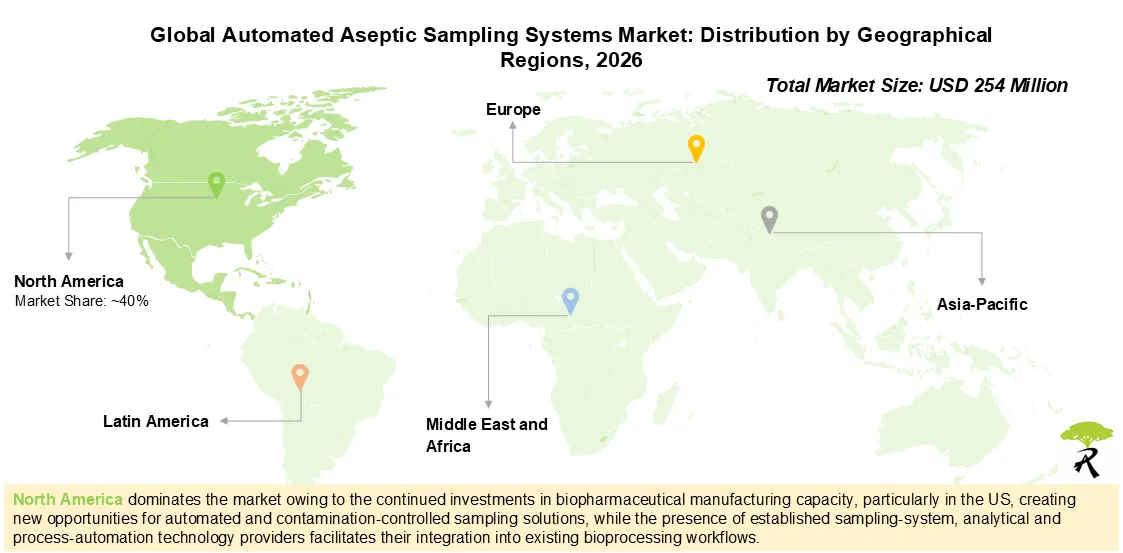
- North America currently captures nearly 40% of the market, while Asia-Pacific is likely to grow at the fastest CAGR during the forecast period.
Key Market Statistics
- Market Size in 2026: USD 254 Million
- Market Size in 2035: USD 564 Million
- CAGR (2026-2035): 9.3%
- North America: Largest market in 2026
- Asia-Pacific: Fastest-growing region
What are Automated Aseptic Sampling Systems?
Automated aseptic sampling systems are closed or controlled technologies designed to collect representative samples from bioreactors and other bioprocess equipment while maintaining aseptic integrity and minimizing the risk of introducing microorganisms or cross-contamination. Depending on system configuration, automation can support sample withdrawal, routing, transfer to analytical instruments, scheduled sampling and digital documentation, while reducing direct operator intervention. Samples collected through these systems can support monitoring of critical process parameters and product quality attributes across upstream and downstream bioprocessing.
These systems are increasingly relevant to the manufacture and development of monoclonal antibodies, recombinant proteins, vaccines and other biologics, where reproducible sampling and contamination control are important for process understanding and product quality. Pharmaceutical and biopharmaceutical companies are key end users, alongside contract research organizations (CROs), contract manufacturing organizations (CMOs) and CDMOs supporting process development and manufacturing. Adoption depends on sampling frequency, level of automation, compatibility with process equipment and analytical instruments, validation requirements, operating cost and the ability to preserve sample and process integrity.
The transition toward continuous manufacturing and digitally connected bioprocessing is likely to increase the value of automated aseptic sampling. Integration with process analytical technology (PAT), cell-culture analyzers, biosensors, bioprocess information-management platforms and, where supported, laboratory information management systems (LIMS) can connect sample identity, analytical results and process conditions in a more traceable workflow. This can enable earlier detection of process deviations and more timely process decisions without implying that every sampling mode is fully real-time.
Scope, Methodology and Industry Expert Interviews
Roots Analysis defines the automated aseptic sampling systems market as the opportunity associated with systems that enable automated, contamination-controlled collection and transfer of representative process samples from biopharmaceutical process streams for in-process monitoring and analysis. The market segmentation covers mode of analytical operations, intended workflow supported, end users and geographical regions.
The study triangulated findings across market sizing, automated aseptic sampling systems landscape, sampling modes, bioprocess stage coverage, automation levels, integration with bioreactors and process analytical technologies (PAT), end-user applications, partnerships, and regional adoption. Secondary research was complemented by primary and third-party industry discussions to validate market assumptions and provide qualitative context. The report includes perspectives from the following key stakeholders:
- Key Account Manager, Large Company, India
In addition, the market report includes transcripts of the following third-party discussions:
- Head of the PAT Center of Excellence, R&D, Integrated Biologics, Very Large Company, Switzerland
- Global Marketing Manager Bioprocess, Large Company, Germany
- Product Manager, Sampling & Containers, Product Management, Transfer Technology, Very Large Company, Germany
- R&D Manager, Upstream Bioprocessing Applications, Very Large Company, US
- Process Applications Scientist and PAT Raman Product Manager, Very Large Company, US
- Senior Regulatory Expert, Very Large Company, Germany
- Senior Research Scientist, Large Company, Germany
- Senior Scientist, Very Large Company, Germany
- Applications Engineer, Very Large Company, Germany
- Bioprocessing Applications Engineer III, Very Large Company, Germany
Emphasizing the cost determining factors of automated aseptic sampling systems, John Sullivan (key Account Manager, Portescap), stated that "In addition to the inherent characteristics of the system, external factors such as the source and availability of funding can significantly influence pricing consideration. The type of organization purchasing the system is also a relevant factor, as funding availability can differ between established biopharmaceutical companies, new companies, research projects and universities. Consequently, understanding who the ultimate client for the data is and how the work is being funded in the short term is important, as privately funded, government-funded and university-funded projects can each have different budget levels available for these types of systems."
How is the Automated Aseptic Sampling Systems Market Segmented?
The report segments the automated aseptic sampling systems market by mode of analytical operations, intended workflow supported, end users and geographical region. The structure is designed to help pharmaceutical and biopharmaceutical companies, CROs / CMOs / CDMOs, bioprocess equipment and single-use technology providers, PAT and analytical-instrument providers, procurement and technical-operations teams, and investors evaluate adoption patterns and market opportunities.
- By Mode of Analytical Operation: On-line Operations, At-line Operations and Off-line Operations
- By Intended Workflow Supported: Manufacturing, Research and Development, and Other Workflows
- By End User: Pharmaceutical and Biopharmaceutical Companies, Contract Research Organizations and Contract Manufacturing Organizations, and Other End Users
- By Geographical Regions: North America, Europe, Asia-Pacific, Middle East and North Africa, and Latin America
Your Business is Unique – Why Shouldn't Your Report Be?
Automated Aseptic Sampling Systems Market Key Insights
What Factors are Driving Increased Adoption of Automated Aseptic Sampling Systems?
The market growth is being supported by increasing biologics production, wider use of single-use and closed bioprocessing, manufacturing intensification, and the need for more frequent and reproducible in-process data. Regulatory frameworks do not prescribe automated sampling as a universal requirement; however, current Good Manufacturing Practice (cGMP), FDA aseptic-processing expectations and EU GMP Annex 1 place strong emphasis on contamination control, scientifically sound sampling, validated procedures and maintaining a state of control. Automated sampling can therefore help manufacturers reduce open manipulation, standardize sampling procedures and strengthen traceability within qualified manufacturing workflows.
Digitalization is another adoption driver. Integration with PAT, automated liquid handling, analytical instruments and bioprocess data systems can reduce manual data transfer and support faster interpretation of process performance. Artificial intelligence and predictive analytics may add value when applied to sufficiently reliable process datasets, for example by identifying deviations or supporting predictive maintenance, but these capabilities should be viewed as an enabling layer rather than a substitute for validated process controls.
What are the Main Challenges Affecting Automated Aseptic Sampling Systems Market Growth?
The main challenges include dependence on proprietary or single-use consumables, integration with heterogeneous bioreactors and analytical systems, validation burden and recurring operating costs. Compatibility can be affected by tubing and connector configurations, sample volume, pressure conditions, cleaning or sterilization strategy, and the analytical method used downstream. Manufacturers must also manage supply-chain continuity for critical consumables and demonstrate that automated sampling does not adversely affect process closure or sample representativeness.
As automated platforms become more digitally connected, data-management requirements also increase. GMP-relevant implementations may require validated interfaces, reliable sample identification, secure data transfer, role-based access, audit trails and documented system performance where applicable. These requirements can add implementation effort, particularly when new sampling platforms must connect with legacy equipment, laboratory systems or facility-wide data infrastructure.
How Are Closed-System Sampling and Analytical Integration Evolving?
Advances in closed-system sampling, sterile connectors, single-use flow paths, programmable sampling schedules and automated or robotic liquid handling are expanding the role of automated aseptic sampling across upstream and downstream bioprocessing. These technologies can reduce repeated manual connections, support higher sampling frequency and improve consistency between operators and production runs.
The next stage of adoption is increasingly focused on system integration rather than sample withdrawal alone. Platforms are being connected with cell-culture analyzers, spectroscopy and other PAT tools, biosensors and bioprocess data-management systems so that sample identity, process conditions and analytical results remain associated. Where technically supported and validated, links to LIMS, data historians or supervisory control platforms can strengthen traceability and reduce manual transcription.
How Do Regulatory Compliance, Validation and Data Integrity Shape Adoption?
Automated aseptic sampling systems used in regulated manufacturing must fit within the site quality system and contamination-control strategy. FDA cGMP and aseptic-processing guidance emphasizes procedures designed to prevent microbial contamination and scientifically sound sampling practices, while EU GMP Annex 1 emphasizes contamination control and reduction of unnecessary critical interventions in aseptic processing. These frameworks support the value of closed and well-controlled sampling, but they do not remove the need for process-specific risk assessment and validation.
For manufacturers, this translates into verification and validation of sampling accuracy, system interfaces, cleaning or sterilization where relevant, alarms, electronic records and data transfer. Qualification should demonstrate that the system performs consistently under its intended operating conditions and that sampling does not introduce unacceptable contamination or compromise the integrity of the process or collected sample. Clear documentation and traceability also support quality assurance, deviation investigations and regulatory audits.
Recent Developments in the Automated Aseptic Sampling Systems Market
- In October 2026, Securecell and Beckman Coulter Life Sciences announced a collaboration to integrate the Vi-CELL BLU Cell Viability Analyzer with Securecell's Numera 3 automated sampling platform. The planned hardware and software integration is intended to connect automated bioprocess sampling, cell analysis and process data through Lucullus, reducing manual transfer steps and supporting more coordinated cell-culture monitoring.
- In April 2026, ArgusEye launched AugaSampler at BioProcess International Europe in Vienna. The system combines automated liquid handling and data processing with aseptic sampling for on-line and at-line bioprocess measurements, with the aim of reducing hands-on sampling and shortening the time from sample collection to analytical insight.
- In April 2026, ArgusEye announced a EUR 3.3 million funding round backed by existing investors Voima Ventures and Eir Ventures and new investor Impilo Partners Invest. The funding is intended to support continued development and commercialization of the Auga real-time bioprocess monitoring platform, which includes automated sampling and analytical-monitoring capabilities.
Pay Only for What You Need – The Best Way to Optimize
Automated Aseptic Sampling Systems Market Share Insights
Which Mode of Analytical Operation Holds the Largest Share of Automated Aseptic Sampling Systems Market?
On-line operations currently account for more than 60% of the market and are expected to remain the leading segment during the forecast period. Their position reflects demand for high-frequency sampling, seamless integration with process analytical technologies (PAT) and analytical instruments, and their ability to generate near-real-time process data with minimal operator intervention.
Which Intended Workflow Supported Holds the Largest Share in the Automated Aseptic Sampling Systems Market?
Manufacturing workflows currently account for the largest share of the automated aseptic sampling systems market because commercial biopharmaceutical production relies on frequent in-process monitoring and consistent process control. Automated sampling can support tracking of critical process parameters and quality attributes, reduce sampling-related interventions and provide more standardized information for process decisions and batch review.
Which End User Holds the Largest Share of the Automated Aseptic Sampling Systems Market?
Pharmaceutical and biopharmaceutical companies currently account for the largest share of the market, supported by established biomanufacturing infrastructure and the need for contamination-controlled sampling across process development and commercial manufacturing. Adoption is also supported by the integration of PAT, automated analytical workflows and facility-level data systems. CROs, CMOs and CDMOs represent an important secondary customer base where standardized sampling can support multiple client programs and technology-transfer requirements.
Regional Analysis: North America Leads While Asia-Pacific Grows Fastest
North America Leads with Nearly 40% Market Share
North America currently captures nearly 40% of the automated aseptic sampling systems market. The region benefits from established pharmaceutical and biopharmaceutical manufacturing and R&D infrastructure, a high concentration of bioprocessing facilities, and comparatively advanced adoption of process automation, single-use technologies and PAT-enabled monitoring. Demand is also supported by investment in biologics, vaccines and advanced-therapy manufacturing capacity.
Asia-Pacific Is the Fastest Growing Region
Asia-Pacific is expected to register the fastest CAGR during the forecast period, supported by expanding pharmaceutical and biopharmaceutical manufacturing capacity across China, India, South Korea, Singapore, and Australia. Investment in biologics, biosimilars, vaccines and advanced therapies is increasing the need for scalable contamination-control strategies, standardized sampling and more integrated process monitoring across new and expanding facilities.
Get an Instant Quote in 10 Minutes. Lowest Price Guaranteed
Who are the Key Players Profiled in the Automated Aseptic Sampling Systems Market?
Examples of key companies profiled in this market report, arranged in alphabetical order, include bbi-biotech, Flownamics, Merck, Mettler Toledo, QB Systems, Repligen, Securecell. The complete list of companies is available in the full report together with a searchable Excel database. Additional named organizations referenced elsewhere in this report's underlying data reflect initiatives undertaken across the automated aseptic sampling system ecosystem, not an endorsement relationship with Roots Analysis.
Report Deliverables and Customization
Alongside the core market report, clients receive complimentary Excel data packs covering the automated aseptic sampling systems market landscape, partnerships and collaborations, and market sizing and opportunity analysis. We also include a complimentary PowerPoint presentation summarizing the key findings and offer 15% free customization on request. The report is designed to support system and PAT providers, pharmaceutical and biopharmaceutical manufacturers, CROs / CMOs / CDMOs, quality and validation teams, procurement and technical-operations functions, business-development teams and investors evaluating technology adoption, supplier positioning, integration requirements and partnership opportunities.
Report Authorship
This report was authored by Pemba Lahmo, part of Roots Analysis's healthcare and pharma research practice. Her work focuses on competitive intelligence, company benchmarking, market forecasting and bioprocessing technology assessment, including automation, analytical integration and manufacturing workflows.
Independence and Non-Affiliation
Roots Analysis is an independent market research and consulting firm. This report draws on publicly available information, primary interviews and proprietary analysis. Roots Analysis is not affiliated with, endorsed by or acting on behalf of the U.S. Food and Drug Administration, European regulatory authorities, or any company, technology provider or individual named in the report. Company and product names are used solely for identification, market analysis and benchmarking purposes. Nothing in this report should be construed as medical advice.
This first edition reflects ongoing tracking of technological, regulatory and commercial developments in automated aseptic sampling. Roots Analysis maintains its own proprietary primary research process and does not receive compensation from companies profiled in the report in exchange for inclusion or favorable characterization.


