Bioink Market Overview
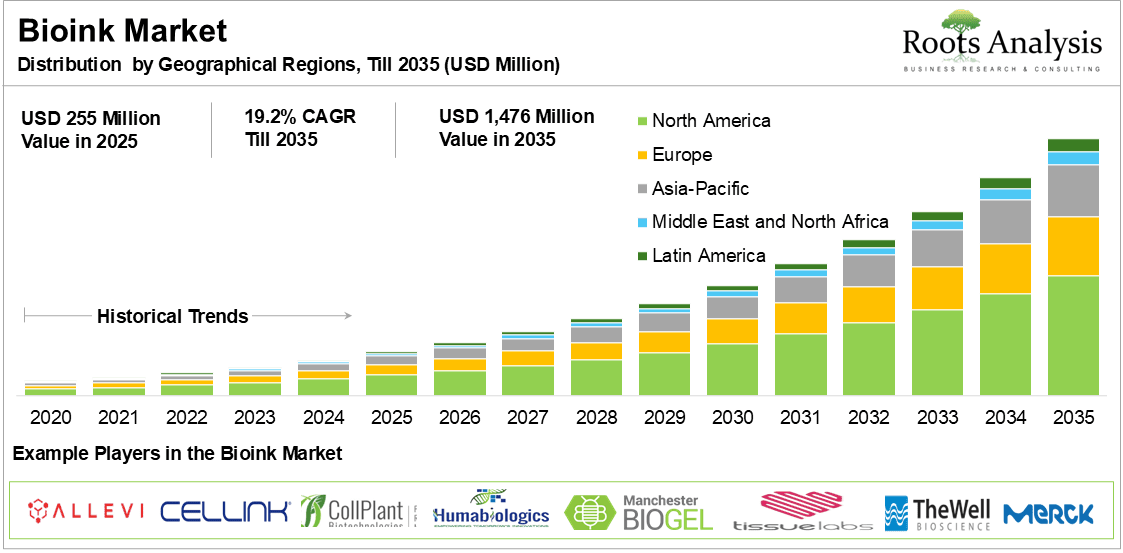
The global bioink market size, valued at USD 204 million in 2024, is projected to reach USD 255 million in 2025 and USD 1,476 million by 2035, representing a CAGR of 19.2% during the forecast period.
To learn more about this report, request a free sample copy
Bioink Industry: In Summary
- The global bioink market is valued at USD 255 million in 2025 and is estimated to grow at a CAGR of 19.2% during the forecast period. This rapid market growth is primarily fueled by the increasing focus on regenerative medicine and tissue engineering, alongside the critical global shortage of organs for transplantation.
- Bioinks are emerging as the fundamental building blocks for 3D bioprinting of tissues and organs. These bioinks offer a groundbreaking pathway to address this critical unmet medical need and revolutionize transplant medicine.
- The market's foundation firmly rests on natural bioinks, particularly alginate, and hydrogels, which holds over 85% of the market share. Their inherent biocompatibility, cost-effectiveness, non-toxicity, and ability to mimic the body's natural extracellular matrix make them indispensable for creating functional tissues.
- Extrusion-based bioprinting leads modality segment, securing 54% share of the market due to its versatility, compatibility with various bioink formulations, and scalability.
- The tissue and organ generation segment holds the largest share (46%) of the application area, highlighting the critical role of bioinks in creating artificial tissues to restore damaged functions. Its adaptability to diverse bioink formulations and its scalability make it the go-to technique for researchers and developers pushing the boundaries of tissue engineering.
- North America currently dominates the bioink market occupying 47% of the market share. This dominance is due to its strong emphasis on tissue engineering, regenerative medicine, and investments in bioprinting technologies.
- Expect a shift towards sophisticated smart bioinks that can dynamically respond to stimuli, enabling the creation of more lifelike and functional tissues. Innovations in 4D bioprinting will offer immense opportunities, which allows structures to change shape and function over time.
- The bioink market features a highly competitive landscape with both established giants and agile startups vying for dominance. Key players like CELLINK (Sweden), Organovo (US), CollPlant Biotechnologies (Israel), Allevi (US), Humabiologics (US), TheWell Bioscience (US) are at the forefront of innovations.
- Industrial players are continuously investing in advancing bioink materials (plant-based collagen by CollPlant Biotechnologies (Israel), and volumetric resins by BIO INX (Belgium)), developing novel bioprinting technologies (Readily3D's volumetric printing), and exploring integration with AI and microfluidics.
Bioink Market Introduction
A bioink is a specialized engineered material made with semi-fluid, polymeric, natural, or synthetic components. It serve as the foundation in 3D bioprinting whereby structures are manufactured with enhanced biocompatibility and strength. These structures mimic human body tissues and are thus invaluable in regenerative medicine, tissue engineering, and drug discovery / testing. The continuous evolution of bioinks, as well as 3D Bioprinters, enable researchers to make artificial tissues and organs that can substitute and augment damaged tissues, thereby restoring the functions of damages tissues.
Notably, the growing incidence of skin burns, complex bone fractures and dislocations, and nerve injuries are encouraging researchers to invent new forms of artificial biological tissues for purposes, such as skin grafting, cartilage repair, nerve repair, and even bone tissue engineering. It is important to highlight here that the increasing use of bioinks in the pharmaceutical industry is motivating industrial players to further investigate and formulate bioinks.
Considering the ongoing demand, several market players are pursuing opportunities in bioinks such as personalized medicines, organ-on-a-chip models for streamlined drug testing, and the clinical bioprinting of organs. For instance, in March 2025, a research team at National Institute of Technology Rourkela, India has developed a bioink made with natural materials for 3D bioprinting of bone-like structures. Given the emphasis on innovations and applications of bioink in regenerative medicine, we anticipate steady growth in the bioinks market in the coming years.
Bioinks Market: Report Attributes
| Key Report Attributes |
Details |
| Historical Trend |
Since 2020 |
| Forecast Period |
Till 2035 |
| Market Size 2025 |
USD 255 Million |
| Market Size 2035 |
USD 1,476 Million |
| CAGR (Till 2035) |
19.2% |
One of the key objectives of the bioinks market report was to estimate the current size, opportunity, and the market growth potential, over the forecast period, till 2035. We have provided informed estimates on the likely evolution of the market for the forecast period.
The global bioinks market analysis also features the likely distribution of the current and forecasted opportunity within the market across various segments, such as type of material, type of component, type of source, type of printing modality, type of organ, application area, end user, geographical regions, and leading players.
In order to account for future uncertainties associated with some of the key parameters and to add robustness to our model, we have provided three market forecast scenarios, namely conservative, base, and optimistic scenarios, representing different tracks of industry’s evolution.
Recent Developments in Bioinks Market
Several recent developments in the field of bioinks industry have occurred, and we outlined some of these below.
- In May 2025, Readily3D (Switzerland) and BIO INX (Belgium) released READYPCL INX, the world’s first commercially available volumetric resin, which is polyester based. This breakthrough release is a major step in the development of the next generation of bioprinting materials and reaffirms the co-efforts between the two leading companies.
- In April 2025, CollPlant Biotechnologies (Israel) highlights how its Collink.3D® Bioink products, based on non-animal-derived rhCollagen, align with the USFDA initiative to replace animal testing for drug development. These bioinks are crucial for creating tissue-on-a-chip and organ-on-a-chip systems, offering a more efficient, economical, and faster alternative to traditional animal studies for drug screening.
- In February 2025, TheWell Bioscience (US) announced the distribution of VitroINK®, a nobel xeno-free biofunctional bioink through REGEMAT 3D for advanced bioprinting solutions in Europe.
- In February 2025, A research team led by Professor Insup Noh, Seoul National University of Science and Technology in the Republic of Korea developed a bioink using the nanocellulose derived from Kombucha (Symbiotic Culture of Bacteria and Yeast (SCOBY)) as a scaffolding material.
Bioink Market Segmentation Insights
The market report provides comprehensive information on bioink industrial players who are currently active across various segments of the industry as mentioned in the table below.
Bioink Market: Market Segmentation
| Market Segmentations |
Details |
| Type of Material |
- Agarose
- Alginate
- Chitosan
- Collagen
- Fibrinogen
- Gelatin
- Hyaluronic Acid
- Graphene Hydroxyapatite
- Cell and Tissue-Derived ECM Poly (Ethylene Glycol) Diacrylate (PEGDA)
- Others
|
| Type of Component |
- Cell Types
- Hydrogels
- Additives
|
| Type of Source |
|
| Type of Printing Modality |
- Extrusion-Based Bioprinting
- Inkjet-Based Bioprinting
- Laser-Based Bioprinting
|
| Type of Organ |
- Human Ears
- Kidneys
- Liver
- Heart
- Skin
- Cartilages
- Bones
- Stem Cells
- Blood Vessels
- Lungs
- Muscles
|
| Application Area |
- Medical
- Tissue and Organ Generation
- Medical Pills
- Dental
- Prosthetics and Implants
- Biosensors Consumer / Personal Product Testing
- Others
|
| End User |
- Medical Device Manufacturers
- Pharmaceutical and Biotechnology Companies
- Research and Academic Institutions
- Contract Research Organizations
|
| Geographical Regions |
- North America
- Europe
- Asia-Pacific
- Middle East and North Africa
- Latin America
|
| Market In North America |
|
| Market In Europe |
- France
- Germany
- Italy
- Spain
- UK
- Rest of Europe
|
| Market in Asia-Pacific |
- China
- India
- Japan
- South Korea
- Rest of Asia-Pacific
|
| MMarket in Middle East and North Africa |
- Egypt
- Saudi Arabia
- United Arab Emirates
|
| Market in Latin America |
|
Industry Experts on Bioink Market
When it comes to drug development, and specifically for bioprinting applications, reproducibility and reliability are vital. During an interview, Mitch Scanlan Managing Director, Bioglex (UK) highlighted the potential of bioprinting market and demand for bioinks.
“We see massive potential in the bioprinting market and are keeping a keen eye on the industry’s future. There is a lot of interest from the media about printed transplantable human organs, however, this will undeniably take many years to achieve. Whilst we definitely want to be part of this journey we are also focused on more immediate opportunities for 3D bioprinting and bioinks such as the development of more accurate disease models and cell-based assays for the screening and testing new drugs”, said Mitch Scanlan, Managing Director, Bioglex (UK).
Bioink Market Share Insights
Market Share by Type of Material: Alginate Segment Holds the Highest Share
- This segment highlights the distribution of global market based on type of material into agarose, alginate, chitosan, collagen, fibrinogen, gelatin hyaluronic acid, graphene hydroxyapatite, cell and tissue-derived ECM poly (ethylene glycol) diacrylate (PEGDA), and others. According to the bioink market forecast, alginate segment is dominating the market by holding 32% of the overall revenue share. Alginate bioink is broadly used to prepare bioink due to its quick crosslinking ability with calcium ions to form stable hydrogels. It is relatively cost-effective compared to other biomaterials and offer excellent printability.
- It is important to highlight here that collagen segment is expected to grow at a higher CAGR during the forecast period. This is potentially due to the increasing usage of collagen-based bioinks for printing connective tissues, bones, tendons, and skin, underscoring its significant role in these regenerative medicine applications.
Market Share by Type of Component: Hydrogels Holds the Maximum Share of the Market
- The global market is sub-divided based on type of component into cell types, hydrogels, and additives. According to the bioink market report, hydrogels segment holds the highest share, and the trend of dominance is likely to remain unchanged in the future. Hydrogels are the primary component of bioink as it provides structural framework to hold large amount of water content. These desirable characteristics make them ideal to print encapsulating cells and offer suitable environment for cellular growth.
- It is important to highlight here that the hydrogels segment will continue to grow at a higher CAGR during the forecast period. This can be owing to the growing need of hydrogel bioinks in developing and fabricating 3D complex tissue structure, which can be replaced for a damaged tissue and its function in cell normal growth.
Market Share by Type of Source: Natural Segment is Dominating the Market
- Based on the type of source, the global market is segmented into natural and synthetic. Among these, natural segment holds more than 85% of the bioink market size. Natural materials, such as collagen, and alginate are cost-effective and possess unique characteristics, such as non-toxicity, and biocompatibility. These properties makes natural material ideal for tissue engineering and regenerative medicine applications. Additionally, the growing focus on sustainability as further fueled the demand for natural material based bioinks.
- It is important to highlight that synthetic segment is anticipated to grow at a higher CAGR during the forecast period. Synthetic materials, such as polyethylene glycol (PEG), polycaprolactone (PCL), and polylactic acid (PLA) can be customized to offer precise control over physical and chemical properties. These material can be engineered to mimic the structure of native tissues. These capabilities of synthetic materials are gaining attention of industrial players for bioink preparation, which is expected to drive its demand in the future.
Market Share by Type of Printing Modality: Extrusion-Based Bioprinting Segment Holds Majority of the Market Share
- The global market is distributed across different type of printing modality, such as extrusion-based bioprinting, inkjet-based bioprinting, and laser-based bioprinting. According to the bioink market analysis, extrusion-based bioprinting segment holds 54% of the market share. This dominance is potentially due to the widespread usage of extrusion-based bioprinting for tissue printing due to its versatility, compatibility, and scalability. Moreover, extrusion-based bioprinting are highly compatible with broad range of bioink formulations, such as cell-laden materials, hydrogels, and composite scaffolds, which further increases its acceptance across biopharmaceutical industries.
- While extrusion-based bioprinting segment dominate the market, inkjet-based bioprinting segment is likely to grow at a higher CAGR during the bioink market forecast period. Inkjet-based bioprinting offer precise control on bioink placement onto a substrate. This printing modality is helpful to generate cell-laden materials and delicate tissue structure, making it ideal for applications, such as organ-on-a-chip model, tissue engineering and drug screening assays.
Market Share by Type of Organ: Kidney Segment Holds the Highest Share
- On the basis of organ type, the global market is segmented into human ears, kidneys, liver, heart, skin, cartilages, bones, stem cells, blood vessels, lungs, and muscles. According to our projection, kidney segment holds the highest share of the market. The rapid increase in the incidence of renal failure drives the demand for bioprinted kidney tissues to restore the function. This increasing demand has further bolstered the requirement for bioinks for printing kidney tissues, which is expected to be a key reason for highest share. In addition, extensive research on bioprinting functional kidney tissues has further accelerated the demand for bioinks.
- Notably, the liver segment is expected to grow at a higher CAGR during the forecast period. This is potentially due to the extensive usage of liver tissues based models for drug research and study of therapeutic effects in pharmaceutical industry.
Can Bioink be Used for Organ Transplantation Research: Tissue and Organ Generation Segment Holds Largest Share
- Based on the application area, the global market is segmented into medical, tissue and organ generation, medical pills, dental, prosthetics and implants, biosensors consumer / personal product testing, and others. Among these, tissue and organ generation segment occupies 46% of the bioink market share. Tissues engineering is widely growing field that focus on creating artificial tissues that restore the function of damage tissues. Bioinks play an essential role in the construction of complex tissues with precise spatial arrangement, making it an invaluable material for tissue and organ generation.
- Notably, the biosensors consumer / personal product testing segment is likely to grow at a higher CAGR during the forecast period. This is driven by the potential of 3D bioprinted tissues to reduce or replace animal testing in cosmetics and other personal care products, which is a significant ethical and regulatory guidelines.
Market Share by End User: Pharmaceutical and Biotechnology Companies Holds Maximum Share
- On the basis of end user, the global market is segmented into medical device manufacturers, pharmaceutical and biotechnology companies, research and academic institutions, and contract research organizations. According to our projection, pharmaceutical and biotechnology companies segment is dominating the industry by occupying 47% of the bioink market growth. Pharmaceutical and biotechnology companies are at forefront of using 3D bioprinting technology to develop surgical implants, drug study models and tissue engineering solutions. These companies are accelerating the demand for bioink, fostering a positive ecosystem for market growth.
- While pharmaceutical and biotechnology companies are dominating the market, academic and research institutes segment is likely to propel at a higher CAGR in the future. Academic and research institutes are encouraging fundamental research on bioinks for drugs discovery, diseases and tissue engineering which increases the demand for bioink based technologies for printing organ-on-a-chip models.
Market Share by Geographical Regions: North America is Dominating the Market
- The global market is distributed across North America, Europe, Asia-Pacific, Middle East and North Africa, and Latin America. Currently, North America occupies 47% of the bioink market size and the trend of dominance is likely to remain unchanged in the future. This dominance is due to the rising emphasis on tissue engineering bioinks, regenerative medicine, and investments on bioprinting technologies.
- In Asia-Pacific, the market for bioink is expected to be driven at a higher CAGR during the forecast period. Notably, the market players of Asian countries, such as China, Japan, and India are increasingly focused on medical research to find the robust solution for damage tissues and organs, which is expected to accelerate the adoption of 3D bioprinting technologies in this region.
Bioink Market: Report Deliverables
| Report Deliverables |
Details |
Excel Data Packs
(Complimentary) |
Available |
| Key Bioink Companies Profiled |
- Allevi (US)
- Axolotl Biosciences (Canada)
- CELLINK (Sweden)
- CollPlant Biotechnologies (Israel)
- Black Drop Biodrucker (Germany)
- Foldink (US)
- Humabiologics (US)
- Merck (US)
- Manchester BIOGEL (UK)
- TheWell Bioscience (US)
- TissueLabs (Switzerland)
- UPM Biomedicals (Finland)
(A complete list of companies captured is available in the report) |
PowerPoint Presentation
(Complimentary) |
Available |
| Customization Scope |
15% Free Customization |
Bioink Market Major Takeaways
The “Bioink Market Report: Industry Trends and Global Forecasts, till 2035” market report features an extensive study of the current market landscape, market size, market share, market growth, market trends, market value, market forecast, market outlook, statistics, and future opportunities for bioink industry players. The market research report lays emphasis on the bioink that are being developed for pharmaceutical industry. Key takeaways of the market report are briefly discussed below.
Market Landscape: Competitive Landscape and Key Players in Bioink Market
The global market landscape is immensely competitive, featuring the presence of well-established and startup companies. Notably, the industrial players, such as Organovo (US), CollPlant Biotechnology (Israel), and Cellink (Sweden) are emphasizing on the development of sustainable bioinks with high compatibility and stability. Moreover, the market players are enhancing their product portfolio to maintain a robust position in the industry. Strategic opportunities abound in the development of personalized medicine solutions, high-throughput drug screening models, and the eventual clinical translation of bioprinted organs.
Bioink Market Size Analysis: How Does Tissue Engineering Influence Bioink Demand?
In 2025, the bioink market is valued at USD 255 million and is projected to reach USD 1,476 million by 2035, representing a CAGR of 19.2% during the forecast period. Notably, the advancements in tissue engineering, particularly through the use of 3D bioprinting, have a profound and direct influence on the demand for bioinks.
3D bioprinting overcomes many of these limitations by allowing for the precise, layer-by-layer deposition of cells, biomaterials, and bioactive molecules. This additive manufacturing approach enables the creation of highly intricate and anatomically accurate tissue constructs that more closely resemble native tissues in structure, function, and microenvironment. As tissue engineering progresses from simple 2D cell cultures to complex 3D organoids, vascularized tissues, and even entire organs, the demand for bioinks with tailored properties will escalate in the future.
Bioink Market Drivers: What are the Key Drivers for Growth in the Bioink Market?
Bioink market growth is driven by regenerative medicine and several other factors listed below:
Rising Focus on Regenerative Medicine and Tissue Engineering
Tissue engineering integrates biology, medicine, engineering, and materials science to create functional substitutes for damaged tissues or organs. It's designed to restore functions of the tissues and the organs, thus improving the patient's life quality. Regenerative medicine bioinks play a crucial role in the fabrication of tissue constructs for the reconstruction or repair of damaged tissues or organs. Therefore, there is an increase in the requirement for bioinks due to the extensive research and development activities in this field.
Shortage of Organs for Transplantation
The increasing shortage of organ donor is catalyzing the demand for bioprinting technologies which require bioinks. As per the latest statistics of National Donate Life America, in 2025, more than 100,000 patients were on the national transplant waiting life in the US. This critical unmet medical need remains a powerful motivator behind compelling innovations in bioprints and bioinks. Notably, the bioinks have emerged as a core component in organoid generation which serves as the scaffold and matrix for organoid culturing. In order to mitigate the concern, market players are focusing on clinically applicable bioprinted tissues or organs, which is expected to be a key driver for the bioink industry.
Bioink Market Challenges: What Challenges Affect Bioink Production and Supply?
Some of the notable challenges in the bioink industry are listed below:
High Cost and Limited Infrastructure
It is worth mentioning that 3D bioprinting require specialized infrastructure and bioinks that are costly. Additionally, the advanced nature of 3D bioprinting necessitates high skilled personnel which further enhance overall operation of bioprinting. Therefore, high expenditure associated with infrastructure, specialized bioinks and skilled personnel requirement may limit the market growth.
Material Limitations & Scalability, and Regulatory Hurdles
Notably, the printability is governed by the bioink's rheological properties, such as viscosity and shear-thinning behavior. Achieving the right balance of mechanical properties, biocompatibility, and printability of the bioinks can create a significant challenge for the market player. For instance, in extrusion-based bioprinting, the bioink needs to be viscous enough to hold its shape after deposition but fluid enough to flow smoothly through the nozzle without damaging encapsulated cells.
In addition, the regulatory landscape of regulatory agencies and government policies for bioprinted products is complex, fragmented, and continuously evolving across different regions. Regulatory agencies, such as USFDA in the US, MHRA in the UK, and the EU MDR in Europe are developing frameworks for bioprinting. The stringent approval filing processes and potential for high failure rates present significant restraints for market expansion. These challenges in bioink scalability and regulatory approval may hinder the market progress in the future.
Bioink Market Trends: What are the Emerging Trends in Natural and Synthetic Bioinks?
While government policies are influencing bioink market, several trends are likely to increase the market growth in the future. Some of the notable trends that are shaping the market growth are listed below:
Advancements in Collagen and Hydrogel Bioinks
The bioink industry players are continually emphasizing advancing in collagen and hydrogel bioinks. The new bioink formulation has been made with elastic hydrogels that enable printing of soft living tissues, such as blood vessels. These elastic hydrogels offer high flexibility and mechanical properties to resemble the environment of native soft tissues.
In addition, researchers have also developed nanoengineered granular hydrogel bioinks that are specifically designed to improve the mechanical properties of printing structure without impacting its microporosity. This unique architecture is crucial for facilitating cell attachment, nutrient diffusion, and effective tissue regeneration within the construct. Furthermore, researchers are developing stimuli-responsive biomaterials for bioinks that can change the shape and function over time in response to external stimuli, enabling the construction of complex tissues.
Expansion of Pharmaceutical and Biotechnology Research
The increasing adoption of 3D bioprinting and 4D bioprinting in pharmaceutical and biotechnology research for high-throughput drug screening and toxicology assessments is likely to propel the demand for bioinks in the future. It is worth noting that bioinks helps to create physiologically similar tissue models. Interestingly, bioinks enable the creation of physiologically relevant tissue models that offer more accurate drug responses, reducing reliance on expensive and ethically complex animal testing. This unique application is likely to increase the demand for bioinks in pharmaceutical and biotechnology industry.
What Technological Advancements are Shaping the Bioink Market?
Notably, the emergence of 4D bioprinting technology is likely to influence the market growth for bioinks. This technology helps to create tissue structures with stimuli-responsive materials that can change their shape and function over time in response to external cues like light, pH, or temperature. These unique capabilities of 4D bioprinting holds an immense potential for tissue and implants development.
In addition, the increasing integration of multi-material printing capabilities enable the creation of heterogeneous tissues with different biomaterials and cell types with precise spatial arrangement simultaneously. Additionally, the nanotechnology and microfluidics are gaining tractions in the field of bioprinting as it promotes the self-assembly of microvascular networks, crucial for nutrient and waste exchange within larger tissues, and facilitates the creation of patient-specific tissues and weight-bearing structures.
What Role Do Government Policies Play in the Bioink Market?
Governments and research organizations are presently investing in the biotechnology, regenerative medicine, and advanced manufacturing. This financial support often goes to universities, research institutions, and start-ups developing new bioink formulations, bioprinting technologies, and applications. For instance, initiatives like India's BioE3 (Biotechnology for Economy, Environment and Employment) policy and the Bio-RIDE scheme aim to boost biomanufacturing and research, including areas relevant to bioinks. This funding is vital for early-stage research, which is often too risky for private investment alone, helping to translate fundamental scientific discoveries into commercially viable bioink products.
Bioink Market Report Coverage
The market report presents an in-depth analysis, highlighting the capabilities of various stakeholders in the bioink industry, across different geographies. Amongst other elements, the market report includes:
- An Infographic Executive Summary
- Regulatory Scenario
- Comprehensive Database of Leading Players
- Competitive Landscape
- Company Competitiveness Analysis
- Startup Ecosystem in Bioink Market
- Porter’s Five Forces Analysis
- Value Chain Analysis
- Company Profiles
- Patent Analysis
- Market Opportunity Analysis
- Adjacent Market Analysis
From the Author’s Desk
Author’s View on Bioink Market
The global bioink market demand is clearly positioned for transformative growth, driven by an urgent global demand for organ transplantation, rapid advancements in 3D bioprinting technologies, and increasing investments in regenerative medicine and pharmaceutical research. It is worth mentioning that market's current foundation rests heavily on natural bioinks, particularly hydrogels, due to their inherent biocompatibility and ability to mimic native biological environments. However, the increasing sophistication of bioprinting applications is fostering a clear shift towards more specialized, "smart," and functional bioinks, including hybrid and advanced synthetic formulations. These next generation bioinks, capable of dynamic responses and precise biomimicry, represent a critical area for future innovation and market capture.
Glossary
- Biocompatibility: The ability of a material to perform with an appropriate host response in a specific application, without causing adverse reactions like toxicity or inflammation when interacting with living cells or tissues.
- Extrusion-Based Bioprinting: A common 3D bioprinting technique where bioinks are extruded through a nozzle to deposit continuous filaments layer by layer, known for its versatility and ability to handle various bioink viscosities.
- Hydrogel: A network of crosslinked polymers that are highly hydrophilic, capable of absorbing large amounts of water. They are widely used as bioinks due to their soft, hydrated structure that mimics biological tissues and their ability to encapsulate cells.
- Inkjet Bioprinting: A droplet-based 3D bioprinting technique that deposits cell-laden droplets, typically requiring lower viscosity bioinks for high-resolution printing.
- Rheological Properties: The properties of a material related to its flow and deformation, crucial for how bioinks behave during extrusion and deposition in bioprinting.
Frequently Asked Questions
What are bioinks?
These are specialized materials that are used in 3D bioprinting to create artificial tissues and organs to replace the function of damaged tissues.What is the current market size of bioinks?
The current bioink market size is likely to be USD 255 million in 2025.What is the CAGR of bioinks industry?
The global market for bioinks is likely to grow at a CAGR of 19.2% till 2035Which regions dominate the bioink market globally?
North America is likely to capture the highest share of the market in the next decade and is likely to remain dominant in the future.What is the projected size of the global bioink market by 2035?
The global market size for bioinks is likely to reach USD 1,476 million in 2035.Who are the leading manufacturers in the bioink market?
Allevi (US), Axolotl Biosciences (Canada), Black Drop Biodrucker (Germany), CELLINK (Sweden), CollPlant Biotechnologies (Israel), Foldink (US), Humabiologics (US), Merck (US), Manchester BIOGEL (UK), TheWell Bioscience (US), TissueLabs (Switzerland), and UPM Biomedicals (Finland).What are the main types of bioinks available in the market?
Natural bioink, and synthetic bioink are three main types of bioinks available in the market.