
Lowest Price Guaranteed
Slides
216
Last Updated
August 2026
View Count
11743
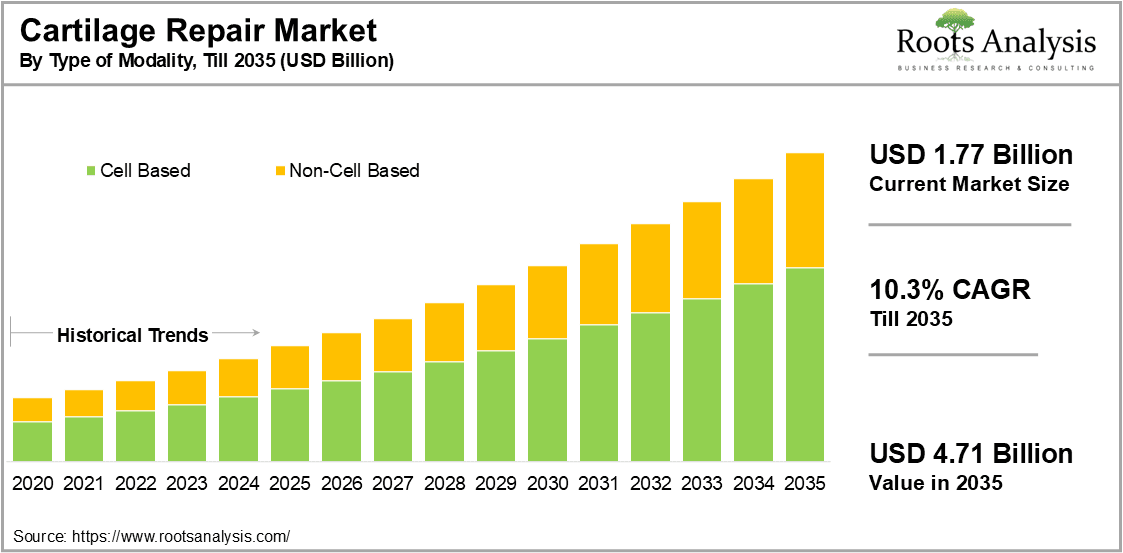
The global cartilage repair market, valued at USD 1.57 billion in 2024, is projected to reach USD 1.77 billion in 2025 and USD 4.77 billion by 2035, representing a CAGR of 10.3% during the forecast period.
 |
To learn more about this report, request a free sample copy
Cartilage repair is a form of surgical procedure that helps in healing damaged cartilage within joints to improve mobility. It is worth mentioning that due to limited ability, cartilage cannot repair itself naturally, especially during injuries which makes it crucial to avail a treatment procedure to restore mobility function. Notably, the conditions, such as repetitive sports motions, injuries, age-related degeneration, overweight, vitamin D deficiency and genetic factors can further lead to cartilage damage.
Considering the increasing incidence, market players are focusing on the development of advanced biomaterials, cell-based therapies, and tissue engineering and regeneration solutions to help patient regain mobility and improve patient outcomes. It is worth mentioning that several industrial players are entering into strategic initiatives to develop advanced treatment options for cartilage repair.
For instance, in May 2024, Altach Biomedical (medical device company) secured an investment of EUR 1.2 million during a venture funding round. The investment will be utilized to meet the requirement for treatment of articular cartilage injuries which are primary cause of osteoarthritis. Furthermore, in September 2024, the Australian Government announced to investing USD 34.5 million in research funding to trial advanced therapies, such as stem cell therapies to heal tissue damage occurred due to osteoarthritis.
Driven by the ongoing initiatives and investments, the cartilage repair market is expected to grow at a higher CAGR during the forecast period, making this market investible for a long time.
The market report provides comprehensive information on industrial players who are currently active across various segments of the industry as mentioned in the table below.
| Key Report Attributes | Details | |
| Historical Trend | Since 2020 | |
| Forecast Period | Till 2035 | |
| Market Size 2025 | USD 1.77 Billion | |
| Market Size 2035 | USD 4.77 Billion | |
| CAGR (Till 2035) | 10.3% | |
| Type of Modality |
|
|
| Type of Cartilage |
|
|
| Type of Treatment |
|
|
| Application Areas |
|
|
| Type of Surgical Procedure |
|
|
| End Users |
|
|
| Geographical Regions |
|
|
| Key Companies Profiled |
|
|
| PowerPoint Presentation (Complimentary) |
Available | |
| Customization Scope | 15% Free Customization | |
| Excel Data Packs (Complimentary) |
Available | |
One of the key objectives of the cartilage repair market report was to estimate the current size, opportunity, and the market growth potential, over the forecast period, till 2035. We have provided informed estimates on the likely evolution of the market for the forecast period.
The market analysis report also features the likely distribution of the current and forecasted opportunity within the market across various segments, such type of modality (cell based (chondrocyte transplantation, stem cells, and growth factors) and non-cell based (tissue scaffolds and cell-free composites)), type of cartilage (hyaline cartilage and fibrocartilage), type of treatment (palliative and intrinsic repair stimulus), application areas (knee, spine, ankle, hip and other applications), type of surgical procedure (microfracture, debridement, abrasion arthroplasty, autologous chondrocyte implantation, osteochondral autograft transplantation, osteochondral allograft transplantation, cell-based cartilage resurfacing and others), end users (hospitals, ambulatory surgical centers, and other end users), geographical regions (North America, Europe, Asia-Pacific, Middle East and North Africa, and Latin America) and leading players.
In order to account for future uncertainties associated with some of the key parameters and to add robustness to our model, we have provided three cartilage repair market forecast scenarios, namely conservative, base, and optimistic scenarios, representing different tracks of industry’s evolution.
All actual figures have been sourced and analyzed from publicly available information forums and primary research discussions. The financial figures mentioned in this market report are in USD, unless otherwise specified.
Based on the type of modality, the global market is segmented into cell based (chondrocyte transplantation, stem cells, and growth factors) and non-cell based (tissue scaffolds and cell-free composites). According to our projection, currently, cell-based segment holds the highest share (63%) of the cartilage repair industry. This can be attributed to increasing usage of cell-based modalities, such as autologous chondrocyte transplants as a primary surgical treatment to repair cartilage. Furthermore, the availability of cell-based therapies to treat cartilage damage. Driven by the increasing preferences for cell-based therapies, this segment will continue to grow at a higher CAGR during the forecast period.
However, it is worth mentioning that non-cell-based modalities such as cell-free composites and tissue scaffolds are currently being explored by healthcare professionals to treat cartilage damage. Hence, this segment is likely to gain traction in the future during the forecast period.
This segment highlights the distribution of global market across different types of cartilage, such as hyaline cartilage and fibrocartilage. Among these, currently hyaline cartilage holds 55% cartilage repair market share. This can be attributed to the growing incidence of physical trauma, such as chondral lesions and osteochondral in patients. Furthermore, the damaged hyaline cartilage lacks active blood supply which makes it difficult to repair itself. Therefore, the patients require hyaline cartilage treatment to repair the damage and regain the mobility, which is likely to be a key reason for highest share of this segment.
However, in the future, it is expected that fibrocartilage segment is likely to grow at a higher CAGR during the forecast period. This is likely to be the result of increasing patient preferences for minimal invasive treatment to repair damaged cartilage. Notably, fibrocartilage treatment is minimally invasive and requires shorter recovery time, which is likely to be a key reason for gaining traction across global population for cartilage repair.
On the basis of treatment type, the global market is segmented into palliative and intrinsic repair stimulus. According to our market analysis, currently the intrinsic repair stimulus segment holds the highest share of the market. This dominance is due to the increasing preferences for microfracture (a form of intrinsic repair stimulus method) to draw mesenchymal stem cells at the site of damages cartilage to generate new tissues.
However, in the long run, palliative treatment segment is likely to register a higher CAGR during the forecast period. Palliative treatment options, such as debridement & lavage are the top treatment options adopted by the healthcare experts for cartilage regeneration.
The global market is segmented across different application areas, such as knee, spine, ankle, hip and other applications. The knee segment at present occupies the highest share (over 45%) of the cartilage repair market. This is primarily due to the increasing incidence of knee injuries among elderly people and athletes. Additionally, the increasing technological advancements in minimally invasive treatment procedures and availability of biomaterials are likely to increase the success rate of cartilage repair during knee surgeries. Owing to the increasing preferences for minimally invasive surgical procedures (including surgery through surgical robots, and endovascular surgery), this segment is likely to grow at a steady CAGR during the forecast period.
On the basis of surgical procedure, the global market is segmented into microfracture, debridement, abrasion arthroplasty, autologous chondrocyte implantation, osteochondral autograft transplantation, osteochondral allograft transplantation, cell-based cartilage resurfacing and others.
Currently, osteochondral allograft transplantation segment occupies the highest share of the cartilage repair industry. This is primarily due to the fact that the osteochondral allograft is crucial to maintaining cartilage matrix and reduce further damage. Owing to its ability to maintain cartilage matrix, healthcare professionals prefer osteochondral allograft for cartilage repair. Driven by the preferences, this segment is likely to remain dominant and is poised to grow at a higher CAGR during the forecast period.
Based on the end user, the global market is segmented across hospitals, ambulatory surgical centers, and other end users. According to our projection, presently the hospitals segment is dominating the market by holding nearly 60% cartilage repair market share. This is likely to be the result of the availability of advanced healthcare infrastructure and cutting-edge technologies to treat complex cartilage injuries. Additionally, the patient preferences of hospitals for surgical procedures, specifically damage cartilage and complex joint injuries has further contributed to the highest share of this segment. It is important to highlight here that the presence of orthopedic specialists and acceptance of reimbursement policies further fueled the growth of this segment at a higher CAGR during the forecast period.
The global market is distributed across different geographical regions, such as North America, Europe, Asia-Pacific, Middle East and North Africa, and Latin America. According to our cartilage repair market forecast, North America is dominating the market by holding 45% share of the overall revenue. This is probably due to the increasing incidence of age-related osteoarthritis and musculoskeletal diseases in this region. Additionally, the presence of advanced healthcare infrastructure and technologies to perform cartilage repair surgeries in this region has contributed to the highest share.
However, in Asia-Pacific, the market for cartilage repair is likely to grow at a higher CAGR during the forecast period. This lucrative growth is due to the increasing geriatric population with age related musculoskeletal diseases that necessitated the demand for advanced cartilage repair treatment.
The “Cartilage Repair Market: Industry Trends and Global Forecasts, till 2035” market report features an extensive study of the current market landscape, market size, market share, market growth, market trends, market value, market forecast, market outlook, statistics, and future opportunities for cartilage repair industrial players. The market research report lays emphasis on the cartilage repair products that are being developed. Key takeaways of the market report are briefly discussed below.
Currently, the market landscape is immensely competitive, featuring the presence of several small, mid-sized and large players. The market players are focusing on the latest product launch, strategic partnerships and collaborations to strengthen their product portfolios. For instance, in December 2024, CO.DON partners in EU-Funded Project (m2M project) to advance their research on advance 3D bioprinting for tissue regeneration. This m2M project focuses on precise pattering cell aggregates and microtissues into customizable and stable grafts that remodel into a functional tissue. With growing initiatives by industrial players, this market is expected to remain competitive throughout the projected period.
The demand for cartilage repair is significantly increasing, driven by the rising incidence of osteoarthritis and sports injuries that lead to cartilage damage. According to Centers for Disease Control and Prevention, over 33 million adults in United States have osteoarthritis. With time, osteoarthritis can lead to cartilage and bone damage which further creates challenges for patients in performing daily tasks due to limited mobility. Additionally, the growing incidence of sports injuries has further fueled the demand for advanced cartilage repair treatment.
Some of the potential challenges in the cartilage repair and regeneration market includes high treatment costs and limited insurance coverage. Notably, the average cost of cartilage repair procedure may range from USD 4,000 to USD 16,000, which may limit its adoption across low to middle income population. In addition, the tissue regeneration procedures required skilled personnels with technological expertise.
Lack of skilled personnel staff to perform tissue regeneration procedures is a significant barrier for the widespread adoption of cartilage repair solutions. Additionally, stringent approval guidelines associated with cartilage repair products and technologies approval may further slow down the approval process.
Some of the potential trends that are shaping cartilage repair industry growth includes, increasing advancements in cell-based therapies, such as autologous chondrocyte implantation and stem cell therapy. Additionally, the industry players are focusing on advanced 3D bioprinting, biomaterials and tissue engineering techniques to enhance cartilage regeneration. Moreover, the growing preferences for minimally invasive procedures and rising funding and investment in this field is contributing to the market growth during the forecast period.
The cartilage repair market is estimated to be valued at USD 1.77 billion in 2025 and is poised to reach USD 4.71 billion by 2035, representing a CAGR of 10.3% during the forecast period. Driven by rising incidence of osteoarthritis and joint injuries and advanced cartilage repair technologies for osteoarthritis treatment, several industrial players are forging strategic partnerships and collaborations in this field.
For instance, in March 2024, Smith+Nephew teamed up with the Preferred Sports Medicine Technology Partner of UFC. Under this multi-year partnership, Smith+Nephew activates its brand through UFC’s immense global presence with an aim of regenerating, repairing and recovery of sports injuries by using advanced technologies.
Examples of key players engaged in this domain (which have also been captured in this report) include Arthrex, Anika Therapeutics, B. Braun, BD (Becton, Dickinson and Company), Collagen Solutions, Johnson & Johnson, Medcata International, Stryker, Smith+Nephew, Vericel and Zimmer Biomet. This market report includes an easily searchable excel database of all the companies focusing on the development of products for cartilage repair.
The market report presents an in-depth analysis, highlighting the capabilities of various companies engaged in this domain across different segments. Amongst other elements, the market report includes:
Several recent developments have taken place in the field of cartilage repair. We have outlined some of these recent initiatives below.