


 Download Free Sample
 Buy Now
Companion Animal Osteoarthritis Market Overview
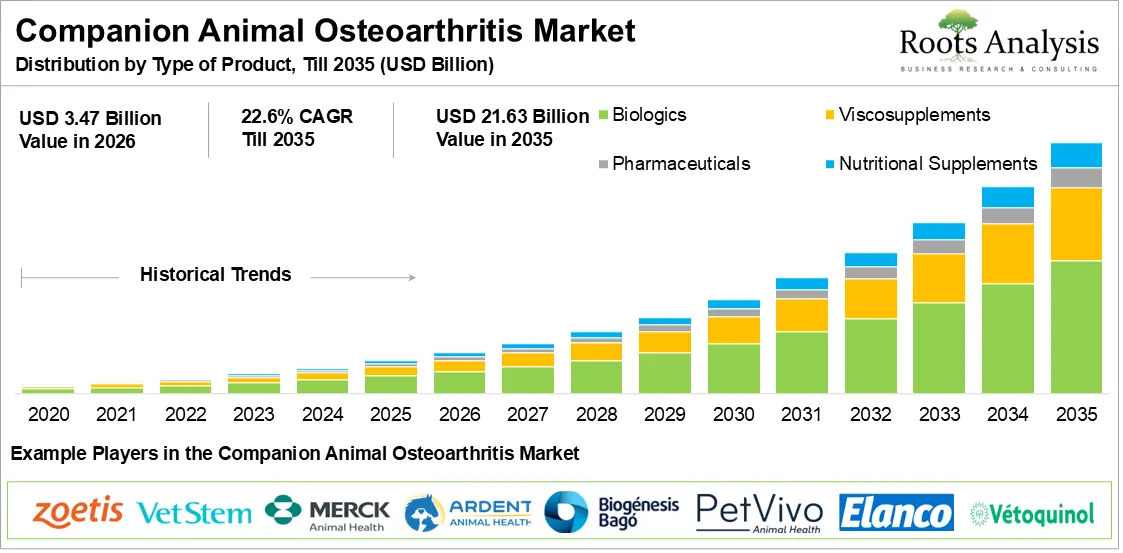
The global companion animal osteoarthritis market size, valued at USD 2.81 billion in 2025, is projected to reach USD 3.47 billion in 2026 and USD 21.63 billion by 2035, representing a CAGR of 22.6% during the forecast period.
See What’s in the Full Report – Request Your Complimentary Insights!
Market Report: Key Takeaways
Market Size and Trends
- The global companion animal osteoarthritis witness an upward trajectory due to the growing pet ownership and rapid demand for advanced drugs to manage osteoarthritis.
- In terms of products, biologics segment secures nearly 45% of the market share and the trend of dominance will remain same.
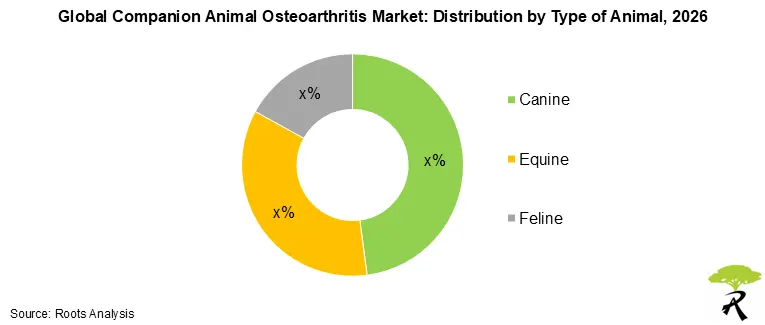
- On the basis of animal type, the canine segment holds nearly 50% of the market share and likely to remain dominant in the future.
- With regards to distribution channel, the veterinary hospitals & clinics holds 60% of the overall revenue share. This dominance stems from the availability of veterinarians and advanced facilities to deliver optimal care to animals.
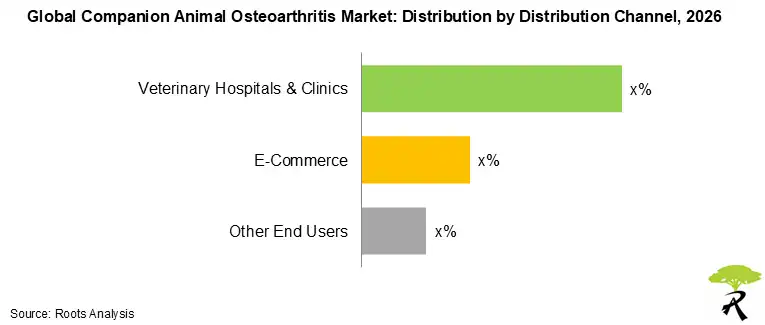
- Based on geographical regions, North America dominates the market by holding 45% of the overall revenue share. In Asia-Pacific, the market is likely to grow at a higher CAGR.
Key Market Statistics
- Market Size in 2026: $3.47 Billion
- Estimated Market Size in 2035: $21.63 Billion
- CAGR (2026-2035): 22.6%
- North America: Largest market in 2026
- Asia Pacific: Fastest growing region
Market Overview
Companion animal osteoarthritis is a form of progressive joint disease that causes inflammation and cartilage breakdown. This joint disease cause leads to intense pain and reduce mobility in companion animals. With rising concern of age-related osteoarthritis in pets, there has been a surge in the demand for advanced therapies for managing osteoarthritis in companion animals. Notably, pet owners are also willing to invest heavily in veterinary services to keep their pets healthy, which further fuels the market growth.
It is worth noting that there is no complete cure available till now for osteoarthritis in animals. Researchers are currently focusing on the development of advanced stem cells, platelet-rich plasma (PRP), monoclonal antibodies (mAb), nutritional supplements, and pain management medication to improve motor function and comfort. In July 2025, Gallant (US) announced USD 18 million funding support to bring the first USFDA approved ready-to-use stem cell therapy to veterinary medicine to improve mobility in pets.
Market Segmentation
The global companion animal osteoarthritis market provides an in-depth analysis of segments and sub-segments listed below:
Companion Animal Osteoarthritis Market, by Type of Product
- Biologics
- Stem Cells
- Platelet-Rich Plasma (PRP)
- Monoclonal Antibodies (mAb)
- Other Biologics
- Viscosupplements
- Pharmaceuticals
- Steroids
- NSAIDS
- Others
- Nutritional Supplements
Companion Animal Osteoarthritis Market, by Type of Animal
- Canine
- Equine
- Feline
Companion Animal Osteoarthritis Market, by Route of Administration
- Oral
- Injectables
- Intramuscular
- Intraarticular
- Other injectables
- Other Route of Administration
Companion Animal Osteoarthritis Market, by Distribution Channel
- Veterinary Hospitals & Clinics
- E-Commerce
- Other Distribution Channels
Companion Animal Osteoarthritis Market, by Geographical Regions
- North America
- US
- Canada
- Mexico
- Rest of North America
- Europe
- France
- Germany
- Italy
- Spain
- UK
- Rest of Europe
- Asia-Pacific
- China
- India
- Japan
- South Korea
- New Zealand
- Rest of the Asia-Pacific
- Middle East & Africa
- Egypt
- Iran
- Iraq
- Israel
- Saudi Arabia
- South Africa
- United Arab Emirates
- Latin America
- Argentina
- Brazil
Key Market Insights
What are the Main Drivers of Market Growth?
Some of the potential companion animal osteoarthritis market drivers are raising incidence of osteoarthritis in companion animals, such as dogs, cats and horses. It is worth noting that pet owners are treating their pets as family members. They are willing to make investment for their pet well-being, which is expected to drive the demand for premium healthcare services. In addition, rising innovation in diagnostic technologies are enabling early detection of osteoarthritis in pet for adequate management.
What are the Latest Advances in Diagnosis, Monitoring, and Disease Management for Animal OA?
- Increasing Focus on Companion Animal Osteoarthritis Diagnostic Innovations: The future focus of industrial players will be on the development of standardized diagnostic tools, such as canine osteoarthritis stagging tool (COAST) for early stage diagnosis. Notably, the advanced diagnostic tools enable detailed physical examination, such as posture, and gait. This further helps to facilitate tailored treatment to improve treatment outcomes. Moreover, the radiography and advanced imaging technologies will remain the cornerstone for early diagnosis in the future.
- Tailored Pharmaceuticals and Regenerative Therapies: Notably, the market players, such as Zoetis (US) has recently launched injectable therapies, such as Librela (bedinvetmab) and Solensia (frunevetmab), which is marked as a significant milestone in this field. These successful approval of the therapies has catered the attention of industrial players. However, the primary focus of veterinary drug manufacturing companies will be on the development of pharmaceuticals, such as monoclonal antibodies, regenerative therapies, such as stem cell therapy to support joint repair.
- Nutraceuticals and Supplements Will Remain the Center Focus: The future companion animal osteoarthritis market trends also includes nutraceuticals and supplements to improve overall well-being of the pet. Considering the ongoing demand, the market players are emphasizing nutraceutical products, such a chondroitin, glucosamine, and omega-3 fatty acid as preventive health solution.
What Challenges Exist for Clinical Validation, Long-Term Efficacy, or Regulatory Approval of New OA Therapies?
- Challenges in Identifying Real-World Evidence For OA Drug Efficacy In Pets: There is a significant disconnection between the real-world evidence and controlled laboratory studies of therapeutic drug efficacy. Due to the complexity of osteoarthritis, the induced mode of osteoarthritis in laboratories for drug efficacy testing may not accurately show the progressive nature of the disease in companion animals. Furthermore, clinical trials that use real animals looks promising to understand drug efficacy, however, controlling the animals can be a significant challenge.
- Challenges with Long-Term Efficacy: It is important to note here that osteoarthritis is a progressive disease. Therefore, the effectiveness of the therapies may fluctuate over time or as disease continue to progress. To overcome this challenges, researchers are focusing on multimodal management that combines advanced AI-enabled monitoring of pet mobility and OA symptoms, combinational therapies and wearable technology to gather real-world evidence of treatment efficacy.
Recent Developments in Companion Animal Osteoarthritis Market
- In September 2025, The Senior Dog Veterinary Society (SDVC, US), and Virbac (France) entered into a collaboration to advance education and awareness about mobility issues in aging canines and available solutions to improve outcomes.
- In September 2025, Zoetis (US) announced that the committee for Veterinary Medicinal Products of the European Medicines Agency has accepted the granting of marketing authorization of Portela® (relfovetmab), a newly launched monoclonal antibody therapy to alleviate pain associated with osteoarthritis in cats.
- In March 2025, Can-Fite BioPharma (US) announced that its veterinary partner VetBioLix is initiating an advanced clinical study in dogs with osteoarthritis by using oral daily treatment with Piclidenoson.
Industry Experts on Companion Animal Osteoarthritis Market
Industry experts believe that the companion animal osteoarthritis industry is highly progressive in the future driven by the ongoing therapeutics demand and pet ownership.
Ross Plamer (DVS, MS and DACVS), stated that, ‘Oftentimes they are discussing certain behaviors that they see, certain impairments in the dog's mobility. And then sometimes, actually, in the context just of that discussion. And this is ideal, is when they'll actually ask me, ‘Do you think he's in pain?’ That's wonderful, because that opens up the door.’
Market Share Insights
What are the Main Treatment Categories for Companion Animal OA?
- The global market is categorized across different type of product, such as biologics (stem cells, platelet-rich plasma (PRP), monoclonal antibodies (mAb), and other biologics), viscosupplements, pharmaceuticals (steroids, NSAIDS, and others), and nutritional supplements. According to the companion animal osteoarthritis market forecast, the biologics segments is dominating by securing nearly 55% of the market share. This growth stems from the rising focus on the development of stem cell therapies and monoclonal antibodies due to its higher efficacy and minimal side effects of animals.
- It is important to mention here that this segment will continue to grow in the future at a higher CAGR. This lucrative growth is due to the rising approval of monoclonal antibodies and platelet-rich plasma (PRP) to support joint repair and modulate inflammation in pets with osteoarthritis.
Which Animal Types Drive the Largest Share of OA Diagnosis and Treatment?
- This segment highlight the distribution of global market across, different type of animal, such as canine, equine, and feline. Based on the companion animal osteoarthritis market report, the canine segment is account for nearly 50% of the market share. Increasing ownership of the dogs and high prevalence of osteoarthritis in canine are the robust factors for the highest share of this segment.
- Notably, this segment will continue to maintain its dominance in the future and is expected to grow at a higher CAGR. The increasing launch of the USFDA approved monoclonal antibody therapies for dogs to manage osteoarthritis and pain relief therapies for feline osteoarthritis is likely to fuel the growth of this segment.
Which Route of Administration Drive the Largest Share of the Market?
- Based on the route of administration, the global market is distributed across oral, injectables (intra-muscular, intra-articular, and other injectables), and other route of administrations. According to the companion animal osteoarthritis market report, the injectables segment is dominating the market and is likely to remain dominant in the future. This growth stems from the fact that injectables offer direct release of novel biologics for canine osteoarthritis management at targeted sites.
- It is important to note here that this segment is expected to grow at the fastest CAGR during the forecast period. The injectables offer rapid onset of action, minimal side effects and relief from joint pain for extended period. Moreover, the minimal invasive approach is likely to increase the acceptance of injectables for drug delivery.
Unlock Deeper Insights – Schedule Your Personalized Workshop Today!
Regional Analysis: Which Regions are Dominating the Market?
The global market is distributed across North America, Europe, Asia-Pacific, Middle East & Africa and Latin America.
North America: Maintain the Market Dominance
North America is currently dominating the market by securing nearly 45% of the overall revenue share. Several factors, such as rising pet ownership, presence of well-established market players and consistent focus on therapies innovations are fueling the market growth in this region. In addition, the approval of the Librela® by the USFDA in the US has further propelled the initiatives by the industrial players to develop more advanced therapies for managing osteoarthritis in pets.
Europe: Holds the Substantial Share
Europe is currently holding second largest companion animal osteoarthritis market share. This is driven by the wider access to veterinary healthcare services, supportive regulatory framework, and aging pet populations. In addition, the consistent focus on preventive care initiatives and real-time mobility monitoring are further driving growth of the market in this region. Notably, the countries like German and Italy have robust demand for natural and targeted stem cell therapies for pet’s integrative care.
Asia-Pacific: Growing at a Higher CAGR
In Asia-Pacific, the rising pet adoption and heightened incidence of osteoarthritis in pets are driving the market growth in this region. In addition, the growing emphasis on the pet owner education on osteoarthritis management by the government is expected to drive the market in this region at a higher CAGR.
Want Information on Specific Region / Segment?
When are Next-Generation OA Products, Such as Gene Therapies or Injectable Biologics, Expected to Reach The Market?
The next generation osteoarthritis products, such as gene therapies and injectables, are expected to reach the market in the 2026. Market players, such as Rejuvenate Bio (US) are on clinical programs in advancements gene therapy approaches for canine osteoarthritis. Notably, the gene therapy candidates, such as CureLab Veterinary’s (US) ElenaVet™ has shown promising results in clinical studies conducted in 2024. However, its commercial availability is likely to be scheduled by late 2026.
Companion Animal Osteoarthritis Market Segmentation Insights
The market report provide in-depth information of the key players who are active across various segments of the growing industry as mentioned in the table below.
Companion Animal Osteoarthritis Market: Report Attributes / Market Segmentation
| Key Report Attributes | Details | |
| Historical Trend | Since 2020 | |
| Forecast Period | Till 2035 | |
| Market Size 2026 | $ 3.47 Billion | |
| Market Size 2035 | $ 21.63 Billion | |
| CAGR (Till 2035) | 22.6% | |
| Market Segmentation |
|
|
| Key Players Profiled |
|
|
| PowerPoint Presentation | Complimentary) | |
| Customization Scope | 15% Free Customization | |
| Excel Data Packs | (Complimentary) Available | |


