Cosmeceuticals Market
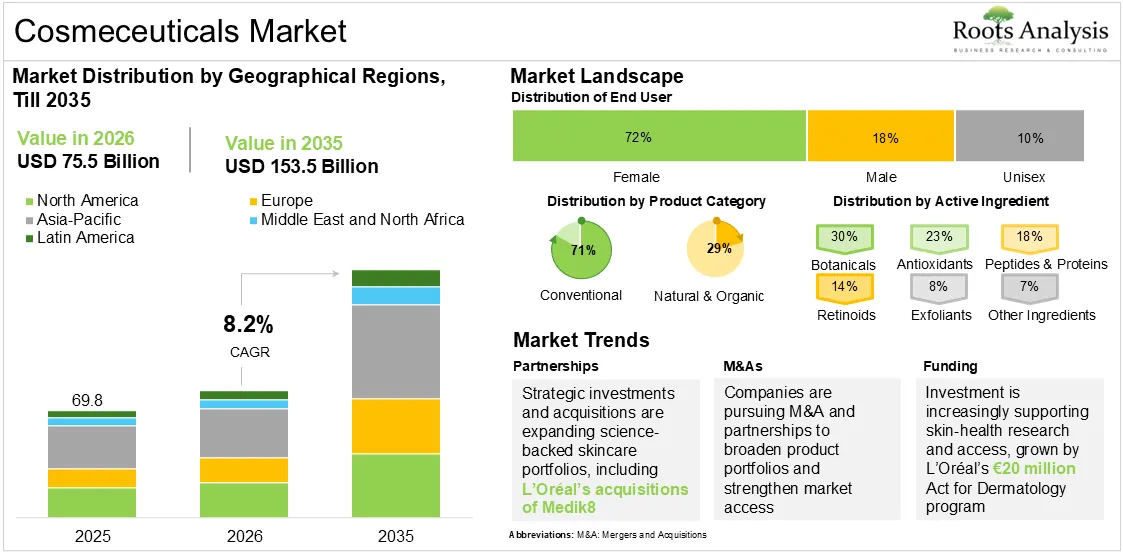
The cosmeceuticals market, valued at USD 69.8 billion in 2025, is projected to reach USD 75.5 billion in 2026 and USD 153.5 billion by 2035, representing a CAGR of 8.2% during the forecast period 2026 to 2035.
-
Lowest Price Guaranteed
-
Pages
355 -
Last Updated
October 2026 -
View Count
3124 -
Market Outlook
The cosmeceuticals market, valued at USD 69.8 billion in 2025, is projected to reach USD 75.5 billion in 2026 and USD 153.5 billion by 2035, representing a CAGR of 8.2% during the forecast period 2026 to 2035.
To learn more about this report, request a free sample copy
Market Report: Key Takeaways
Market Size & Trends
- The skin care segment dominates the market, driven by increasing consumer demand for advanced skincare formulations and products targeting specific dermatological concerns.
- The anti-aging segment accounts for the largest market share, primarily owing to the growing emphasis on preventive skincare, increasing adoption of age-defying formulations, and consistent demand for products addressing wrinkles, fine lines, and skin firmness.
- Botanicals segment holds the leading market position, supported by widespread incorporation of plant-derived ingredients in cosmetic formulations and growing consumer preference for naturally sourced ingredients.
- Conventional products account for the largest market share, supported by their widespread availability, established consumer acceptance, extensive product portfolios, and strong retail presence.
- The female segment dominates the market, owing to higher product penetration, established skincare routines, and greater expenditure on personal care and beauty products.
- The pharmacy and specialist retail segment holds the largest market share, benefiting from professional product recommendations, curated product offerings, and greater consumer confidence in purchasing specialized skincare formulations.
- Asia-Pacific dominates the global market, supported by a substantial consumer base, rising disposable incomes, strong beauty and personal care consumption, and increasing demand for innovative cosmetic formulations.
Key Market Statistics
- Market Size in 2026: $75.5 Billion
- Estimated Market Size in 2035: $153.5 Billion
- CAGR (2026-2035): 8.2%
- Asia-Pacific: Largest market in 2026
- North America: Fastest growing region
Market Introduction
Cosmeceuticals are advanced personal care products formulated with biologically active ingredients designed to deliver functional benefits beyond conventional cleansing, moisturizing, and cosmetic enhancement. Positioned at the intersection of cosmetics and dermatological science, these products are increasingly gaining prominence for their role in addressing specific skin and hair concerns, including premature aging, acne, hyperpigmentation, hair thinning, scalp health, and impaired skin-barrier function. Cosmeceutical formulations incorporate a wide range of active ingredients, such as retinoids, antioxidants, peptides, botanical extracts, vitamins, and other bioactive compounds, which are selected to support skin health, improve appearance, and address specific consumer needs.
The global cosmeceuticals market is witnessing steady growth, primarily driven by increasing consumer awareness of skin and hair health, rising demand for scientifically formulated personal care products, and growing preference for targeted, ingredient-driven beauty solutions. The expanding influence of dermatologists, skincare professionals, and digital beauty platforms has further encouraged consumers to prioritize ingredient transparency, product quality, and scientifically supported claims when making purchasing decisions. In addition, the growing availability of cosmeceutical products through pharmacies, dermatology clinics, specialty retail outlets, and e-commerce platforms is improving accessibility and supporting wider market penetration. Furthermore, ongoing advancements in active-ingredient stabilization, encapsulation techniques, delivery systems, and formulation technologies are enabling manufacturers to develop more specialized products tailored to diverse skin types, hair concerns, and consumer preferences.
Despite these favorable growth prospects, the market faces several challenges, particularly the lack of a universally recognized regulatory definition for cosmeceuticals and increasing scrutiny of product safety and marketing claims. Regulatory differences across geographical markets, especially concerning the classification of products as cosmetics, drugs, biologics, or medical devices, create additional complexities for manufacturers operating internationally. Moreover, evolving requirements related to scientific substantiation, ingredient disclosure, product labeling, and advertising practices are encouraging companies to strengthen testing procedures and regulatory compliance strategies.
Nevertheless, continued innovation in dermatological science, increasing adoption of preventive skincare practices, and growing consumer interest in specialized personal care solutions are expected to create significant growth opportunities for stakeholders in the global cosmeceuticals market.
Market Segmentation
Based on the research, we have segmented the cosmeceuticals market into product type, skin care application, active ingredient, product category, end user, distribution channel, and geographical regions.
- By Product Type: Skin Care, Hair Care, Oral Care, Lip Care, and Other Products
- By Skin Care Application: Anti-aging, Acne Treatment, Sun Protection, Moisturization and Hydration, Pigmentation Treatment and Other Applications
- By Active Ingredient: Botanicals, Antioxidants, Peptides and Proteins, Retinoids, Exfoliants and Other Ingredients
- By Product Category: Conventional, and Natural and Organic
- By End User: Female, Male and Both
- By Distribution Channel: Pharmacy and Specialist Retail, Online Platforms, Supermarkets and Hypermarkets, and Other Channels
- By Geographical Regions: North America, Europe, Asia-Pacific, Latin America, Middle East and North Africa
Cosmeceuticals Market Key Insights
What Are the Key Drivers of Growth in the Cosmeceuticals Market?
- Increasing Consumer Demand for Scientifically Backed, Active Ingredient-Based Formulations: Growing consumer awareness regarding skin health, ingredient efficacy, and targeted skincare solutions is significantly driving the adoption of cosmeceutical products. Consumers are increasingly shifting from conventional beauty products toward advanced formulations containing clinically studied active ingredients, such as retinoids, peptides, antioxidants, alpha-hydroxy acids, and botanical extracts. Additionally, the rising influence of dermatologists, skincare professionals, and digital educational platforms is encouraging consumers to prioritize products offering demonstrable benefits for skin aging, pigmentation, acne, and other dermatological concerns. This shift toward evidence-based skincare, coupled with increasing demand for ingredient transparency and product efficacy, is expected to support sustained market growth.
- Growing Adoption of Preventive Skincare and Long-term Personal Care Regimens: Increasing emphasis on preventive skin health, healthy aging, and personalized beauty routines is emerging as a major growth driver for the cosmeceuticals market. Consumers are increasingly incorporating specialized skincare products into their daily routines to address concerns such as premature aging, hyperpigmentation, acne, skin dehydration, and sun-induced damage. Furthermore, growing interest in scalp health and hair restoration is expanding the application of cosmeceutical formulations beyond traditional facial skincare. As many of these concerns require consistent, long-term product use, manufacturers are developing integrated product portfolios comprising cleansers, serums, moisturizers, sunscreens, and targeted treatments. This trend is contributing to repeat purchases, product diversification, and greater consumer engagement.
- Expanding Dermatologist Recommendations and Professional Skincare Distribution Channels: The growing involvement of dermatologists, skincare specialists, pharmacists, and aesthetic professionals in consumer purchasing decisions is strengthening demand for specialized cosmeceutical formulations. Professional recommendations help consumers identify appropriate products based on skin type, active ingredient concentration, individual sensitivities, and desired treatment outcomes, thereby improving confidence in product selection. Additionally, the expanding availability of dermatologist-developed and clinically evaluated products through pharmacies, dermatology clinics, specialist retail outlets, and online platforms is enhancing market accessibility. Increasing collaboration between cosmetic manufacturers and dermatology professionals, alongside investments in clinical testing and product innovation, is further strengthening brand credibility and supporting market expansion.
What are the Main Challenges for Market Growth?
- Complex Regulatory Requirements and Differences in Product Classification Across Regions: The absence of a universally harmonized regulatory classification for cosmeceuticals presents a significant challenge for manufacturers operating across international markets. Depending on product composition, intended use, and marketing claims, cosmeceutical formulations may be regulated as cosmetics, drugs, or other product categories under different national regulatory frameworks. Consequently, manufacturers must navigate varying requirements related to ingredient safety, product registration, labeling, advertising claims, and supporting scientific evidence. These differences can increase compliance costs, complicate international commercialization strategies, and delay product launches. Furthermore, heightened regulatory scrutiny of therapeutic and efficacy-related claims is compelling manufacturers to invest in rigorous product evaluation, substantiation, and regulatory compliance.
- Technical Challenges Associated with Formulation Stability, Ingredient Efficacy, and Skin Tolerability: Developing cosmeceutical formulations that consistently deliver intended benefits while maintaining product stability and consumer safety remains a major industry challenge. The effectiveness of active ingredients can be influenced by several formulation parameters, including ingredient concentration, chemical stability, pH, compatibility with other ingredients, delivery mechanisms, and packaging conditions. Certain active ingredients are susceptible to oxidation, degradation, or reduced performance when exposed to environmental factors, potentially affecting product efficacy and shelf life. Additionally, manufacturers must balance ingredient potency with skin tolerability, as poorly optimized formulations may cause irritation, sensitivity, or other undesirable reactions. These considerations increase research and development requirements, formulation complexity, and product validation costs.
- Growing Concerns Regarding Misleading Product Claims, Counterfeit Products, and Consumer Trust: Increasing competition and rapid expansion of digital marketing channels have intensified challenges associated with product authenticity, scientific credibility, and transparency in the cosmeceuticals market. The proliferation of exaggerated efficacy claims, insufficiently substantiated marketing statements, and misleading promotional content can create unrealistic consumer expectations and undermine confidence in product performance. Moreover, the availability of counterfeit, unauthorized, and improperly stored products through fragmented distribution networks can pose risks to consumer safety and brand reputation. To address these concerns, manufacturers are increasingly required to strengthen clinical claim substantiation, implement robust quality assurance procedures, improve supply chain traceability, and maintain tighter oversight of authorized distribution channels. These measures may increase operational costs but remain essential for sustaining consumer confidence and long-term market competitiveness.
Recent Developments in Cosmeceuticals Market
- LUMA Skincare: In September 2026, Luma Dermatology launched LUMA Skincare nationwide in the US, expanding a dermatologist-developed product line originally created for the practice's patients. The portfolio includes antioxidant, brightening and corrective formulations, supported by nationwide virtual dermatology consultations.
- AHA Firming & Brightening Crème: In September 2026, Cosmedical launched AHA Firming & Brightening Crème, a dermatologist-developed medical-grade skincare formulation combining glycolic acid, marine peptides and a brightening complex. The product expands the company's portfolio of practitioner-dispensed cosmeceutical formulations intended for professional skincare brands.
- Skin Renewing Super Boost Serum: In September 2026, CeraVe launched Skin Renewing Super Boost Serum, an anti-aging formulation developed with dermatologists. The product combines patent-pending Ceramide Booster Technology with five anti-aging ingredients to address fine lines, firmness, smoothness, brightness and hydration while supporting the skin barrier.
Industry Experts on Cosmeceuticals Market
Cosmeceuticals are increasingly adopting pharmaceutical-style formulation and delivery technologies to improve product efficacy, stability, and measurable skin outcomes.
In May 2026, Neha Gupta, Director of Leeford Healthcare, highlighted the growing importance of advanced delivery technologies in cosmetics, including encapsulation, controlled release, nanoparticles, and micro-emulsions. Discussing the shift toward efficacy-driven product development, Neha Gupta stated, "The real measure of innovation today is whether an active ingredient is stable, reaches the right layer of skin, and delivers a measurable outcome. Smart delivery systems, encapsulation, controlled-release technologies, nanoparticles, and micro-emulsions, are now central to how that is achieved."
Detailed insights were obtained from publicly available discussions with senior stakeholders across the global cosmeceuticals industry, including several executives and specialists spanning biotechnology and pharmaceutical companies, CMOs / CDMOs, business development, chemistry, regulatory affairs, R&D and commercial functions, including the following roles:
- Chief Executive Officer, Leading Dermatology & Skincare Company, US
- President & Chief Executive Officer, Leading Skincare Products Company, US
- Chief Executive Officer, Leading Dermocosmetics Company, France
- President & Chief Executive Officer, Leading Professional Skincare Company, US
- Chief Executive Officer, Leading Cosmetic Active Ingredients & Biotechnology Company, France
- Founder, Chief Executive Officer & Formulator, Leading Cosmeceutical Skincare Company, France
- Global President, Leading Dermatological Skincare Company, France
- Chief Executive Officer, Leading Beauty & Skincare Company, US
- President & Chief Executive Officer, Leading Cosmetic & Dermatology Company, Europe
Market Share Insights
Which Product Type Accounts for the Largest Share of the Cosmeceuticals Market?
- Skin care currently holds the largest share by product category, driven by its broad range of routine and condition-specific applications and strong repeat-purchase potential. For cosmeceutical brands, the segment offers opportunities across cleansers, serums, moisturizers, exfoliants, pigmentation treatments and photoprotective formulations, supported by established consumer familiarity with active ingredients and multi-step skincare regimens.
- Hair care is expected to register the fastest growth during the forecast period, driven by increasing demand for targeted solutions for scalp health, hair thinning, breakage and repair. For manufacturers and brands, this creates opportunities for evidence-backed formulations that address specific consumer concerns while maintaining compliance with cosmetic claim requirements.
Which Skin Care Application Represents the Biggest Opportunity in the Cosmeceuticals Market?
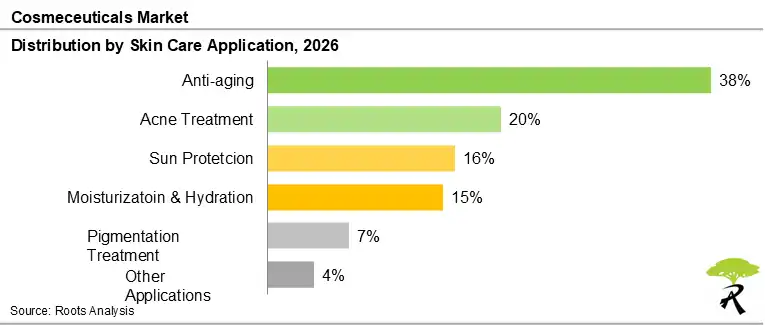
- Anti-aging holds the largest share by application, driven by demand for products targeting fine lines, uneven skin tone, dryness, texture and loss of firmness. Broad formulation options and multi-step regimens support recurring consumer purchases.
- Acne treatment is expected to register relatively faster growth during the forecast period, driven by rising awareness of adult acne and demand for products targeting sensitive and acne-prone skin. However, acne-treatment claims may result in drug classification in markets such as the US.
Which Active Ingredient Accounts for the Largest Share of Market?
- Botanicals hold the leading share by active ingredients, supported by their widespread use across skin, hair, lip and oral-care formulations. Their soothing, antioxidant and sensory benefits, along with strong consumer familiarity, support broad adoption.
- Antioxidants are expected to register the fastest growth during the forecast period, driven by their use in anti-aging, brightening and environmental-stress protection formulations. Growth will favor formulations with effective stabilization and demonstrated consumer benefits.
What Makes Pharmacy and Specialist Retail the Leading Choice in the Cosmeceuticals Market?
- Pharmacy and Specialist Retail holds the leading share, supported by convenient product access, curated portfolios and staff guidance. These channels are important for consumers to evaluate active ingredients and product tolerability, while supporting professional recommendations.
- Online Platforms are expected to register the fastest growth during the forecast period, driven by wider geographic reach, convenient product discovery and repeat-purchase opportunities. E-commerce also enables brands to provide product information and education directly to consumers.
Cosmeceuticals Market: Regional Analysis
Asia-Pacific Accounts for the Largest Share of the Cosmeceuticals Market
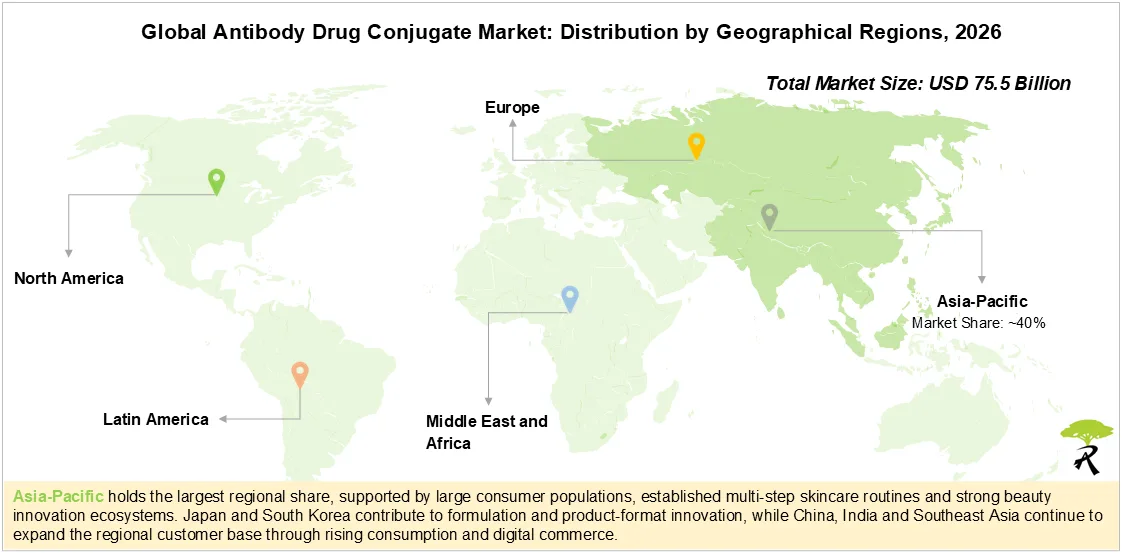
In the current market, Asia-Pacific holds the largest regional share, supported by large consumer populations, established multi-step skincare routines and strong beauty innovation ecosystems. Japan and South Korea contribute to formulation and product-format innovation, while China, India and Southeast Asia continue to expand the regional customer base through rising consumption and digital commerce.
North America to Register Fastest Growth by 2035
North America is expected to witness the fastest growth during the forecast period, driven by strong dermatologist-linked brands, high consumer awareness of active ingredients, developed e-commerce channels and growing demand for premium skincare products. The region also benefits from an established physician-administered aesthetics market and evolving regulatory requirements in the US.
Key Players Profiled in the Cosmeceuticals Market
The cosmeceuticals market includes cosmetic and skincare manufacturers, dermatology-focused companies, beauty and personal care companies, and consumer health companies involved in the development, manufacturing, marketing and distribution of science-backed skincare, haircare and personal care products, including L'Oréal, The Estée Lauder Companies, Shiseido Company, Beiersdorf, Kenvue, Galderma, AbbVie and Colgate-Palmolive. L'Oréal participates through its Dermatological Beauty portfolio, including La Roche-Posay, CeraVe and SkinCeuticals, while Beiersdorf participates through Eucerin and Aquaphor.
Report Deliverables and Customization
The report includes complimentary Excel data packs covering market landscape analysis, company competitiveness analysis, company profiles, partnerships and collaborations, funding and investment analysis, and market sizing and forecast analysis. A complimentary PowerPoint presentation is available, and up to 15% customization can be requested subject to data availability.
Report Authorship
Author(s): Simriti Gupta and Pemba Lahmo. Both authors contribute to Roots Analysis's healthcare and pharma research practice, covering biologics discovery, development, and manufacturing market studies.
Independence and Non-Affiliation
This report is an independent work of market research and analysis published by Roots Analysis. It is not affiliated with, sponsored by, endorsed by, or reviewed by Kenvue, Galderma, AbbVie and Colgate-Palmolive, or any other pharmaceutical company, drug brand, or regulatory body referenced within it. No content in this report should be construed as medical advice. Roots Analysis maintains its own proprietary primary research process, and does not receive compensation from any company profiled within the report, in exchange for inclusion or favorable characterization.