
Lowest Price Guaranteed
Slides
213
Last Updated
August 2026
View Count
5801
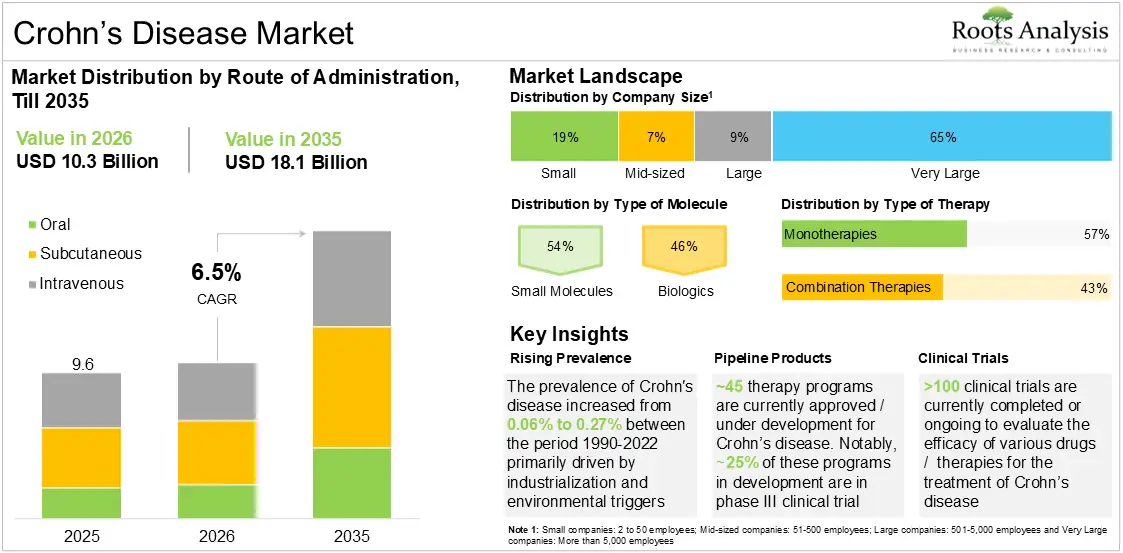
The global Crohn's disease market size, valued at USD 9.6 billion in 2025, is projected to reach USD 10.3 billion in 2026 and USD 18.1 billion by 2035, representing a CAGR of 6.5% during the forecast period 2026 to 2035.
To learn more about this report, request a free sample copy
Crohn's disease is a chronic inflammatory disorder of the gastrointestinal tract. It may affect any segment of the digestive system, although the small intestine and colon are the sites most commonly involved. The disease typically follows a relapsing and remitting course, characterized by periods of symptom worsening followed by temporary improvement.
The clinical presentation of Crohn's disease varies considerably across patients, ranging from mild gastrointestinal discomfort to severe and debilitating illness. Common manifestations include abdominal pain, diarrhea, fatigue, weight loss, and reduced appetite, while impaired nutrient absorption may also lead to malnutrition. Notably, in more advanced or uncontrolled cases, the disease can result in serious complications, such as intestinal strictures, fistulas, and persistent inflammation. This wide variation in symptoms and severity often makes diagnosis, monitoring, and management more complex.
The treatment landscape for Crohn's disease is evolving rapidly, with increasing emphasis on targeted and individualized therapeutic approaches. Conventional therapies, including amino salicylates, corticosteroids, and immunomodulators, continue to play an important role in disease control. At the same time, biologic therapies have become a central component of treatment for many patients, particularly those with moderate to severe disease. Newer drug classes, such as JAK inhibitors and other advanced therapies, are further broadening the treatment landscape. Overall, treatment strategies are now focused not only on symptom relief but also on deeper disease control, complication prevention, and improved long-term outcomes.
A number of biologics are approved for the treatment of Crohn's disease. The most recent biologic to receive approval is Eli Lilly's Omvoh, an IL-23 inhibitor targeting moderate to severe Crohn's disease. The FDA approval came in January 2025.
In May 2023, FDA granted approval to AbbVie's Rinvoq, the first once-daily pill for moderate to severe Crohn's disease. The table below lists some of the approved drugs for this indication.
| Drug Name | Developer Name | Year of Establishment | Headquarters | Stage of Development | Type of Molecule |
| Cimzia | UCB | 1928 | Brussels, Belgium | Marketed | Biologic |
| ENTYVIO | Takeda | 1781 | Tokyo, Japan | Marketed | Biologic |
| HUMIRA | AbbVie | 2012 | Illinois, United States | Marketed | Biologic |
| Omvoh | Eli Lilly and Company | 1876 | Indiana, United States | Marketed | Biologic |
| Remicade | Janssen Biotech | 1979 | Pennsylvania, United States | Marketed | Biologic |
| Rinvoq | AbbVie | 2012 | Illinois, United States | Marketed | Small Molecule |
| Skyrizi | AbbVie | 2012 | Illinois, United States | Marketed | Biologic |
| Stelara | Janssen Biotech | 1979 | Pennsylvania, United States | Marketed | Biologic |
| TREMFYA | Janssen Biotech | 1979 | Pennsylvania, United States | Marketed | Biologic |
| TYSABRI | Biogen | 1978 | Massachusetts, United States | Marketed | Biologic |
Based on the research, we have segmented the Crohn's Disease Market Report into drug class, route of administration, distribution channel, and geographical regions.
By Drug Class
By Route of Administration
By Distribution Channel
By Geographical Regions
The Crohn's disease drugs market is projected to expand rapidly, driven by the rising disease prevalence and the lack of effective treatment approaches. Validating this trend, Jean-Frederic Colombel (Professor), stated that, "A study we conducted with the Crohn's & Colitis Foundation in the USA 2 years ago revealed that approximately 50% of patients with CD had to wait more than 2 years to receive their diagnosis."
Discussions with multiple stakeholders in this domain influenced the opinions and insights presented in this study. The market report includes transcripts of the following third-party discussions:
This segment highlights the distribution of market value for Crohn's disease across various drug classes, such as biologics, amino salicylates, antibiotics, corticosteroids, immunomodulators and others.
Currently, the biologics segment captures the majority of the Crohn's disease market share. This dominance is due to their established role as the standard of care for patients with moderate-to-severe Crohn's disease, where conventional therapies, such as corticosteroids and immunomodulators are often insufficient for long-term disease control. Their ability to target specific inflammatory pathways, reduce steroid dependence, and support long-term remission has made them a preferred treatment option.
Moreover, continued physician confidence, strong treatment guideline support, broad reimbursement coverage across developed markets, and the availability of multiple approved biologic classes have reinforced their widespread adoption. Furthermore, the increasing preference for early biologic intervention under treat-to-target management strategies has expanded their use beyond refractory patients, strengthening the segment's market leadership.
Biologics are also expected to register the highest CAGR during the forecast period. This accelerated growth is due to continued innovation in targeted mechanisms, especially IL-23 inhibitors. Recent approvals of therapies such as SKYRIZI, OMVOH and TREMFYA have expanded treatment options for patients who have failed older anti-TNF therapies. This creates opportunities for companies developing biologics with better efficacy, durable remission, convenient dosing and stronger positioning in earlier lines of treatment.
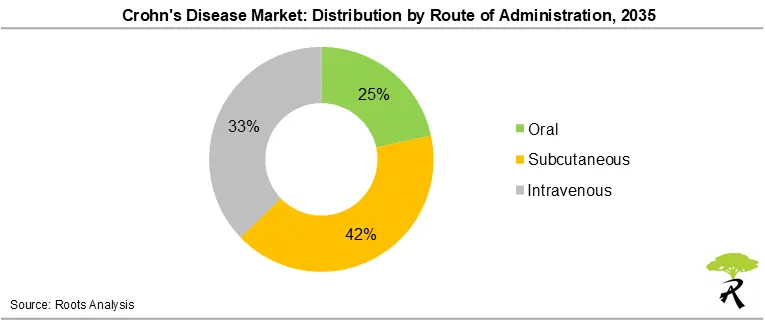
Based on the route of administration, the global market is segmented into subcutaneous, intravenous, and oral routes.
Currently, the subcutaneous sub-segment is likely to capture the majority of the Crohn's disease market size. This is due to the fact that most high-value biologic therapies used for long-term disease control are administered subcutaneously during maintenance treatment. This route is well established across major marketed products, including HUMIRA, STELARA, SKYRIZI, and newer subcutaneous formulations such as ZYMFENTRA and ENTYVIO Pen. Moreover, unlike the intravenous route of administration, which often requires complex and patient-specific body weight, subcutaneous injections frequently use a standard fixed dose, minimizing the risk of dosing errors. In addition, subcutaneous formulations offer greater convenience through self-administration at home, reducing hospital visits and lowering treatment burden for patients.
Moreover, it is worth highlighting that, as per Crohn's disease market analysis, the market share for oral sub-segment is likely to grow at a relatively higher CAGR (8.1%) during the forecast period. This trend is supported by the growing development of targeted oral therapies that offer a more convenient alternative to injectable treatments. Pharmaceutical companies are increasingly investing in oral small molecules and other novel therapies that can improve patient compliance, simplify long-term disease management, and reduce dependence on healthcare facility-based administration.
As the pipeline of oral therapies expands and more products demonstrate favorable efficacy and safety profiles, companies that focus on differentiated oral formulations and earlier treatment positioning are likely to benefit from the increasing demand for patient-friendly Crohn's disease therapies.
Based on the distribution channel, the global market is segmented into hospital pharmacies, retail pharmacies and online pharmacies.
According to our market analysis, currently hospital pharmacies occupy the highest market share in Crohn's disease market. This is because advanced therapies, particularly biologic agents and immunomodulators, require professional administration, close clinical monitoring, and specialized infusion services that are most efficiently delivered in a hospital setting. Moreover, these high-cost, complex treatments often involve initial dose supervision to manage potential adverse reactions, dose adjustments based on real-time patient response, and integrated care coordination with gastroenterologists. For pharmaceutical companies, this dynamic underscores the importance of building strong partnerships with hospital networks and developing targeted hospital sales and medical affairs strategies to optimize market access.
On the contrary, the online pharmacy segment is likely to grow at a higher CAGR during the forecast period. This is due to the fact that Crohn's disease frequently involves unpredictable flare-ups, fatigue, and mobility challenges that make repeated in-person pharmacy visits burdensome. Online platforms offer discreet home delivery, auto-refill programs, and 24/7 access, significantly reducing treatment disruptions. Moreover, patients benefit from price transparency, copay assistance, and integrated telehealth services that improve adherence, with these advantages amplified by post-pandemic digital adoption and regulatory support for e-prescriptions.
In terms of geographical regions, the global market is distributed across North America, Europe, Asia-Pacific, Middle East and Africa, and Latin America.
According to our Crohn's disease market forecast, North America is likely to capture the majority (around 70%) of the Crohn's disease market share in the current year, and this trend is unlikely to change. The region's dominance is driven by its advanced healthcare infrastructure, high diagnosis rates, and widespread adoption of biologics supported by favorable reimbursement policies and strong access to specialist care.
The region's leadership is further reinforced by the significant disease burden in the US, where the Centers for Disease Control and Prevention (CDC) estimates that 2.4-3.1 million people are living with inflammatory bowel disease, sustaining demand for long-term treatment. Additionally, the increasing adoption of early diagnosis and treat-to-target care strategies continues to drive the use of advanced therapies, maintaining North America's dominant position in the global market.
The market in Asia-Pacific is likely to grow at a high CAGR during the forecast period till 2035. This is owing to expanding healthcare infrastructure, increased biologic therapy availability, and regulatory approvals of newer treatments, including oral B-cell inhibitors. Further, rising awareness among gastroenterologists and increased investment in IBD clinical trials is accelerating treatment adoption among patients.
| Key Report Attribute | Details | |
| Historical Trend | Since 2023 | |
| Forecast Period | Till 2035 | |
| Market Size 2026 | $ 10.3 Billion | |
| Market Size 2035 | $ 18.1 Billion | |
| CAGR (Till 2035) | 6.5% | |
| Segments Covered |
|
|
| Key Players |
|
|
| PowerPoint Presentation (Complimentary) |
Available | |
| Customization Scope | 15% Free Customization | |
| Excel Data Packs (Complimentary) |
Available | |