
Lowest Price Guaranteed
Pages
253
Last Updated
August 2026
View Count
33458
The global cultured meat market, valued at USD 0.27 billion in 2025, is projected to reach USD 0.34 billion in 2026 and USD 229 billion by 2050, representing a CAGR of 31% during the forecast period from 2026 to 2050.
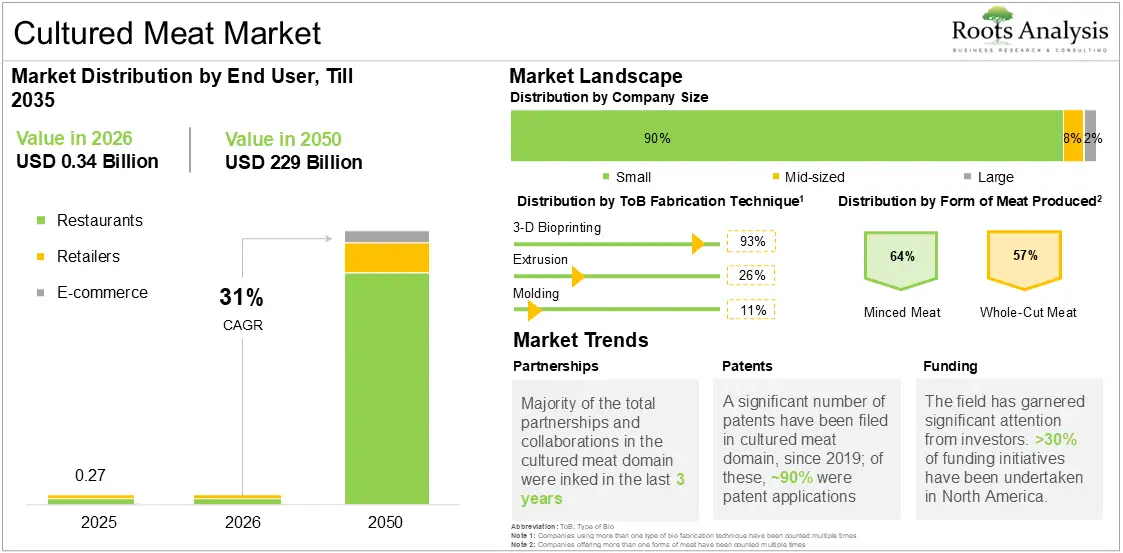
To learn more about this report, request a free sample copy
In recent years, there has been a perpetual rise in the global population. According to recent estimates provided by the United Nations, the world population is projected to reach 9.8 billion by 2050. This demographic trend is accompanied by an increase in demand for food, particularly meat products.
Meat is an important source of macronutrients and micronutrients, such as proteins, fats, carbohydrates, and vitamins which provide the ability to build and repair worn-out tissues as well as fulfill the energy requirements of the body. Given its several benefits, the demand for meat is increasing extensively, which has led to a three-fold increase in industrial meat production. However, the increased demand for meat cannot be solely met by conventional animal farming methods, necessitating the adoption of alternative approaches.
The conventional approach of livestock farming employed to meet the global meat demand poses significant challenges, contributing to adverse environmental consequences such as increased greenhouse gas emissions, water scarcity, and an overburden on land resources, thereby impeding sustainable resource management. It is worth highlighting that currently, approximately three-quarters of agricultural land is estimated to be allocated for animal farming, thus leaving behind only a small portion of land for crop production. Additionally, the raising and culling of animals for food, along with growing the crops necessary to feed those animals, is responsible for nearly 60% of all greenhouse gas emissions from the global food production system. Therefore, in order to mitigate these challenges and cater to the heightened demand for protein amid the rising population, an increased interest in cultured meat production has been observed.
Cultured meat, also known as cultivated meat, has emerged as a promising protein alternative, capitalizing on several benefits associated with its production and consumption over traditional meat, including reduced environmental impact, owing to its minimal land and water requirements. Moreover, there exists a discernible shift in consumer preferences towards alternative protein sources, driving the increasing acceptance and adoption of cultured meat products. Considering this shift, along with the surging demand for alternative proteins and the positive environmental impact of cultured meat production, the global cultured meat market is poised to witness substantial market growth during the forecast period.
| Company | Headquarters | YoE | Product / Ingredient | Market / Regulatory Status |
| Aleph Farms | Israel | 2017 | Cultivated beef steak | Israel regulatory approval |
| GOOD Meat | US | 2020 | Cultivated chicken | Singapore and US approvals |
| Mission Barns | US | 2018 | Cultivated pork fat | FDA "no questions" letter and USDA clearance |
| UPSIDE Foods | US | 2015 | Cultivated chicken | US clearance |
| Vow | Australia | 2019 | Cell-cultured quail | Australia and New Zealand permissions |
| Wildtype | US | 2016 | Cultured salmon cell material | FDA consultation completion |
Abbreviation: YoE: Year of Establishment
Based on our research, we have segmented the Cultured Meat Market into source of meat, type of cultivation technique, form of meat produced, end products offered, application, end user and geographical regions.
By Source of Meat
By Type of Cultivation Technique
By Form of Meat Produced
By End Products Offered
By Application
By End User
By Geographical Regions
Driven by the increasing demand for meat along with the rise in concerns over the adverse environmental effects associated with traditional methods of meat production, the cultured meat domain is expected to grow in the near future.
Josh Tetrick (Founder and Chief Executive Officer, Eat Just and GOOD Meat), stated that, "The US has now been ahead of the curve on it too, the FDA has approved two companies, including ours, and the USDA is actively engaged in this. So, I think sometimes people look at the US and think it's behind the curve, but at least our experience with US regulators has shown that they've been proactive and ahead of the curve on this."
Discussions with multiple stakeholders in this domain influenced the opinions and insights presented in this study. The market report includes transcripts of the following discussions:
In addition, the market report includes transcripts of the following third-party discussions:
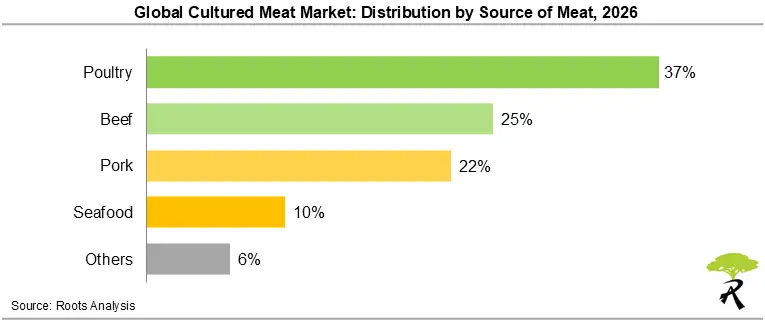
This segment highlights the distribution of market value for cultured meat across various sources of meat, such as beef, pork, poultry, seafood, and others.
Currently, the poultry sub-segment captures close to 40% of the cultured meat market share, driven by its relatively simpler cell culture requirements, lower production costs, and strong consumer acceptance compared to other meat types. The segment has also benefited from early commercialization efforts, favorable regulatory milestones, and significant investments by leading cultivated meat companies focused on chicken products. Cultivated chicken became the first major proof point for the industry, with UPSIDE Foods receiving its first FDA completed pre-market consultation for food made from cultured animal cells. In addition, the global popularity of poultry, coupled with its widespread use across foodservice and retail channels, has encouraged developers to prioritize chicken-based products as the most commercially viable entry point.
In contrast, the seafood segment is expected to register the highest CAGR (~53%) during the forecast period, driven by rising demand for premium seafood products. Moreover, the technical feasibility of cultivating high-value species such as tuna, salmon, and shrimp, is encouraging developers to expand their cultured seafood pipelines. It is worth highlighting that the market opportunity for seafood gained visibility after Wildtype completed FDA consultation for cultured salmon in 2025, with the agency raising no questions about the product's safety conclusions.
Based on the type of cultivation technique, the global market is segmented into scaffold-based, suspension-based, tissue-based and others.
Presently, the scaffold-based cultivation technique is likely to capture the majority of the cultured meat market size. This is owing to its ability to replicate the structural and textural characteristics of conventional meat by supporting three-dimensional cell growth and tissue formation. This technique enables better cell attachment, proliferation, and differentiation, making it particularly suitable for producing whole-cut and premium cultivated meat products. As consumer demand shifts beyond processed formats toward products that closely resemble conventional meat, developers are increasingly adopting scaffold-based platforms.
Moreover, it is worth highlighting that, as per the cultured meat market analysis, the market share for the scaffold-based cultivation technique is likely to grow at a relatively higher CAGR during the forecast period. This is driven by continuous innovation in biomaterials, 3D bioprinting, and tissue engineering technologies that are enhancing production efficiency and product functionality. Moreover, increasing R&D efforts are focused on developing scalable scaffolds that enable uniform cell distribution, efficient nutrient transport, and reduced production costs. For instance, Sallea is developing edible 3D scaffold structures to support highly structured cultivated meat products.
Based on the form of meat, the global market is segmented into minced meat and whole-cut meat.
According to our market analysis, minced meat form occupies the highest market share in the cultured meat market, primarily because it is technically less complex and more cost-effective to manufacture than structured meat products. Products such as burgers, nuggets, meatballs, and sausages require simpler tissue architecture and lower cell density, enabling developers to achieve faster commercialization and production scale. Moreover, several early regulatory approvals and commercial launches have focused on minced meat formats, making them the preferred entry point for cultivated meat companies.
Moreover, the whole-cut meat segment is likely to show the highest growth rate of 51% during the forecast period. This is due to the advances in scaffold technologies that enable the production of complex, structured meat with improved texture and sensory attributes. Growing consumer demand for premium meat products that closely resemble conventional cuts, along with increasing investments in next-generation manufacturing technologies, is accelerating innovation in this segment. For companies, the shift toward whole-cut cultivated meat presents significant opportunities to develop proprietary production platforms and secure intellectual property around scaffold and bioprocess technologies.
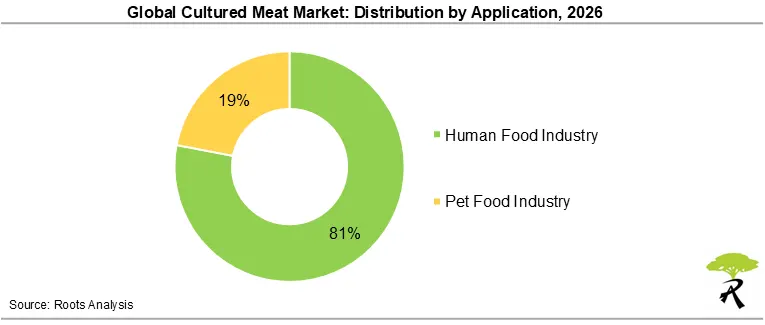
Based on the application, the global market is distributed into human food industry and pet food industry.
Currently, the human food industry occupies the highest (more than 80%) share in the overall market. This is owing to the increasing consumer demand for sustainable protein alternatives, rising environmental and ethical concerns associated with conventional meat production, and the growing commercialization of cultivated meat products for human consumption. Moreover, most industry investments, regulatory approvals, and product development initiatives have historically been directed toward human food applications, supported by collaborations between cultivated meat companies, food manufacturers, and food service providers.
Moreover, it is worth highlighting that, as per cultured meat market analysis, the market share for pet food industry is likely to grow at a relatively higher CAGR during the forecast period. Pet food offers an attractive commercialization pathway for developers, as regulatory requirements and consumer expectations for product appearance and texture are generally less stringent than those for human food. This trend is reflected in recent commercialization initiatives, such as the launch of Coolty Meat by FORZA10 and Bene Meat Technologies, which introduced Europe's first complete cultivated meat-based dog food, highlighting the growing industry focus on cultivated protein for companion animal nutrition. In addition, growing investments in cultivated meat ingredients specifically designed for companion animal nutrition are expanding innovation in this segment.
Pet food applications can use cultured meat as a functional or premium ingredient in treats, toppers, and blended formulations, reducing the need to immediately replicate whole-cut meat texture or achieve price parity with conventional meat. For example, Meatly received regulatory clearance in the UK for cultivated chicken used in pet food; further, in February 2025, it partnered with THE PACK to launch cultivated meat-based treats for dogs through Pets at Home.
In terms of geographical regions, the global market is distributed across North America, Europe, Asia-Pacific, Middle East and North Africa, Latin America, and Rest of the World.
According to our cultured meat market forecast, North America is likely to capture the majority (around 40%) of the cultured meat market share in the current year, and this trend is unlikely to change. This is because the region has been one of the earliest commercialization and investment hubs for cell-cultured food technologies. The US, in particular, benefits from a comparatively defined regulatory pathway, with FDA pre-market consultation process for cultured animal cell foods and joint FDA / USDA-FSIS oversight for livestock and poultry-derived cultured products. This has supported early market validation by companies such as UPSIDE Foods, GOOD Meat, Mission Barns, and Wildtype, which have helped demonstrate commercial feasibility across cultivated chicken, pork fat, and seafood formats.
The market in Asia-Pacific is likely to grow at a high CAGR during the forecast period till 2050. This is primarily because the region is increasingly treating cultured meat as a strategic solution to reduce dependence on meat imports, strengthen protein security, and enhance the resilience and sustainability of regional food systems. In fact, Singapore has established a novel–food approval pathway and authorized sale of Eat Just's cultured chicken following safety review.
Other APAC countries are strengthening their cultured meat ecosystems by establishing supportive regulatory frameworks, expanding food technology innovation clusters, promoting public-private collaborations, and increasing targeted R&D investments. For instance, South Korea launched a Gyeongbuk Regulatory–Free Special Zone, Japan is developing a dedicated cultivated–product framework and China has incorporated cultivated meat into its five–year agricultural innovation plan.
| Key Report Attribute | Details | |
| Historical Trend | Since 2020 | |
| Forecast Period | Till 2050 | |
| Market Size 2026 | $0.34 Billion | |
| Market Size 2050 | $229 Billion | |
| CAGR (Till 2050) | 31% | |
| Segments Covered |
|
|
| Key Players |
|
|
| PowerPoint Presentation (Complimentary) |
Available | |
| Customization Scope | 15% Free Customization | |
| Excel Data Packs (Complimentary) |
Available | |