
Lowest Price Guaranteed
Slides
202
Last Updated
August 2026
View Count
12574
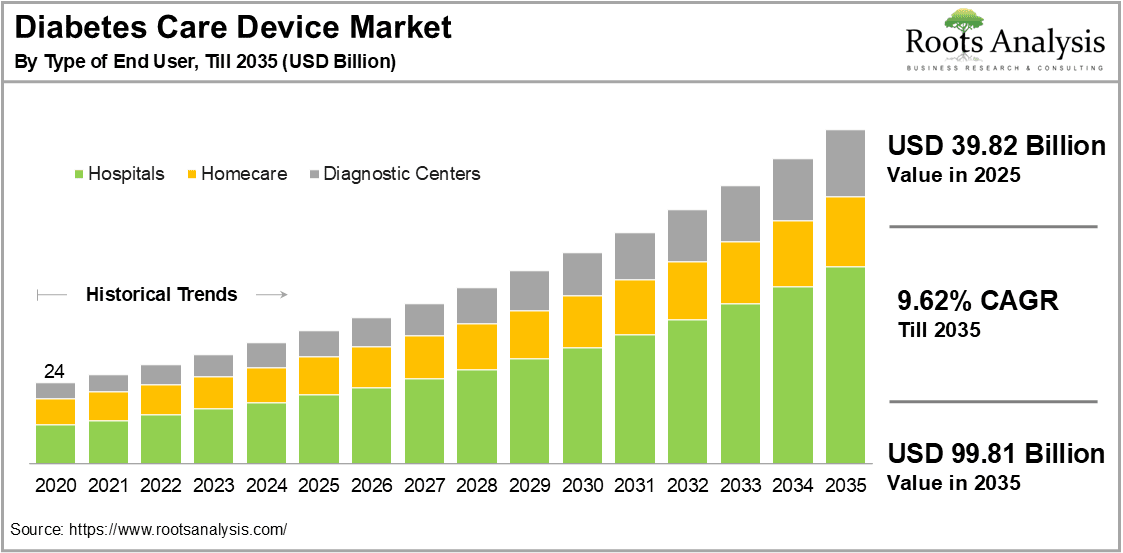
The diabetes care devices market size is projected to grow from USD 39.82 billion in 2025 to USD 99.81 billion by 2035, representing a CAGR of 9.62% during the forecast period till 2035.
 |
To learn more about this report, request a free sample copy
The new research study consists of diabetes care devices market and trends analysis, detailed market forecast analysis, and provide actionable strategic recommendations.
Over the course of decades, the diabetes care device market has reached new heights of expansion driven by the growing number of diabetic patients worldwide. According to a report, approximately 800 million people have diabetes around the world. Diabetes rates in adults doubled from about 7% to 14% between 1990 to 2022. It is interesting to note that countries with low and middle income have the largest rise in diabetes cases, generating ample opportunities for the diabetes care device market growth.
A diabetes device is a medical equipment that is designed to help people with diabetes monitor, manage, and treat their blood glucose levels effectively. The benefits of diabetes care devices in improving diabetes management, preventing complications, and enhancing quality of life have widened the market scope. The impact of diabetes prevalence significantly influences the diabetes device market by increasing demand for monitoring devices and innovation in insulin delivery.
Ongoing innovation in insulin delivery, such as smart insulin pumps, automated insulin delivery systems, and connected insulin pens integrating with AI, IoT, and real-time glucose monitoring for better diabetic management is amplifying the potential growth of the market. As an effect, biotech firms and emerging startup companies are increasingly investing in the industry to leverage this lucrative opportunity. For instance, in October 2024, Glooko, a diabetes software company secured $100 million in funding to expand the diabetes management systems. Through this funding coupled with North America, the company aims to expand in the Middle East and Asia. Moreover, the future of the diabetes device industry with the growing trend of diabetes management apps integrated with AI and cloud-based solutions is promising and expected to boost the market growth during this forecast period.
The diabetes care devices market report presents an in-depth analysis of the various companies that are involved in offering diabetes care devices, across different segments, as defined in the table below:
| Key Report Attributes | Details | |
| Historical Trend | Since 2020 | |
| Forecast Period | Till 2035 | |
| Current Market Size | $ 39.82 Billion | |
| Market Size Value by 2035 | $ 99.81 Billion | |
| CAGR (Till 2035) | 9.62% | |
| Type of Product |
|
|
| Type of Distribution Channel |
|
|
| Type of End User |
|
|
| Geographical Regions |
|
|
| Leading Market Players | ||
| PowerPoint Presentation (Complimentary) |
Available | |
| Customization Scope | 15% Free Customization | |
| Excel Data Packs (Complimentary) |
|
|
The global diabetes care devices market features a diverse range of products wherein the insulin device is expected to continue to hold the maximum (~49%) of the market share by 20235. Smart Insulin Pens bring connectivity to pen-based delivery by recording dose information and supporting data-informed diabetes management. Insulin devices play a critical role in diabetes management with smart insulin pumps and pens due to their ability to automate insulin dosing and improve convenience for patients.
While the continuous glucose monitoring systems segment is emerging rapidly in the market and is anticipated to experience a faster (11.44%) CAGR over this projection period. The significant feature of real-time glucose tracking and better diabetes management is ascribed to the growth of the continuous glucose monitoring segment. Apart from this, blood glucose monitoring systems are gaining popularity, elevating the market demand driven by the growing demand for self-monitoring devices.
Based on the distribution channel, the hospital pharmacies are poised to maintain their dominance by capturing (~50%) of the current market share till the forecast period. The major factor of this dominance is the high patient footfall in hospitals and clinics. Hospital pharmacies have direct supplies from manufacturers which ensure the authenticity, safety, and regulatory compliance of the devices. Also, healthcare professionals in hospitals guide patients on the proper use of diabetes care devices, solidifying the segment’s growth.
Furthermore, retail pharmacies are gaining traction in the industry and are expected to grow at a noteworthy CAGR of (14.58%) during this forecast period. The surge in the demand for homecare diabetes devices is fostering the growth of retail pharmacies for self-monitoring blood glucose devices, insulin pens, and strips. Additionally, the growing popularity of online pharmacies, particularly quick commerce due to convenience and home delivery segment supporting the market progress.
The distribution of the market based on the type of end-user is split into diagnostic centers, home care, and hospitals. As per this diabetes care device growth forecast report, the hospital sub-segment is driving the market growth with the largest (~49%) of the current market share. This trend is expected to continue in the future as well due to high patient volume and advanced treatment facilities. Hospitals require continuous glucose monitors, insulin pumps, and advanced diagnostic tools for precise monitoring. Hence, the augmenting demand for diabetes care in hospitals will spur market expansion.
Additionally, the home care setting is emerging as the fastest-growing segment and fueling the adoption of self-monitoring blood glucose devices and smart insulin pens. Resulted in, the homecare segment is predicted to rise at the fastest (12.74%) CAGR throughout this forecast period.
This segment highlights the distribution of the diabetes care devices market across various geographical regions, such as North America, Europe, Asia, Latin America, the Middle East and North Africa, and the rest of the world. In respect of revenue generation, North America is projected to lead the global market for diabetes care devices with (~48%) share during this projection period. Furthermore, the diabetes devices market size in Asia expanding remarkably and is likely to witness an unprecedented (15.23%) growth rate in the upcoming years driven by the increasing cases of diabetes in the region.
According to a report, China and India had the world’s largest diabetic populations with 140.9 million and 74.2 million consecutively in 2021. This number is expected to rise and, thus, will likely generate extensive demand for diabetes care device market growth. Along with this, the expanding healthcare infrastructure, government spending, and initiated healthcare programs by companies are attributed to the market development. For instance, in November 2024, Fitterfly Healthcare teamed up with Ascensia Diabetes Care and introduced a complimentary 21-day Diabetes Management Program for Ascensia’s glucometer users. The goal of this program was to make diabetes care simpler and more effective for people by offering them personalized support.
The “Diabetes Care Devices Market, Till-2035: Industry Trends and Global Forecasts" report features an extensive study of the current market landscape, market size and future opportunities within the diabetes care devices market, during the given forecast period. The market report highlights the efforts of several stakeholders involved in this rapidly emerging segment of the service providers industry. Key takeaways of the diabetes care devices market report are briefly discussed below.
Among numerous key drivers, the rising prevalence of diabetes cases is one of the primary factors to foster the growth of the diabetes device market. Worldwide, the number of patients with type 1 and type 2 diabetes is growing rapidly owing to the sedentary lifestyle, aging population, and obesity. Therefore, this spike in the number of diabetic patients is expected to continue to propel the demand for monitoring and treatment devices, boosting market growth. Also, the development of continuous glucose monitors, automated insulin delivery devices, and smart insulin pens integrated with AI and IoT solutions is broadening the market outlook. Moreover, the increasing geriatric population and rising adoption of wearable & digital health solutions are further anticipated to broaden the market prospects.
Currently, several global giants and small regional players including Medtronic, Abbott, Dexcom, Roche Diabetes Care, Tandem Diabetes Care, and many more are operating in the market and leading the industry with significant market share. These companies dominate the market through their competitive strategies, such as production innovation, global expansion in emerging markets, strategic partnerships and acquisitions to expand their product portfolio. Moreover, small regional players are striving for technological advancements and investing in integrated technologies to beat the market competition.
Among the numerous constraining factors, regulatory hurdles in the diabetes care device market are one of the key challenges that may obstruct potential market growth. Strict approval processes from regulatory agencies, such as the Food and Drug Administration and European Medica Device Regulation ensure that diabetes care devices meet high safety and efficiency standards before they reach the market. Therefore, adhering to strict guidelines on device accuracy reliability, cybersecurity, and patient safety can increase development costs and become mandatory and raising development costs can be a challenge for the operating companies in the market.
North America is expected to be the prominent market for diabetes care devices with an expected (~48%) acquisition of the global market share during this forecast period. The high prevalence of diabetes is the leading factor contributing to this market growth. The increasing number of patients with type 1 and type 2 diabetes due to obesity and the growing geriatric population fueling the demand for glucose monitoring devices. In addition, growing awareness & early diagnosis along with technological advancement in the healthcare sector is also attributed to the market dominance. Several established companies based in North America are driving innovation and in devices such as blood glucose monitoring services, automated insulin delivery systems, and following trends in diabetes management. For instance, in November 2024, Validic integrated data from Abbot’s FreeStyle Libre into Epic and Oracle Health EHR systems to enhance diabetes management by streamlining access to personal health data for healthcare providers.
Examples of key players involved in the market for diabetes care devices (which have also been captured in this market report, arranged in alphabetical order) include Medtronic (Ireland), Abbott (US), F. Hoffmann-La Roche (Switzerland), Bayer (Germany), LifeScan (US), B. Braun Melsungen (Germany), Dexcom (US), Insulet (US), Ypsomed Holding (Switzerland), Companion Medical (US), Sanofi (France), Valeritas Holding (US), Novo Nordisk (Denmark), Arkray (Japan), Terumo (Japan), and Sinocare (China). This market report includes an easily searchable excel database of all the companies who have adopted the diabetes care devices market.
The market report presents an in-depth analysis, highlighting the capabilities of various companies engaged in this domain, across different segments. Amongst other elements, the market report includes: