
Lowest Price Guaranteed
Pages
324
Last Updated
September 2026
View Count
14360
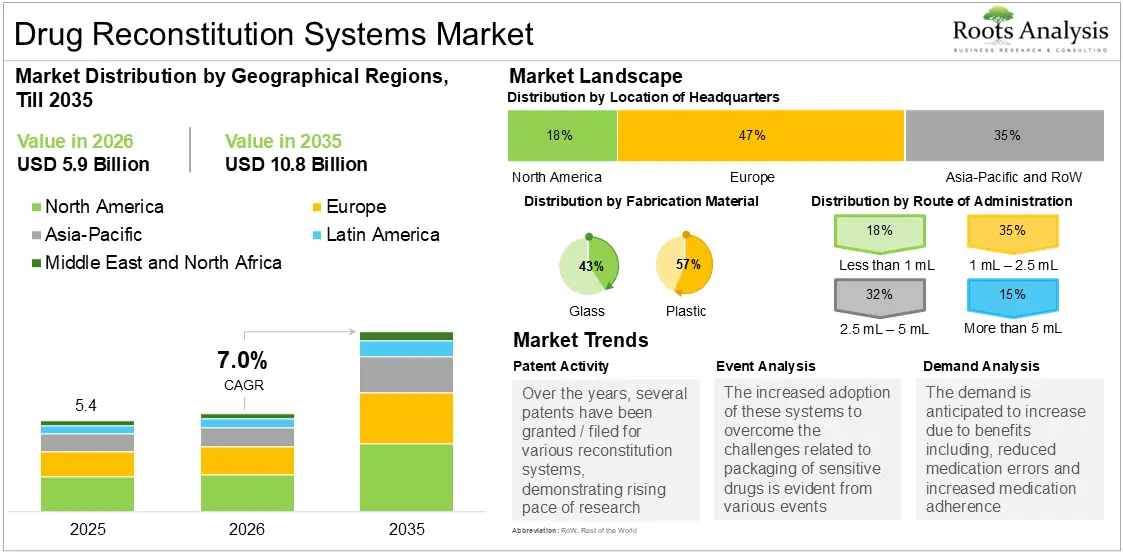
The global drug reconstitution systems market, valued at USD 5.4 billion in 2025, is projected to reach USD 5.9 billion in 2026 and USD 10.8 billion by 2035, representing a CAGR of 7.0% during the forecast period 2026 to 2035.
To learn more about this report, request a free sample copy
Over the last few years, numerous biologics and small molecule APIs have made their way to the market. Most of these biologic products are not stable as liquid formulations and tend to lose efficacy with alterations in their pharmacokinetic and pharmacodynamic properties. This makes it difficult to preserve them for a longer period of time.
In order to achieve a longer shelf life, lyophilization has emerged as the preferred choice for making dry biopharmaceutical formulations. In fact, around 30% of the FDA-approved parenteral drugs are in lyophilized form. The increased adoption of such drugs has led to the rise in demand for reconstitution systems that allow proper mixing of lyophilized drugs with the diluent and administration of the required dose.
The traditional reconstitution methods involve manual extraction and transfer of diluent into the vials containing the lyophilized product, using a syringe and transfer needle. Given the large number of steps involved and multiple containers, this method is associated with the risk of medication errors and injuries due to needles. In addition, the complexity of conventional reconstitution systems limits the administration of lyophilized drugs primarily to healthcare professionals within clinical and healthcare facility settings.
The existing challenges in the conventional reconstitution method have prompted the pharmaceutical industry to develop advanced reconstitution devices, which allow the patients and caregivers to administer drugs without healthcare provider’s intervention. These systems contain a premeasured dose of drug and diluent, which essentially reduces the chances of dosing errors and needle-stick injuries.
Moreover, these advanced systems enhance the portability, efficiency and optimum delivery of the lyophilized drugs and have the potential to reduce the number of steps significantly, which enables the dilution and reconstitution at the time of delivery. Owing to their multiple benefits, various pharmaceutical companies are considering these systems for lifecycle management of their drugs in order to enhance the provision of healthcare.
Based on the research, we have segmented the Drug Reconstitution Systems Market into type of reconstitution system, fabrication material, physical state of drug in syringe and cartridge, physical state of drug in infusion bag, volume in syringe and cartridge, volume in infusion bag and geographical regions.
By Type of Reconstitution System
By Fabrication Material
By Physical State of Drug in Syringe and Cartridge
By Physical State of Drug in Infusion Bag
By Volume in Syringe and Cartridge
By Volume in Infusion Bag
By Geographical Regions
Recently, a growing shift towards dual-chamber and multi-chamber reconstitution systems has been observed in this domain. This shift is driven by the increasing demand for safer, more convenient, and user-friendly drug delivery solutions. These systems enable the separate storage of drug components until the point of administration, thereby improving product stability and shelf life while reducing preparation complexity. By integrating the reconstitution process within a single device, dual- and multi-chamber systems minimize handling steps, lower the risk of contamination and dosing errors, and enhance patient and healthcare provider convenience. Their increasing adoption for biologics, vaccines, and other complex injectable therapies is expected to support continued market growth.
Driven by the expanding applications of biologics and biosimilars across lyophilized formulations, home-based therapy transitions, oncology and chronic disease treatments, and the critical need to eliminate medication errors during manual reconstitution, the market is poised to grow significantly in the near future.
Laxman Halleppanavar (Head of Portfolio Strategy and Management, Credence MedSystems), stated that, “One of the major barriers is that historical dual-chamber systems have not had the usability or the inherent safety to allow easy and proper administration of these medicines that require mixing at the time of use. The conventional approaches required a full autoinjector device around the primary package to allow use, and the number and complexity of use steps was still onerous.”
Discussions with multiple stakeholders in this domain influenced the opinions and insights presented in this study. The market report includes transcripts of the following third-party discussions:
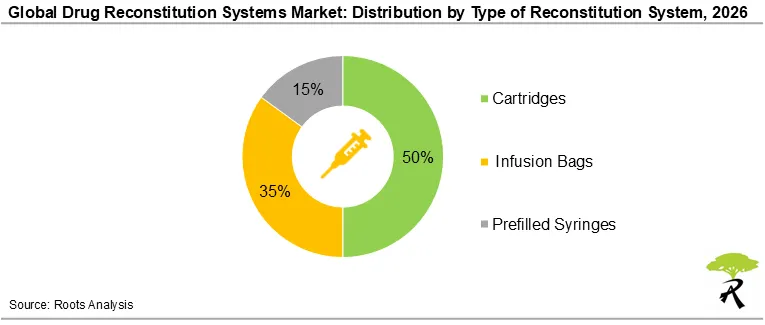
This segment highlights the distribution of market value for drug reconstitution systems across various types of reconstitution systems, such as cartridges, infusion bags and prefilled syringes.
Currently, cartridges hold the largest share of the global market due to their widespread use in combination drug-device products, autoinjectors, pen injectors, and other advanced delivery systems. These systems offer a closed and integrated format that enhances dosing accuracy and reduces the risk of contamination. Further, cartridges are particularly well-suited for biologics, vaccines, and other sensitive therapeutics that require precise reconstitution prior to administration. Their compatibility with self-administration devices, improved product stability, and ability to support convenience have contributed significantly to their adoption across various therapeutic areas.
Further, the prefilled syringe segment is expected to grow at a significant pace during the forecast period, owing to the increasing demand for ready-to-use, convenient, and error-free drug administration systems. Moreover, prefilled syringes reduce preparation time of reconstitution systems and minimize dosing inaccuracies due to lower risk of medication contamination when compared to conventional vial-and-syringe methods. The advancements in syringe design, increasing use of biologics and specialty drugs, and the pharmaceutical industry's focus on improving patient adherence and healthcare efficiency are expected to accelerate the adoption of prefilled syringe-based drug reconstitution systems during the forecast period.
global-drug-reconstitution-systems-market-share-by-type-of-reconstitution-system-2026
This segment highlights the distribution of market value for drug reconstitution systems across various fabrication materials, such as glass and plastic.
Currently, the glass subsegment captures the majority of the drug reconstitution system market share. This is because of its excellent chemical stability, superior barrier properties, and long-established use in pharmaceutical packaging and drug delivery systems. Further, glass containers are highly resistant to interactions with drug formulations, helping preserve the safety, efficacy, and stability of sensitive therapeutics, including biologics, vaccines, and lyophilized drugs. Their transparency allows for easy visual inspection of drug products, while their proven compatibility with stringent regulatory requirements has made them the preferred material for cartridges, vials, ampoules, and prefilled syringes.
Notably, the plastic subsegment is expected to grow at a significant pace during the forecast period due to the advancements in medical-grade polymer technologies and the increasing demand for lightweight, durable, and cost-effective drug delivery solutions. Plastic components also offer greater design flexibility, improved resistance to breakage, and enhanced suitability for patient-friendly drug delivery devices.
This segment highlights the distribution of market value for drug reconstitution systems across various physical states of drugs in syringes and cartridges, such as liquids / powders and liquids / liquids.
Currently, the liquid / powder form holds the largest share of the drug reconstitution systems market because it is widely used for biologics, vaccines, antibiotics, and other injectable therapies that exhibit limited stability in fully liquid form. In these systems, the active pharmaceutical ingredient is stored as a lyophilized powder and mixed with a liquid diluent immediately before administration, helping preserve drug potency, extend shelf life, and maintain product integrity during storage and transportation. This format is particularly valuable for temperature-sensitive and complex biologic formulations, making it a preferred choice among pharmaceutical manufacturers and healthcare providers. Furthermore, the extensive use of lyophilized drugs across multiple therapeutic areas and the need for reliable, safe, and effective reconstitution solutions have contributed to the segment's dominant market position.
The liquid / powder segment is expected to grow at a significant pace during the forecast period due to the increasing development and commercialization of therapies that require enhanced stability. As pharmaceutical companies continue to expand their pipelines of complex molecules, the demand for reconstitution systems capable of maintaining drug efficacy until the point of administration is expected to rise. The growing prevalence of chronic diseases, increasing adoption of self-administered injectable therapies, and rising focus on patient-centric drug delivery solutions are further expected to drive substantial growth of the liquid / powder segment over the forecast period.
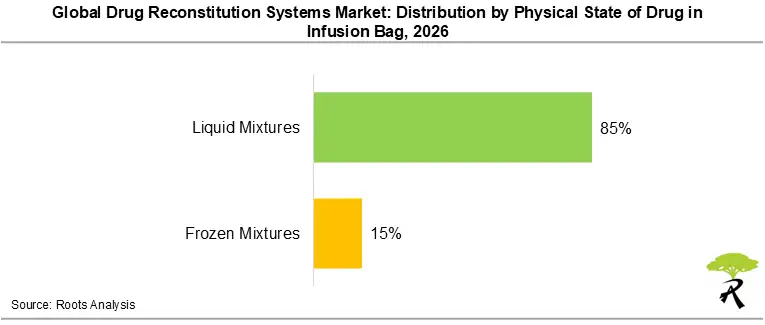
This segment highlights the distribution of market value for drug reconstitution systems across various physical states of drug in infusion bags, such as liquid mixtures and frozen mixtures.
Liquid mixture formulations hold the largest share of the drug reconstitution systems market because a significant proportion of intravenous therapies are ultimately administered as liquid admixtures in infusion bags. These formulations offer immediate readiness for administration, reducing preparation time and minimizing the risk of dosing errors in clinical settings. Hospitals and infusion centers widely prefer liquid mixtures due to their ease of handling, compatibility with infusion systems, and ability to support efficient drug delivery workflows. Additionally, many antibiotics, oncology drugs, biologics, and supportive care medications are supplied or prepared as liquid admixtures for intravenous administration, contributing to the segment's substantial market share.
The liquid mixture segment is expected to grow at a significant pace during the forecast period due to the increasing demand for ready-to-administer and ready-to-use infusion products that enhance operational efficiency and patient safety. Healthcare providers are increasingly adopting pre-prepared liquid formulations to reduce compounding requirements, lower the risk of medication preparation errors, and improve workflow efficiency. Furthermore, growth in outpatient infusion services, home infusion therapies, and advances in infusion bag technologies that improve drug stability and storage are also expected to support the rapid expansion of the liquid mixture segment during the forecast period.
This segment highlights the distribution of market value for drug reconstitution systems across various volumes in syringes and cartridges, such as <1 mL, 1 - 2.5 mL, 2.5 - 5 mL and >5 mL.
The 1 – 2.5 mL container volume segment holds the largest share of the drug reconstitution systems market because this volume range aligns with the dosing requirements of a wide variety of injectable drugs delivered through syringes and cartridges. Further, many biologics, vaccines, and specialty pharmaceuticals are formulated for administration in relatively small volumes, making 1 – 2.5 mL containers the preferred choice for ensuring accurate dosing, while minimizing the drug wastage, and enhancing patient comfort during injection. In addition, this volume range is highly compatible with prefilled syringes, dual-chamber syringes, cartridges, autoinjectors, and pen injector systems, which are increasingly used across healthcare settings.
The 2.5 – 5 mL container volume segment is expected to grow at a significant pace during the forecast period, owing to the increasing use of biologics, biosimilars, and specialty injectable therapies that require larger reconstitution volumes or higher drug doses. As pharmaceutical manufacturers continue to develop complex formulations with greater dosing requirements, demand for syringes and cartridges within the 2.5–5 mL range is expected to increase. This volume category also offers greater flexibility for combination therapies and high-concentration formulations while maintaining ease of administration. Furthermore, advancements in drug delivery technologies, growing adoption of wearable injectors and large-volume injection systems, and the expanding use of injectable therapies in oncology, immunology, and rare diseases are anticipated to drive significant growth in the 2.5–5 mL segment over the forecast period.
This segment highlights the distribution of market value for drug reconstitution systems across various volume in infusion bags, such as <250 mL, 250 - 500 mL, 500 - 1000 mL and >1000 mL.
Currently, the 500–1000 mL segment holds the largest share of the market because this volume range is widely used for intravenous fluid therapy, parenteral nutrition, electrolyte replacement, and the administration of numerous reconstituted drugs in hospital settings. Infusion bags within this capacity provide sufficient volume for proper drug dilution, controlled infusion rates, and extended administration periods, making them suitable for a broad range of therapeutic applications. Furthermore, the widespread use of 500 mL - 1000 mL infusion bags as standard hospital formats, combined with their compatibility with a variety of injectable medications and reconstituted formulations, has contributed significantly to the segment's dominant market position.
The >1000 mL infusion bag segment is expected to grow at a significant pace during the forecast period owing to the increasing demand for high-volume infusion therapies in critical care, long-duration treatments, and specialized clinical applications. Growing utilization of large-volume parenteral solutions for hydration, nutritional support, renal therapies, and complex drug administration regimens is driving demand for infusion bags exceeding 1000 mL. In addition, the rising prevalence of chronic diseases, increasing number of critically ill patients, and expanding healthcare infrastructure are supporting greater adoption of large-capacity infusion systems.
According to our projections, North America is likely to capture the majority of the drug reconstitution systems market share in 2026. This can be attributed to its well-established healthcare infrastructure, high adoption of advanced drug delivery technologies, and strong presence of leading pharmaceutical and biotechnology companies. Further, the region has witnessed significant growth in the use of biologics, specialty injectables, vaccines, and personalized medicines, many of which require reconstitution prior to administration. Moreover, favorable reimbursement policies, substantial healthcare spending, and ongoing investments in pharmaceutical research and development have further reinforced North America's dominant position in the market.
The market in Asia-Pacific is likely to grow at the highest CAGR during the forecast period. This is due to expanding healthcare infrastructure, rising healthcare expenditure, and increasing demand for advanced injectable therapies across countries such as China, India, Japan, and South Korea. Further, increasing investments by pharmaceutical manufacturers, rising adoption of self-administration devices, improving access to healthcare services, and supportive government initiatives aimed at strengthening healthcare systems are expected to accelerate market growth. The expanding biopharmaceutical industry and growing awareness regarding safe and efficient drug administration practices are also anticipated to contribute to the rapid expansion of the Asia-Pacific market during the forecast period.
| Key Report Attribute | Details | |
| Historical Trend | Since 2021 | |
| Forecast Period | Till 2035 | |
| Market Size 2026 | $ 5.9 Billion | |
| Market Size 2035 | $ 10.8 Billion | |
| CAGR (Till 2035) | 7.0% | |
| Segments Covered |
|
|
| Key Companies Profiled |
|
|
| PowerPoint Presentation (Complimentary) |
Available | |
| Customization Scope | 15% Free Customization | |
| Excel Data Packs (Complimentary) |
Available | |