
Lowest Price Guaranteed
Pages
203
Last Updated
February 2026
View Count
12550
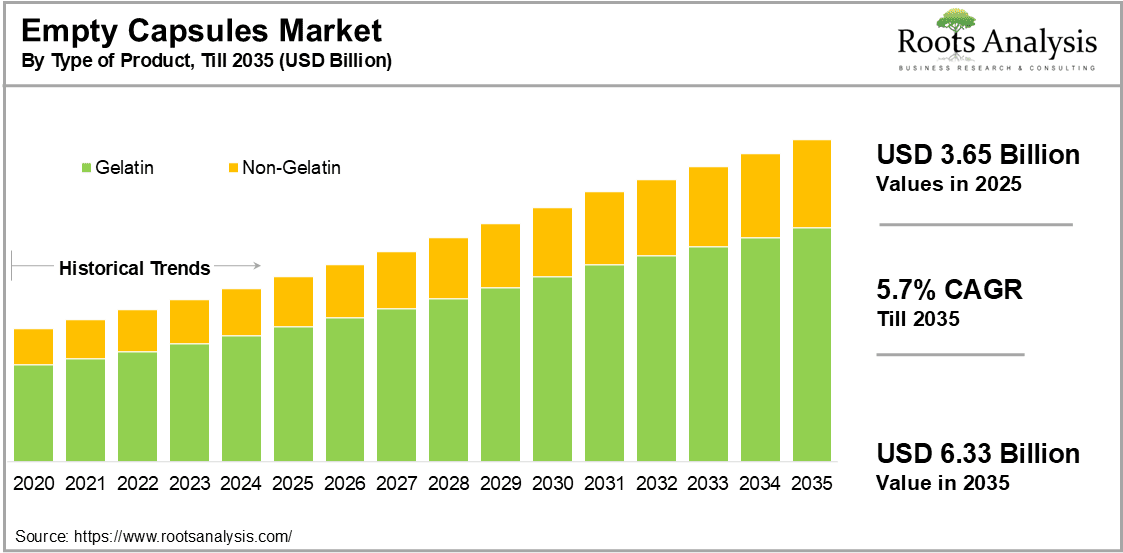
The global empty capsules market, valued at USD 3.41 billion in 2024, is projected to reach USD 3.65 billion in 2025 and USD 6.33 billion by 2035, representing a CAGR of 5.7% during the forecast period.
 |
Empty capsule is a cylindrical structure consisting of cap and body designed to fill the medicinal formulation for easy patient consumption. These capsules are made with pharmaceutical-grade or food grade material for quicker dissolution. Moreover, these empty capsules can be custom designed to enhance bioavailability of active ingredients and drug absorption.
Currently, capsules are the most preferred solution for medicinal drug consumption owing to faster absorption, quick disintegration and tastelessness. Notably, patients with chronic conditions require regular medication which further enhances the demand for capsule-based drug formulation for easy consumption. In addition to medicinal drug, empty capsules are currently gaining traction in food supplements and cosmeceutical industry as they are slightly more effective than tablets and allow delivery of solid and liquid drug dosage efficiently.
Driven by the growing demand, several market players are focusing on the development of empty capsules with higher bioavailability and instant dissolving capabilities. Furthermore, the emergence of advanced non-gelatin material, such as hydroxypropyl methylcellulose (HPMC), pullulan and hydroxypropyl starch has further gained the attention of industrial players.
For instance, in December 2024, Lonza announced capacity expansion including hard gelatin capsule lines at its sites in Rewari (India) and Suzhou (China) to support the manufacturing of high-quality hard gelatin capsules including specialized capsules for nutraceuticals and pharmaceutical industries. Owing to the increasing demand and consistent initiatives to expand the manufacturing of capsules, we believe empty capsules market will continue to expand at a steady rate during the forecast period.
The market report provides comprehensive information on empty capsule manufacturers who are currently active across various segments of the industry as mentioned in the table below.
| Key Report Attributes | Details | |
| Historical Trend | Since 2021 | |
| Forecast Period | Till 2035 | |
| Market Size 2025 | $8.98 Billion | |
| Market Size 2035 | $17.49 Billion | |
| CAGR (Till 2035) | 6.9% | |
| Type of Product |
|
|
| Type of Functionality |
|
|
| Type of Therapeutic Application |
|
|
| Type of Capsule Size |
|
|
| Type of Raw Material |
|
|
| End User |
|
|
| Geographical Regions |
|
|
| Key Companies Profiled |
|
|
| PowerPoint Presentation (Complimentary) |
Available | |
| Customization Scope | 10% Free Customization | |
| Excel Data Packs (Complimentary) |
Available |
|
One of the key objectives of the empty capsules market report was to estimate the current size, opportunity and the market growth potential, over the forecast period, till 2035. We have provided informed estimates on the likely evolution of the market for the forecast period.
The global report also features the likely distribution of the current and forecasted opportunity within the market across various segments, such type of product (gelatin (pig meat gelatin, bovine derived, bone meal, and other gelatin capsule products) and non-gelatin (hydroxypropyl methylcellulose (HPMC), pullulan and starch material)), type of functionality (immediate release, sustained release, and delayed release), type of therapeutic application (antibiotic and antibacterial drugs, vitamins and dietary supplements, antacid and antiflatulent preparations, antianemic preparations (hematinic preparations), anti-inflammatory drugs, cardiovascular therapy drugs, cough and cold preparations and other therapeutic applications), type of capsule size (size "000" empty capsules, size "00" empty capsules, size "0" empty capsules, size "1" empty capsules, size "2" empty capsules, size "3" empty capsules, size "4" empty capsules and size "5" empty capsules), type of raw material (pig meat, bovine-derived, plant, starch-based, pullulan, hydroxypropyl methylcellulose (HPMC), and others), end-user (pharmaceutical, nutraceutical, cosmeceutical, research laboratories and other end users), geographical region (North America, Europe, Asia-Pacific, Middle East and North Africa, and Latin America) and leading players.
In order to account for future uncertainties associated with some of the key parameters and to add robustness to our model, we have provided three market forecast scenarios, namely conservative, base, and optimistic scenarios, representing different tracks of industry’s evolution.
All actual figures have been sourced and analyzed from publicly available information forums and primary research discussions. The financial figures mentioned in this market report are in USD, unless otherwise specified.
Based on the type of product, the global market is segmented into gelatin (pig meat gelatin, bovine derived, bone meal, plant-based gelatin capsules, and other gelatin capsule products) and non-gelatin (hydroxypropyl methylcellulose (HPMC), pullulan and starch material). Currently, gelatin segment is dominating the market by holding 73% empty capsules market share.
This can be attributed to the fact that gelatin is gluten-free, tasteless and a form of pure protein which does not cause any allergic reaction. Moreover, it can easily tailor into different shapes and sizes to meet the requirement of individual patients. It is important to highlight here that non-gelatin segment is likely to grow at a higher CAGR during the forecast period. This is primarily due to the growing preferences for non-animal source products such as cellulose and pullulan.
On the basis of functionality, the global market is segmented into immediate release, sustained release and delayed release. Among these, presently, the immediate release segment holds the highest empty capsules market share (56%) of the market. This can be attributed to the increasing demand for immediate release capsules for the preparation of drugs such as antibiotics, antimicrobial drugs and antacids.
However, in the long run, sustained and delayed released segments are likely to grow at a higher CAGR during the forecast period. This lucrative growth is likely to be the result of increasing patient compliance due to enhanced therapeutic efficacy and controlled drug release. Moreover, stable release of the drugs from sustained and delayed release capsules reduces the requirement of frequent dosing, which further enhance patient adherence.
The global market is bifurcated on the basis of therapeutic application into antibiotic and antibacterial drugs, vitamins and dietary supplements, antacid and antiflatulent preparations, antianemic preparations (hematinic preparations), anti-inflammatory drugs, cardiovascular therapy drugs, cough and cold preparations and other therapeutic applications. According to our empty capsules market forecast, currently, antibiotic and antibacterial drugs accounts for the highest share (30%) of the market. This can be attributed to the increasing demand for antibiotic and antibacterial drugs to treat infectious diseases such as gastrointestinal infections and tuberculosis. Capsules are easy to consume and have faster dissolution rate which makes it a preferred choice for drug consumption.
However, it is worth mentioning here that vitamins and dietary supplements segment is likely to register a faster CAGR during the forecast period. This is likely to be the result of increasing demand for dietary supplements (including probiotics) to improve overall health and growing awareness about healthy lifestyle.
Based on the type of capsule size, the global market is segmented into size "000" empty capsules, size "00" empty capsules, size "0" empty capsules, size "1" empty capsules, size "2" empty capsules, size "3" empty capsules, size "4" empty capsules and size "5" empty capsules. According to our empty capsules market analysis, size “0” empty capsules segment is dominating the market with a share of nearly 25%. This can be attributed to the size “0” capsule size is ideal for pharmaceutical drugs. Moreover, it is easy to swallow and hold sufficient amount of drugs dosage which further make it suitable for side range of therapeutic drugs.
However, in the long run, size “00” and size “000” empty capsules segments are gaining traction at a higher CAGR during the forecast period. Size “00” and size “000” empty capsules can accommodate large doses of drugs, which makes it ideal for dietary supplements and nutraceuticals.
Based on the raw material, the global empty capsules market is distributed into pig meat, bovine-derived, plant, starch-based, pullulan, hydroxypropyl methylcellulose (HPMC), and others. According to our market report, currently pig-meat segment accounts for the highest share (30%) of the market. This can be attributed to the exceptional availability and quality of gelatin extracted from the pig-meat, such as quick dissolving and efficient task masking capabilities.
However, in the long run, plant-based, hydroxypropyl methylcellulose segments are likely to grow at a higher CAGR during the forecast period. This is likely to be the growing ethical concerns and consumer preferences for non-animal derived gelatin-based products.
The global market is categorized based on the end user into pharmaceutical, nutraceutical, cosmeceutical, research laboratories and other end users. According to our empty capsules market analysis, presently the pharmaceutical empty capsules market segment accounts for the largest market share (45%). This can be attributed to the growing prevalence of chronic diseases and infectious diseases that necessitated the demand for immediate release capsules. Moreover, pharmaceutical companies are also focusing on the manufacturing of capsules with higher dissolution properties so active ingredients within drug formulation can quickly dissolve into the blood stream for higher effect.
Contrastingly, the nutraceuticals segment is anticipated to register a higher CAGR during the forecast period. This is primarily due to the rising adoption of nutraceuticals for managing chronic conditions and fitness.
Currently, North America dominates the global empty capsules market with a share of 36%. The growing prevalence of chronic conditions, such as diabetes and obesity in this region has necessitated the demand for advanced capsule-based drug formulations. Additionally, the increasing demand for dietary supplements to maintain good health has further contributed to the highest share of the market in this region.
In Asia-Pacific, the market for empty capsules is likely to grow at a higher CAGR during the forecast period. This is likely to be the result of increasing government initiatives to develop advances drug formulation with higher bioavailability and quick dissolution properties.
The “Empty Capsules Market: Industry Trends and Global Forecasts, till 2035” market report features an extensive study of the current market landscape, market size, market share, market growth, market trends, market value, market forecast, market outlook, statistics and future opportunities for empty capsule manufacturers. Key takeaways of the market report are briefly discussed below.
Currently, the empty capsules industry is highly competitive, witnessing the presence of several well-established and new entrants which required expertise. These industrial players are focusing on the introduction of immediate real capsules, advanced coating-based capsules and titanium dioxide-free capsule products.
In order to leverage competitive edge, several industrial players are focusing on expanding their manufacturing capabilities and launching new products. For instance, in January 2025, ACG (a leading supplier of integrated manufacturing solutions for nutraceutical and pharmaceutical companies) announced the expanding of capsule manufacturing facility in Rayong, Thailand. In this newly launched capsule manufacturing facility, the company will focus on the manufacturing of empty hard gelatin capsules.
As more market players continue to expand their foothold in this industry to meet with growing demand, we believe that the empty capsules market will remain competitive during the forecast period.
Some of the potential drivers that are propelling the market include the rising prevalence of chronic diseases across the globe and shift towards dietary supplements to maintain good health. It is worth mentioning here that geriatric population with chronic conditions require frequent dosing to manage disease condition.
Their inability to consume tablets due to bad aftertaste of medicine and swallowing difficulties has necessitated the demand for immediate release capsules that are easy to swallow and release drug quickly for maximum effect. In addition, the rising focus on overall health has increased the demand for dietary supplements which further underscored the requirement for empty capsules.
Despite high demand, the market for empty capsules is witnessing several challenges that need to be addressed. Some of the notable challenges in the market include complex regulatory guidelines associated with the approval of capsule material and ethical concerns.
It is important to highlight here that the pharmaceutical industry is highly regulated, and capsule manufacturers are required to adhere with stringent guidelines to ensure safety and efficacy of capsule consumptions. Moreover, competition from evolving drug delivery systems, such as oral disintegrating tablets and microencapsulation for oral solid dosage manufacturing are limiting the adoption of empty capsules.
Some of the potential trends in the market include growing preferences for non-gelatin / vegetarian / vegan capsules and rising focus on specialized capsules. Notably, non-gelatin capsules such as hydroxypropyl methylcellulose are mostly preferred by the consumers who are seeking alternative to animal-derived gelatin-based capsules. This evolving requirement is the key empty-capsule market growth factor, which is likely to drive the market at a substantial rate.
In addition to growing preferences for non-gelatin capsules, the rising focus on specialized targeted delivery capsules with modified release profiles such as delayed release and sustained release is the key growth trend in the market. Moreover, the industrial players are aiming to develop enteric capsules that can resist stomach acid and dissolve appropriately in the intestine to deliver them at specific areas of the digestive tracts which is further driving the market during the forecast period.
The empty capsules industry is expected to be valued at USD 3.65 billion in 2025 and is poised to reach USD 6.33 billion by 2035, anticipated to grow at a CAGR of 5.7% during the forecast period. The market for empty capsules is likely to be driven by the growing preferences for immediate drug release solutions among patients with chronic conditions and shift towards dietary supplements.
Currently, the industrial players are focusing on technological advancements, product portfolio expansion and microencapsulation. For instance, in August 2024, Lehmann Ingredients announced a strategic partnership with Xampla aiming to supply its breakthrough nutrient microencapsulation technology across a wide range of food and beverage applications. The partnership aims to provide “superior” fortification of vitamin D within food & beverages by encapsulating it within digestible capsule developed using plant proteins. The various advantages of using plant-based capsules is likely to add on to growth of empty capsules industry.
Examples of key empty capsule manufacturers engaged in this domain (which have also been captured in this report) include ACG, Bright Pharma Caps, CapsCanada, Comed Chemicals, Erawat Pharma, Fortcaps, Goerlich Pharma, HealthCaps, H & CARE, Lonza, NATURAL CAPSULES, NecLife Lifesciences, SavoiurCaps, Wuhan Carma Technology, QUALICAPS, Roxlor, SUHEUNG, SNAIL PHARMA INDUSTRY, SHAOXING KANGKE CAPSULE. This market report includes an easily searchable excel database of all the companies focusing on the development of empty capsules.
The market report presents an in-depth analysis, highlighting the capabilities of various companies engaged in this domain across different segments. Amongst other elements, the market report includes:
Several recent developments have taken place in the field of empty capsules. We have outlined some of these recent initiatives below.