
Lowest Price Guaranteed
Pages
199
Last Updated
August 2026
View Count
11495
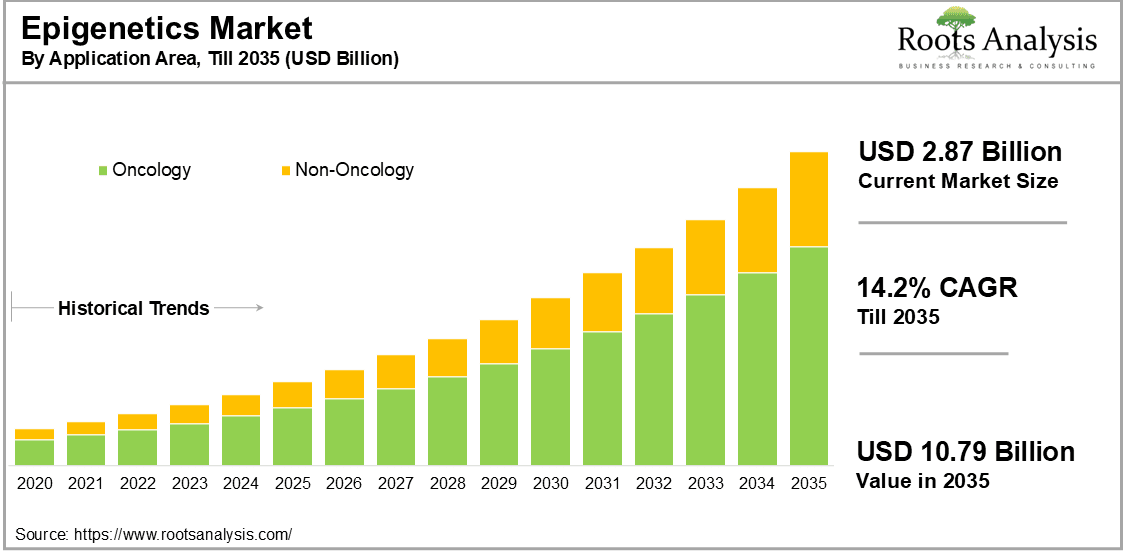
The global epigenetics market, valued at USD 2.44 billion in 2024, is projected to reach USD 2.87 billion in 2025 and USD 10.79 billion by 2035, representing a CAGR of 14.2% during the forecast period.
To learn more about this report, request a free sample copy
Epigenetics is the branch of science that helps to explain how behavioral and environmental factors affect gene function and contribute to diseases, such as diabetes, cancer and neurodegenerative disorders by changing gene expression patterns without altering DNA sequence.
It is worth noting that epigenetics has become an important tool for pharmaceutical companies for designing oncology precision medicine. As per the American Cancer Society cancer statistics in 2025, over 2 million new cancer cases will be diagnosed in the United States this year and over 6,18,000 people will die with the disease. This significant increase in the incidence of cancer has further contributed to the demand for epigenetics to understand disease progression and therapeutic interventions for patients. Beyond cancer, epigenetics also plays a significant role in understanding autoimmune disorders, cardiovascular diseases and cognitive dysfunction, which further encourages the growth of this market. Within this workflow, EZH2 inhibitors target an epigenetic regulator implicated in selected hematological and solid malignancies.
Driven by the increasing applications of epigenetics, several industrial players are focusing on the expansion of their products and services. In May 2025, Elis Bio (spun-out of the University of Chiacago) announced the launch of SuperMethyl™, a fast bisulfite conversion kit which provides 99.5% methyl conversion within ten minutes, in 2024 Chicago BioCapital Summit. Earlier, in August 2024, Genentech signed a licensing agreement worth up to USD 2 billion with Sangamo Therapeutics to develop genomic medicines for treating neurodegenerative diseases. Under this agreement, Genentech will leverage Sangamo’s epigenetic regulation capabilities and proprietary capsid delivery platform to develop genomic medicine.
Similarly, several research are currently undergoing on epigenetics, which is likely to be a key growth factor for the market. For instance, in November 2024, Oxford Nanopore Technologies entered into a collaboration with UK Biobank with the aim of creating the world’s first large-scale epigenetic datasets. Driven by the ongoing initiatives in this field, we believe that the epigenetics market is likely to expand at a substantial rate during the forecast period, making this industry investible for a long time.
The market report provides comprehensive information on industrial players who are currently active across various segments of the industry as mentioned in the table below.
| Key Report Attributes | Details | |
| Historical Trend | Since 2020 | |
| Forecast Period | Till 2035 | |
| Market Size 2025 | USD 2.87 Billion | |
| Market Size 2035 | USD 10.79 Billion | |
| CAGR (Till 2035) | 14.2% | |
| Type of Product |
|
|
| Type of Technology |
|
|
| Application Area |
|
|
| End User |
|
|
| Geographical Regions |
|
|
| Key Companies Profiled |
|
|
| PowerPoint Presentation (Complimentary) |
Available | |
| Customization Scope | 15% Free Customization | |
| Excel Data Packs (Complimentary) |
Available | |
One of the key objectives of the epigenetics market report was to estimate the current size, opportunity, and the market growth potential, over the forecast period, till 2035. We have provided informed estimates on the likely evolution of the market for the forecast period.
The global epigenetics market analysis report also features the likely distribution of the current and forecasted opportunity within the market across various segments, such as type of product (reagents, kits (ChIP sequencing kit, whole genomic amplification kit, bisulfite conversion kit, RNA sequencing kit and others), instruments, enzymes and services), type of technology (DNA methylation, histone methylation, histone acetylation, large non-coding RNA, microrna modification and chromatin structures), application area (oncology (solid tumors and liquid tumors) and non-oncology (inflammatory diseases, metabolic diseases, infectious diseases, cardiovascular diseases and others)), end user (academic research, clinical research, hospitals & clinics, pharmaceutical & biotechnology companies and other end users), geographical regions (North America, Europe, Asia-Pacific, Middle East and North Africa, and Latin America) and leading players.
In order to account for future uncertainties associated with some of the key parameters and to add robustness to our model, we have provided three market forecast scenarios, namely conservative, base, and optimistic scenarios, representing different tracks of industry’s evolution.
All actual figures have been sourced and analyzed from publicly available information forums and primary research discussions. The financial figures mentioned in this market report are in USD, unless otherwise specified.
Based on the type of product, the global market is segmented into reagents, kits (ChIP sequencing kit, whole genomic amplification kit, bisulfite conversion kit, RNA sequencing kit and others), instruments, enzymes and services. According to the epigenetics market forecast, presently reagents account for the highest share (33%) of the market. This dominance is largely due to the increasing usage of reagents in epigenetics studies. DNA modifiers and histone are the two main reagents that are largely used in understanding epigenetic mechanisms and research studies. Owing to the increasing demand for reagents across research studies, this segment holds the highest share of the market.
However, it is worth mentioning here that services segment is likely to grow at a higher CAGR during the forecast period. Epigenetic services, such as analysis, DNA sequencing and consultation services are widely adopted across research institutes to perform analysis for epigenetics pharma and diseases accurately. With continuous demand for high throughout technologies, such as DNA methylation profiling, bisulfite sequencing and ChIP-seq, this segment is likely to grow at an unprecedented rate.
The global market is distributed across different types of technology, such as DNA methylation, histone methylation, histone acetylation, large non-coding RNA, microRNAmodification and chromatin structures. According to our epigenetics market analysis, DNA methylation currently holds 46% of the overall revenue share of the market. This can be attributed to the undergoing research on biological processes and diseases that necessitated the demand for DNA methylation. It is worth mentioning that technological advancements in methylation-specific PCR to analyze DNA methylation patterns has further fueled the growth of this segment.
However, in the future, histone acetylation segment is expected to register a higher CAGR during the forecast period. This is likely to be increasing efficacy of the histone acetylation technology and its healing benefits in various disorders, such as viral infection, inflammation, solid tumors and leukemia.
This segment highlights the distribution of global market across different application areas, such as oncology (solid tumors and liquid tumors) and non-oncology (inflammatory diseases, metabolic diseases, infectious diseases, cardiovascular diseases and others). Presently, oncology segments occupy the highest epigenetics market size (with a share of 70%). This is likely to be the result of increasing prevalence of cancer and growing understanding of correlation between cancer development and epigenetic alternations. Thus, understanding the epigenetic mechanisms in cancer field holds immense potential for the development of effective cancer diagnostics and personalized treatment, which further contributed to the highest share of this segment.
It is worth mentioning that non-oncology segment is likely to grow at a higher CAGR during the forecast period. This is potentially due to the expanding usage of epigenetic mechanism across wide range of conditions, such as cardiovascular diseases, neurological disorders, autoimmune diseases, rare diseases, metabolic disorders and psychiatric disorders.
Based on the end user, the global market is distributed into academic research, clinical research, hospitals & clinics, pharmaceutical & biotechnology companies and other end users. Currently, pharmaceutical & biotechnology companies segment accounts for the highest share (55%) of the epigenetics industry. This is potentially due to the growing usage of epigenetics for understand microorganisms-derived drug resistance and molecular aspects of oncological disorders. Additionally, the increasing research on genetics to develop customized treatment has contributed to the highest share of this segment.
However, in the long run, clinical research and academic research segments are likely to grow at a higher CAGR during the forecast period. This can be attributed to the growing integration of epigenetic analysis in understanding diseases, identification of biomarkers (including cancer biomarkers) and validation of advanced drug targets with higher precision.
The global market is distributed across different geographical regions, such as North America, Europe, Asia-Pacific, Middle East and North Africa, and Latin America. According to our epigenetics market size, currently North America holds 39% of the overall revenue share of the market. This dominance is likely to be the result of growing prevalence of chronic conditions and rising research on personalized therapeutics. Furthermore, the increasing adoption of epigenetics studies across research areas to understand disease mechanism has contributed to the highest share of this region.
In Asia-Pacific, the market for epigenetics is expected to grow at a higher CAGR during the forecast period. This is potentially due to the increasing adoption of advanced epigenetics technology, such as next generation sequencing (NGS) and PCR-based molecular diagnostics kits and assays for diseases diagnosis. Furthermore, the increasing incidence of cancer and rising healthcare expenditure to leverage advanced technologies for early diagnosis and treatment planning is likely to grow market at a higher CAGR in this region.
The “Epigenetics Market Analysis Report: Industry Trends and Global Forecasts, till 2035” market report features an extensive study of the current market landscape, market size, market share, market growth, market trends, market value, market forecast, market outlook, statistics, and future opportunities for epigenetics industrial players. The market research report lays emphasis on the epigenetic solutions that are being developed. Key takeaways of the market report are briefly discussed below.
Currently, the epigenetics market landscape is immensely competitive, featuring the presence of several small, mid-sized and large industrial players. Notably, majority of the market players are focusing on technological innovations followed by product and services expansions. In order to leverage competitive edge, various epigenetics industry players are taking strategic initiatives, such as collaborations and partnerships. For instance, in December 2024, Chroma Medicine merged with Nvelop Therapeutics to form nChroma Bio. This new entity secured USD 75 million to advance genetic medicine. The merger combines leading in vivo delivery technologies with epigenetic editing technologies, aiming to unlock the full potential of genetic medicines for treating diseases. As stated by Jeff Walsh (Chief Executive Officer, nChroma Bio), ”The new company will allow us to leverage the technologies, talent and capital of both organizations to drive products into the clinic and to forge strategic partnerships to expand our reach into new tissues and diseases”.
As more market players continue to accelerate their efforts in this field, we believe that the market will remain highly competitive during the forecast period.
The growing prevalence of chronic conditions has heightened the demand for targeted therapeutics that further fueled the requirement of epigenetics analysis. Notably, detailed information of epigenomic data helps in creating effective therapies that help to treat patients with chronic conditions. Additionally, the growing usage of epigenetic biomarkers to identify targeted molecules and diseases indication has further supported the unprecedented growth of this industry during the forecast period. Moreover, increasing research on diseases and expanding applications of epigenetics across different disorders are likely to be key growth drivers for the market.
The epigenetics market, despite its promising growth and increasing demand, faces several significant hurdles that could limit its expansion. These challenges primarily include high costs, stringent regulatory pathways, and a shortage of specialized personnel.
The advanced technologies and tools required for epigenetics research and product development, such as next-generation sequencing (NGS), chromatin immunoprecipitation (ChIP), and specialized reagents, are inherently expensive. This high upfront investment and ongoing operational costs limit accessibility, particularly for smaller research institutions and in developing regions with constrained healthcare budgets.
The approval process for epigenetics products is subject to rigorous and complex regulatory guidelines. Given the novelty and intricate nature of epigenetic interventions, regulatory bodies often require extensive clinical trials and data to ensure safety and efficacy. This stringent oversight can significantly prolong the approval timeline, leading to substantial delays in bringing innovative products to market.
In addition, complexity of epigenetics research demands a highly skilled workforce proficient in molecular biology, bioinformatics, data analysis, and other interdisciplinary areas. Lack of professionals with the specific expertise needed to conduct advanced epigenetic research, develop new technologies, and translate findings into clinical applications.
Despite the aforementioned challenges, the epigenetics market is poised for significant growth during the forecast period, driven by several transformative technological advancements and evolving research landscapes. The emergence of CRISPR-based epigenome editing tools is revolutionizing the field. Unlike traditional gene editing that alters the DNA sequence, CRISPR-based epigenomics allows for precise manipulation of gene expression without changing the underlying genetic code. This capability enables researchers to activate or silence specific genes, modify histone marks, or alter DNA methylation patterns with unprecedented accuracy. This precise control over epigenetic mechanisms provides powerful new avenues for understanding disease pathogenesis, identifying novel therapeutic targets, and developing innovative gene therapies and diagnostics.
Additionally, the industrial players are accelerating collaborations and raising investments to drive innovations in this field.
For instance, in March 2025, Epicrispr Biotechnologies (US) announced it has secured USD 68 million in the first close of its Series B financing. The funding will be utilized to support the clinical development of EPI-321, a first-in-class, disease-modifying epigenetic therapy for facioscapulohumeral muscular dystrophy (FSHD), a genetic neuromuscular disease.
In 2025, the global epigenetic market is valued at USD 2.87 billion and is poised to reach USD 10.79 billion by 2035, representing a CAGR of 14.2% during the forecast period. This lucrative growth is due to the growing understanding of gene expression and environmental factors in diseases. It is worth mentioning here that several industrial players are raising investments followed by partnerships. For instance, in January 2025, Tune Therapeutics (a genetic medicine startup) has raised USD 175 million to develop gene therapies that are capable of “tunning” genes for the treatment of hepatitis B diseases, instead of editing them by cutting / replacing DNA directly. Scientists of Tune Therapeutics described that epigenetic editing is more effective and minimally disruptive compared to DNA-cutting technologies. As more market players continue to accelerate their research efforts in this field, we believe that epigenetics market will continue to grow at a steady rate.
Examples of key players engaged in this domain (which have also been captured in this report) include 10x Genomics, Active Motif, Bio-Rad Laboratories, Dovetail Genomics, Element Biosciences, Illumina, Merck, New England Biolabs, Novartis, PerkinElmer, Promega, Pacific Biosciences of California, Storm Therapeutics, QIAGEN, Thermo Fisher Scientific and Zymo Research. This market report includes an easily searchable excel database of all the companies focusing on the development of epigenetics products.
The market report presents an in-depth analysis, highlighting the capabilities of various companies engaged in this domain across different segments. Amongst other elements, the market report includes:
Several recent developments have taken place in the field of epigenetics. We have outlined some of these recent initiatives below.