Europe AI in Clinical Trials Market Size, Share, Trends and Analysis Report, 2026-2035
Europe AI in Clinical Trials Market by Trial Phase (Phase I, Phase II and Phase III), Type of Offering (Software and Services), Deployment Mode (Cloud-based and On-premises), Therapeutic Area (Oncological Disorders, Infectious Diseases, CNS Disorders, Metabolic Disorders, Immunological Disorders, Cardiovascular Disorders and Other Disorders), Technology Exposure, End-user and Countries – Trends and Forecast, 2026-2035
-
Lowest Price Guaranteed
-
Slides
187 -
Last Updated
October 2026 -
View Count
5680 -
Market Outlook
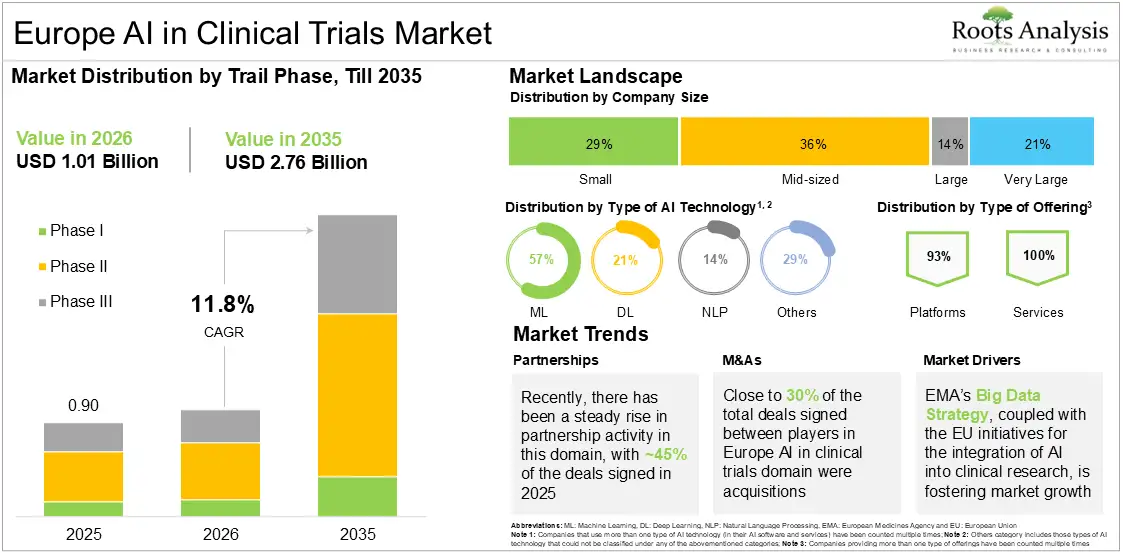
The Europe AI in clinical trials market, valued at USD 0.90 billion in 2025, is projected to reach USD 1.01 billion in 2026 and USD 2.76 billion by 2035, with a CAGR of 11.8% during the forecast period, 2026 to 2035.
To learn more about this report, request a free sample copy
Market Report: Key Takeaways
Market Size and Trends
- In terms of trial phase, phase II holds the largest share of the current market.
- With respect to type of offering, the services segment dominates (around 55%) the current market.
- Based on the deployment mode, cloud-based AI solutions capture the largest share of the current market, and the trend is unlikely to change in the future.
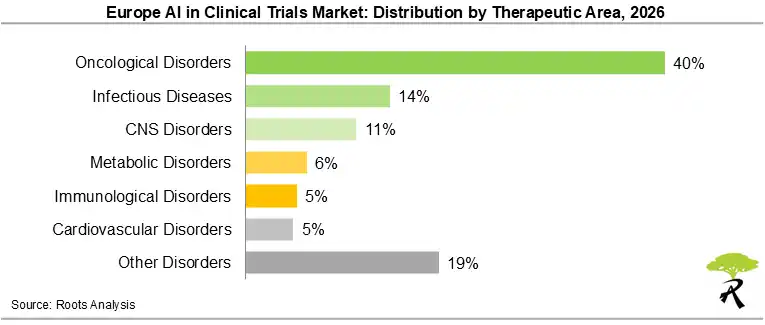
- In terms of therapeutic areas, oncological disorders are likely to hold the largest market share (more than 40%) in 2026.
- With respect to technology exposure, machine learning dominates the current market (around 40%).
- Based on end-users, biotechnology and pharmaceutical companies capture the largest share of the current market, and the trend is unlikely to change in the future.
Key Market Statistics
- Market Size in 2026: $1.01 billion
- Estimated Market Size in 2035: $2.76 billion
- CAGR (Till 2035): 11.8%
Market Introduction
Clinical trials have become increasingly data-intensive, complex and globally distributed, creating a growing need for technologies that can improve study design, operational efficiency and decision-making. Artificial intelligence (AI) has emerged as a transformative tool across the clinical development lifecycle, supporting applications such as patient identification, site selection, enrolment forecasting, protocol optimization, trial monitoring and clinical data analysis.
In Europe, the adoption of AI in clinical trials is being strengthened by the region's advanced healthcare infrastructure, established pharmaceutical industry and increasingly harmonized regulatory environment. Since 31 January 2025, all clinical trials across the European Union have been governed under the unified Clinical Trials Regulation (CTR), with the Clinical Trials Information System (CTIS) serving as the centralized platform for trial submission, assessment and oversight. In fact, by the end of 2025, CTIS had received over 13,000 initial applications and facilitated the authorization of more than 10,600 clinical trials across EU member states.
The Europe AI in clinical trials market is likely to gain further momentum as sponsors seek to reduce development timelines, improve trial success rates and generate more reliable clinical evidence. Growing interest of European pharmaceutical companies and contract research organizations in decentralized trials, precision medicine, digital biomarkers and predictive analytics is likely to create new opportunities for AI solution providers. However, market growth will remain closely linked to data quality, model transparency, patient privacy, regulatory compliance and the effective integration of AI into existing clinical research workflows.
Europe-Based AI Clinical Trial Innovators
| Company | Headquarters | YoE | European Base | AI Clinical Trial Focus |
| Evinova | Switzerland | 2023 | Switzerland | AI-native clinical development and unified trial operations |
| CluePoints | Belgium | 2012 | Belgium | AI-powered RBQM and data quality oversight |
| Lindus Health | UK | 2021 | UK | AI-assisted trial operating system and next-generation CRO model |
| Trialbee | Sweden | 2010 | Sweden | AI-driven patient recruitment and Honey Platform |
| uMed | UK | 2018 | UK | EHR-based recruitment, AI-driven patient matching and real-world evidence |
Abbreviation: YoE: Year of Establishment
Market Segmentation
Based on the research, we have segmented the Europe AI in clinical trials market report into trial phase, type of offering, deployment mode, therapeutic area, technology exposure, end-users and countries.
By Trial Phase
- Phase I, Phase II, Phase III
By Type of Offering
- Software and Services
By Deployment Mode
- Cloud-based and On-premises
By Therapeutic Area
- Oncological Disorders, Infectious Diseases, CNS Disorders, Metabolic Disorders, Immunological Disorders, Cardiovascular Disorders, Other Disorders
By Technology Exposure
- Machine Learning, Molecular Modeling and Simulation, Deep Learning, Omics Integration, Generative Models, Other Technologies
By End-user
- Biotechnology and Pharmaceutical Companies, Academic Research Institutes, Other End-users
By Countries
- UK, Germany, France, Spain, Italy
Key Market Insights
What Factors are Driving Increased Adoption of AI in Clinical Trials within Europe?
- Harmonized Clinical Trial Regulations: The implementation of the EU Clinical Trials Regulation (CTR) and the Clinical Trials Information System (CTIS) has streamlined trial submissions and oversight across EU and EEA countries, creating a more consistent regulatory environment for AI-enabled clinical research. This progress was reinforced in 2025, when the European Medicines Agency issued its first qualification opinion for an AI-based clinical trial methodology, recognizing a human-supervised tool used to assess liver biopsy images in metabolic dysfunction-associated steatohepatitis trials. Together, these developments provide greater regulatory clarity and are expected to accelerate the adoption of AI-powered trial design, patient assessment, monitoring and data analysis solutions across Europe.
- Rising Pressure to Reduce Trial Costs and Development Timelines: Pharmaceutical and biotechnology companies are under increasing pressure to control research and development expenditure while accelerating the launch of new therapies. AI can automate repetitive activities, predict operational risks, identify underperforming sites and optimize resource allocation, helping sponsors conduct trials more efficiently and cost-effectively.
What are the Main Challenges in Europe AI in Clinical Trials Market Growth?
- Cybersecurity and Patient Trust Risks: AI adoption expands the number of systems accessing sensitive trial and healthcare information, increasing exposure to data breaches, ransomware and unauthorized access. ENISA classifies the European health sector as being in a cybersecurity risk zone, indicating a gap between the sector's critical importance and its current cybersecurity maturity.
- Cross-Border Operational Complexity: Europe's multilingual and multi-jurisdictional environment means that multinational clinical trials must navigate differing healthcare systems, ethics committee requirements and national implementation of EU regulations. These variations complicate the deployment of standardized AI solutions across multiple countries.
Recent Developments in Europe AI in Clinical Trials Market
- In June 2026, Owkin entered a multiyear collaboration with Sanofi to build K Pro biopharma AI agents backed by a five-year K Pro license. K Pro uses multimodal patient data and agentic AI to support decisions from early discovery through clinical development.
- In April 2026, Boehringer Ingelheim launched an AI and machine learning center in London to strengthen pharmaceutical R&D. The center aims to support areas, including clinical trial recruitment, site selection and regulatory processes.
- In March 2026, myTomorrows and Clínica Universidad de Navarra partnered to advance AI-powered clinical trial infrastructure in Spain. The collaboration integrates AI-assisted patient trial matching into the hospital's electronic health record and clinical trial management environment.
Industry Experts on Europe AI in Clinical Trials Market
Owing to the rising complexity of multi-country studies, increasing volumes of clinical and real-world data, persistent patient recruitment challenges and growing pressure to reduce trial costs and timelines, the Europe AI in clinical trials market is poised for transformative growth over the coming years.
Daniel-Timon (Product Manager Data Analytics at Alcedis), stated, "This is a very exciting topic, especially in Germany. Patient data naturally requires special protection, which is why we work according to the highest data protection standards. We can only process personal data if the patient has given their written consent and the sponsor (i.e. the client of the clinical trial) has also approved this. We are seeing more and more innovative sponsors wanting to participate in the development of AI solutions and asking us specifically for such technologies. The necessary concepts for data protection are then considered between all parties right from the start."
Discussions with multiple stakeholders in this domain influenced the opinions and insights presented in this study. The market report includes transcripts of the following discussions:
- Co-founder, Chief Executive Officer and Chief Technology Officer, Small Company, Switzerland
- Founder and Chief Executive Officer, Mid-Sized Company, US
- Founder and Chief Executive Officer, Small Company, US
- Co-founder and Executive Director, Mid-Sized Company, US
- Chief Technology Officer, Chief Commercial Officer, Chief Delivery Officer, Head of Marketing, Mid-Sized Company, US
In addition, the market report includes transcripts of the following third-party discussions:
- Chief Scientific Officer, Large Company, US; Co-Founder and Chief Executive Officer, Mid-Sized Company, US; Chief Executive Officer, Mid-Sized Company, US; Associate Professor and Blue Cross California Distinguished Professor, Large Organization, US
- Co-Founder and Chief Executive Officer, Mid-Sized Company, US
- Chief Science Officer, Large Company, US; Co-Founder and Chief Executive Officer, Mid-Sized Company, US; Chief Executive Officer, Mid-Sized Company, US; Associate Professor and Blue Cross California Distinguished Professor, Large Organization, US
- EVP, Chief Information, Technology, and Product Officer, Large Company, US
- Chief Technology Officer, Mid-Sized Company, US
- Director of the Office of Medical Policy (CDER), Large Organization, US
- Professor of Medicine, Large Organization, US; Program Manager, Large Organization, US; Director, Bioethics Lead, Large Company, US; Associate Dean, Human Research Protections and Director of the Human Research Protections Program, Large Organization, US; Executive IRB Chair and VP of IBC Affairs, Large Company, US
- Hematologist, AI Specialist, and Research Group Leader, Large Organization, Germany
- Cardiologist and Associate Director of the Accelerator for Clinical Transformation
- Research Group, Large Organization, US
- Heart Failure Cardiologist and Researcher, Large Organization, US
- Senior Community Development Manager, Mid-Sized Company, Netherlands
Market Share Insights
Which Type of Offering Accounts for the Largest Market Share?
- Based on the Europe AI in clinical trials market analysis, the services sub-segment is likely to occupy highest market share (around 55%) in 2026. This dominance is due to the complex, highly regulated and fragmented nature of the European clinical research ecosystem, where successful AI deployment requires extensive data integration, algorithm customization, model validation, regulatory compliance, system implementation and ongoing technical support. In addition, differences in healthcare databases, languages, clinical workflows and data protection requirements across European countries encourage companies to rely on specialized service providers for study-specific AI implementation rather than adopting standardized software independently.
- The software sub-segment is likely to be the fastest-growing segment in this industry, with an annualized growth rate during the forecast period. This growth is primarily attributable to the increasing adoption of AI-powered software platforms that automate and optimize key clinical trial processes, including protocol design, patient recruitment, site selection, data management, risk-based monitoring, and predictive analytics.
Based on Therapeutic Area, Which Segment Captures the Largest Europe AI in Clinical Trials Market Share?
- In 2026, oncological disorders are likely to capture the highest (>40%) market share. Furthermore, this segment is likely to witness a relatively higher compound annual growth rate (CAGR) during the forecast period.
- According to WHO, Europe records over 3.7 million new cancer cases annually, which drives a disproportionately large volume of highly complex regional clinical oncology research trials. Cancer trials often involve heterogeneous patient populations, intricate biomarker identification, personalized medicine approaches, adaptive designs, and high failure rates. This creates substantial challenges that AI technologies address through improved patient recruitment and stratification, predictive modeling of treatment responses, analysis of medical imaging and genomic data, and overall trial optimization.
Which Technology Exposures Accounts for the Highest Share in the Europe AI in Clinical Trials Market?
- Currently, the machine learning sub-segment occupies a higher Europe AI in clinical trials market share (around 40%). This is primarily due to its proven effectiveness in handling large, complex, and diverse datasets generated during clinical research. ML algorithms excel at analyzing vast amounts of structured and unstructured data from sources such as electronic health records, genomics, medical imaging, and real-world evidence. This enables the identification of hidden patterns, predictive insights, and actionable outcomes that are difficult to achieve through traditional methods.
- Generative models are likely to grow at a higher CAGR during the forecast period. Generative models can rapidly draft and revise study protocols and clinical study reports, while also summarizing medical records for eligibility screening and converting trial information into multiple European languages. For sponsors conducting multinational studies, these capabilities can reduce the time spent adapting documents across countries, accelerate responses to protocol amendments and regulatory queries, and allow clinical teams to focus on trial design, patient safety and operational decision-making. Moreover, the ability of generative models to operate as conversational AI copilots across existing clinical platforms is likely to support faster enterprise-wide adoption than narrowly configured predictive models.
Key Players in the Europe AI in Clinical Trials Market
Examples of key companies profiled in this market report, arranged in alphabetical order, include Accenture, Brainomix, Carenity, Huma, Inato, Quibim, Phastar, and Risklick. The complete list of companies is available in the full report, which also includes an easily searchable Excel database of Europ AI in clinical trials software and service providers worldwide. Additional named organizations referenced elsewhere in this report's underlying data, reflect funding and partnership activity tracked across the broader Europe AI in clinical trials ecosystem, not an endorsement relationship with Roots Analysis.
Report Deliverables and Customization
Alongside the core market report, purchasers receive complimentary Excel data packs covering the Europe AI in clinical trials software and service providers market landscape, clinical trial analysis, partnerships and collaborations analysis, funding and investment analysis, big pharma analysis, cost saving analysis, and market sizing and opportunity analysis. The report also includes a complimentary PowerPoint presentation summarizing the key findings and offers 15% free customization upon request.
Report Authorship
Author(s): This report was co-authored by Simriti Gupta, Pemba Lahmo, both part of Roots Analysis's healthcare and pharma research practice. All findings are based on proprietary databases, executive interviews, and regulatory analysis, subject to internal peer review prior to publication.
Independence and Non-Affiliation
Roots Analysis is an independent market research and consulting firm. This report draws on publicly available information, primary interviews, and proprietary analysis. Roots Analysis is not affiliated with, endorsed by, or a representative of the USFDA, the European Medicines Agency, or any of the companies, technologies, or individuals named in this report. Figures are derived from primary interviews with industry stakeholders combined with secondary research and are not directly comparable to market-sizing studies published by other research firms.
Clients evaluating this report alongside competing market studies should weigh how the publisher defines the segment boundary, since Europe AI in clinical trial market sizing is not standardized across research firms and some studies fold in adjacent manufacturing or CDMO revenue that this report treats separately.