Market Outlook
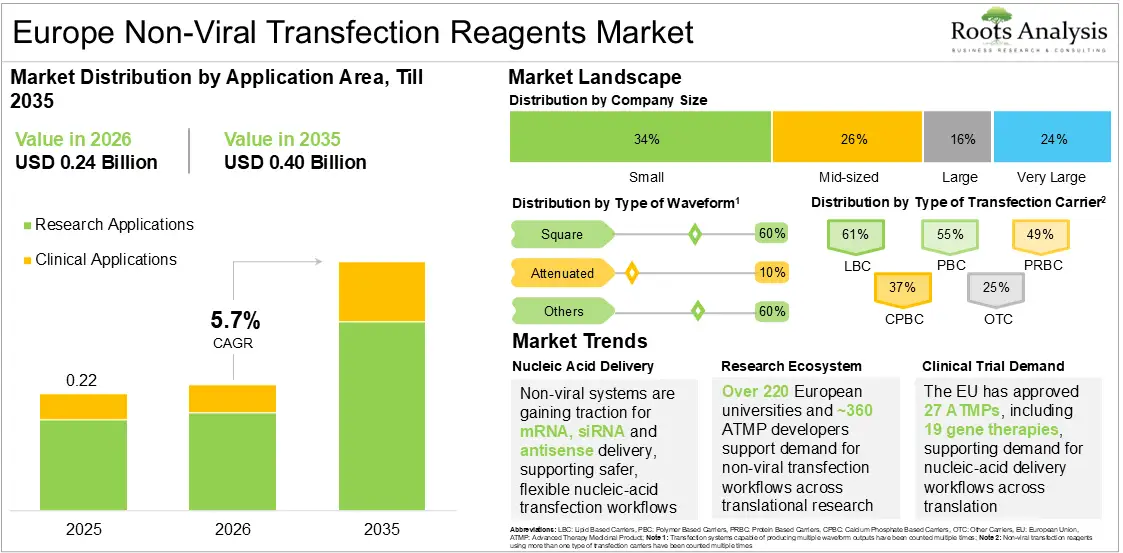
The Europe non-viral transfection reagents market, valued at USD 0.22 billion in 2025, is projected to reach USD 0.24 billion in 2026 and USD 0.40 billion by 2035, representing a CAGR of 5.7% during the forecast period 2026-2035.
To learn more about this report, request a free sample copy
Market Report: Key Takeaways
Market Size & Trends
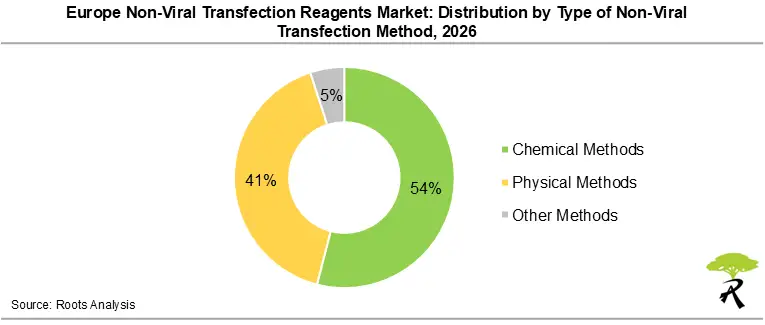
- In terms of type of non-viral transfection method, chemical methods hold the highest share, accounting for around 55% of the current market.
- With respect to application area, research applications dominate the current market.
- Based on end-user, academic and research institutions capture the largest share of the current market; this trend is unlikely to change in the future.
Key Market Statistics
- Market Size in 2026: $ 0.24 Billion
- Estimated Market Size in 2035: $ 0.40 Billion
- CAGR (2026-2035): 5.7%
Market Introduction
Non-viral transfection reagents refer to chemical or physical delivery systems that introduce nucleic acids, including DNA, RNA, mRNA, siRNA, and gene editing components, into target cells without relying on viral vectors. In Europe, academic institutions, biotechnology companies, pharmaceutical developers, advanced therapy developers, and translational research groups widely use these reagents across diverse R&D workflows. The region's strong life sciences ecosystem and rising demand for safer, flexible, and cost-efficient nucleic acid delivery approaches continue to drive their adoption.
Established biotechnology clusters across Germany, France, UK, Italy, Spain, and other European countries further support the Europe non-viral transfection reagents market. The region has a strong base of universities, research institutes, biopharmaceutical companies, and advanced therapy developers working on gene editing, mRNA therapeutics, ex vivo cell engineering, oncology research, and rare disease programs. These activities are increasing the use of chemical and physical transfection methods across both research and clinical development settings.
Europe also has a strong supplier and technology base for transfection workflows. For instance, France-based Polyplus (now part of Sartorius) provides upstream technologies and transfection reagents for advanced biologics and cell and gene therapy production. Such regional capabilities strengthen the availability of specialized reagents for research, bioproduction, and therapeutic development applications.
In addition, rising investment in nucleic acid-based and advanced therapy programs is likely to support market growth. For example, BioNTech expanded its partnership with the UK government in 2025 and announced plans to invest up to GBP 1 billion over ten years to broaden its R&D activities in the UK. Such initiatives are likely to increase demand for reliable transfection reagents that can support mRNA research, gene modulation studies, and next-generation therapeutic development.
Despite growing adoption, the market faces challenges related to transfection efficiency, cell viability, reagent stability, scalability, and transition from research-grade to GMP-compatible workflows. However, increasing investment in advanced therapies, growing adoption of genome editing tools, and rising demand for safer alternatives to viral delivery are likely to create significant opportunities in the Europe non-viral transfection reagents market.
Leading Non-Viral Transfection Reagents Companies in Europe
| Company |
Establishment |
Headquarters |
Type of Offering |
Product / Technology |
Key Application Area |
| Biontex Laboratories |
2008 |
Germany |
Specialized transfection reagents |
Metafectene reagent family |
Academic, biotech and pharma research applications |
| Lonza |
1897 |
Switzerland |
Nucleofection and electroporation-based transfection solutions |
Nucleofector technology |
Primary cells, stem cells and difficult-to-transfect cells |
| Merck |
1668 |
Germany |
Chemical transfection reagents and bioprocessing solutions |
GeneJuice, X-tremeGENE and Mirus Bio transfection reagents |
Research transfection, protein expression and viral vector production |
| OZ Biosciences |
2003 |
France |
Lipid, polymer and magnetic transfection reagents |
Magnetofection, Lipofection and Polyfection reagents |
DNA, siRNA, mRNA, primary cell and 3D cell culture transfection |
| Polyplus |
1991 |
France |
PEI-based and GMP-grade transfection reagents |
PEIpro and PEIpro-GMP |
Viral vector production and cell and gene therapy manufacturing workflows |
| QIAGEN |
1984 |
Netherlands |
Non-liposomal lipid transfection reagents |
Effectene transfection reagent |
DNA transfection, primary cells and high-throughput screening |
Market Segmentation
Based on the research, we have segmented the Europe Non-Viral Transfection Reagents Market into type of non-viral transfection method, application area and end-user.
By Type of Non-Viral Transfection Method
- Chemical Methods
- Physical Methods
- Other Methods
By Application Area
- Research Applications
- Clinical Applications
By end-user
- Academic and Research Institutions
- Pharmaceutical and Biotechnological Companies
- Contract Manufacturers
- Other end-users
Europe Non-Viral Transfection Reagents Market Key Insights
What are the Key Drivers for Europe Non-Viral Transfection Reagents Market Growth?
- Expanding Functional Genomics Research: European research groups are increasingly using transfection reagents in CRISPR screening, RNA interference studies, reporter assays, iPSC-based models, organoid systems, and disease-specific cellular models. These workflows require reliable delivery of plasmids, siRNA, mRNA, and gene editing components into a wide range of cell types. As academic and translational laboratories in Europe continue to expand high-throughput screening and cell-based assay programs, demand for reproducible, easy-to-use, and cell-type-specific transfection reagents is likely to increase.
- Shift Toward Non-Viral Delivery: European developers are increasingly evaluating non-viral delivery approaches during early-stage cell and gene therapy development to reduce dependence on viral vectors, simplify process development, and improve flexibility during candidate optimization. Non-viral transfection reagents are particularly useful in applications requiring transient expression, rapid screening of constructs, gene modulation, and early feasibility testing before developers commit to more complex clinical-scale delivery systems. This is expected to support demand across research, preclinical development, and process optimization workflows.
What are the Main Challenges for Market Growth?
- Variable Cell-Type Performance: European research and translational programs use primary cells, immune cells, stem cells, iPSCs, organoids, and patient-derived samples, which can respond differently to the same transfection reagent. This creates challenges related to delivery efficiency, cell viability, reproducibility, and assay comparability across laboratories. As a result, researchers often need extensive optimization for each cell type, which increases development time and limits the routine adoption of standardized reagent-based workflows in complex cell models.
- Cost and Procurement Barriers: A large share of demand in Europe stems from universities, public research institutes, and hospital-linked laboratories, where purchasing decisions are often influenced by grant funding, institutional procurement rules, and country-specific budget constraints. Premium transfection reagents, specialized formulations, and GMP-compatible products can therefore face slower adoption in cost-sensitive settings. This creates a challenge for suppliers trying to scale reagent adoption across a fragmented European customer base with diverse purchasing requirements.
Recent Developments in Europe Non-Viral Transfection Reagents Market
- In June 2026, OZ Biosciences published stem cell mRNA transfection data for NanOZ-LNP Stem, its proprietary LNP formulation optimized for primary human CD34+ stem cells. The application note reported mRNA delivery, viability, and phenotype preservation data for difficult-to-transfect stem cell workflows.
- In June 2026, T-CURX received Swissmedic approval to initiate a first-in-human Phase 1 trial of TCX-001, its non-viral CAR-T therapy for relapsed or refractory AML and CLL. The program uses a non-viral cell engineering approach for CAR-T development.
- In April 2026, PartitionBio was shortlisted for SLAS Europe 2026 Innovation AveNew and SLAS Ignite Awards for BubbleFect, its non-lipid, non-viral intracellular delivery reagent. The platform targets mRNA, CRISPR, protein, and DNA delivery for cell transfection and scalable biology workflows.
Industry Experts on Europe Non-Viral Transfection Reagents Market
Driven by the growing demand for non-viral gene delivery solutions that offer improved safety, reduced immunogenicity, and greater manufacturing flexibility compared to viral vectors, the Europe non-viral transfection reagents market is likely to witness substantial growth over the forecast period.
Emphasizing this trend, Ram Shankar (Chief Scientific Officer at PlasmidFactory), stated that: "Minicircles produced at PlasmidFactory have already entered multiple clinical trials, including CARAMBA, TranspoCART19, and LION-1. These programs explore virus-free CAR-T cell generation using transposon systems and hopefully demonstrate strong efficacy and favorable safety profiles"
Discussions with multiple stakeholders in this domain influenced the opinions and insights presented in this study. The Europe non-viral transfection reagents market report includes detailed transcripts of interviews conducted with the following individuals:
- Former Vice President, Business Development and Partnerships, Small Company, US
- Former Global Business Development Manager, Clinical Operations, Mid-sized Company, France
- Researcher, Mid-sized Company, Chile
In addition, the market report includes transcripts of the following other third-party discussions:
- Chairman and Chief Executive Officer, Mid-sized Company, US
- Co-Founder and Chief Executive Officer, Small Company, US
- Chief Scientific Officer and Executive Vice President of R&D, Mid-sized Company, US
- Chief Scientific Officer, Mid-sized Company, US
- Chief Scientific Officer, Small Company, Germany
- Vice President of Cell Therapy Process Development, Large Company, US
- Group Leader of R&D Transfection, and Director and Senior Product Manager, Large Company, Switzerland
- Director, Senior Product Manager, Very Large Company, Switzerland
- Senior Vice President of Technical Applications, Mid-sized Company, US
- Head of Transfection R&D, Very Large Company, Switzerland
Market Share Insights
Which Type of Non-Viral Transfection Method Accounts for the Largest Share in the Europe Non-Viral Transfection Reagents Market?
- Currently, the chemical methods segment occupies the highest share, accounting for around 55% of the Europe non-viral transfection reagents market. This dominance is primarily driven by the widespread use of chemical transfection reagents in routine research workflows, including plasmid DNA delivery, siRNA knockdown, mRNA delivery, reporter gene assays, and transient protein expression.
- The physical methods segment is likely to witness strong growth during the forecast period. This is owing to the increasing use of electroporation and related techniques for primary cells, immune cells, stem cells, and other difficult-to-transfect cell types. Moreover, as European developers expand ex vivo cell engineering, gene editing, and early-stage cell therapy workflows, demand for physical non-viral transfection methods is likely to increase steadily.
Amongst the End-Users, Which Segment Holds the Highest Share in the Europe Non-Viral Transfection Reagents Market?
- Currently, the academic and research institutions segment captures the largest share of the Europe non-viral transfection reagents market. This dominance is supported by Europe's strong base of universities, public research institutes, hospital-linked research centres, and translational laboratories. These establishments generate steady demand because they run high volumes of small-scale experiments that require repeated reagent use across cell line optimization, protocol screening, gene silencing, plasmid delivery, and genome editing workflows.
- The pharmaceutical and biotechnological companies segment is likely to grow at a higher CAGR during the forecast period. This is primarily because these companies are using non-viral transfection reagents for target validation, screening, lead optimization, nucleic acid delivery studies, and early process development for mRNA, gene editing, and cell therapy programs.
Scope of Europe Non-Viral Transfection Reagents Market Report
| Key Report Attribute |
Details |
| Historical Trend |
Since 2022 |
| Forecast Period |
Till 2035 |
| Market Size 2026 |
$ 0.24 Billion |
| Market Size 2035 |
$ 0.40 Billion |
| CAGR (Till 2035) |
5.7% |
| Segments Covered |
- Type of Non-Viral Transfection Method
- Application Area
- End-User
|
| Key Players |
(A complete list of players captured is available in the report)
|
PowerPoint Presentation
(Complimentary) |
Available |
| Customization Scope |
15% Free Customization |
Excel Data Packs
(Complimentary) |
Available |
Frequently Asked Questions
What is a non-viral method of transfection?
Non-viral transfection methods use physical or chemical approaches to deliver nucleic acids into the target cells. These include techniques like electroporation (electric pulses), lipofection (lipid-DNA complexes), microinjection, calcium phosphate precipitation, and polymer-based delivery.How big is the Europe non-viral transfection reagents market?
The Europe non-viral transfection reagents market is estimated to be around USD 0.24 Billion in 2026.What is the projected growth of the Europe non-viral transfection reagents market?
The market is likely to grow at a CAGR of 5.7% during the forecast period, from 2026 to 2035.Which end-user holds the highest market share in the Europe non-viral transfection reagents industry?
Presently, academic and research institutions capture ~50% of the overall industry.Who are the leading players specializing in Europe non-viral transfection reagents market?
Biontex Laboratories, Lonza, MilliporeSigma, OZ Biosciences, PromoCell, QIAGEN, Sartorius, ScreenFect.