Extractables and Leachables Testing Market by Type of Container / Device Tested (Container / Closures and Packaging Materials, Single Use Systems and Processing Equipment, Medical Devices and Others), Type of Technique Used (Chromatography, Spectroscopy, and Other Techniques), Company Size, Application (Parenteral Drug Products, Inhalation Drug Products, and Oral Solutions and Suspensions) and Geographical Regions – Trends and Forecast 2026-2035
Extractables and Leachables Testing Market Outlook: USD 2,501 Million by 2035 at a CAGR of 10.6%
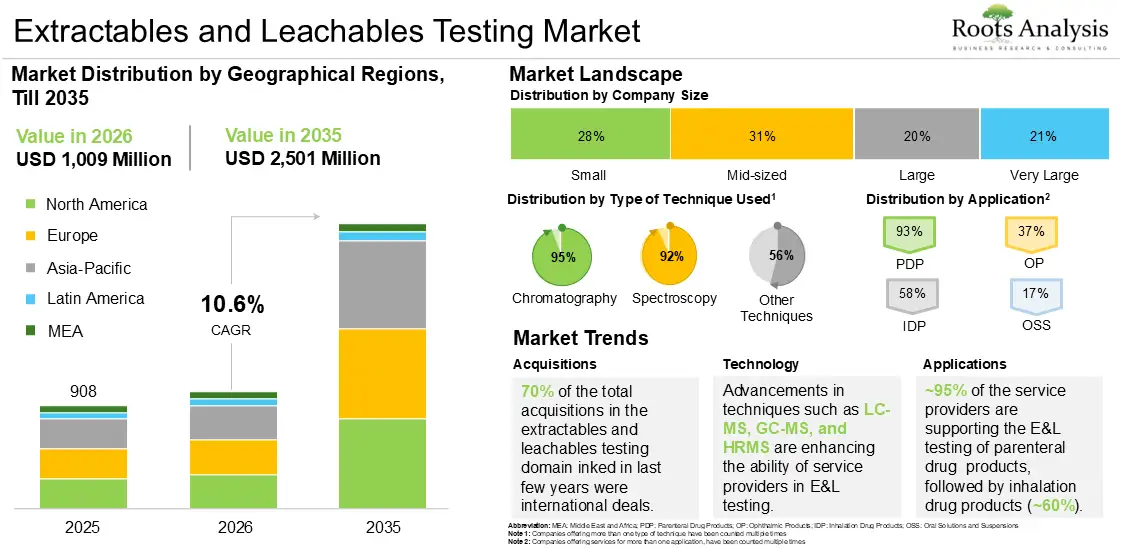
The global extractables and leachables testing market, valued at USD 908 million in 2025, is projected to reach USD 1,009 million in 2026 and USD 2,501 million by 2035, representing a CAGR of 10.6% during the forecast period 2026 to 2035. This growth is supported by the increasing regulatory emphasis on patient safety, product quality, expanding use of polymer-based materials and single-use systems in pharmaceutical manufacturing, and rising development of biologics, injectable products, combination products and advanced drug-delivery systems.
See What's in the Full Report – Request Your Complimentary Insights!
Market Report: Key Takeaways
Market Size & Trends
- Container / closures and packaging materials currently account for the largest share of the extractables and leachables testing market.
- Among the type of technique used, chromatography currently accounts for the largest market revenue, reflecting its central role in separating and characterizing organic extractables and leachables before mass-spectrometric identification and quantification.
- Large companies capture the highest share of the extractables and leachables testing market size, and market momentum will likely sustain this trend through the forecast period.
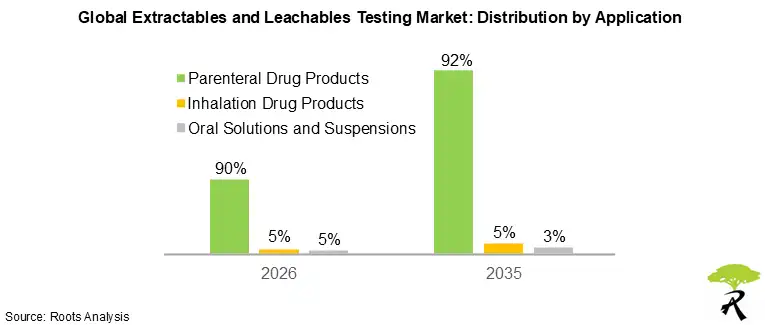
- By application, parenteral drug products hold the highest share (90%) of the global extractables and leachables testing market.
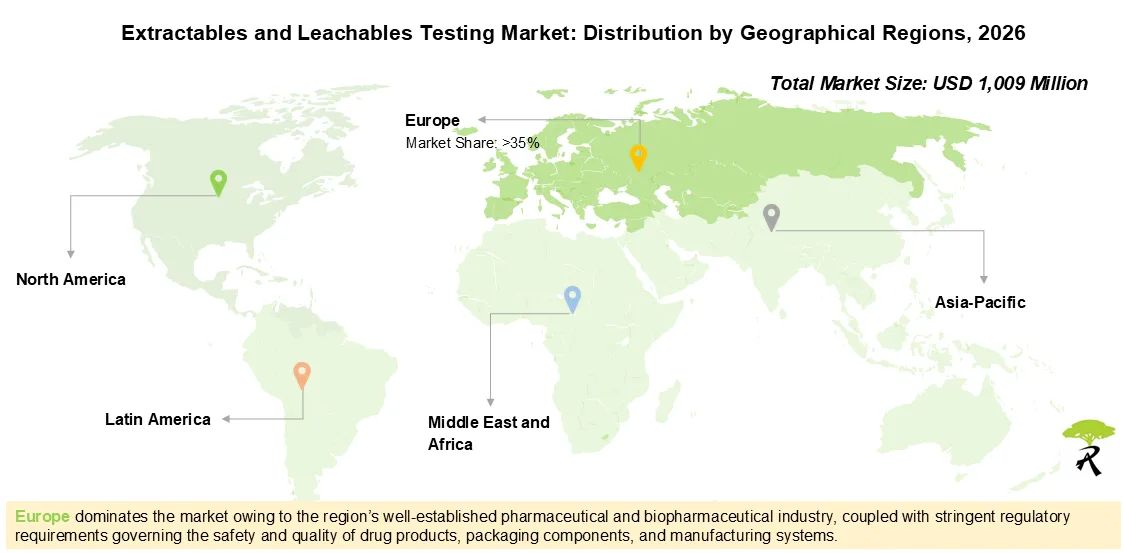
- Europe currently captures more than 35% of the market, while Asia-Pacific is expected to register the fastest growth during the forecast period.
Key Market Statistics
- Market Size in 2026: $1,009 Million
- Estimated Market Size in 2035: $2,501 Million
- CAGR (2026-2035): 10.6%
- Europe: Largest market in 2026
- Asia-Pacific: Fastest growing region
What Are Extractables and Leachables, and Why Is Testing Important?
Extractables are chemical species that can be released from a material or component under deliberately exaggerated laboratory conditions, whereas leachables are substances that migrate into a drug product under normal or simulated conditions of manufacture, storage and use. E&L testing is therefore used to identify, characterize and assess chemical substances originating from pharmaceutical packaging, container-closure systems, processing equipment, medical devices and drug-delivery systems.
The testing scope has expanded beyond conventional container-closure assessments as pharmaceutical and biopharmaceutical manufacturers adopt more polymer-based components, single-use bioprocess systems and complex delivery formats. Potential sources can include plastics, elastomers, glass-contact components, coatings, adhesives, bags, tubing, filters, connectors and other product-contact materials. Drug-delivery systems such as prefilled syringes, autoinjectors, inhalers and infusion systems may also require chemical characterization depending on the product and regulatory pathway.
Because leachables can affect product quality and may create patient-safety risks, study design must consider material composition, route of administration, duration of contact, sterilization or processing conditions, expected patient exposure and the sensitivity of the drug product matrix. This is particularly important for parenteral, ophthalmic and inhalation products, where exposure routes and formulation sensitivity can increase the scrutiny applied to E&L assessment.
Extractables and Leachables Testing Market Overview
The market opportunity for extractables and leachables testing service providers is likely to significantly rise in the coming decade. Rising adoption of pharmaceutical and biopharmaceutical products fuels this growth, primarily by intensifying the need to evaluate potential interactions between drug products and their associated container closure systems, packaging materials, and manufacturing components. Demand is also being reinforced by the wider use of single-use systems, biologics, combination products and specialized delivery devices that introduce additional material-contact interfaces across development, manufacturing, storage and administration.
While some large pharmaceutical and biopharmaceutical companies maintain internal analytical capabilities, comprehensive E&L programs often require specialized scientific expertise, high-sensitivity instrumentation, toxicological risk assessment, method development and validation, and traceable documentation. Outsourcing to specialized laboratories can therefore provide access to technical expertise and analytical infrastructure without requiring every drug developer or CMO / CDMO to build dedicated in-house capacity.
For service providers, differentiation increasingly depends on the ability to support the full study lifecycle - from material-risk assessment and extraction-study design through non-targeted screening, targeted leachables testing, compound identification, toxicological evaluation, method verification / validation and regulatory-ready reporting.
Scope, Methodology and Industry Expert Interviews
The findings in this report were developed through a structured methodology combining secondary research, proprietary databases and primary stakeholder interviews. Secondary research included company disclosures, regulatory information, facility and capacity announcements, scientific and technical literature, partnership activity and other publicly available market evidence. The research team triangulated findings across market sizing, segmentation, analytical technology adoption, outsourcing activity, regulatory expectations, company capabilities and regional trends before finalizing the analysis.
Emphasizing the recent advancements in extractables and leachables testing market, Tarja Nurmi, (Senior Expert, Extractables & Leachables, at Bayer R&D Pharmaceutical Sciences), stated, "Health authorities have recently paid a lot of attention to chemical safety of processes. Therefore, this is an E&L topic which the industry is working on at present."
The market report includes the transcripts from the following primary calls:
- Former Commercial Development Manager of Biotechnology, Large Organization, US
- Former Senior Study Manager, Large Organization, UK
- Former Director, Analytical Services, Mid-sized Organization, US
- President, Analytical Services, Small Organization, US
In addition, the market report includes transcripts of the following third-party discussions:
- Associate Principal Scientist, Large Organization, US
- Chief Scientific Officer, Mid-sized Organization, US
- Scientific director, E&L Expert, Large Organization, US
- Senior Expert, Extractables & Leachables, Very Large Organization, Germany
- Principal Scientist, Very Large Organization, Germany
- Director of Sales and Marketing, Small Organization, US
How is the Extractables and Leachables Testing Market Segmented?
Based on the research, the extractables and leachables testing market is segmented by type of container / device tested, type of technique used, company size, application, and geographical regions. This segmentation enables pharmaceutical and biopharmaceutical companies, CMO / CDMO business development teams, procurement and technical-operation teams, quality and regulatory professionals, investors and other market participants to assess the opportunity most relevant to their strategic requirements.
- By Type of Container / Device Tested: Container / Closures and Packaging Materials, Medical Devices, Single Use Systems and Processing Equipment, and Other Components
- By Type of Technique Used: Chromatography, Spectroscopy, and Other Techniques
- By Company Size: Large Companies, Mid-sized Companies, and Small Companies
- By Application: Parenteral Drug Products, Inhalation Drug Products, and Oral Solutions and Suspensions
- By Geographical Regions: North America (US and Canada), Europe (Germany, Italy, France, UK, Spain, and Rest of Europe), Asia-Pacific (India, China, Japan, and Rest of Asia-Pacific), Latin America (Brazil, Argentina), Middle East and Africa (South Africa, Bahrain, Saudi Arabia, and Israel)
Pay Only for What You Need – The Best Way to Optimize
Extractables and Leachables Testing Market Key Insights
What are the Key Drivers of Extractables and Leachables Testing Industry Growth?
- Evolving Regulatory Requirements: Regulatory expectations are increasing the need for systematic E&L assessment across packaging, manufacturing systems and drug-delivery components. The draft ICH Q3E guideline introduces a harmonized, risk-based framework for the assessment and control of leachables, while USP chapters <1663> and <1664> provide established frameworks for extractables and drug-product leachables. USP <665>, which became official in May 2026, further strengthens expectations for plastic components and systems used in pharmaceutical and biopharmaceutical manufacturing. These developments are increasing demand for defensible study design, analytical sensitivity, toxicological risk assessment and lifecycle control strategies.
- Growing Use of Single-Use Systems: The rising adoption of disposable bags, tubing, filters, connectors and other polymer-based components in biopharmaceutical manufacturing is increasing the number of product-contact materials that may require extractables characterization. This is supporting demand for risk-based E&L studies that evaluate material compatibility, process exposure and patient-safety implications while also supporting the contamination-control benefits of single-use manufacturing.
- Expansion of Biologics, Parenteral Products and Combination Products: Growth in biologics and sensitive injectable products increases the importance of understanding low-level chemical migration from containers, closures, delivery devices and processing equipment. Combination products and advanced drug-delivery formats can add interfaces involving syringes, autoinjectors, inhalers or other device components, further increasing the need for integrated material and product testing.
What are the Main Challenges in Extractables and Leachables Testing?
- High Cost and Resource Intensity: E&L testing requires specialized scientific instruments, skilled analytical professionals, validated methods and extensive laboratory resources. Multiple extraction conditions, non-targeted screening, compound identification, targeted quantification and toxicological assessment can increase project cost and turnaround time, particularly for smaller companies without dedicated in-house capability.
- Complex Drug-Product Matrices: Complex drug-product matrices present a major challenge because proteins, lipids, surfactants and excipients can interfere with the detection and quantification of trace-level chemical compounds. Matrix effects may suppress or amplify analytical signals, obscure low-level leachables and complicate compound identification, requiring product-specific sample preparation and analytical strategies.
- Unknown Compounds and Changing Material Profiles: Changes in suppliers, polymer formulations, coatings, sterilization methods or manufacturing conditions can alter extractables profiles over time. Laboratories therefore need robust unknown-identification workflows, change-control strategies and sufficient historical data to determine when bridging studies or repeat testing are scientifically justified.
How Are Regulatory Expectations for E&L Testing Evolving?
Regulatory convergence is increasing around a risk-based, lifecycle approach to E&L assessment. ICH Q3E was endorsed at Step 2 in August 2025 and, as of 2026, remains a draft guideline under the ICH process. The FDA issued draft Q3E guidance in November 2025, while the EMA consultation on the draft opened in August 2025 and subsequently closed. The framework emphasizes assessment and control of leachables to protect patient safety and pharmaceutical product quality.
Alongside ICH Q3E, USP <1663> and <1664> remain important scientific frameworks for extractables and leachables associated with pharmaceutical packaging and delivery systems. USP <665>, official from May 1, 2026, is especially relevant to plastic components and systems used in pharmaceutical and biopharmaceutical manufacturing. For medical-device applications, chemical characterization may also intersect with ISO 10993-18 and toxicological risk assessment requirements, depending on the device and regulatory pathway.
For testing service providers, these developments increase the value of scientifically justified study designs, qualified analytical methods, data integrity, clear documentation and audit-ready reporting that can support regulatory submissions across multiple regions.
Recent Developments in Extractables and Leachables Testing Market
- In May 2026, USP General Chapter <665> became official, providing an informational framework for assessing plastic components and systems used in pharmaceutical and biopharmaceutical manufacturing.
- In February 2026, Scientech Laboratories reported that it had added mass spectrometry and microbiology laboratories, expanding its product-safety testing capabilities. Its mass spectrometry platform supports extractables and leachables testing alongside other impurity analyses.
- In February 2026, the ICH Q3E Expert Working Group published its work plan and began addressing public-consultation comments on the draft Extractables and Leachables guideline. The program moves toward a harmonized framework for assessing and controlling E&L impurities in pharmaceutical products.
Your Business is Unique – Why Shouldn't Your Report Be?
Extractables and Leachables Testing Market Share Insights
Which Type of Container / Device Tested Accounts for the Largest Share?
Container / closures and packaging materials currently account for the majority share of the extractables and leachables testing market. This reflects their direct role in protecting pharmaceutical products throughout storage and use and the need to evaluate compatibility, stability and patient-safety risks associated with product-contact materials. Single use systems and processing equipment segment is likely to grow at a relatively faster pace, primarily driven by the increasing adoption of single-use technologies in biopharmaceutical manufacturing.
Which Type of Technique Used Accounts for the Largest Share in the Extractables and Leachables Testing Market?
Chromatography currently accounts for 60% of market revenue, supported by its established role in separating complex mixtures before identification and quantification of organic extractables and leachables. The spectroscopy segment is expected to grow at a healthy CAGR of 10.3% throughout the forecast period.
Which Company Size Holds the Largest Share in the Extractables and Leachables Testing Market?
Large companies currently account for the largest share, reflecting the capital-intensive analytical infrastructure, scientific expertise, quality systems and regulatory capabilities required to execute comprehensive E&L programs. Small companies are expected to grow faster, at a CAGR of 12.6%, as specialized laboratories compete on technical depth, flexibility, turnaround time and niche analytical capabilities.
Which Application Accounts for the Largest Share?
Parenteral drug products currently account for the largest application share, at 90%. Because these products bypass many of the body's protective barriers, leachables associated with container-closure systems, syringes, elastomeric components, infusion-related components and manufacturing systems can receive particularly close scrutiny. Ophthalmic and inhalation products also require product-specific assessment because of route-of-administration sensitivity and the complexity of their packaging and delivery systems.
Regional Analysis
Why Does Europe Hold the Largest Share of the Extractables and Leachables Testing Market?
Europe currently captures more than 35% of the global market, supported by its established pharmaceutical and biopharmaceutical manufacturing base, concentration of specialized analytical laboratories, and strong regulatory focus on pharmaceutical quality and patient safety. Asia-Pacific is expected to register the fastest growth during the forecast period as pharmaceutical manufacturing, outsourcing activity and investment in analytical-testing infrastructure expand across the region.
Get an Instant Quote in 10 Minutes. Lowest Price Guaranteed
Key Players in the Extractables and Leachables Testing Market
The report profiles Agilent Technologies, ALS Pharmaceutical, Cytiva, Element Materials Technology, Eurofins Scientific, Intertek Group, PPD (Part of Thermo Fisher Scientific), Sartorius, SGS, and WuXi AppTec. A complete list of close to 130 companies captured is available within the full report. Company references are included for independent market analysis and benchmarking and do not imply endorsement, sponsorship or a commercial relationship with Roots Analysis.
Report Deliverables and Customization
Alongside the core market report, clients receive complimentary Excel data packs covering the extractables and leachables testing market landscape, company competitiveness analysis, recent acquisitions, and market sizing and opportunity analysis. The package also includes a complimentary PowerPoint presentation summarizing the full report, and we offer a 15% free customization scope on request. The report is designed to support pharmaceutical and biopharmaceutical business-development teams, procurement and technical-operations functions, R&D teams, quality and regulatory professionals, CMO / CDMO leadership, investors and other decision-makers evaluating outsourcing partners, analytical capabilities, testing capacity, regulatory readiness and regional expansion opportunities.
Report Authorship
Author(s): This report was co-authored by Rupali Vadhera and Simriti Gupta, both part of Roots Analysis's healthcare and pharma research practice, covering biologics discovery, development, and manufacturing market studies. All findings are based on proprietary databases, executive interviews, and regulatory analysis, subject to internal peer review prior to publication.
Independence and Non-Affiliation
Roots Analysis is an independent market research and consulting firm. This report draws on publicly available information, primary interviews and proprietary analysis. Roots Analysis is not affiliated with, endorsed by or acting on behalf of the FDA, the European Medicines Agency, any pharmaceutical or biopharmaceutical company, CMO / CDMO, testing laboratory, branded product or individual named in this report. Company and product names are referenced solely for factual, market-analysis and benchmarking purposes.
This report represents the second edition of an ongoing research series tracking the extractables and leachables testing market. Roots Analysis maintains an independent primary-research process and does not receive compensation from companies profiled in the report in exchange for inclusion or favorable characterization.


