


 Download Free Sample
 Buy Now
Market Size
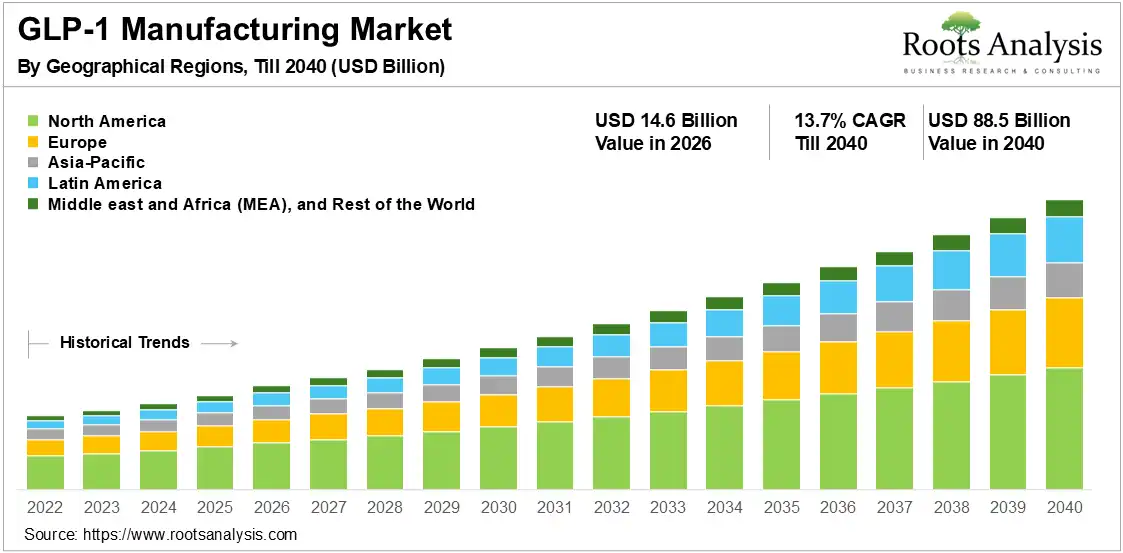
The global GLP-1 manufacturing market is expected to rise from USD 14.6 billion in 2026 to reach USD 88.5 billion by 2040, growing at a CAGR of 13.7% over the forecast period 2026 to 2040, driven by chronic obesity and cardiometabolic demand.
See What’s in the Full Report – Request Your Complimentary Insights!
Market Report: Key Takeaways
- Based on manufacturing stage, drug substance / peptide API synthesis captures 35.0% market share in 2026, whereas device assembly and secondary packaging registers a 16.5% CAGR through 2040, driven by pen and combination-product scale-up.
- Based on manufacturing technology, solid-phase peptide synthesis captures 52.0% market share in 2026, whereas continuous / flow-based peptide manufacturing registers an 18.8% CAGR through 2040, driven by throughput and solvent-efficiency gains.
- Based on dose form / delivery format, injectable pens capture 45.0% market share in 2026, whereas oral tablets register a 23.0% CAGR through 2040, driven by needle-free obesity treatment access.
- Based on participant / service type, in-house originator manufacturing captures 42.0% market share in 2026, whereas drug delivery device manufacturers register a 15.9% CAGR through 2040, driven by device capacity diversification.
- Based on geography, North America captures 45.0% market share in 2026, whereas Asia-Pacific registers an 18.2% CAGR through 2040, driven by localization of manufacturing and supply chains.
GLP-1 Manufacturing Market Outlook
GLP-1 supply has moved from concentrated originator capacity into a wider manufacturing race across peptide API, fill-finish, and device assembly. Demand now comes from diabetes, obesity, cardiovascular risk, kidney risk, MASH, and sleep apnea programs. The GLP-1 manufacturing market remains capacity-constrained because SPPS, purification, sterile cartridges, pens, and oral tableting require specialized assets. Competitive advantage now depends on secure, scalable, inspected manufacturing control across originator and outsourced networks.
Current growth reflects peptide API scarcity, weekly injectable adoption, and policy pressure for resilient pharmaceutical supply chains. FDA’s June 2026 PreCheck pilot selected Eli Lilly and other firms to accelerate reviews of new domestic manufacturing facilities, including Lilly’s Lebanon, Indiana weight-loss ingredient facility. This program links GLP-1 manufacturing market growth with facility readiness, regulatory review speed, domestic capacity planning, and stronger procurement confidence for buyers.
Through 2040, the market will remain high-growth while shifting toward oral GLP-1 manufacturing, automated peptide synthesis, flow-based production, and device platform diversification. Oral tablets will outpace other formats as manufacturers reduce injection-device dependence and expand needle-free obesity access. Novo Nordisk’s March 2026 Ireland tableting expansion supports current and future oral GLP-1 treatments. Long-term growth remains strong, but execution risk stays concentrated in capacity, quality, and supply assurance.
GLP-1 Manufacturing Market Dynamics
GLP-1 Manufacturing Market Drivers
Peptide API capacity now drives near-term market growth because SPPS, purification, and lyophilization remain technically constrained. Drug substance / peptide API synthesis holds 35.0% share in 2026, while sterile fill-finish grows at 15.4% CAGR through 2040. Demand also broadens beyond diabetes into obesity, MASH, sleep apnea, and cardiometabolic risk.
GLP-1 Manufacturing Market Restraints
Supply access remains constrained by capital intensity, quality systems, solvent-heavy peptide chemistry, and limited inspected capacity. Solid-phase peptide synthesis holds 52.0% share in 2026 because proven reactor trains still anchor commercial production. This dependence narrows supplier choice for semaglutide, tirzepatide, and next-generation incretin programs. Compounded semaglutide scrutiny also raises compliance risk, as South Africa’s High Court blocked iDexis in June 2026 over registration and quality concerns.
GLP-1 Manufacturing Market Opportunities
Oral GLP-1 manufacturing creates the strongest format opportunity because tablets reduce device dependence and simplify distribution. Oral tablets grow at 23.0% CAGR through 2040, far above injectable pens and cartridges. Novo Nordisk announced a EUR 432 million tableting expansion in Ireland in March 2026 for current and future oral GLP-1 treatments. This shift opens capacity demand across formulation, compression, coating, analytics, and commercial packaging.
GLP-1 Manufacturing Market Challenges
Device assembly and secondary packaging create operational bottlenecks as weekly therapies scale across pens, autoinjectors, and cartridges. This stage grows at 16.5% CAGR through 2040, faster than API synthesis and purification. Manufacturers must qualify containment systems, manage supplier redundancy, and align device launch timing with drug approvals. Stevanato’s June 2026 Deora launch for incretin therapies shows how device platforms increasingly shape commercial readiness.
GLP-1 Manufacturing Market Size Estimation Methodology
- As a starting point, the forecast mapped the GLP-1 manufacturing market across peptide API synthesis, purification, lyophilization, drug product formulation, sterile fill-finish, oral-solid manufacturing, primary packaging, and device assembly. The baseline used verified 2026 segment shares and 2022 to 2026 demand progression from multiple credible secondary sources and industry data. It treated GLP-1 drug sales forecasts as demand pressure, not as direct manufacturing revenue.
- Moving forward, the model linked manufacturing demand to molecule type, dose format, and therapeutic application. It used drug approval timelines and clinical trial direction. It also separated diabetes, obesity, cardiovascular risk, kidney risk, MASH, and sleep apnea demand. FDA’s August 2025 Wegovy MASH approval helped support higher growth for metabolic liver disease manufacturing demand.
- Building on this, the analysis reviewed capacity announcements from originators, CDMOs, containment suppliers, and device manufacturers. These disclosures helped size shifts across in-house manufacturing, peptide API CDMO services, fill-finish CDMO services, and drug delivery device manufacturers. The model gave higher growth weights to oral tablets, flow-based peptide production, and device assembly because these segments gained share through 2040.
- Drawing upon these inputs, regional shares were tested against capital investment, domestic manufacturing policy, and supply-chain localization signals. North America led the 2026 base because originators concentrate strategic API, fill-finish, and device investments there. Asia-Pacific received the fastest regional growth profile because global firms are localizing manufacturing, supply management, and contract capacity. Regional checks also included announced India investment and Asia-Pacific localization signals.
- The projected value was then calculated through a bottom-up segment model and a top-down market-growth cross-check. Each segment received a 2026 share, a 2040 share, and an implied CAGR based on its role in the GLP-1 supply chain. The model reconciled higher-growth segments, including oral tablets and continuous manufacturing, with slower-growing legacy formats such as vials.
- Finally, the forecast was checked against regulatory submission counts, Drug Master File activity, CGMP readiness, investment announcements, and commercial launch signals. CPC Scientific’s May 2026 tirzepatide API Drug Master File filing supported the generic and follow-on API view. The final CAGR reflects capacity expansion, technology adoption, and indication-led demand through 2040.
GLP-1 Manufacturing Market Share Insights
Market Share by Dose Form / Delivery Format
According to our analysis, injectable pens lead because current GLP-1 treatment relies on recurring self-administration and established patient familiarity. Lilly received Indian approval for Mounjaro KwikPen in June 2025, expanding pen-based GLP-1 access.
Oral tablets will grow fastest as manufacturers pursue needle-free access, easier distribution, and lower device dependence. Novo Nordisk announced a EUR 432 million Ireland tableting expansion for oral GLP-1s in March 2026.
Market Share by Therapeutic Application
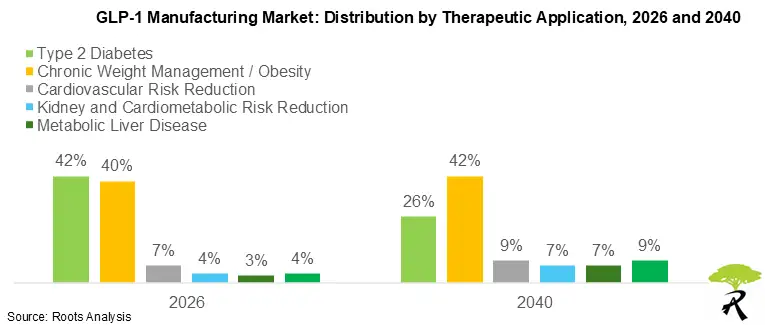
Type 2 diabetes leads because GLP-1s retain entrenched use across glycemic control and cardiometabolic risk management. Novo Nordisk reported CagriSema type 2 diabetes phase 3 data in February 2026.
Metabolic liver disease will grow fastest as MASH expands GLP-1 demand beyond diabetes and obesity. FDA approved Wegovy for adults with MASH and moderate-to-advanced fibrosis in August 2025.
Want Information on Specific Region / Segment?
Regional Analysis: North America Leads the Market and Asia-Pacific is Likely to Register Higher CAGR
Presently, North America holds 45.0% share in 2026. The region leads through originator capital access, FDA-grade manufacturing depth, peptide API scale-up, and device assembly ecosystems. Lilly’s January 2026 Pennsylvania facility shows how U.S. states are competing for GLP-1 manufacturing megaprojects.
On the contrary, Asia-Pacific registers an 18.2% CAGR from 2026 to 2040. Growth will come from contract manufacturing localization, rising obesity and diabetes treatment demand, and regional supply-chain diversification. Lilly’s October 2025 India investment shows global firms using Asian technical talent and contract manufacturing capacity.
Market Ecosystem Analysis
Across the provided 25-company scope, 12 Tier 1 leaders anchor commercial activity, while seven specialists and six emerging entrants fill capacity gaps. Vertical integration now dominates, as Novo Nordisk and Lilly expand controlled API, fill-finish, and oral GLP-1 supply. Acquisition-driven consolidation is rising in parallel, shown by CordenPharma’s May 2026 agreement to acquire AmbioPharm for peptide API capacity. The primary commercial force is capacity control after FDA shortage resolutions restricted mass compounding and shifted leverage back toward approved-drug manufacturers. Competitive advantage is shifting from molecule ownership alone to integrated peptide synthesis, purification, sterile filling, cartridges, and injection-device security.
- Novo Nordisk announced a USD 1.09 billion Brazil investment in April 2025 to expand injectable-drug production. The facility covers GLP-1 medicines such as semaglutide, strengthening Latin America manufacturing and export resilience. This pressures regional generic entrants because Novo can defend supply reliability, not only brand equity.
- Novo Nordisk’s 2025 annual report also showed DKK 60.1 billion in PP&E capex. The company linked this to API, fill-finish, injectable, oral product, aseptic, finished production, and packaging capacity. This strengthens in-house originator manufacturing across oral tablets, injectables, and finished-dose packaging.
- Eli Lilly announced a USD 6.5 billion Houston API facility in September 2025 for synthetic medicines, including orforglipron. The site strengthens the oral small-molecule GLP-1 segment and reduces dependence on peptide-only manufacturing bottlenecks. In October 2025, Lilly also committed over USD 1 billion to India manufacturing and supply through local drugmakers.
- Bachem highlighted in February 2025 that diabetes and obesity drugs were driving API demand beyond current capacity. Its Bubendorf, Sisslerfeld, and Vista investments strengthen large-scale peptide API synthesis and metric-ton supply readiness. This raises the technical barrier for smaller peptide API suppliers lacking SPPS scale and waste-handling infrastructure.
- CordenPharma advanced more than EUR 1 billion in peptide manufacturing investment in March 2025. Its Basel-region greenfield and Colorado expansion strengthen GLP-1 and non-GLP-1 SPPS capacity. Its May 2026 AmbioPharm acquisition adds U.S. and Shanghai peptide API capacity, purification, and lyophilization depth.
- PolyPeptide invested EUR 110.0 million in 2025 and completed ramp-up of large-scale SPPS capacity in Belgium. This strengthens metabolic peptide supply and improves customer confidence in outsourced commercial API manufacturing. Cambrex expanded Snapdragon Chemistry’s Waltham API facility in August 2025, adding GMP peptide manufacturing via SPPS, LPPS, and hybrid approaches.
- Thermo Fisher completed its acquisition of Sanofi’s Ridgefield, New Jersey sterile fill-finish and packaging site in September 2025. This adds U.S. drug-product capacity for pharma and biotech customers. The move strengthens fill-finish CDMO positioning for vials, syringes, cartridges, and packaged injectable products.
- SCHOTT Pharma broke ground in June 2025 on a Hungary facility for sterile ready-to-use cartridges. The company linked the investment to GLP-1, insulin, biologics, diabetes, and obesity demand. This increases the barrier for device competitors because cartridge quality and fill compatibility directly affect rejection risk.
- Ypsomed announced in July 2025 that Innovent’s dual GCG/GLP-1 obesity drug launched in China using an Ypsomed autoinjector. Ypsomed also linked the launch to its Changzhou manufacturing site and China-for-China supply strategy. This strengthens autoinjector positioning for dual incretin and China obesity applications.
Startup Companies and their Key Highlights
- HYBIO Pharmaceutical
- Event type: NMPA registration of semaglutide API
- Month and year: January 2026
- Stated purpose of the event: Support formulation development and industrial-scale production for semaglutide.
- Market implication: Accelerates follow-on GLP-1 API supply in China and raises competition in generic semaglutide manufacturing.
- CPC Scientific
- Event type: U.S. FDA DMF filing for self-developed tirzepatide API
- Month and year: May 2026
- Stated purpose of the event: Let formulation partners reference CPC’s DMF data for relevant U.S. FDA applications.
- Market implication: Accelerates GLP-1/GIP dual agonist API commercialization support for formulation partners worldwide.
- PeptiSystems
- Event type: Growth equity investment
- Month and year: November 2025
- Lead investor or strategic partner name: Rubicon Healthcare Partners
- Stated purpose of the event: Accelerate global expansion and meet demand for scalable pharmaceutical manufacturing solutions.
- Market implication: Strengthens automated flow-through peptide synthesis infrastructure for CDMOs and peptide drug developers.
- Snapdragon Chemistry Pharmaceutical
- Event type: Peptide API facility expansion
- Month and year: August 2025
- Stated purpose of the event: Support development and manufacturing of peptide therapies from development to GMP production.
- Market implication: Accelerates continuous-flow, LPPS, SPPS, and hybrid peptide manufacturing for lower-cost peptide scale-up.
- Medtide
- Event type: Hong Kong Stock Exchange listing
- Month and year: June 2025
- Stated purpose of the event: Leverage global capital, strengthen peptide CRDMO services, and expand global sales.
- Market implication: Accelerates China-U.S. peptide CRDMO capacity for peptide APIs, CMC support, and commercial production.
GLP-1 Manufacturing Market Trends / Opportunities
Peptide API Megaprojects Reshaping GLP-1 Manufacturing Market Capacity Control
Peptide drug substance capacity is becoming a strategic control point because API synthesis holds the largest 2026 manufacturing-stage share. CordenPharma agreed in May 2026 to acquire AmbioPharm, adding peptide API capacity in North Augusta and Shanghai. This strengthens integrated CDMO positioning for originators that need redundant peptide supply and faster tech transfer options. It also increases buyer reliance on integrated peptide networks.
Large in-house API projects show that innovators will keep strategic manufacturing close when molecule economics justify capital spending. Eli Lilly announced a USD 6.5 billion Houston facility in September 2025 for orforglipron active pharmaceutical ingredient production. This raises the entry threshold for smaller suppliers and favors CDMOs with proven peptide scale.
Oral GLP-1 Scale-Up Shifting Competition From Device Dependence to Tableting Capacity
Oral GLP-1 manufacturing is changing capacity priorities because tablets grow faster than injectable pens, autoinjectors, and cartridges. Novo Nordisk announced a EUR 432 million Monksland, Athlone expansion in March 2026 for oral GLP-1 tableting capacity. This shift rewards manufacturers with formulation, tableting, coating, analytics, and commercial oral-solid expertise. It also widens demand for validated oral production lines.
Orforglipron investments show how small-molecule GLP-1 agonists can reshape manufacturing location strategy. Eli Lilly announced a more than USD 1.2 billion Puerto Rico expansion in October 2025 to support oral GLP-1 production. The commercial implication is lower reliance on injection devices and more competition for oral-solid capacity.
Device Platform Diversification Tightening GLP-1 Manufacturing Market Supply Partnerships
Pen and autoinjector platforms are becoming launch-critical because device assembly grows faster than peptide API synthesis through 2040. Stevanato introduced Deora in June 2026 for incretin-based diabetes and weight-management therapies. This gives device suppliers stronger influence over originator timelines, procurement terms, lifecycle planning, and format differentiation.
Cartridge and containment capacity is tightening because GLP-1, insulin, and hormone therapies compete for sterile ready-to-use formats. SCHOTT Pharma broke ground in June 2025 on a more than EUR 100 million cartridge expansion in Hungary. The competitive effect is closer alignment between drug developers, containment suppliers, and fill-finish partners. It also raises the value of supplier redundancy.
Your Business is Unique – Why Shouldn’t Your Report Be?
Market Access Considerations
FDA PreCheck and Domestic Facility Review Pathways
Domestic facility readiness now shapes market access because regulators can influence construction, review timing, and launch sequencing. FDA’s June 2026 PreCheck pilot selected Eli Lilly and other manufacturers to speed reviews of new domestic facilities. Companies with inspected U.S. assets gain stronger access to launch-critical capacity. Firms without regulatory-ready sites face slower commercialization, weaker supply credibility, longer partner diligence cycles, and reduced negotiating power during long-term supply contracting.
Drug Master File and CGMP Peptide API Readiness
Drug Master File readiness determines whether follow-on GLP-1 API suppliers can enter regulated markets at commercial speed. CPC Scientific completed a U.S. FDA DMF filing for tirzepatide API in May 2026 from its Hangzhou CGMP facility. This type of filing supports buyer diligence, quality review, and supplier qualification. Suppliers without comparable documentation face longer technical audits, higher sampling requirements, lower procurement confidence, and weaker long-term supply agreements with regulated buyers.
Compounded Semaglutide Quality and Registration Exposure
Quality enforcement constrains unauthorized or weakly controlled GLP-1 supply because regulators and courts scrutinize registration, safety, and compliance. South Africa’s High Court blocked iDexis in June 2026 from manufacturing and selling compounded semaglutide weight-loss medicines. This behavior protects originator control and raises barriers for informal supply channels. Commercial access depends on compliant manufacturing status, validated quality systems, defensible product authorization, documented release testing, and traceable distribution controls across approved commercial channels.
Device Qualification and Containment Supplier Availability
Device qualification shapes access because GLP-1 launches require aligned pens, cartridges, prefilled syringes, and secondary packaging capacity. Ypsomed supported Innovent’s July 2025 mazdutide launch in China with an YpsoMate 1.0 autoinjector variant. Qualified device partners reduce launch risk and strengthen regional commercialization. Companies with limited device redundancy face timeline slippage, higher procurement costs, weaker negotiating power, and narrower launch-format flexibility across regional product rollouts.
How Stakeholders Benefit from the Key Focus Areas of Our GLP-1 Manufacturing Market Report
GLP-1 manufacturing now matters because obesity, diabetes, and cardiometabolic indications are stretching peptide API, fill-finish, oral-solid, and device capacity. The report supports capital allocation, supplier selection, technology prioritization, and regional expansion decisions.
- Unmet Needs and Market Gaps in GLP-1 Manufacturing Market: The report identifies gaps across peptide API synthesis, purification, sterile fill-finish, oral tableting, and device assembly. Teams planning capacity investments can see where technical bottlenecks create defensible entry points. The analysis supports decisions on whether to prioritize API, oral-solid, cartridge, pen, or autoinjector capacity.
- Funding and Venture Investment Opportunities in GLP-1 Manufacturing Market: The report tracks where investment signals cluster across originator megaprojects, CDMO capacity, containment systems, and device platforms. Capital teams can compare high-growth segments such as oral tablets, continuous manufacturing, and device assembly. This supports decisions on acquisition targets, expansion timing, and exposure to capacity-constrained value pools.
- Technology Innovation and Adoption Trends: The report explains how SPPS, hybrid synthesis, automated peptide synthesis, and continuous or flow-based manufacturing change the cost curve. Technical teams can assess which platforms gain share through throughput, solvent efficiency, and purification improvements. This supports decisions on process investment, equipment selection, and supplier technology screening.
- GLP-1 Manufacturing Market Competitive Landscape and Industry Analysis: The report maps Tier 1 leaders, Tier 2 specialists, and emerging suppliers across API, CDMO, fill-finish, packaging, and delivery-device roles. Commercial teams can identify which companies control scarce assets and which suppliers support specific formats. This supports decisions on partnership outreach, account prioritization, and competitive positioning.
- Mapping Strategic Partnerships and Ecosystem Synergies: The report shows how originators, peptide CDMOs, containment suppliers, and device manufacturers align around launch readiness. Teams evaluating supplier ecosystems can see how acquisitions, platform launches, and facility expansions change bargaining power. This supports decisions on preferred partners, redundancy planning, and regional manufacturing alliances.
- GLP-1 Manufacturing Market CAGR and Growth Trends: The report quantifies 13.7% overall CAGR through 2040 and compares segment-level growth across regions, formats, technologies, and service types. Planning teams can separate current scale leaders from faster-growing pools such as Asia-Pacific, oral tablets, and device manufacturers. This supports decisions on budget allocation, market entry sequencing, and long-term portfolio focus.
GLP-1 Manufacturing Market: Scope of the Report
| Key Report Attributes | Details | |
| Forecast Period | Till 2040 | |
| Market Size 2026 | USD 14.6 Billion | |
| Market Size 2040 | USD 88.5 Billion | |
| CAGR (Till 2040) | 13.7% | |
| Segments Covered |
|
|
| Geographical Regions Covered |
|
|
| Key Sections Covered |
|
|
Market Segmentation
The GLP-1 Manufacturing Market report presents an in-depth analysis, highlighting the capabilities of various stakeholders, based on different segments, such as manufacturing stage, manufacturing technology, dose form / delivery format, molecule / product type, participant / service type, therapeutic application, geographical regions, and leading players.
By Manufacturing Stage
- Drug substance / Peptide API Synthesis
- Downstream Purification
- Lyophilization
- Drug Product Formulation
- Sterile Fill-Finish
- Device Assembly and Secondary Packaging
By Manufacturing Technology
- Solid-Phase Peptide Synthesis
- Liquid-Phase Peptide Synthesis
- Hybrid Solid / Solution-Phase Synthesis
- Fragment-Based Peptide Synthesis
- Automated Peptide Synthesis Systems
- Continuous / Flow-Based Peptide Manufacturing
By Dose Form / Delivery Format
- Injectable Pens
- Autoinjectors
- Prefilled Syringes
- Cartridges
- Vials
- Oral Tablets
By Molecule / Product Type
- GLP-1 Receptor Agonists
- Dual GIP / GLP-1 Receptor Agonists
- Dual GCG / GLP-1 Receptor Agonists
- Triple Incretin Agonists
- Oral Small-Molecule GLP-1 Agonists
- Generic / Follow-On GLP-1 APIs
By Participant / Service Type
- In-House Originator Manufacturing
- Peptide API CDMO Services
- Fill-Finish CDMO Services
- Primary Packaging and Containment Suppliers
- Drug Delivery Device Manufacturers
- Analytical, Regulatory and Quality-Support Providers
By Therapeutic Application
- Type 2 Diabetes
- Chronic Weight Management / Obesity
- Cardiovascular Risk Reduction
- Kidney and Cardiometabolic Risk Reduction
- Metabolic Liver Disease
- Sleep Apnea and Obesity-Related Comorbidities
By Geographical Regions
- North America
- US
- Canada
- Mexico
- Rest of North America
- Europe
- Austria
- Belgium
- Denmark
- France
- Germany
- Ireland
- Italy
- Netherlands
- Norway
- Russia
- Spain
- Sweden
- Switzerland
- UK
- Rest of Europe
- Asia-Pacific
- China
- India
- Japan
- Singapore
- South Korea
- Rest of Asia-Pacific
- Latin America
- Argentina
- Brazil
- Chile
- Colombia
- Venezuela
- Rest of Latin America
- Middle East and Africa (MEA)
- Egypt
- Iran
- Iraq
- Israel
- Kuwait
- Saudi Arabia
- UAE
- Rest of MEA
- Rest of the World


