
Lowest Price Guaranteed
Pages
195
Last Updated
July 2025
View Count
10768
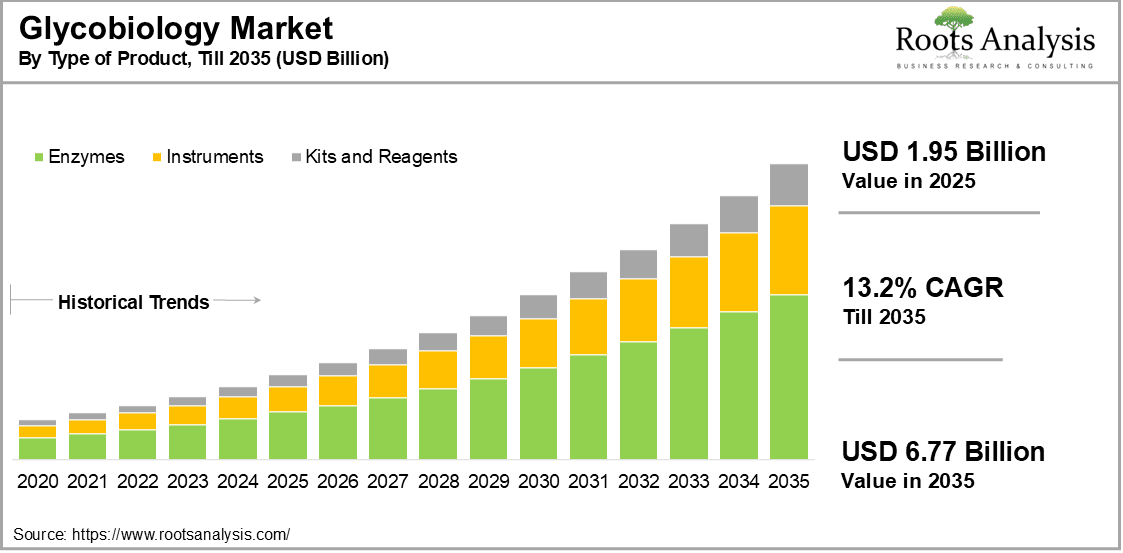
The global glycobiology market, valued at USD 1.68 billion in 2024, is projected to reach USD 1.95 billion in 2025 and USD 6.77 billion by 2035, representing a CAGR of 13.2% during the forecast period.
 |
To learn more about this report, request a free sample copy
Glycobiology refers to the study of glycans / carbohydrates linked to lipids and proteins that play a crucial role in biological processes. The study entails comprehensive examination of glycan structure and their correlation with cells. Glycobiology plays a significant role in understanding the underlying causes of diseases, such as autoimmune disorders, cancer and infectious diseases. Further, glycans can also be used as biomarkers for diagnosis, prognosis and identification of targets for tailored therapeutics.
Driven by the expanding application of glycobiology across diverse dimensions of pharmaceutical and healthcare industries, several market players have shown active interest in expanding research in this field and development of advanced glycan analysis technologies. For instance, in November 2024, Valora Therapeutics announced the successful closing of USD 30 million in seed funding round co-led by Avalon BioVentures, Bregua and TigerGene investors to transform immunotherapy by leveraging Glyco-immune checkpoint platform. Additionally, the company is focusing on sugar molecules / glycans and their specific mechanism that regulates them to develop immune therapies.
Furthermore, several industrial players are aiming to enhance glycoengineering technologies and therapies development. For instance, in December 2024, OBI Pharma (clinical-stage cancer therapies development company) signed a marketing and material transferring agreement with GlyTech (manufacturer of glycan and chemical glycosylation technologies). Under the Marketing agreement, OBI gran the right to market and promote OBI’s GlycOBI® ADC technology that are powered by EndoSymeOBI® to pharmaceutical and biotechnology partners in Japan. However, under the material transfer agreement, OBI will transfer the innovations to GlyTech for advancing the production of glycans for ADCs.
Driven by the growing initiatives in this field, we believe that the market will continue to grow at a steady rate during the forecast period.
The market report provides comprehensive information on glycobiology companies who are currently active across various segments of the industry as mentioned in the table below.
| Key Report Attributes | Details | |
| Historical Trend | Since 2020 | |
| Forecast Period | Till 2035 | |
| Market Size in 2025 | USD 1.95 Billion | |
| Market Size in 2035 | USD 6.77 Billion | |
| CAGR (Till 2035) | 13.2% | |
| Type of Product |
|
|
| Type of Technology |
|
|
| Application Area |
|
|
| End User |
|
|
| Geographical Regions |
|
|
| Key Companies Profiled |
|
|
| PowerPoint Presentation (Complimentary) |
Available | |
| Customization Scope | 15% Free Customization | |
| Excel Data Packs (Complimentary) | Available | |
One of the key objectives of the glycobiology market report was to estimate the current size, opportunity, and the market growth potential, over the forecast period, till 2035. We have provided informed estimates on the likely evolution of the market for the forecast period.
The market report also features the likely distribution of the current and forecasted opportunity within the market across various segments, such as type of product (enzymes (galactosidases (fructosidases, chitinases, acetylgalactosaminidase, heparinase, PNGase F, and others), GlcNAc transferases (acetylglucosaminyltransferase, exstosin and others), fucosyltransferases, GalNAc transferases, galactosyltransferases, pentosyltransferases, carbohydrate kinases neuraminidases sialyltransferases and others), instruments, and kits and reagents), type of technology (chromatography, mass spectrometry, electrophoresis, NMR (nuclear magnetic resonance)), application area (diagnostics, drug discovery and development, therapeutic applications, and other applications), end user (biopharmaceutical companies, research laboratories, hospitals, diagnostic centers, contract research organizations, biotechnology industries and other end users), geographical regions (North America, Europe, Asia-Pacific, Middle East and North Africa, and Latin America) and leading players.
In order to account for future uncertainties associated with some of the key parameters and to add robustness to our model, we have provided three glycobiology market forecast scenarios, namely conservative, base, and optimistic scenarios, representing different tracks of industry’s evolution.
All actual figures have been sourced and analyzed from publicly available information forums and primary research discussions. The financial figures mentioned in this market report are in USD, unless otherwise specified.
Based on the type of product, the global market is segment into enzymes (galactosidases (fructosidases, chitinases, acetylgalactosaminidase, heparinase, PNGase F, and others), GlcNAc transferases (acetylglucosaminyltransferase, exstosin and others), fucosyltransferases, GalNAc transferases, galactosyltransferases, pentosyltransferases, carbohydrate kinases neuraminidases sialyltransferases and others), instruments, and kits and reagents. According to our glycobiology market report, presently, enzymes segment accounts for the highest share (56%) of the market. This can be attributed to the fact that enzymes, such as galactosidase, play a significant role in metabolizing carbohydrates and modifying carbohydrates, making it a comprehensive tool to understand the function and structure of carbohydrates.
However, in the future, the kits and reagents segment is anticipated to register a higher CAGR during the forecast period. This lucrative growth is due to the growing requirement for easy to use and standardized processes for glycomics and diagnostics.
The global market is distributed across different types of technology, such as chromatography, mass spectrometry, electrophoresis, NMR (nuclear magnetic resonance). According to our projection, currently, mass spectrometry has emerged as the dominant segment in the market. This dominance is due to the fact that mass spectrometry offers higher accuracy, sensitivity and high throughout in glycan analysis, which increases its adoption across pharmaceutical industry.
It is worth mentioning that the chromatography segment is likely to register a higher CAGR during the forecast period. This lucrative growth is due to the increasing advanced in column technology for high throughput and expanding usage across glycomics research.
Based on the application area, the global market is segmented into diagnostics, drug discovery and development, therapeutic applications, and other applications. According to glycobiology market analysis, presently drug discovery and development segment hold 55% share of the market. It is important to highlight here that the trend of dominance is likely to remain unchanged during the forecast period. This is likely to be the result of increasing focus on glycan-based medication and development of glycan-based biomarkers to identify drug targets.
Furthermore, the therapeutic applications segment is likely to register the fastest CAGR during the forecast period. This unprecedented growth is due to the technological advancements in glycomics engineering and technology that aid in the development of personalized therapeutics.
This segment highlights the distribution of global market across different types of end user, such as biopharmaceutical companies, research laboratories, hospitals, diagnostic centers, contract research organizations, biotechnology industries and other end users. Presently the biopharmaceutical companies segment accounts for the highest share (over 25%) of the glycobiology market.
This can be attributed to the growing usage of enzymes, reagents and kits for the glycan analysis to develop advanced therapies in biopharmaceutical companies. Driven by the growing adoption of glycobiology and its products in biopharmaceutical companies, this segment is likely to grow at a higher CAGR during the forecast period.
Based on the geographical regions, the global market is distributed across North America, Europe, Asia-Pacific, Middle East and North Africa, and Latin America. Presently, North America accounts for the highest share (41%) of the market for glycobiology. This can be attributed to the increasing research on glycomics and technological innovations to expand the development of glycan-based medicines. Additionally, the favorable regulatory guidelines for research on glycomics has further fueled the market growth in this region.
In Asia-Pacific, the market for glycobiology is expected to grow at a higher CAGR during the forecast period. This can be attributed to the increasing awareness about glycans and their potential role in disease diagnosis and drug development.
The “Glycobiology Market: Industry Trends and Global Forecasts, till 2035” report features an extensive study of the current market landscape, market size, market share, market growth, market trends, market value, market forecast, market outlook, statistics, and future opportunities for glycobiology companies. The market research report lays emphasis on the glycobiology products that are being developed. Key takeaways of the market report are briefly discussed below.
Presently, the market landscape is moderately competitive, featuring the presence of several small, mid-sized and large companies. Key players of the industry, such as Agilent Technologies, CD BioGlyco, Danaher and Thermo Fisher Scientific are undertaking strategic initiatives for breakthrough innovations followed by new products, instruments and reagents launch in this field.
For instance, in October 2024, CD BioGlyco (an innovator in glycobiology products and services) announced the launch of the latest line of high-quality enzymes that are specifically designed for glycans research purposes. The expansion of product portfolio further features a diverse range of glycosyltransferases, endoglycosidases and exoglycosidase.
Overall, the market players are consistently focusing on leveraging technological expertise to expand research on glycans, which is expected to maintain competitiveness in this field over the forecast period.
The market is propelled by the growing expansion of biomedical research specifically to understand the role of glycan in autoimmune disorders, cancer, and infectious diseases. Additionally, the increasing technological innovations, such as glycan microarrays, high-resolution mass spectrometry and bioinformatic tools to improve glucan analysis has further fueled the market growth.
Furthermore, glycomics is crucial for drug development as it helps in the identification of glycan targets for tailored therapies. Additionally, the rising prevalence of infectious diseases has necessitated the demand for personalized medicine that further underscored the requirement for glycan-based medication development.
Despite of significant growth, the market for glycobiology is witnessing several challenges that needs to be addressed. Some of the notable challenges are lack of standardization and complexity of glycan structure. Notably, the glycans are heterogenous and have complex structure, which creates difficulty on analysis.
It is worth mentioning that the lack of standardization of research materials and techniques for glycan analysis further create challenges in the research. Furthermore, high cost associated with reagents, instruments and kits may further limit the adoption across pharmaceutical industry.
Some of the notable growth trends that are shaping industry growth includes rising demand for precision medicine, shift towards bioinformatics and research initiatives. It is worth noting that glycomics play a significant role in the development of patient-specific glycan biomarkers that are used for diagnosing diseases, prognosis and drug development. This trend of precision medicine has bolstered the demand for glycomics technologies, which is further anticipated to create enormous opportunities for industrial players to drive innovations.
Additionally, the increasing advancements in data analytics and bioinformatics have further created opportunities for industrial players to integrate large-scale glycomics data with omics data for thorough examination of glycan structures. Furthermore, the increasing research on glycan biomarker and glycomics research has further offered enormous opportunities for industrial players to drive innovation in this field.
Currently, the global market for glycobiology is valued at USD 1.95 billion in 2025 and is poised to reach USD 6.77 billion by 2035, representing a CAGR of 13.2% during the forecast period. This lucrative growth is likely to be the result of increasing research on glycomics.
To leverage the competitive edge, several industrial players are driving innovations, investments and partnerships in this field. For instance, in December 2024, GlycoNet (global leader in glycomics research and innovations) announced an investment of around USD 4.5 million for 21 research projects that are currently focusing on unsolved health challenges through the study of glycans / biological sugars.
Examples of key players engaged in this domain (which have also been captured in this report) include Agilent Technologies, Asparia Glycomics, Bruker, Danaher, New England Biolabs, Merck, Promega, RayBiotech Life, Shimadzu, Takara Bio, Thermo Fisher Scientific and Waters. This market report includes an easily searchable excel database of all the companies focusing on the development of glycobiology products.
The market report presents an in-depth analysis, highlighting the capabilities of various companies engaged in this domain across different segments. Amongst other elements, the market report includes:
Several recent developments have taken place in the field of glycobiology. We have outlined some of these recent initiatives below.