


 Download Free Sample
 Buy Now
Healthcare Cybersecurity Market Overview
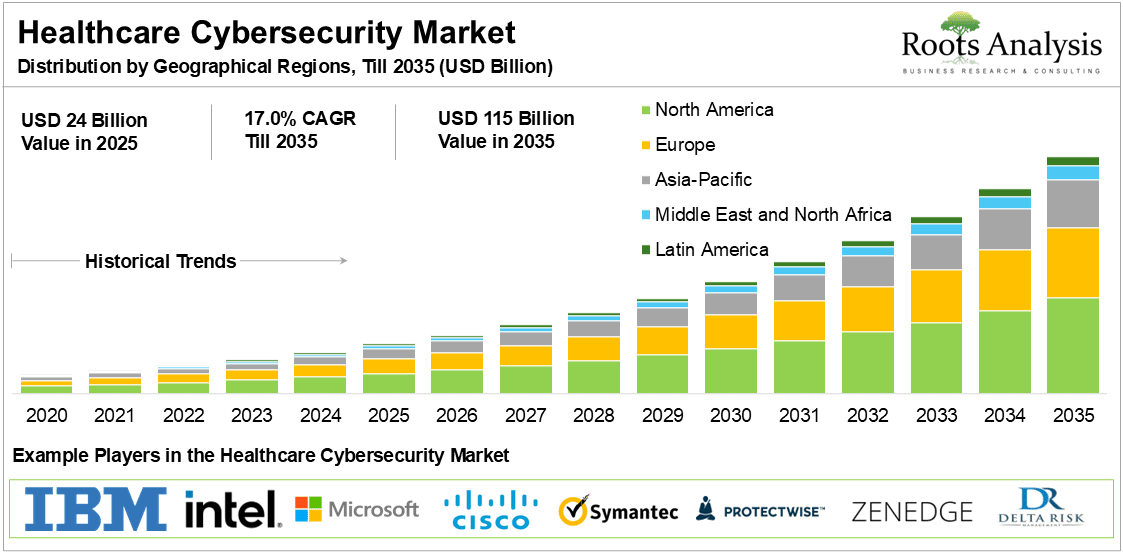
The healthcare cybersecurity market size is estimated to grow from USD 20 billion in 2024 to reach USD 24 billion in 2025 and USD 115 billion by 2035, representing a higher CAGR of 17.0% during the forecast period.
 |
To learn more about this report, request a free sample copy
Healthcare Cybersecurity Industry: In Summary
- The global healthcare cybersecurity market is experiencing significant growth, projected to expand from USD 24 billion in 2025 to USD 115 billion by 2035, demonstrating a robust CAGR of 17.0%. This rapid expansion is primarily driven by the escalating threat of data breaches, increased adoption of digital health technologies, and stringent regulatory compliance requirements.
- Widespread adoption of electronic health records (EHRs), telemedicine, Internet of Medical Things (IoMT) devices, and cloud-based solutions in healthcare necessitate enhanced cybersecurity.
- Rising data breaching activities: Over 22,000 security breaching incidents occurred across diverse sectors in 2025, with healthcare experiencing 1,710 incidents resulting in sensitive patient data exposure. Ransomware attacks alone surged by 37% since 2024.
- Regulations like HIPAA, GDPR, HITECH Act, and new USFDA cybersecurity requirements for medical devices compel organizations to invest in robust cybersecurity solutions.
- North America currently holds the largest share (40.20%) of the global healthcare cybersecurity market, underscoring its maturity and the significant investment in protecting digital health infrastructure. This dominance is driven by a highly digitized healthcare ecosystem, stringent regulatory compliance requirements (like HIPAA in the US), and a high volume of sophisticated cyber threats targeting sensitive patient data across the region.
- The cloud segment is estimated to register a higher CAGR during the forecast period. This accelerated growth is primarily fueled by the increasing adoption of cloud-based healthcare solutions, which offer scalability, cost-effectiveness, and enhanced accessibility to patient data.
- Network security segment is likely to show lucrative growth, expecting to register a higher CAGR during the forecast period. This strong performance is driven by the fundamental need to secure vast and complex healthcare networks, which are increasingly vulnerable to sophisticated attacks like ransomware and distributed denial-of-service (DDoS).
- The market landscape for healthcare cybersecurity is highly competitive, and majority of the industrial players, including IBM (US), Microsoft (US), and Censinet (US) are undertaking strategic initiatives to develop advanced healthcare cybersecurity solutions.
- In February 2025, Censinet (US) entered into a collaboration with Amazon Web Services (US) to launch a new suite of advanced AI capabilities to transform (GRC) Governance, Risk and Compliance and cybersecurity risk management within the healthcare industry. Such alliances are vital for integrating cutting-edge AI to enhance threat detection, automate risk assessments, and streamline compliance processes in an increasingly interconnected and vulnerable healthcare landscape.
- The future of the healthcare cybersecurity industry seems promising with increasing focus on enhancing cybersecurity measures, multi-factor authentication, and integration of AI technology.
Healthcare Cybersecurity Market Introduction
Cyber security for healthcare industry has become a vital component, as the threat of data breaches, hacking, and cybercrime continues to grow. According to the Verizon Data Breach Investigation report, in 2025, over 22,000 security breaching incidents occurred across diverse sectors, including the healthcare industry. Notably, ransomware attacks have significantly rose by 37% since 2024 and 1,710 security breaching incidents have been experienced in the healthcare industry that result into exposure of patient’s sensitive data. For sensitive genomic information, blockchain in genomic data management can provide auditable permission and access records alongside established cybersecurity controls.
With increasing incidence of data stealing activities, there is high demand for healthcare cyber security measures. Moreover, the adoption of digital healthcare technologies, such as wearable medical devices and remote patient monitoring, the need for robust cybersecurity measures has become more pressing than ever. Interestingly, the importance of information security in healthcare lies in its ability to protect sensitive information, maintain employee productivity, and enhance customer confidence in products and services.
With ongoing surge, healthcare cybersecurity providing companies are focusing on the development of advanced security solutions and technologies. Multiple factor authentication, zero tolerance architecture and cloud security measure are expected to be the primary solutions where the companies are investing heavily. Furthermore, several companies and government organizations are leveraging partnership and acquisition to strengthen cybersecurity measures. For instance, in May 2025, the Department of Health-Abu Dhabi and CPX (UAE) signed MoU (memorandum of understanding) to advance their cybersecurity and digital resilience in healthcare sector.
Additionally, the top tier cybersecurity solutions providing companies, including IBM (US), Cisco Systems (US), Fortinet (US), and Palo Alto Networks (US) are currently accelerating technological innovations, integrating IoMT (Internet of Medical Things) measures along with artificial intelligence to make cybersecurity in healthcare industry more robust. The consistent efforts towards innovations and rising partnerships reflect a steady growth of healthcare cybersecurity market in the upcoming years, offering enormous opportunities to industrial players.
Healthcare Cybersecurity Market: Report Attributes
| Key Report Attribute | Details | |
| Historical Trend | Since 2020 | |
| Forecast Period | Till 2035 | |
| Market Size 2025 | USD 24 Billion | |
| Market Size 2035 | USD 115 Billion | |
| CAGR (Till 2035) | 17.0% | |
One of the key objectives of the healthcare cybersecurity market report was to estimate the current size, opportunity, and the market growth potential, over the forecast period, till 2035. We have provided informed estimates on the likely evolution of the market for the forecast period.
Want Information on Specific Region/Segment?
The healthcare cybersecurity market analysis report also features the likely distribution of the current and forecasted opportunity within the market across various segments, such as type of offering, type of threat, type of solution, type of security, deployment mode, end users, geographical region and leading players.
In order to account for future uncertainties associated with some of the key parameters and to add robustness to our model, we have provided three market forecast scenarios, namely conservative, base, and optimistic scenarios, representing different tracks of industry’s evolution.
Recent Developments in Healthcare Cybersecurity Market
Several recent developments in the field of healthcare cybersecurity industry have occurred, and we outline some of these below.
- In April 2026, Nexus IT completed the acquisition of Imagis, expanding its national platform for regulated industries including healthcare.
- In March 2026, Abacus Group launched its unified brand following the 2025 Medicus IT merger, focusing on healthcare IT with bolstered cybersecurity, cloud services, and compliance.
- In March 2026, the Health Care Cybersecurity and Resiliency Act allocated $250M in HHS grants over five years to bolster healthcare cybersecurity, prioritizing rural providers with threat detection, training, and ransomware defenses.
- In June 2025, FDA finalized cybersecurity guidance for medical devices, mandating SBOMs, vulnerability plans, and premarket submissions.
Healthcare Cybersecurity Market Trends and Segmentation Insights
The market report provides comprehensive information on industrial players who are currently active across various segments of the industry as mentioned in the table below.
Healthcare Cybersecurity Market: Market Segmentation
| Market Segmentations | Details | |
| Type of Offering |
|
|
| Type of Threat |
|
|
| Type of Security |
|
|
| Deployment Mode |
|
|
| End User |
|
|
| Geographical Region |
|
|
| Market in North America |
|
|
| Market in Europe |
|
|
| Market in Asia-Pacific |
|
|
| Market in Middle East and Africa |
|
|
| Market in Latin America |
|
|
Healthcare Cybersecurity Market Share Insights
Market Share by Type of Offering: Solutions Holds the Highest Share
- The global market is segmented based on type of offering into solutions (identity and access management, risk and compliance management, antivirus and antimalware, DDOS mitigation, security information and event management, intrusion detection and prevention system, and others), and services. According to the healthcare cybersecurity market report, presently solutions segment holds the highest share, and the trend of dominance is likely to remain unchanged. This is likely due to the growing demand for filtering and monitoring network traffic and protecting connected infrastructure. Solutions, such as identity and access management, risk and compliance management are security information and event management for real-time threat monitoring are driving growth of solutions.
- However, in the future, services segment is likely to register at higher CAGR during the forecast period. The continuous shift towards hybrid healthcare security software, and cloud services are the key factors for increasing shift towards services for cybersecurity measures implementation.
Market Share by Type of Threat: Malware Lead the Healthcare Cybersecurity Market
- The global market is further bifurcated based on type of threat into malware, DDoS, advanced persistent threat, spyware, lost or stolen devices, and others. Currently, malware segment holds the highest share (over 25%) of healthcare cybersecurity market growth. The rising malware attacks, and data breaching incidences are likely to support the demand for healthcare cybersecurity measures to control malware activities.
- In future, advanced persistent threat segment is likely to grow at a higher CAGR during the forecast period. This is potentially due to the growing shift towards cloud-solution to store patient data. Notable, cloud solutions are prime targets for advanced persistent threat, therefore, there is high demand for standardized cybersecurity measures.
Market Share by Type of Security: Cloud Security Holds the Largest Share
- This segment is bifurcated into different type of security, such as cloud security, network security, application security, and endpoint security. Currently, cloud security holds the highest share (nearly 40%) of the healthcare cybersecurity market share. This is likely to be the result of the growing adoption of cloud solutions for storing and managing patient healthcare data. It is worth noting that cloud-security is essential to prevent ransomware and data breaching activities, which is likely to be a key reason for highest share.
- However, the network security segment is likely to show lucrative growth, expecting to register higher CAGR during the forecast period. The adoption of telehealth services and digital technologies requires secure network to prevent phishing activities during data transfer.
Market Share by Type of Deployment Mode: Cloud Segment Is Likely to Show Robust Growth in the Future
- This segment highlights the distribution of global market based on type of deployment mode, into cloud, hybrid and on-premises. Presently, the on-premises segment also holds the highest share (65%) of the healthcare cybersecurity market size. This is primarily due to the fact that on-premises deployment mode offers better control to the healthcare system for enhancing security measures.
- In the future, the cloud segment is anticipated to register a higher CAGR during the forecast period. This can be attributed to the growing adoption of cloud based cybersecurity for health industry to minimize the risk of data threats.
Have Questions? Let’s Get Them Answered.
Market Share by End User: Hospitals Holds the Maximum Share
- Based on the end user, the global market is segmented into pharmaceuticals, medical devices, payers, hospitals, and others. According to our market analysis, the hospitals segment is holding majority (48%) of the healthcare cybersecurity market share. This lucrative growth share is driven by increased data breach activities and regulatory requirements.
- However, in the future, the pharmaceuticals segment is likely to grow at a higher CAGR during the forecast period. This is potentially due to the growing IP protection needs for protecting data associated with drug discovery and clinical trials.
Market Share by Geographical Regions: North America Occupies the Dominating Position
- The global market is distributed into North America, Europe, Asia-Pacific, Middle East and Africa, and Latin America. According to the healthcare cybersecurity market analysis, North America holds the largest share (40%) of the market. This is driven by the rising investments in cybersecurity enhancement in healthcare infrastructure, and adoption of digital technologies.
- In Asia-Pacific, the market for cybersecurity in healthcare industry is anticipated to grow at a higher CAGR during the forecast period. Factors such as government initiatives, increasing focus on digital technologies to support remote patient monitoring and increasing cyberattacks are likely to increase the demand for healthcare cybersecurity.
Healthcare Cybersecurity Market: Report Deliverables
| Report Deliverables | Details | |
| Excel Data Packs (Complimentary) |
Available | |
| Key Healthcare Cybersecurity Companies Profiled |
(A complete list of companies captured is available in the report) |
|
| PowerPoint Presentation (Complimentary) |
Available | |
| Customization Scope | 15% Free Customization | |
Healthcare Cybersecurity Market Key Takeaways
The “Healthcare Cybersecurity Market Report: Industry Trends and Global Forecasts, till 2035” market report features an extensive study of the current market landscape, market size, market share, market growth, market trends, market value, market forecast, market outlook, statistics, and future opportunities for healthcare cybersecurity industry players. The market research report lays emphasis on the healthcare cybersecurity solutions that are being offered to healthcare sectors. Key takeaways of the market report are briefly discussed below.
Unlock Deeper Insights–Schedule Your Personalized Workshop Today!
Healthcare Cybersecurity Market Competitive Landscape
Healthcare cybersecurity market landscape is immensely competitive, featuring a mix of technology giants, well-established players and startup companies. Several companies, such as GE Healthcare Cybersecurity (US), Cisco Systems (US), Fortinet (US), and IBM Healthcare Cybersecurity (US) are leveraging partnerships to develop advanced cybersecurity measures for healthcare.
For instance, in February 2025, Censinet (US) entered into a collaboration with Amazon Web Services (US) to launch a new suite of advanced AI capabilities to transform (GRC) Governance, Risk and Compliance and cybersecurity risk management within healthcare industry.
Likewise, several other industrial players will be emphasizing technological innovations and cloud security parameters to enhance healthcare cybersecurity. The immense competitiveness within healthcare cybersecurity market presents compelling investment opportunities driven by regulatory requirements, escalating threats, and rapid digital transformation, making it one of the most attractive for investors seeking sustainable growth.
Healthcare Cybersecurity Market Drivers: How is the Market for Cybersecurity Expanding?
Rising Incidence of Data Breaching
The healthcare industry faces an unprecedented surge in data breaching incidence. As per the report of HIPAA journal, there were over 1 million healthcare records that have been compromised due to data breaching incidence within healthcare industry. This high incidence of data breaching underscores the urgent need for robust cybersecurity measures.
Growing Usage of Digital Technologies in Healthcare Industry
Furthermore, Healthcare organizations are rapidly adopting digital technologies including electronic health records (EHRs), telemedicine, Internet of Medical Things (IoMT) devices, and cloud-based solutions. The digital expansion has further prompted the risk of cyber-attacks, which further necessitated the demand for advance cybersecurity solutions.
In addition, stringent regulations such as HIPAA, GDPR, HITECH Act, and the USFDA cybersecurity requirements for medical devices are compelling healthcare organizations to invest in comprehensive cybersecurity solutions.
Healthcare Cybersecurity Market Challenges: How is Market Growth Impacted?
Lack of Skilled Healthcare Cybersecurity Personnel
Despite immense demand, the healthcare cybersecurity industry witness several challenges that impact market growth. Some of the noticeable challenges are the shortage of healthcare cybersecurity professionals in the industry. This skills gap is exacerbated by the specialized knowledge required for healthcare-specific regulations and systems.
Outdated Computing Systems That Lack Advanced Cybersecurity Features
Furthermore, several healthcare organizations are still running on outdated computing systems that lack modernized security features. These outdated systems may increase the risk of cyberattacks. Moreover, the budget constraints in healthcare industry to implement latest cybersecurity technologies may hinder the market growth.
Healthcare Cybersecurity Market Trends: What are the Future Growth Opportunities?
Integration of Artificial Intelligence and Machine Learning
Some of the potential trends that are propelling the market include integration of artificial intelligence and machine learning. Notably, several companies are leveraging AI for threat detection, predictive analytics and instant response to cyberattacks, which is expected to rise the demand for AI-driven security measures. It is worth mentioning that automation can help to detect threats on time and allow healthcare organizations to take prompt action.
Increasing Acceptance of Medical Devices
Notably, the increasing adoption of cloud-based healthcare solutions and proliferation of connected medical devices creates substantial opportunities for specialized security providers. Considering the ongoing demand, several companies focusing on cloud security posture management and internet of medical device IoT security are experiencing strong investor interest.
Furthermore, emerging technologies including quantum computing are beginning to impact healthcare cybersecurity, with quantum cryptography and quantum key distribution offering next-generation protection for sensitive healthcare data.
Regional Market Analysis: Which Region Shows Lucrative Growth in the Upcoming Years?
North America Healthcare Cybersecurity Market Share and Outlook 2025
Based on current growth scenarios, North America is dominating the global healthcare cybersecurity market. Several factors, such as advanced healthcare infrastructure, stringent regulatory requirements, and high cybersecurity spending. In addition, the increasing preferences for zero-trust security solutions for hybrid cybersecurity for healthcare field is likely to be a key reason for the highest share of this region.
Asia-Pacific Emerged as the Fastest Growth Region
The Asia-Pacific region is emerging as the fastest-growing market. The rapid adoption of digital healthcare technologies and rising government initiatives to increase cybersecurity measures in healthcare industry are the key drivers for highest growth in this region.
Healthcare Cybersecurity Market Size Analysis
In 2025, the global healthcare cybersecurity market is valued at USD 24 billion and is poised to reach USD 115 billion by 2035. The unprecedented growth is driven by the increasing data breaching concern in healthcare industry that necessitated the demand for connected medical device security solutions and services to protect valuable data.
Healthcare Cybersecurity Market Report Coverage
The market report presents an in-depth analysis, highlighting the capabilities of various stakeholders in healthcare cybersecurity solutions and services providing industry, across different geographies. Amongst other elements, the market report includes:
- An Infographic Executive Summary
- Regulatory Scenario
- Comprehensive Database of Leading Players
- Competitive Landscape
- Porter’s Five Forces Analysis
- Company Competitiveness Analysis
- Startup Ecosystem in the Healthcare Cybersecurity Market
- Company Profiles
- Patent Analysis
- Recent Developments
- Market Opportunity Analysis
- Adjacent Market Analysis
- Key Winning Strategies
- Value Chain Analysis
Get an Instant Quote in 10 Minutes.Lowest Price Guaranteed
Glossary
- Protected Health Information (PHI): Any information about health status, provision of healthcare, or payment for healthcare that is created or received by a covered entity and can be linked to a specific individual.
- Ransomware: A type of malicious software that encrypts data on a system, making it inaccessible until a ransom is paid, often in cryptocurrency. Healthcare organizations are particularly vulnerable due to the critical nature of their services and the high incentive to regain access to patient data quickly.
- HIPAA (Health Insurance Portability and Accountability Act): A US law that sets standards for protecting patient data. Healthcare providers must implement administrative, physical, and technical safeguards to comply. Non-compliance can lead to significant fines and legal consequences.
From the Author’s Desk
Author’s View on Healthcare Cybersecurity Market
The healthcare sector continues evolving and is likely to witness robust growth in the upcoming years. The alarming statistics from the 2025 Verizon Data Breach Investigations Report indicate a significant surge in ransomware attacks, which underscore the necessity to implement advanced healthcare cybersecurity measures to protect patient data. This ongoing technology transformation and their susceptibility to cyberattacks reflect the dynamic requirement of cybersecurity measures, which is expected to be a key reason for lucrative growth of cyber security in healthcare market.


