Healthcare RAG Market by Component (Software Platforms, AI Infrastructure, Data and Knowledge Assets, Implementation and Integration Services, and Managed Services and Support), Deployment Model, Application, Knowledge Source, Technology / Architecture, End User, Geographical Regions, and Leading Players – Trends and Forecasts, 2026-2040
Market Size
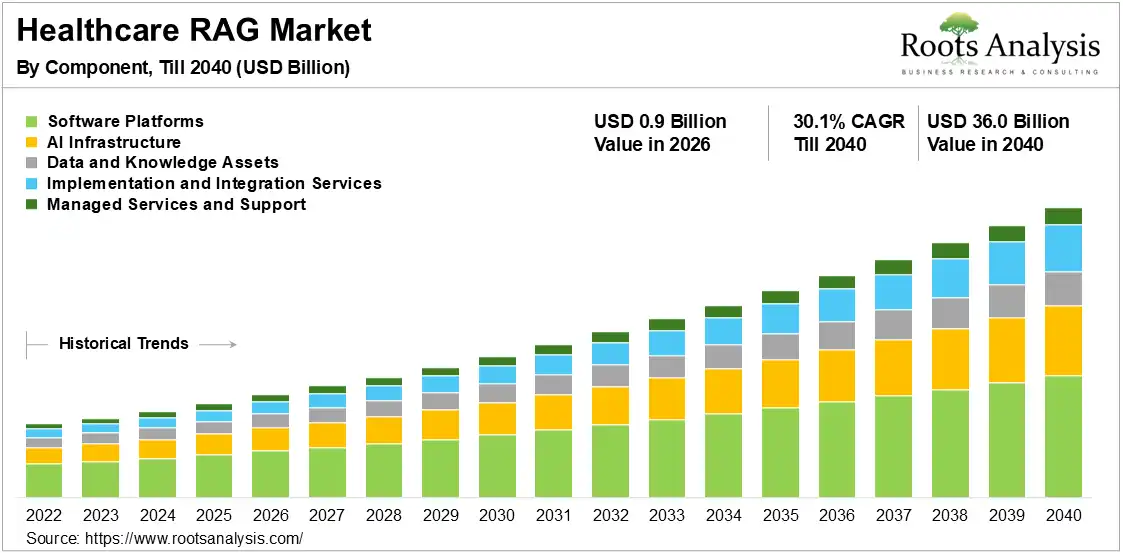
The global healthcare RAG market is expected to rise from USD 0.9 billion in 2026 and is projected to reach USD 36.0 billion by 2040, growing at a CAGR of 30.1% over the forecast period 2026 to 2040, driven by clinical trust, traceable answers, and EHR-grounded AI workflows.
See What’s in the Full Report – Request Your Complimentary Insights!
Market Report: Key Takeaways
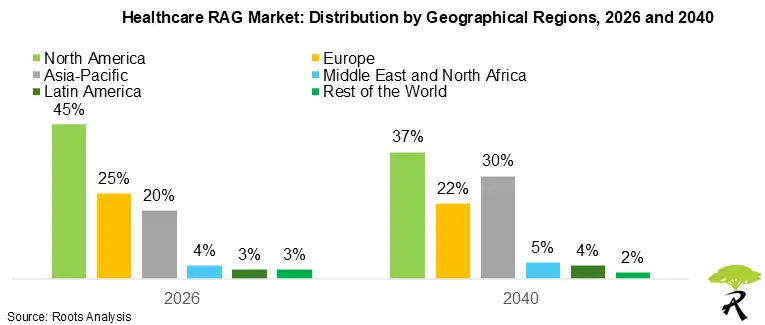
- Based on geography, North America captures 45.0% market share in 2026, whereas Asia-Pacific registers a 34.0% CAGR through 2040, driven by faster hospital digitization.
- Based on component, software platforms capture 43.0% market share in 2026, whereas AI infrastructure registers a 33.3% CAGR through 2040, driven by production retrieval scaling.
- Based on deployment model, cloud-based deployment captures 61.0% market share in 2026, whereas hybrid deployment registers a 35.1% CAGR through 2040, driven by protected health data controls.
- Based on application, clinical decision support captures 25.0% market share in 2026, whereas clinical trial matching and feasibility registers a 35.5% CAGR through 2040, driven by protocol complexity.
- Based on technology / architecture, vector-search RAG captures 38.0% market share in 2026, whereas agentic RAG registers a 36.8% CAGR through 2040, driven by workflow automation.
Healthcare RAG Market Outlook
Clinical trust is replacing experimentation as the main buying criterion for evidence-grounded medical AI. The Healthcare RAG market is moving from standalone search pilots toward electronic health records connected copilots, clinical knowledge retrieval AI, and governed agent workflows. Buyers now want citation-backed answers, protected health data controls, and workflow integration. Supply constraints center on validated knowledge assets, retrieval quality, and clinical governance rather than model access alone. This shift rewards platforms with auditable medical context.
Current growth comes from documentation pressure, guideline overload, and regulatory scrutiny around AI-enabled clinical software. FDA’s January 2025 draft guidance pushed lifecycle management and submission expectations into vendor roadmaps. Oracle Health added automated order creation to Clinical AI Agent in February 2026 across labs, imaging, prescriptions, and follow-up appointments. These moves convert RAG from search assistance into clinical workflow execution and accountability.
Through 2040, adoption will shift toward agentic RAG, multimodal clinical data, and hybrid deployment models. The market will remain high-growth as clinical trial matching, regulatory intelligence, and patient navigation expand beyond early decision-support use cases. NVIDIA launched BioNeMo Agent Toolkit in June 2026 for evidence gathering and computational experiment workflows. Long-term demand should favor vendors combining content, governance, clinical workflow automation, and scalable infrastructure.
Healthcare RAG Market Dynamics
Healthcare RAG Market Drivers
Traceable clinical answers now drive healthcare retrieval augmented generation market growth more than raw model performance. Software platforms hold 43.0% share in 2026, and clinical decision support holds 25.0% application share. Oracle reported in March 2025 that Clinical AI Agents reduced physician documentation time by 30 percent. That productivity signal supports faster budget approval across hospitals and health systems.
Healthcare RAG Market Restraints
Protected health data rules slow vendor onboarding because RAG tools must connect to EHRs, guidelines, claims, and patient records. FDA’s January 2025 draft guidance raised lifecycle-management expectations for AI-enabled software functions. On-premises deployment falls from 16.0% share in 2026 to 8.0% by 2040, showing limited appetite for fully local scaling. Integration costs will restrain smaller providers and point-solution vendors.
Healthcare RAG Market Opportunities
Clinical trial matching creates the clearest expansion path because eligibility review remains fragmented across protocols, notes, biomarkers, and imaging. The segment registers a 35.5% CAGR through 2040, outpacing clinical decision support and documentation. OpenEvidence raised USD 250 million in January 2026 at a USD 12 billion valuation for its AI medical knowledge platform. Funding signals support specialist platforms with trusted content and physician adoption.
Healthcare RAG Market Challenges
Evaluation complexity will intensify as systems move from vector-search RAG toward agentic and multimodal architectures. Agentic RAG grows at 36.8% CAGR through 2040, while medical imaging and multimodal clinical data grows at 38.1%. Anthropic introduced healthcare connectors in January 2026 across clinical-trial, PubMed, CMS, ICD-10, and NPI sources. Each new source adds retrieval testing, permissioning, auditability, and clinical-risk review.
Healthcare RAG Market Size Estimation Methodology
- As a starting point, the forecast treated Healthcare RAG market demand as the traceable retrieval layer inside healthcare generative AI. Multiple credible secondary sources provided RAG growth benchmarks, healthcare GenAI benchmarks, and adjacent clinical AI adoption indicators. The baseline separated evidence-grounded retrieval spend from broader model training, ambient documentation, and general analytics spend. This boundary kept the market focused on healthcare RAG.
- Moving forward, the model mapped demand across components, deployment modes, applications, knowledge sources, architecture, end users, and regions. EHR-connected workflows received the highest baseline weighting because electronic health records hold 32.0% knowledge-source share in 2026. Clinical decision support, documentation, and drug development use cases then anchored near-term revenue allocation. Cloud, hybrid, and on-premises splits were tied to data-control requirements.
- Building on this, segment growth rates were calibrated using healthcare-specific adoption signals, not generic enterprise AI enthusiasm. Inputs included clinical trial databases, clinical AI product launches, regulatory submission expectations, funding rounds, and healthcare cloud deployment evidence. Agentic RAG, multimodal RAG, and hybrid deployment received higher growth assumptions. These areas solve workflow, data-residency, and source-integration constraints.
- Drawing upon these, the regional model weighed North America higher in 2026. Mature EHR infrastructure, AI capital access, and FDA guidance support for earlier commercialization in that region. Asia-Pacific received the fastest growth curve because hospital digitization, localized language needs, and public-sector GenAI programs expand addressable demand. Europe was moderated for privacy controls, procurement timelines, and stronger data-governance requirements.
- The projected value was then tested against vendor activity across the supplied company database. OpenAI, Anthropic, Microsoft, Google Cloud, Amazon Web Services, Oracle Health, NVIDIA, and OpenEvidence shaped platform and infrastructure assumptions. The company database helped distinguish platform revenue, infrastructure revenue, and content-led clinical knowledge retrieval AI. This step reduced double counting across cloud services, software subscriptions, implementation services, and managed support.
- Finally, the long-term forecast applied share migration from early vector-search RAG toward hybrid retrieval and knowledge-graph RAG. Agentic RAG and multimodal clinical data workflows received separate uplifts because they expand clinical task automation. Share changes were checked against the 30.1% overall CAGR and faster segment CAGRs above 35.0%. The final model favors vendors that combine HIPAA-ready infrastructure, validated knowledge assets, retrieval evaluation, and clinical workflow integration.
Healthcare RAG Market Share Insights
Market Share by Deployment Model
According to our analysis, cloud-based deployment leads because providers need rapid provisioning, managed security, model access, and multi-site scaling. Microsoft unveiled Dragon Copilot in March 2025 for clinical documentation, information surfacing, and workflow automation.
On the contrary, hybrid deployment will expand as hospitals keep sensitive records governed locally while using scalable cloud intelligence. Fujitsu Japan announced in February 2026 a hospital GenAI project with information infrastructure and governance.
Market Share by Application
Clinical decision support leads because RAG grounds recommendations in patient context, guidelines, and auditable medical sources. Oracle announced in August 2025 an AI-driven EHR using agents for clinical meaning and in-the-moment insights.
Clinical trial matching and feasibility will grow fastest because eligibility review remains fragmented and labor-intensive. Triomics announced in October 2025 that MSK would deploy its AI clinical-trial screening platform.
Want Information on Specific Region / Segment?
Regional Analysis: North America Leads the Market and Asia-Pacific is Likely to Register Higher CAGR
Presently, North America holds 45.0% market share in 2026 and leads through mature EHR infrastructure, healthcare cloud depth, AI capital access, and clearer regulatory pathways. FDA issued final guidance in August 2025 on change control plans for AI-enabled devices.
On the contrary, Asia-Pacific registers a 34.0% CAGR from 2026 to 2040. Growth will accelerate through hospital digitization, localized language needs, public-sector AI programs, and workforce productivity pressure. Synapxe held AI Accelerate 2025 in April 2025, unveiling eight public healthcare GenAI minimum viable products.
Market Ecosystem Analysis
The Healthcare RAG ecosystem is concentrated across 25 scoped players, with 11 Tier 1 leaders driving most commercial visibility. Six specialists defend evidence, regulatory, and governed-RAG niches, while eight emerging entrants convert RAG into clinical workflow adoption. Platform convergence is the dominant consolidation dynamic, as model vendors, hyperscalers, EHR vendors, and content owners embed retrieval into clinical workflows. Competitive advantage is shifting from model access to governed evidence, EHR integration, auditability, and specialty-specific workflow execution.
- OpenAI launched OpenAI for Healthcare in January 2026, including ChatGPT for Healthcare and evidence retrieval with transparent citations. This raises the entry barrier for generic RAG tools because healthcare buyers now compare them against HIPAA-supporting enterprise workspaces. It strengthens clinical decision support, documentation, medical literature search, and institutional policy alignment applications.
- Anthropic introduced Claude for Healthcare in January 2026 with HIPAA-ready products and healthcare connectors. The move pressures smaller clinical copilots by pairing frontier models with PubMed, CMS, ICD-10, and clinical-trial data connectivity. It strengthens medical literature search, payer workflows, regulatory operations, and clinical trial management.
- Google Cloud enhanced Vertex AI Search for healthcare with multimodal AI in March 2025. The update added Visual Q&A and Gemini 2.0 within healthcare search workflows, improving retrieval from medical documents and images. This strengthens multimodal RAG, EHR search, and provider-facing clinical insight workflows.
- AWS launched Amazon Connect Health in March 2026 as agentic AI for patient engagement and point-of-care workflows. It integrates with EHRs for scheduling, verification, histories, documentation, and medical coding. This pressures standalone patient-access and documentation vendors by bundling RAG-like evidence mapping with cloud deployment.
- Oracle Health added automated order creation to Clinical AI Agent in February 2026. The feature uses ambient listening to draft labs, imaging, prescriptions, and follow-up orders for clinician review. This strengthens EHR-integrated clinical documentation and order-entry workflows, while raising integration expectations for RAG vendors.
- Microsoft expanded Dragon Copilot in October 2025 with nursing workflows and partner AI extensions. It enabled partner apps and agents inside Dragon Copilot, including clinical content from Elsevier, OpenEvidence, and UpToDate. This shifts competition toward embedded clinical intelligence ecosystems rather than separate point tools.
- Wolters Kluwer launched UpToDate Expert AI in September 2025 for GenAI clinical decision support. The product grounds answers in UpToDate’s evidence-based content and supports healthcare systems integrating AI responsibly. This strengthens curated clinical reference RAG and pressures general-purpose assistants on trust.
- Elsevier launched PharmaPendium AI in September 2025 for regulatory intelligence in drug development. It uses RAG and natural language processing across FDA and EMA regulatory documents. This strengthens drug development and regulatory intelligence, while raising the bar for citation-backed life-sciences RAG.
- OpenEvidence raised USD 250 million in January 2026 to scale its physician-focused AI medical knowledge platform. The funding supports R&D, compute, multi-agent architecture, and content licensing partnerships. This accelerates medical literature search and clinical decision support, especially in U.S. physician workflows.
Startup Companies and their Key Highlights
- OpenEvidence
- Event type and funding amount: Series D funding, USD 250 million
- Month and year: January 2026
- Lead investor or strategic partner name: Thrive Capital and DST co-led the round
- Stated purpose of the event: Funding R&D, compute costs, multi-agent architecture, and content licensing partnerships
- Market implication: Accelerates medical literature search and clinical decision support through licensed evidence and physician workflow penetration
- Abridge
- Event type and funding amount: Financing round, USD 300 million
- Month and year: June 2025
- Lead investor or strategic partner name: Andreessen Horowitz
- Stated purpose of the event: Improving revenue cycles and connecting clinicians with billing teams
- Market implication: Accelerates clinical documentation, revenue-cycle automation, and EHR-linked workflow RAG across U.S. health systems
- Nabla
- Event type and funding amount: Series C funding, USD 70 million
- Month and year: June 2025
- Lead investor or strategic partner name: HV Capital
- Stated purpose of the event: Building agentic AI for clinical workflows beyond ambient documentation
- Market implication: Accelerates clinical documentation, coding, and agentic workflow automation for providers
- Ambience Healthcare
- Event type and funding amount: Series C funding, USD 243 million
- Month and year: July 2025
- Lead investor or strategic partner name: Oak HC/FT and Andreessen Horowitz
- Stated purpose of the event: Scaling Ambience’s AI platform across health systems
- Market implication: Accelerates EHR-integrated documentation, coding, CDI, and clinical workflow automation across North American providers
- Suki
- Event type and funding amount: Expanded integration with MEDITECH Expanse Documentation APIs
- Month and year: July 2025
- Lead investor or strategic partner name: MEDITECH
- Stated purpose of the event: Generating and sending ambient clinical notes directly into MEDITECH Expanse EHR
- Market implication: Accelerates on-premise and enterprise EHR workflow adoption for ambient documentation and order-generation use cases
Healthcare RAG Market Trends / Opportunities
Healthcare RAG Market Clinical Content Grounding Raising Competitive Bar for Decision Support
Curated clinical reference content is becoming a competitive moat because physicians need answers linked to trusted evidence. Wolters Kluwer launched UpToDate Expert AI in September 2025, grounding generative AI in evidence-based medical content. Vendors without proprietary clinical content will face weaker differentiation in clinical decision support RAG.
Journal access is turning into a distribution advantage as platforms seek deeper biomedical retrieval coverage. Wiley partnered with OpenEvidence in March 2026 to make journal and reference content available through OpenEvidence’s clinical AI platform. This shift favors alliances between content owners and AI medical knowledge search providers.
Healthcare RAG Market Agentic Workflows Moving Vendors from Search to Task Completion
Agentic RAG is changing buyer expectations from answer retrieval to operational execution inside clinical workflows. Oracle Health added automated order creation in February 2026 across labs, imaging, prescriptions, and follow-up appointments. Vendors that prove safe workflow automation can command higher enterprise value than standalone search interfaces.
Life-sciences RAG is expanding from literature lookup into evidence gathering, reasoning, and experiment planning. NVIDIA launched BioNeMo Agent Toolkit in June 2026 for agents that gather evidence and run computational experiments. This trend expands commercial demand across pharmaceutical, biotechnology, and academic research users.
Hybrid and Multimodal RAG Infrastructure Shifting Spend Toward AI Data Platforms
Hybrid deployment is gaining share because hospitals need cloud intelligence without losing control over protected health data. Fujitsu Japan announced a hospital GenAI project in February 2026 focused on information infrastructure and governance. Infrastructure vendors with security, governance, and integration depth gain stronger access to regulated provider environments. Multimodal retrieval is pushing spending toward platforms that connect notes, documents, images, and research data.
Clinical Trial Retrieval Scaling Specialist Revenue Pools and Partnership Demand
Trial feasibility is becoming a high-growth use case because eligibility evidence sits across protocols, EHR notes, and biomarkers. Triomics announced in October 2025 that MSK would deploy its AI clinical-trial screening platform. Specialist vendors can win when they reduce screening burden for oncology centers and sponsors.
Funding concentration is validating physician-facing and research-facing medical knowledge platforms. Capital access should intensify competition for proprietary content, clinician distribution, and enterprise integrations.
Your Business is Unique – Why Shouldn’t Your Report Be?
Market Access Considerations
HIPAA-Ready Deployment and Protected Health Data Governance
Healthcare RAG vendors must prove that retrieval pipelines can handle protected health data, audit logs, permissioning, and clinical source control. Anthropic introduced Claude for Healthcare in January 2026 with HIPAA-ready products and healthcare connectors. The connectors covered clinical-trial, PubMed, CMS, ICD-10, and NPI data sources. This requirement slows pilots but strengthens vendors with security architecture, compliance teams, and enterprise deployment experience. It also separates serious healthcare platforms from generic chatbot deployments during procurement reviews and vendor shortlisting.
Clinical Content Rights and Evidence Provenance
Access depends on trusted medical content because clinicians will not rely on unsupported generative answers. Wiley’s March 2026 partnership with OpenEvidence made journal and reference evidence available through a clinical AI platform. Content licensing can raise operating costs for entrants. Established publishers and evidence platforms gain pricing power through proprietary knowledge assets and stronger citation coverage. This dynamic makes partnerships central to competitive positioning, market access, renewal defensibility, and clinician adoption inside hospital buying committees.
Lifecycle Regulation and Clinical-Risk Validation
Regulatory expectations shape access because RAG outputs can affect clinical decisions, documentation, and care navigation. FDA’s January 2025 draft guidance on AI-enabled device software functions set lifecycle-management and submission expectations for software sponsors. Vendors need validation processes, monitoring evidence, and change-control discipline. These controls can limit speed but improve confidence among compliance, clinical, and procurement teams. Validation depth will influence pricing, renewals, enterprise adoption, hospital approval cycles, and risk committee reviews.
EHR Workflow Integration and Clinical Accountability
Commercial scaling requires EHR workflow fit because hospitals buy outcomes, not separate AI search tools. Oracle Health added automated order creation in February 2026 inside Clinical AI Agent for labs, imaging, prescriptions, and follow-up appointments. Deeper workflow integration increases implementation effort. It also improves retention, expands user coverage, and raises switching costs for enterprise customers. Vendors must balance clinical usability with accountable automation controls, physician trust, liability-sensitive design, and governance evidence.
How Stakeholders Benefit from the Key Focus Areas of Our Healthcare RAG Market Report
Clinical trust, documentation pressure, and evidence-grounded medical AI now make healthcare RAG commercially urgent. The report supports prioritization across applications, architectures, regions, partnerships, and deployment models.
- Unmet Needs and Market Gaps in Healthcare RAG Market: The report identifies where hospitals, payers, and life-sciences teams still lack auditable answers from trusted sources. It separates gaps in EHR retrieval, guideline search, trial matching, and regulatory intelligence. Product and strategy teams can use this view to select workflows with measurable adoption barriers and budget urgency.
- Funding and Venture Investment Opportunities in Healthcare RAG Market: The report maps capital signals across medical knowledge platforms, clinical agents, documentation tools, and retrieval infrastructure. OpenEvidence raised USD 250 million in January 2026 at a USD 12 billion valuation. Investment teams can use this analysis to compare specialist platforms against broader healthcare AI infrastructure plays.
- Technology Innovation and Adoption Trends: The report tracks movement from vector-search RAG toward hybrid retrieval, knowledge-graph RAG, agentic RAG, and multimodal RAG. Technology leaders can use these adoption curves to decide where to build, partner, or buy. The analysis also shows why hybrid deployment grows faster than cloud-only deployment in regulated care settings.
- Healthcare RAG Market Competitive Landscape and Industry Analysis: The report profiles Tier 1 leaders, Tier 2 specialists, and emerging companies across platforms, infrastructure, clinical content, and workflow automation. Commercial teams can use this ecosystem view to identify direct competitors, adjacent partners, and acquisition targets. The analysis clarifies where differentiation depends on content rights, EHR integration, or governance depth.
- Mapping Strategic Partnerships and Ecosystem Synergies: The report shows how content owners, cloud providers, EHR vendors, and AI-agent platforms are forming market access routes. Wiley’s March 2026 partnership with OpenEvidence shows how evidence access can strengthen clinical AI distribution. Business development teams can use this mapping to target partnerships with measurable retrieval or distribution value.
- Healthcare RAG Market CAGR and Growth Trends: The report quantifies growth using a 30.1% overall CAGR through 2040. It shows faster expansion in agentic RAG, multimodal clinical data, and trial feasibility. Planning teams can use the segment tables to prioritize high-growth areas without overcommitting to early-stage categories. The CAGR view supports budget planning, regional entry timing, and portfolio allocation.
Healthcare RAG Market: Scope of the Report
| Key Report Attributes | Details | |
| Forecast Period | Till 2040 | |
| Market Size 2026 | USD 0.9 Billion | |
| Market Size 2040 | USD 36 Billion | |
| CAGR (Till 2040) | 30.1% | |
| Segments Covered |
|
|
| Geographical Regions Covered |
|
|
| Key Sections Covered |
|
|
Market Segmentation
The Healthcare RAG Market report presents an in-depth analysis, highlighting the capabilities of various stakeholders, based on different segments, such as component, deployment model, application, knowledge source, technology / architecture, end user, geographical regions, and leading players.
By Component
- Software Platforms
- AI Infrastructure
- Data and Knowledge Assets
- Implementation and Integration Services
- Managed Services and Support
By Deployment Model
- Cloud-Based Deployment
- On-Premises Deployment
- Hybrid Deployment
By Application
- Clinical Decision Support
- Medical Literature and Guideline Search
- Clinical Documentation and Summarization
- Patient Engagement and Navigation
- Clinical Trial Matching and Feasibility
- Drug Development and Regulatory Intelligence
- Payer and Revenue-Cycle Automation
By Knowledge Source
- Electronic Health Records
- Curated Clinical Reference Content
- Biomedical Literature
- Regulatory and Safety Documents
- Claims and Payer Data
- Patient-Generated Health Data
- Medical Imaging and Multimodal Clinical Data
By Technology / Architecture
- Vector-Search RAG
- Hybrid Keyword-Vector Retrieval
- Knowledge-Graph RAG
- Agentic RAG
- Multimodal RAG
- Fine-Tuned LLM Plus RAG
By End User
- Hospitals and Health Systems
- Clinics and Ambulatory Care Networks
- Healthcare Payers
- Pharmaceutical and Biotechnology Companies
- Clinical Research Organizations
- Academic Medical Centers and Research Institutes
By Geographical Regions
- North America
- US
- Canada
- Mexico
- Rest of North America
- Europe
- Austria
- Belgium
- Denmark
- France
- Germany
- Ireland
- Italy
- Netherlands
- Norway
- Russia
- Spain
- Sweden
- Switzerland
- UK
- Rest of Europe
- Asia-Pacific
- China
- India
- Japan
- Singapore
- South Korea
- Rest of Asia-Pacific
- Latin America
- Argentina
- Brazil
- Chile
- Colombia
- Venezuela
- Rest of Latin America
- Middle East and Africa (MEA)
- Egypt
- Iran
- Iraq
- Israel
- Kuwait
- Saudi Arabia
- UAE
- Rest of MEA
- Rest of the World


