High Energy / Hazardous Chemistry Market
High Energy / Hazardous Chemistry Market: Focus on High Temperature, Low Temperature / Cryogenic, High Pressure and Low Pressure Chemistries, 2020-2030
-
Lowest Price Guaranteed
-
Pages
247 -
Last Updated
July 2026 -
View Count
13220 -
High Energy / Hazardous Chemistry Market Overview
The high energy / hazardous chemistry market is estimated to be worth $14 billion in 2020 and is expected to grow at CAGR of 8% during the forecast period.
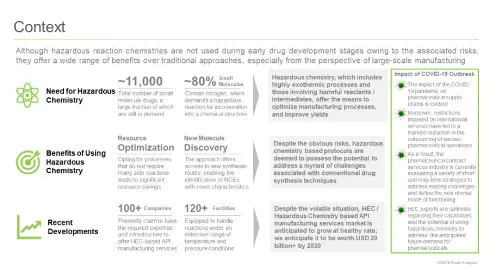
In pharmaceutical contract manufacturing, the use of certain hazardous chemical reactions has been shown to enable developers to optimize existing production processes, as well as improve yields. In other words, certain chemical reactions, which are generally regarded as harmful, offer a more direct route to the end product, requiring fewer raw materials and involving a limited number of side reactions. As a result, the number of process steps are essentially reduced, when compared to using conventional synthesis chemistries. Prominent examples of hazardous chemical reactions include nitrations, oxidations, hydrogenations, alkylations, and reactions involving unstable or highly active compounds (such as azides, nitrate esters, peroxides, diazo compounds and highly potent substances). Generally, such reactions are carried out under specialized temperature and pressure conditions.
However, they are usually not considered during the early drug development stages, owing to the associated risks. From a large-scale manufacturing perspective, the use of such techniques has been proven to offer substantial time and cost-related benefits. In this context, it is also worth mentioning that using hazardous synthesis chemistries it is possible to design new chemical structures, which have interesting bio-active properties, and offer the means to improve overall product quality. Owing to this, the high energy / hazardous chemistry market is likely to witness substantial market growth during the forecast period.
 |
 |
 |
Key Companies in High Energy / Hazardous Chemistry Market
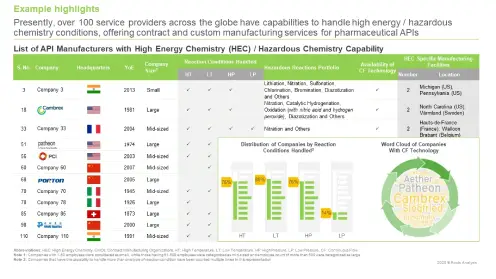
Examples of key companies engaged in high energy / hazardous chemistry market (which have also been profiled in this market report; the complete list of companies is available in the full report) include AGC Chemicals, Beijing Mediking Biopharm, Cambrex, Corden Pharma, Evonik, Hovione, Patheon, PCI Synthesis and Siegfried. This market report includes an easily searchable excel database of all the companies providing high energy chemistry based contract manufacturing, worldwide.
Given the inherent risks associated with hazardous chemistry-based manufacturing processes, innovator companies (especially in the fine chemicals and pharmaceutical industries) prefer to outsource such processes to contract service providers. Presently, there are a number of contract chemicals manufacturers that claim to have the necessary capabilities and infrastructure to support the synthesis of APIs under hazardous conditions. It is worth highlighting that such reactions are best contained within continuous flow processes. However, owning to various reasons (such as reaction specific complexities, fluctuating volumes and certain application specific requirements) the fine chemicals and pharmaceutical industries tend to rely on the traditional batch process.
However, there is an evident shift in operating preferences to continuous systems, which is anticipated to bring about revolutionary changes in the long term. Considering the growing global population and the rising demand for new and effective drugs, faster and more efficient pharmaceutical manufacturing processes have become a necessity. In fact, if a drug against COVID-19 is successfully developed, it is imperative to develop high efficiency processes to ensure the production of sufficient volumes of the therapeutic to treat the global population. We are led to believe that the use of high energy chemistry and hazardous chemistries have much to offer in the aforementioned context. As a consequence, the contract services market catering to this segment of the pharmaceutical industry is anticipated to witness substantial market growth in the coming years.
Scope of the Report
The ‘High Energy / Hazardous Chemistry Market: Industry Trends and Global Forecasts, till 2030’ market report features an extensive study on the current market landscape, market size, market share, market growth, market forecast, market outlook and future opportunities of the high energy / hazardous chemistry market. The market research report features an in-depth analysis, highlighting the capabilities of a diverse set of industry stakeholders.
 |
 |
 |
Amongst other elements, the market research report features:
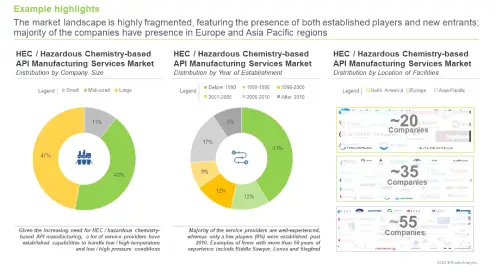
- A detailed review of the overall landscape of companies offering contract and custom services for HEC / hazardous chemistry-based API manufacturing, along with information on type of manufacturer (contract and custom manufacturer), year of establishment, company size, location of headquarters, number and location of manufacturing facilities, general service portfolio (type of product (APIs, intermediates, and drug products), HPAPI manufacturing capability and availability of continuous flow technology), HEC specific service portfolio (type of conditions handled such as high temperature, low temperature, high pressure, low pressure for API manufacturing processes).
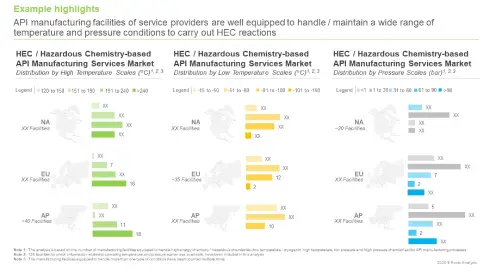
- A detailed list of over 125 manufacturing facilities equipped to handle API manufacturing processes / reactions under high temperature, low temperature, high pressure and low pressure conditions. The chapter features geographical map representations highlighting the location of these manufacturing facilities, along with logo landscape of manufacturers. The chapter also presents a detailed regional capability assessment framework which compares the capabilities of companies (based on manufacturing facilities) across different regions. It further include information on type of reaction conditions handled (high temperature, low temperature, high pressure, low pressure) and operating range.
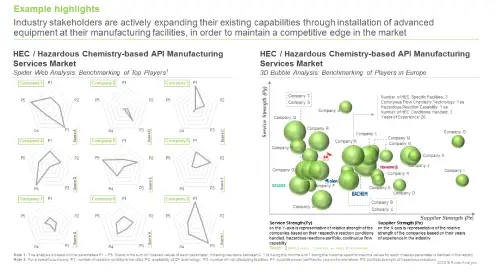
- A competitiveness 3-D bubble analysis of HEC / hazardous chemistry-based contract and custom manufacturers, taking into consideration supplier strength (based year of establishment), service strength (general service portfolio (API, intermediate and FDF, availability of continuous flow technology), HEC / hazardous chemistry-based service portfolio (capability to handle API manufacturing processes under conditions, including high temperature, low temperature, high pressure, low pressure and other hazardous reaction capabilities), and number of HEC-specific manufacturing facilities of companies.
- Elaborate profiles of the key players that offer a diverse range of capabilities for API manufacturing based on HEC / hazardous chemistry. Each profile includes a brief overview of the company, financial information (if available), details related to manufacturing facilities (pharmaceutical manufacturing facilities and HEC / hazardous chemistry specific facilities), information related to its HEC / hazardous chemistry based API manufacturing service portfolio (high temperature and low temperature reaction conditions handled, portfolio of hazardous reactions), recent developments and an informed future outlook.
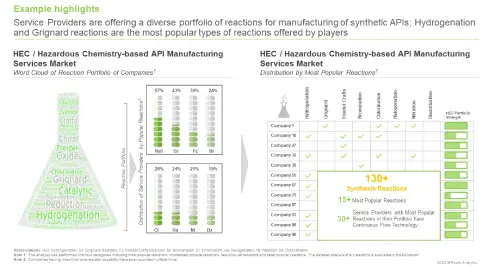
- A case study providing insights on the general reaction portfolio related to small molecule synthesis processes. We have presented this information for HEC / hazardous chemistry-based companies, along with information on the availability of continuous flow technology and capabilities to handle varied reaction conditions, such as high temperature, low temperature, high pressure, and low pressure controls.
- A detailed case study presenting a list of contract research organizations (CROs) and custom synthesis service providers which claim to have the required capabilities to provide a wide range of services, ranging from process development (including preliminary R&D), scale-up and small scale synthesis, for APIs based on HEC / hazardous chemistry.
- A discussion on affiliated trends, key drivers and challenges which are likely to impact the industry’s evolution, under an elaborate SWOT framework. It also includes a Harvey ball analysis, highlighting the relative effect of each SWOT parameter on the overall industry.
The key objective of high energy / hazardous chemistry market report is to provide a detailed market analysis in order to estimate the existing market size, market trends, market value, statistics and future opportunity for high energy / hazardous chemistry market during the forecast period. Based on multiple parameters, such as growth of the overall pharmaceutical drugs market, cost of goods sold, direct manufacturing costs and API manufacturing market, we have developed informed estimates on the financial evolution of the market, over the forecast period 2020-2030. The market report also provides details on the likely distribution of the current and forecasted opportunity across [A] reaction conditions (low temperature, high temperature, low pressure, high pressure), [B] company size (small, mid-sized, large / very large) and [C] region (North America, Europe and Asia Pacific) and [D] scale of operation (preclinical / clinical, commercial). In order to account for future uncertainties and to add robustness to our forecast model, we have provided three market forecast scenarios, namely conservative, base and optimistic scenarios, representing different tracks of the industry’s growth.
The opinions and insights presented in this market research were also influenced by discussions conducted with stakeholders in high energy / hazardous chemistry market. All actual figures have been sourced and analyzed from publicly available information forums. Financial figures mentioned in this market report are in USD, unless otherwise specified.