
Lowest Price Guaranteed
Pages
261
Last Updated
June 2026
View Count
9969
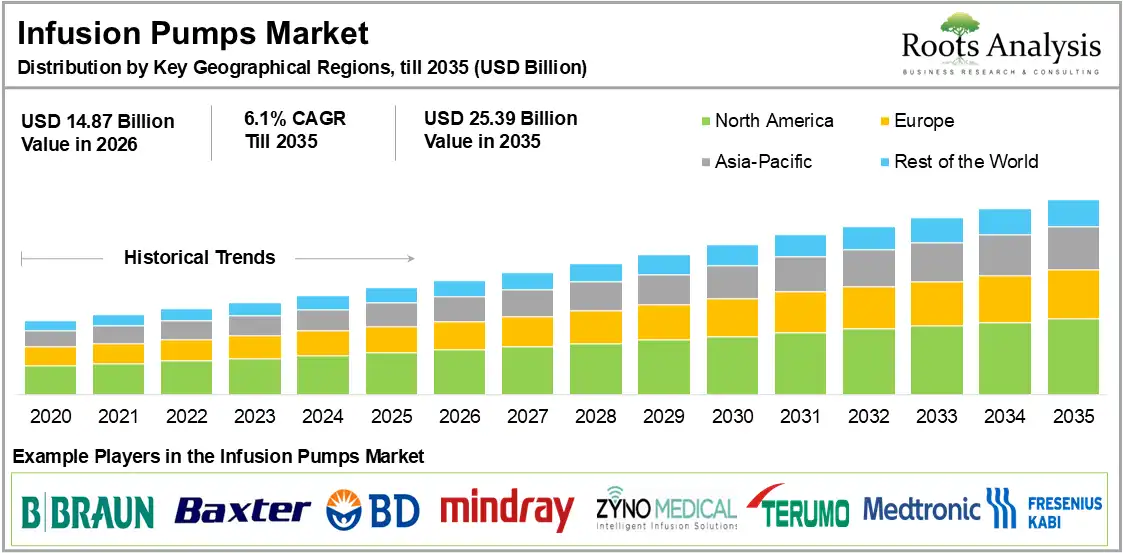
The global infusion pumps market size is valued at USD 13.90 billion in 2025 and projected to grow from USD 14.87 billion in 2026 to USD 25.39 billion in 2035, representing a CAGR of 6.1% during the forecast period 2026 to 2035.
To learn more about this report, request a free sample copy
With evolving medical technologies to treat chronic conditions, the infusion pump market is likely to show an upward trajectory in the upcoming years. Infusion pumps are a form of medical device specifically designed to deliver a precise amount of medication, such as a pain reliever, chemotherapy drugs, antibiotics and hormones directly into the patient’s body. The ability to provide meticulous control over dosage size makes them an essential tool for managing critical medications and therapeutics regimens.
The significance offered by infusion pumps extends across healthcare settings, so patients can manage health conditions, such as diabetes, oncology, and pain management. In addition, the ongoing advancements, such as safety profiles, and integrated mechanisms, such as alert alarms that immediately send alerts about air bubbles, occlusions, and empty reservoir, thereby actively preventing dosing inaccuracies and ensure continuous therapy delivery. This sophisticated blend of safety features, versatility and precision further solidifies the demand for infusion pumps across the globe.
Owing to the ongoing demand, the industrial players will be at the forefront for developing smart infusion pumps integrated with internet of things, artificial intelligence and standard connectivity features to enhance safety and efficiency. For instance, in February 2025, Supernus Pharmaceuticals (US) announced that the USFDA has approved its ONAPGO (subcutaneous apomorphine infusion device) to treat motor fluctuations in adults with advanced Parkinson’s disease. Likewise, several other market players are continually innovating advanced technologies to make infusion pumps more advanced, and user-friendly. The high demand and consistent innovation by industrial players are likely to maintain long-term competitiveness in the infusion pump market.
| Key Report Attributes | Details | |
| Historical Trend | Since 2020 | |
| Forecast Period | Till 2035 | |
| Market Size 2026 | USD 14.87 Billion | |
| Market Size 2035 | USD 25.39 Billion | |
| CAGR (Till 2035) | 6.1% | |
One of the key objectives of the infusion pump market report was to estimate the current size, opportunity, and the market growth potential, over the forecast period, till 2035. We have provided informed estimates on the likely evolution of the market for the forecast period.
The global infusion pumps market analysis also features the likely distribution of the current and forecasted opportunity within the market across various segments, such as type of device, type of technology, therapeutic area, end user, key geographical regions, and leading players.
In order to account for future uncertainties associated with some of the key parameters and to add robustness to our model, we have provided three market forecast scenarios, namely conservative, base, and optimistic scenarios, representing different tracks of industry’s evolution.
Several recent developments in the field of infusion pumps industry have occurred, and we outlined some of these below.
The market report provides comprehensive information on the market players who are currently active across various segments of the industry as mentioned in the table below.
| Market Segmentations | Details | |
| Type of Device |
|
|
| Type of Usage |
|
|
| Type of Technology |
|
|
| End User |
|
|
| Therapeutic Area |
|
|
| Geographical Regions |
|
|
Based on the type of device, the global market is segmented into volumetric, syringe, implantable, elastomeric, insulin pumps, ambulatory, insulin pumps, wearable infusion pumps, and others. Currently, the volumetric segment is dominating the industry by holding 30% of the infusion pumps market share. The dominance is potentially due to the high precision, safety, versatility and broad application in healthcare industry. These volumetric infusion pumps can be used for blood infusion, drug administration, fluid transmission during surgeries and nutrient delivery.
However, in the future, the wearable infusion pumps segment is likely to grow at a higher CAGR during the forecast period. The need for continuous drug administration for managing chronic conditions and shift toward digital technologies are likely to be the solid reason for the unprecedented demand of infusion pumps for home care.
The global market is segmented across different type of usage, such as stationary and ambulatory. Currently, stationary segment holds the largest share of the market. This dominance is due to the high demand for stationary pumps in hospitals to deliver chemotherapies, drug administration, and intravenous fluid resuscitation.
It is worth mentioning that stationary pumps are able to offer controlled delivery of complex medication and designed to handle large volumes. Therefore, the ongoing need for stationary infusion pumps is anticipated to grow this segment at a higher CAGR during the forecast period.
In this segment, the market is bifurcated across different type of technology, such as traditional infusion pumps and smart infusion pumps. Among these smart infusion pumps are dominating the market. This can be attributed to the growing adoption of smart pumps to reduce dosage errors and real-time monitoring to streamline medication administration process.
It is important to highlight here that the continuous integration of smart technologies to make dosage administration more efficient is likely to drive its demand in the future. Hence, this segment will continue to grow at a higher CAGR during the forecast period.
This segment highlights the distribution of the global market across different types of application area, such as diabetes, oncology, hematology, pain management, and others. According to the infusion pump market report, currently the diabetes segment holds the maximum share (nearly 30%) of the market driven by the high demand for infusion pumps for diabetes drug delivery in patients.
However, in the future, the oncology segment is likely to show lucrative growth, expecting to grow at a higher CAGR during the forecast period. Infusion pumps for oncology help to deliver complex medication with higher efficiency, allowing healthcare practitioners to reduce medicine errors.
The global market is further bifurcated into end users, such as hospitals, and home care. According to the infusion pumps market analysis, presently the hospital segment is dominating by holding the maximum share of the market. This is likely to be the high demand for infusion pumps for hospitals to deliver optimal dosage and fluid to patients to treat diseases.
In future, the homecare segment is likely to grow at a substantial CAGR during the upcoming years. This potential growth is driven by the gaining traction of remote treatment to avoid unnecessary hospital visits.
The global market is distributed across different key geographical regions, such as North America, Europe, Asia-Pacific, and rest of the world. According to the infusion pumps market forecast, North America is currently dominating the market by holding 39% of the overall revenue share, and the trend is likely to remain unchanged in the future. Factors, such as increasing geriatric population with chronic conditions and heightened number of patients admitted in hospitals are driving the demand for infusion pumps to deliver precise dosage.
In Asia-Pacific, the market is likely to grow at a higher CAGR during the projected period. The demand for effective drug delivery solutions for managing chronic conditions in hospitals and homes are the key factor for lucrative growth.
| Report Deliverables | Details | |
| Excel Data Packs (Complimentary) |
Available | |
| Key Infusion Pumps Companies Profiled |
|
|
| PowerPoint Presentation (Complimentary) |
Available | |
| Customization Scope | 15% Free Customization | |
The “Infusion Pumps Market Report: Industry Trends and Global Forecasts, till 2035” market report features an extensive study of the current market landscape, market size, market share, market growth, market trends, market value, market forecast, market outlook, statistics, and future opportunities for infusion pumps developers. The market research report lays emphasis on the infusion pumps that are being developed. Key takeaways of the market report are briefly discussed below.
The global market for infusion pumps is characterized by intense competition, featuring the presence of global industrial players, and new entrants. Notably, the leading companies, like BD (US), Baxter (US), B. Braun (Germany), and Fresenius (Germany) are continually innovating and engaging in strategic initiatives to maintain and expand their market positions.
For instance, in May 2025, BD (US) introduced BD neXus platform, an advanced suite of infusion pumps, IV sets and medication management software to the UK & Ireland to simplify nursing staff drug flow and reduce medication error.
Similar to BD (US), numerous market players are actively launching smart infusion pumps to enhance precision in dosage delivery.
Several factors are driving growth of the infusion pumps industry. Some of the notable factors are listed below:
Increasing incidence of chronic conditions is the fundamental factor that accelerates the demand for infusion pumps. For instance, chronic conditions, such as cancer, diabetes, cardiovascular disorders, kidney and stomach-related ailments are becoming increasingly common worldwide. These long-term conditions frequently necessitate precise and continuous medication delivery, making infusion pumps an indispensable tool for effective patient management.
Notably, the expanding graph of geriatric population has significantly contributed to the market expansion. As individuals age, their susceptibility to chronic diseases rises, leading to a greater need for long-term care solutions that often involve infusion therapy.
Despite the growing demand, the infusion pumps market face several challenges:
The initial investment cost of smart infusion pumps, specifically with advanced technologies and features may limit its adoption across small to middle income countries. In addition, the development of smart infusion pumps is required to follow a stringent regulatory framework to ensure its safety and precision for patient use.
Notably, compliance with evolving regulatory standards, such as those from the USFDA and requirements for post-market surveillance, poses a significant challenge for infusion pump manufacturers.
While smart infusion pumps improve patient safety and precise dosage administration, patients and drug administrators may require training to use it effectively. The need for training of patients and healthcare personnels may create a significant barrier for the market players, as complex operation may limit its adoption.
The infusion pump market is expanding dynamically due to the emerging trends:
Some of the pivotal trends that are shaping the future growth of this industry includes, integration of smart technologies, including AI, IoT, dose error reduction software (DERS) and wireless connectivity, into infusion pumps. These advanced features enable real-time monitoring of infusions, detailed analysis of data, and remote management capabilities. The integration of these technologies will significantly enhance precision and reduce the incidence of medication errors. Additionally, the advancements in AI-driven smart infusion pumps help to collect valuable insight about patient data to manage chronic conditions.
For instance, smart pumps with built-in drug libraries provide immediate safety alerts and offer seamless connectivity to electronic health records (EHRs), ensuring instant access to critical medication information and patient history, thereby minimizing programming mistakes.
It is worth mentioning that with the heightened demand for patient convenience and wearable technology to monitor disease remotely, the market players are aiming to develop wearable and implantable infusion devices. These wearable devices are becoming utmost important for patients, specifically those suffering with chronic conditions. Moreover, in Europe, the infusion pump market growth driven by home healthcare trends and healthcare initiatives to support treatment of patients with chronic conditions in their comfort areas.
North America is consistently maintaining its dominating position due to the well-established healthcare infrastructure and adoption of cutting-edge medical technologies for patient care. In addition, the robust reimbursement framework and increasing preferences for digital healthcare technologies to mitigate the concern of chronic conditions are propelling the infusion pumps market growth in this region.
The European market is estimated to hold a substantial share of the infusion pumps industry during the forecast period. This growth is fueled by the rising government initiatives to improve healthcare infrastructure, growing geriatric population and increasing chronic conditions, such as cancer. Furthermore, the continuous shifts from hospital based to home care healthcare services are creating enormous opportunities for leading players for market expansion.
In analysis, Asia-Pacific is estimated to grow at the fastest CAGR during the forecast period. This accelerated growth is due to the growing expenditure on healthcare infrastructure to enhance patient comfort and optimal dosage delivery and increasing awareness about medical technologies. Furthermore, growing chronic conditions, such as diabetes and chronic pains, are substantially increasing the need for advanced infusion pump devices.
In 2026, the infusion pumps market is valued at USD 14.87 billion and is poised to reach USD 25.39 billion by 2035. In terms of devices, volumetric and wearable pumps are dominating the market. The constant innovations by the industrial players will continue to expand the market during the forecast period.
The market has witnessed a flurry of significant collaborations and partnerships. The primary focus on partnerships will be on technological innovations to optimize medication delivery. For instance, in June 2025, Bainbridge Health (US) and B. Braun Medical (Germany) joined the National Infusion Collaborative (NIC). The collaboration aims to leverage B. Braun’s expertise in infusion therapy and data-driven technology of Bainbridge Health to improve medication safety and optimize IV medication utilization in healthcare facilities.
Moreover, strategic collaboration will also emphasize enhancing patient care by gaining deep insight into infusion pump data and promoting safer medication practices. The consistent partnerships between industrial players will continue to expand the market at a steady rate.
The market report presents an in-depth analysis, highlighting the capabilities of various stakeholders in the infusion pumps industry, across different geographies. Amongst other elements, the market report includes: