
Lowest Price Guaranteed
Pages
257
Last Updated
July 2026
View Count
21878
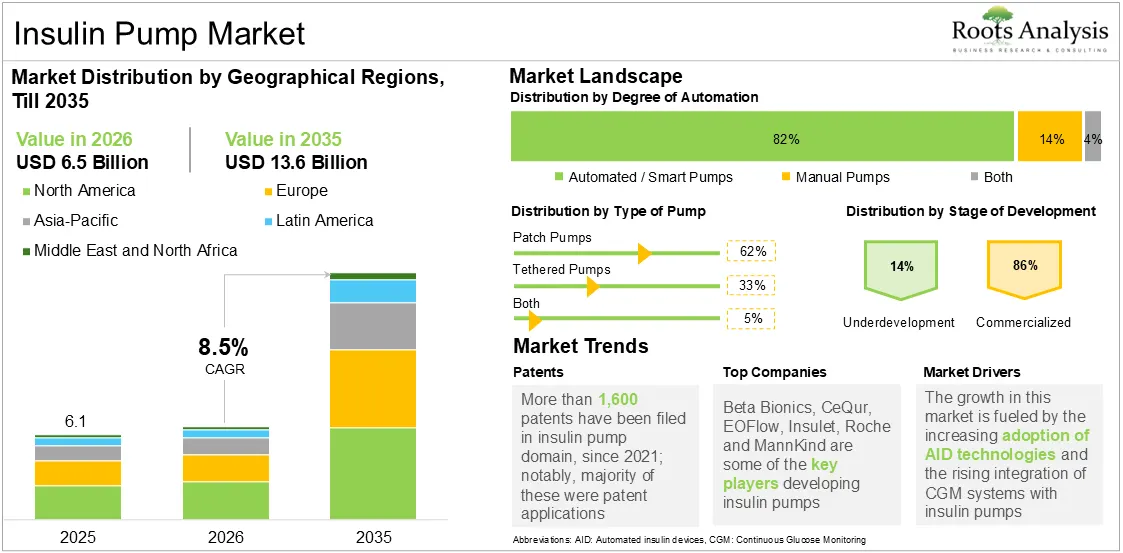
The global insulin pump market, valued at USD 6.1 billion in 2025, is projected to reach USD 6.5 billion in 2026 and USD 13.6 billion by 2035, representing a CAGR of 8.5% during the forecast period 2026 to 2035.
To learn more about this report, request a free sample copy
Over the last couple of decades, the prevalence of diabetes has increased significantly across the globe. According to the World Health Organization, around 830 million people across the world are currently suffering from diabetes. Notably, diabetes is the primary cause of blindness, heart attacks, kidney failure, lower limb amputations, and stroke, and is considered to be among the top 10 leading causes of mortality worldwide. Consequently, healthcare systems are increasingly seeking insulin-delivery solutions that improve glycemic control while reducing the daily treatment burden.
Insulin pumps address this need by delivering continuous, programmable doses of insulin that more closely replicate the body's natural insulin-release pattern. The technology has evolved from traditional infusion devices to compact, tubeless, and digitally connected systems. The current insulin pump market is undergoing a major technological shift, driven by the integration of continuous glucose monitoring (CGM), automated insulin delivery (AID) algorithms, and smartphone-enabled connectivity.
The emergence of automated insulin delivery systems represents a defining shift in the domain. These platforms use real-time glucose data and algorithms to adjust insulin delivery, while recent US regulatory clearances have expanded their application beyond type 1 diabetes to insulin-requiring type 2 diabetes and, in 2026, pregnancy complicated by type 1 diabetes.
Looking ahead, the insulin pumps market is poised for robust growth, supported by the growing regulatory approvals, expanding reimbursement coverage, and increasing adoption across pediatric and adult patient populations. In addition, increasing investments by leading medtech companies in next-generation wearable pumps, patch pumps, and interoperable diabetes ecosystems are intensifying competition and fostering continuous product innovation.
| Automated Insulin Delivery Systems / Platforms | Company | Headquarters | Integration Focus | Key Differentiator |
| Omnipod 5 | Insulet | US | Dexcom G6 / G7 and Abbott FreeStyle Libre 2 Plus in selected markets | Tubeless AID system |
| MiniMed 780G | Medtronic Diabetes | US | Guardian / Simplera Sync ecosystem; Abbott partnership under development | Established hybrid closed-loop pump |
| Tandem pregnancy | Tandem Diabetes Care | US | Compatible integrated CGM ecosystem | Algorithm-led AID across pump platforms |
| iLet Bionic Pancreas | Beta Bionics | US | Dexcom CGM and FreeStyle Libre 3 Plus sensor support | Automated dosing with reduced user burden |
| mylife Loop / CamAPS FX | Ypsomed | Switzerland | Dexcom G7 or FreeStyle Libre 3 Plus configuration | Smartphone-based adaptive algorithm |
| DANA-i with CamAPS FX | SOOIL | South Korea | Compatible with CamAPS FX in selected configurations | Compact pump plus app-based AID |
Based on the research, we have segmented the insulin pump market into type of pump, degree of automation, type of battery, type of diabetes targeted, distribution channel and geographical regions.
By Type of Pump
By Degree of Automation
By Type of Battery
By Type of Diabetes Targeted
By Distribution Channel
By Geographical Regions
Driven by the rising global prevalence of diabetes, increasing demand for precise insulin delivery, and continuous advancements in automated insulin delivery technologies, the insulin pump market is expected to witness significant growth in the coming years.
Kelly Postiglione Cook (Director of Clinical Services, Beta Bionics), stated that, "We have iLet Bionic Pancreas. So, the device itself is fully autonomous insulin delivery, meaning that the system determines 100% of the insulin dosing for the user, and it does that through the work of three separate algorithms that work in conjunction with each other to get the user to goal. You've got a basal algorithm that's going to modulate every five minutes, layered over that you have our corrections algorithm, which I think really sets us apart from other devices on the market, because it's really got strengths to it."
Discussions with multiple stakeholders in this domain influenced the opinions and insights presented in this study. The market report includes third-party transcripts of the following discussions:
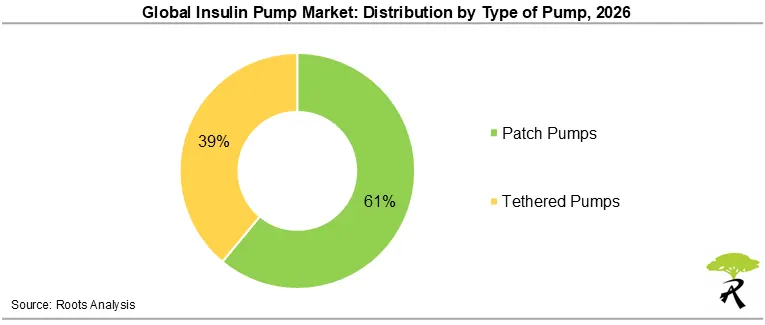
This segment highlights the distribution of market value for insulin pumps across various types of pumps, such as tethered pumps and patch pumps.
Currently, the patch pumps capture more than 60% of the insulin pump market share owing to their ability to deliver continuous insulin therapy through a discreet, tubeless design that seamlessly integrates into patient's daily lives. Beyond improving wearability and convenience, these devices are increasingly evolving into connected diabetes management platforms through smartphone-enabled control and compatibility with multiple CGM systems, reducing the complexity associated with managing multiple diabetes devices.
In January 2025, Insulet expanded the availability of its Omnipod® 5 Automated Insulin Delivery System to five additional European countries with compatibility for both Abbott's FreeStyle Libre 2 Plus and Dexcom G6 CGM systems. Subsequently, in June 2025, the company introduced US iPhone compatibility for Dexcom G7 users, further enhancing the flexibility and interoperability of its patch pump ecosystem.
Moreover, the patch pumps are expected to register the highest CAGR during the forecast period, driven by manufacturers' ability to enhance product functionality through software upgrades, expanded CGM integrations, and geographic expansion without requiring significant hardware redesign. This approach enables faster commercialization, lower development costs and a broader addressable patient population. Illustrating this trend, Omnipod® 5 entered multiple Middle Eastern markets in February 2026, extending its commercial footprint to 19 countries.
Based on the degree of automation, the global market is segmented into manual pumps and automated / smart pumps.
Currently, the automated / smart pumps are likely to capture the majority of the insulin pump market size. This is owing to the fact that these systems combine insulin delivery, continuous glucose monitoring, and algorithm-based dose adjustment within a single connected platform. This reduces the burden of frequent manual calculations and makes pump therapy more attractive to patients transitioning from injections or conventional pumps. Commercial adoption supports this trend; Beta Bionics reported 19,713 new patients, approximately 70% of whom transitioned from multiple daily injections.
Moreover, it is worth highlighting that, as per the insulin pump market analysis, the share for automated / smart pumps is likely to grow at a relatively higher CAGR during the forecast period. This is primarily due to the expanding regulatory approvals, evolving clinical guidelines, and increasingly interoperable product ecosystems. For example, in March 2026, Medtronic received FDA clearance for the MiniMed Flex, a compact, screenless pump controlled via smartphone and powered by the SmartGuard algorithm.
The broader sensor compatibility and the capability for over–the–air algorithm updates enable manufacturers to enhance device functionality without replacing core hardware. Moreover, predictive algorithms used by these smart pumps help users and healthcare providers to make informed decisions about insulin therapy.
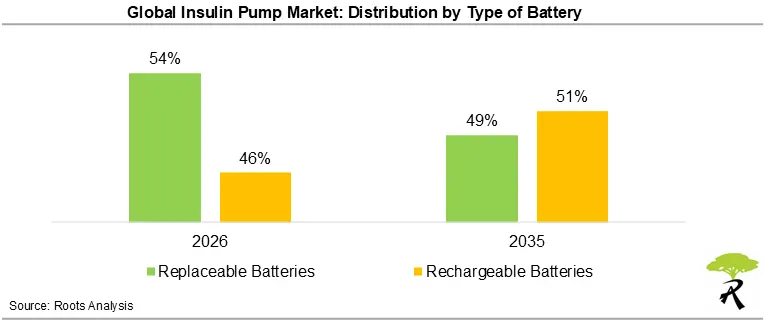
Based on the type of battery, the global market is segmented into replaceable batteries and rechargeable batteries.
According to our market analysis, the replaceable batteries occupy the highest (around 55%) market share in the insulin pump market, primarily because they remain embedded in widely adopted durable insulin-pump platforms and allow users to restore power immediately without waiting for the device to charge. For example, Medtronic's MiniMed 780G operates on a standard AA battery, while SOOIL's DANA-i uses a standard AAA battery, enabling manufacturers to offer familiar, easily available power sources across markets with varying charging infrastructure.
In contrast, the rechargeable batteries are likely to show the highest growth rate of 9% during the forecast period. This is driven by the increasing adoption of next-generation automated insulin delivery (AID) systems incorporating touchscreen interfaces, Bluetooth connectivity, and software-driven dosing capabilities. Rechargeable lithium-based power systems enable compact device designs, improved water resistance, and reduced long-term maintenance while supporting advanced digital functionalities. For instance, Tandem Diabetes Care's t X2 features an integrated lithium-polymer battery and Beta Bionics' iLet provides approximately four to five days of use per charge.
On the basis of type of diabetes targeted, the global market is distributed into type 1 diabetes and type 2 diabetes.
Currently, the type 1 diabetes sub-segment occupies the highest share in the overall market and is likely to register the highest CAGR throughout the forecast period. This dominance is primarily driven by the lifelong dependence of individuals with type 1 diabetes on intensive insulin therapy, making insulin pumps an essential component of disease management rather than an optional treatment modality.
Individuals with type 1 diabetes produce little or no insulin and require insulin every day, whereas only a subset of the considerably larger type 2 diabetes population progresses to intensive insulin therapy. Consequently, insulin pump adoption is substantially higher within this patient population. In fact, Tandem Diabetes Care estimated in its 2026 annual filing that approximately 40% of people with type 1 diabetes in the US use insulin pumps, compared with only around 5% of people with type 2 diabetes.
In terms of geographical regions, the global market is distributed across North America, Europe, Asia-Pacific, Middle East and North Africa, and Latin America.
According to our insulin pump market forecast, North America is likely to capture the majority (around 65%) of the insulin pump market share in the current year, and this trend is unlikely to change. This is primarily due to a highly mature diabetes care ecosystem, broad reimbursement coverage, and rapid adoption of advanced insulin delivery technologies in the region. The US alone has approximately 40.1 million people living with diabetes, including 2.1 million diagnosed with type 1 diabetes, providing a substantial addressable patient population for insulin pump manufacturers. In addition, the American Diabetes Association's 2026 Standards of Care have simplified eligibility for insulin pump initiation, while recent regulatory approvals have expanded automated insulin delivery (AID) systems to insulin-treated type 2 diabetes.
The market in Asia-Pacific is likely to grow at a high CAGR during the forecast period till 2035. This is driven by improving access to diabetes management technologies, expanding reimbursement frameworks, and a rapidly growing base of insulin-dependent patients across countries such as China, Japan, South Korea, India, and Australia. Several governments are increasing investments in diabetes management, while local regulatory reforms are facilitating faster commercialization of innovative medical devices. For example, in March 2025, the National Health Mission of Himachal Pradesh, India, issued implementation guidelines for providing free insulin pumps to patients with type 1 diabetes, with funding for both the devices and their recurring costs.
| Key Report Attribute | Details | |
| Historical Trend | Since 2017 | |
| Forecast Period | Till 2035 | |
| Market Size 2026 | $6.5 Billion | |
| Market Size 2035 | $13.6 Billion | |
| CAGR (Till 2035) | 8.5% | |
| Segments Covered |
|
|
| Key Players |
|
|
| PowerPoint Presentation (Complimentary) |
Available | |
| Customization Scope | 15% Free Customization | |
| Excel Data Packs (Complimentary) |
Available | |