Market Outlook
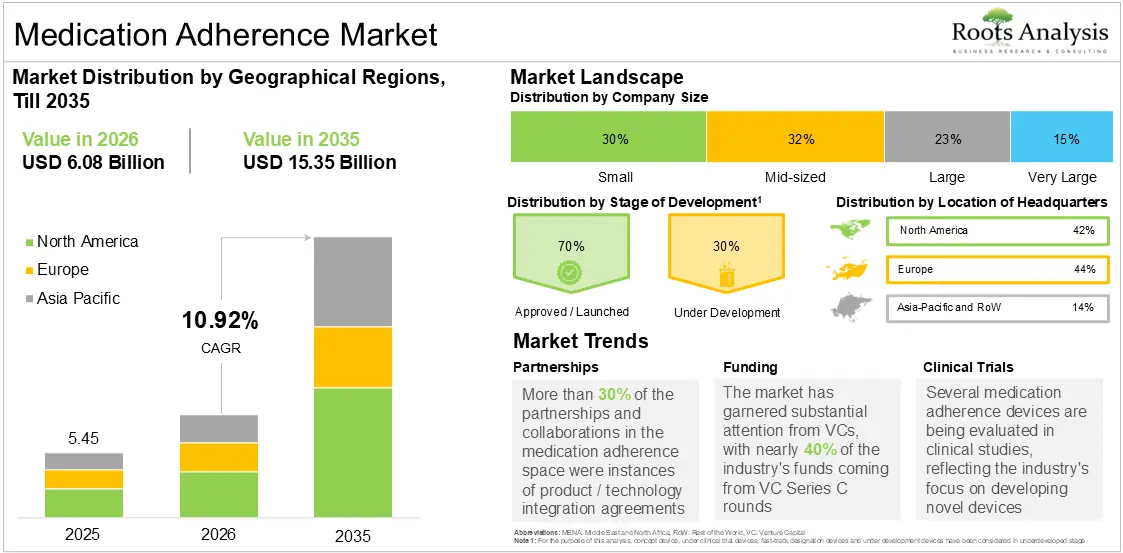
The global medication adherence market, valued at USD 5.45 billion in 2025, is projected to reach USD 6.08 billion in 2026 and USD 15.35 billion by 2035, representing a CAGR of 10.92% during the forecast period 2026 to 2035.
To learn more about this report, request a free sample copy
Market Report: Key Takeaways
Market Size & Trends
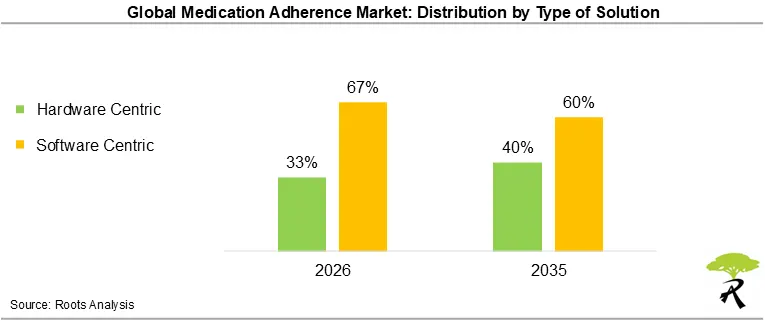
- With respect to type of solution, software centric holds the highest share (more than 65%) of the current market.
- By type of product, smart inhalers dominate the current market.
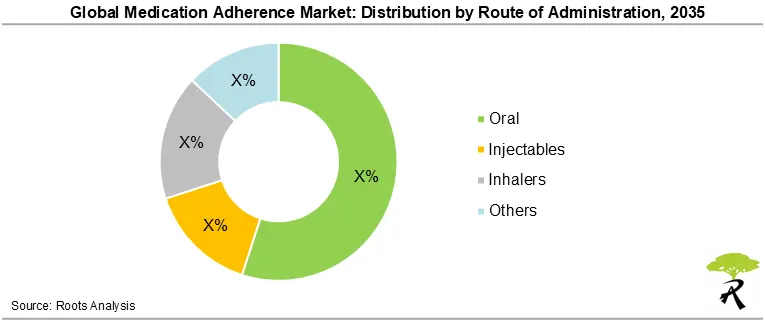
- Based on the route of administration, devices that assist in oral administration capture the largest share of the current market; this trend is unlikely to change in the future.
- In terms of therapeutic area, revenues generated from the devices intended for the treatment of cardiovascular disorders lead the current market.
- Based on the end-user, the hospitals currently hold the highest market share (around 70%).
- In terms of key geographical regions, North America accounts for the majority of the current market share.
Key Market Statistics
- Market Size in 2026: USD 6.08 Billion
- Estimated Market Size in 2035: USD 15.35 Billion
- CAGR (2026-2035): 10.92%
- North America: Largest market in 2026
- Asia-Pacific: Fastest growing region
Market Introduction
Medication adherence, the extent to which patients follow prescriptions from healthcare providers, remains a major challenge within the healthcare sector. Despite significant advances in pharmacotherapy, real-world outcomes often fail to match clinical trial results, as many patients experience challenges initiating, implementing, or persisting with prescribed regimens. This gap has several consequences, as non-adherence contributes to disease progression and increased hospitalizations. This concern is especially prevalent among patients with multiple chronic conditions, such as cardiovascular disease, diabetes, respiratory disorders, and mental health conditions, where polypharmacy, adverse effects, cognitive challenges, and socioeconomic barriers compound the risk.
Over the years, the medication adherence market has evolved to address these systemic gaps through a diverse ecosystem of solutions. These include connected drug delivery devices and smart dispensers for objective monitoring, mobile applications and automated reminders for real-time support, digital therapeutics that combine behavioral science with medication management, and integrated platforms leveraging AI, IoT, and remote monitoring. These tools deliver personalized education, surface adherence patterns, enable caregiver engagement, and provide actionable insights for clinicians and payers.
Additionally, the rising chronic disease prevalence, driven by aging populations and lifestyle factors, intensifies the demand for sustained management. Value-based care models link reimbursement to outcomes, making adherence a key performance metric. The technological convergence of smartphones, wearables, telehealth, and data analytics has made scalable, patient-centric interventions more accessible and affordable. Emerging trends include predictive analytics to identify at-risk patients and integration with electronic health records.
Beyond technology, the market signals a shift toward patient empowerment and holistic care. Effective solutions address root causes of non-adherence and, by improving medication use, enhance clinical outcomes, reduce healthcare utilization, and deliver measurable value across providers, payers, and pharmaceutical stakeholders.
As healthcare systems worldwide prioritize outcomes over volume, the medication adherence sector stands at the intersection of digital innovation, behavioral science, and personalized medicine. It plays a pivotal role in ensuring that therapeutic innovations achieve their intended impact across real-world patient populations. For stakeholders navigating this evolving landscape, understanding the interplay of technology, human behavior, and care delivery models will be essential to unlocking its full potential.
Market Segmentation
Based on the research, we have segmented the medication adherence market into type of solution, type of product, route of administration, therapeutic area, end-user, and key geographical regions.
By Type of Solution
- Hardware Centric
- Software Centric
By Type of Product
- Smart Inhalers
- Smart Injectors
- Smart Wearable Injectors
- Smart Pills
- Smart Medication Dispensers
- Smart Pill Bottles / Caps and Boxes
- Smart Blister Packs
- Others
By Route of Administration
- Oral
- Injectable
- Inhalable
- Others
By Therapeutic Area
- Cardiovascular Disorders
- Metabolic Disorders
- Neurological and Central Nervous System Related Disorders
- Respiratory Disorders
- Others
By End-user
- Hospitals
- Home Care Settings
- Others
By Key Geographical Regions
- North America
- Europe
- UK
- Germany
- France
- Italy
- Spain
- Rest of Europe
- Asia-Pacific
- China
- India
- Japan
- Rest of Asia-Pacific
Medication Adherence Market Key Insights
What are the Key Drivers for Medication Adherence Market Growth?
- Rising Prevalence of Chronic Diseases: The rising global burden of chronic conditions, such as diabetes, hypertension, cardiovascular diseases, and respiratory disorders, is a primary driver of the market. Patients with these conditions require long-term, often lifelong medication regimens, making consistent adherence critical for effective disease management and preventing complications. Furthermore, non-adherence leads to increased hospitalizations, higher healthcare costs, and poorer outcomes. As chronic disease prevalence surges due to lifestyle changes, aging populations, and urbanization, demand for adherence solutions, including reminders, monitoring apps, and smart packaging, is growing rapidly. As a result, healthcare systems and payers are investing in tools to improve compliance, reduce costs, and enhance quality of life, fueling substantial market expansion.
- Technological Advancements in Digital Health Solutions: Rapid innovation in digital tools, including mHealth apps, AI-powered predictive analytics, IoT-enabled smart devices, connected pill bottles, and electronic monitoring systems propel the overall growth of the medication adherence market. These technologies offer real-time reminders, dose tracking, patient education, and data sharing with providers for proactive interventions. Moreover, integration with telemedicine and electronic health records enhances personalization and engagement. These advancements enable scalable, cost-effective solutions that enhance outcomes and support value-based care models. As regulatory support for digital therapeutics increases, adoption accelerates across hospitals, pharmacies, and home care settings.
What are the Main Challenges for Market Growth?
- High Medication Costs and Affordability Issues: Advanced medication adherence solutions, such as smart pill dispensers, electronic reminders, AI-based platforms, and connected devices, often involve significant upfront investments. These costs limit accessibility for many patients, healthcare facilities, and pharmacies. Additionally, inconsistent insurance coverage and reimbursement policies further discourage widespread adoption, while high out-of-pocket medication expenses reduce demand for adherence tools as patients prioritize basic affordability over tech-enabled solutions.
- Privacy, Data Security, and Regulatory Concerns: Digital adherence technologies collect sensitive patient data, raising substantial privacy and cybersecurity risks. Concerns over data breaches, compliance with regulations (like General Data Protection Regulation (GDPR)), and potential algorithmic biases in AI systems can slow adoption and reduce trust among patients and providers.
- Patient-Related and Behavioral Barriers: Underlying issues like forgetfulness, complex medication regimens, low health literacy, fear of side effects, lack of perceived efficacy, and socioeconomic factors (such as transportation issues and cultural barriers) persist. These reduce the perceived value and effectiveness of adherence solutions, limiting market penetration despite the fact that advanced tools are readily available.
Top Medication Adherence Solutions: Product Comparison (2026)
| Company |
Key Products |
Type of Solution |
Core Features |
Therapeutic Area |
| AdhereTech |
Smart Pill Bottles / Caps |
Hardware |
Real-time tracking via sensors, SMS / phone / email reminders, cloud data, escalating alerts, HIPAA-compliant |
Chronic conditions (oncology / diabetes) |
| MedMinder |
Maya / Smart Pill Dispenser |
Hardware |
Automated dispensing, pre-filled trays, visual/audible alerts, caregiver notifications, app integration, refill service |
Polypharmacy, elderly/home care |
| Omnicell |
Medication Adherence Packaging & Automation (XT Series) |
Hardware and Software |
Automated dispensing systems, packaging solutions, analytics for pharmacies / hospitals |
Hospital & retail pharmacy settings |
| Pillsy |
Smart Pill Cap / Bottle |
Hardware |
Bluetooth tracking on bottle opening, app reminders, chatbot support, caregiver alerts |
Chronic conditions |
| Propeller Health (ResMed) |
Smart Inhaler Sensors |
Hardware |
Sensor attaches to existing inhalers, app insights, usage / location tracking, predictive analytics |
Respiratory (Asthma, COPD) |
Recent Developments in Medication Adherence Market
- In May 2026, Omnicell, a leading healthcare technology provider focused on empowering autonomous medication management, announced its participation at the BofA Securities 2026 Healthcare Conference.
- In January 2026, MIT engineers developed ingestible pills equipped with biodegradable radio frequency antennas that confirm ingestion within 10 minutes, potentially reducing medication non-adherence concerns in patients.
- In January 2026, BrightInsight announced an investment round of USD 13 million from various investors. This amount will be used to accelerate development of BrightInsight’s AI-enabled medication persistence and adherence solutions to enable rapid scalability of high-impact programs.
Industry Experts on Medication Adherence Market
The market for medication adherence has a transformative future and is likely to remain progressive in the coming years.
Gaurav Patel (Co-founder and Chief Executive Officer, Cognita Labs) and Rajoshi Biswas (Co-founder and Chief Scientific Officer, Cognita Labs), stated that, “In my opinion, smart inhalers hold 20-30% share in the overall adherence market, which can be attributed to the fact that such devices not only address the non-adherence problem but also provide guidance on the proper use of such products. On the other hand, there are a number of software centric solutions that help patients in complying with their medication regimens and some of these are successful in the market. If there are applications that are being designed only for medication adherence, then they are likely to take up some of the share of smart devices. I believe that smart devices that are cost-effective and also improve medication efficacy are expected to witness substantial market penetration, since there is a significant demand and market opportunity for such products.”
Discussions with multiple stakeholders in this domain influenced the opinions and insights presented in this study. The medication adherence market report includes transcripts of the following discussions:
- Senior Director, Global Strategic Marketing, Medical, Large Company, US
- Co-Founder and Chief Executive Officer, Small Company, US
- Chief Executive Officer, Small Company, US
- Chief Executive Officer and President, Mid-sized Company, US
- Chief Executive Officer, Small Company, Italy
- Vice President and Chief Scientist, Large Company, Israel
- Director of Global Communications, and Former Vice President of Strategic Partnerships and Business Development, Mid-sized Company, US
- Former Chief Executive Officer, Small Company, US
- Former Director of Front-end Innovation and Head of Connected Health, Large Company, US
- Former Vice President, Marketing and Alliance Management, Mid-sized Company, US
- Advisor of Strategy and Business Development, Small Company, US
In addition, the market report includes transcripts of the following other third-party discussions:
- Associate, Very Large Company, United States
- Director, Associate Professor, Very Large Company, United States
- Chief Pharmacy Officer, Policy Analyst, Very Large Company, United States
- Chief Executive Officer, Mid-sized Company, United States
- Chief Executive Officer, Mid-sized Company, United States
- Chief Experience Officer, Mid-sized Company, United States
- Chief Medical Officer, Mid-sized Company, United States
- Co-Founder and Board Member, Small Company, United States
- Chief Executive Officer, Mid-sized Company, United States
- Chief Executive Officer, Small Company, United States
- Chief Executive Officer, Large Company, United States
- Chief Optimus, Small Company, United States
- Chief Technical Officer and Chief Scientific Officer, Mid-sized Company, United States
- Co-Founder and Chief Executive Officer, Mid-sized Company, United States
Market Share Insights
Which Type of Solution Accounts for the Largest Share in the Medication Adherence Market?
- In 2026, software centric solutions dominate the overall market, holding majority of the (more than 65%) market share. This trend is due to the rising adoption of digital health tools, smartphone-based medication management, and the ability of software platforms to deliver real-time monitoring, reminders, analytics, and personalized interventions.
- The hardware centric solutions sub-segment is anticipated to grow at a healthy pace till 2035 primarily because hardware devices (like smart pillboxes, connected inhalers, and wearable sensors) provide tangible, real-time tracking of actual medication intake, which is more reliable than self-reporting.
Regional Analysis: Which Regions are Showing the Fastest Growth in the Medication Adherence Industry?
North America: Dominating the Market by Securing Highest Share
According to our projections, North America is likely to capture the majority of the medication adherence market share in 2026. This can be attributed to the robust healthcare infrastructure, high adoption of digital health technologies, and substantial investment in patient-support programs. Moreover, this trend is fueled by growing awareness of chronic disease management, an aging population, and patient-centric care models in the region. Additionally, active participation from biopharma companies, payer-provider collaborations, and favorable regulatory pathways for adherence-enhancing devices and apps accelerate market growth in the region.
Which Route of Administration Accounts for the Largest Share of Market?
- In 2026, the oral route occupies the largest market share, owing to the widespread preference for tablets and capsules among patients. Moreover, it is important to note that this trend is unlikely to change.
- This growth can be ascribed to the fact that oral medications are non-invasive, easy to administer, and highly convenient for self-administration at home, making them ideal for chronic disease management, such as diabetes and hypertension. Patient compliance is further enhanced by familiar dosing routines and minimal discomfort, driving sustained adoption across healthcare systems worldwide.
Scope of Medication Adherence Market Report
| Key Report Attributes |
Details |
| Historical Trend |
Since 2020 |
| Forecast Period |
Till 2035 |
| Market Size 2026 |
USD 6.08 Billion |
| Market Size 2035 |
USD 15.35 Billion |
| CAGR (Till 2035) |
10.92% |
| Segments Covered |
- Type of Solution
- Type of Product
- Route of Administration
- Therapeutic Area
- End-user
- Key Geographical Regions
|
| Key Players |
- Bigfoot Biomedical
- BIOCORP
- Eitan Medical
- E3D Elcam Drug Delivery Device
- EoFlow
- Gerresheimer
- Insulet
- Medtronic
- Medtrum
- Nemera
- Phillips-Medisize
- Roche
- Sonceboz
- SOOIL Development
- Tandem Diabetes Care
- West Pharmaceutical Services
- Ypsomed
(A complete list of players captured is available in the report) |
PowerPoint Presentation
(Complimentary) |
Available |
| Customization Scope |
15% Free Customization |
Excel Data Packs
(Complimentary) |
Available |
Frequently Asked Questions
What are the 5 R's of medication adherence?
The 5 R’s for medication adherence are Right Patient, Right Drug, Right Dose, Right Route, and Right Time.How big is the medication adherence market?
The market is estimated to be around USD 6.08 billion in 2026.What is the projected medication adherence market growth?
The market is expected to grow at a CAGR of 10.92% during 2026-2035.Which region holds the highest market share in the medication adherence industry?
Presently, North America captures the majority share of the overall industry.Which companies are leading the medication adherence companies?
Bigfoot Biomedical, BIOCORP, Eitan Medical, E3D Elcam Drug Delivery Device, EoFlow, Gerresheimer, Insulet, Medtronic, Medtrum, Nemera, Phillips-Medisize, Roche, Sonceboz, SOOIL Development, Tandem Diabetes Care, West Pharmaceutical Services, and Ypsomed.