


 Download Free Sample
 Buy Now
Market Size
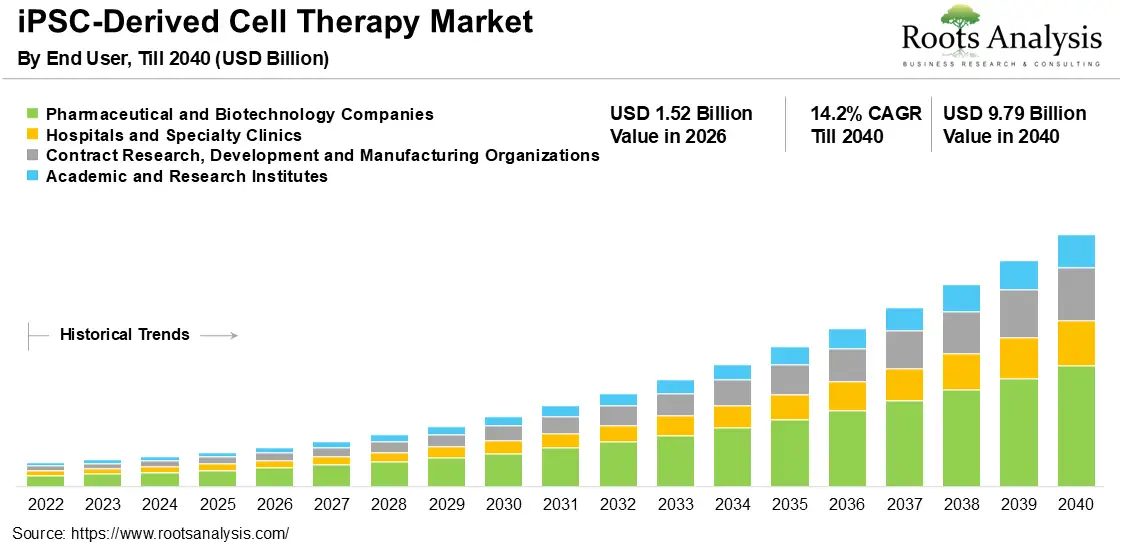
The global iPSC-derived cell therapy market is expected to rise from USD 1.52 billion in 2026 to reach USD 9.79 billion by 2040, growing at a CAGR of 14.2% over the forecast period 2026 to 2040, driven by clinical translation and scalable allogeneic platforms.
See What's in the Full Report – Request Your Complimentary Insights!
Market Report: Key Takeaways
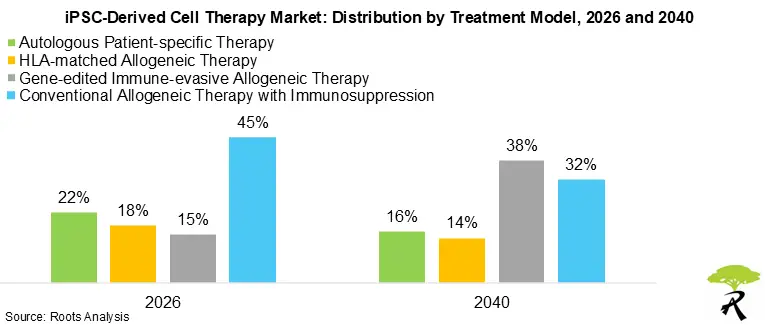
- Based on treatment model, conventional allogeneic therapy with immunosuppression captures 45.0% market share in 2026, whereas gene-edited immune-evasive allogeneic therapy registers a 22.1% CAGR through 2040, supported by scalable immunosuppression-free product development.
- Based on derived cell type, dopaminergic neural progenitor cells capture 24.0% market share in 2026, whereas pancreatic islet cells register a 20.0% CAGR through 2040, supported by immune-evasive beta-cell replacement programs.
- Based on therapeutic area, neurological disorders capture 28.0% market share in 2026, whereas diabetes and metabolic disorders register a 20.0% CAGR through 2040, supported by functional islet replacement technologies.
- Based on end user, pharmaceutical and biotechnology companies capture 48.0% market share in 2026, whereas contract research, development and manufacturing organizations register a 16.6% CAGR through 2040, supported by increasing development outsourcing.
- Based on geography, North America captures 40.0% market share in 2026, whereas Asia-Pacific registers a 17.4% CAGR through 2040, supported by accelerated regulatory pathways and localized manufacturing.
iPSC-Derived Cell Therapy Market Outlook
The iPSC-derived cell therapy market is shifting from experimental, patient-specific programs toward standardized, commercially deployable products. Conventional allogeneic cell therapy currently lead because shared donor banks support batch production, consistent release testing, and lower treatment costs. Clinical demand increasingly favors differentiated cells with clear functional endpoints, especially dopaminergic neural progenitors and cardiomyocytes. Supply constraints now center on GMP iPSC manufacturing, potency testing, cell banking, and specialized delivery capacity.
Regulatory momentum and late-stage clinical progress now drive near-term growth across neurological, cardiac, immune, and reproductive applications. Japan's conditional approval pathway has created the clearest commercialization route for regenerative medicine products. In March 2026, Sumitomo Pharma obtained conditional and time-limited approval for AMCHEPRY, an allogeneic dopaminergic neural progenitor product for Parkinson's disease. This precedent strengthens confidence in defined differentiation, scalable manufacturing, and post-approval evidence generation.
Through 2040, the market will remain high-growth as gene-edited immune-evasive therapies gain share and reduce immunosuppression dependence. Pancreatic islet cells, cell engineering, and contract development services will outpace established categories across priority therapeutic areas. Century Therapeutics advanced Allo-Evasion 5.0 beta-islet and CAR-iT programs in November 2025, supporting scalable immune-compatible product strategies. Commercial success will depend on reproducible potency, durable safety, manufacturing economics, and regional regulatory execution.
iPSC-Derived Cell Therapy Market Dynamics
iPSC-Derived Cell Therapy Market Drivers
Clinical validation and regenerative medicine approvals are moving iPSC programs from platform investment toward commercial execution. Conventional allogeneic therapy holds 45.0% share in 2026 because donor banks enable repeatable batches and standardized release. Dopaminergic neural progenitors also lead derived cell types with 24.0% share. Sumitomo Pharma's March 2026 AMCHEPRY approval gives the iPSC-derived cell therapy market a concrete regulatory and manufacturing precedent for Parkinson's disease.
iPSC-Derived Cell Therapy Market Restraints
Manufacturing variability and immune-management requirements still limit broad commercialization. Directed cell differentiation represents 24.0% of workflow value because lineage purity, potency, yield, and functional consistency require complex controls. Conventional allogeneic products also depend on immunosuppression, which can narrow patient eligibility and increase monitoring burdens. Autologous programs face separate constraints from patient-specific sourcing, longer production cycles, facility intensity, and difficult cost control.
iPSC-Derived Cell Therapy Market Opportunities
Immune-evasive engineering creates the strongest expansion opportunity by combining off-the-shelf inventory with reduced rejection risk. This treatment model will grow at 22.1% CAGR through 2040, while gene editing and cell engineering will expand at 19.2%. Century Therapeutics advanced Allo-Evasion 5.0 beta-islet and CAR-iT programs in November 2025. The program strengthens commercial interest in clonal master banks, consistent product attributes, and immunosuppression-free treatment models.
iPSC-Derived Cell Therapy Market Challenges
Commercial scale requires coordinated progress across manufacturing, clinical delivery, reimbursement evidence, and long-term safety monitoring. Hospitals need specialized implantation or infusion pathways, while sponsors need validated potency assays and cryopreserved logistics. Contract development and manufacturing organizations will grow at 16.6% CAGR as companies outsource scarce GMP expertise. Competition will increasingly favor developers that control cell banks, release testing, regulatory documentation, and dependable multiregional supply.
iPSC-Derived Cell Therapy Market Size Estimation Methodology
- As a starting point, the estimate assembled historical market values from 2022 through 2025 and the 2026 baseline. The team compared multiple credible secondary sources for direction, scope, and treatment-model coverage. The review aligned terminology across autologous, HLA-matched, conventional allogeneic, and gene-edited immune-evasive therapies. This created a consistent base for the iPSC-derived cell therapy market forecast.
- Moving forward, the analysis mapped clinical pipelines by derived cell type, therapeutic area, development stage, and treatment model. Clinical trial databases, company pipeline disclosures, and dated program updates indicated where translation activity was deepest. Dopaminergic neural progenitors, cardiomyocytes, immune cells, mesenchymal stromal cells, pancreatic islets, and ophthalmic cells received separate adoption assumptions. Regulatory submission counts and approval timelines informed commercialization timing.
- Building on this, the model assessed manufacturing workflows from somatic cell sourcing through cryopreservation and logistics. Company disclosures on GMP iPSC manufacturing, master cell banks, directed differentiation, gene editing, and release testing shaped workflow weighting. Capacity expansion, platform launches, and contract manufacturing activity signaled where spending would shift. These inputs supported faster growth assumptions for cell engineering, analytical testing, and outsourced development services.
- Drawing upon these, the model allocated segment shares for treatment model, cell type, therapeutic area, workflow, end user, and geography. Each segment received a 2026 share and a 2040 share based on pipeline maturity, approval precedent, scalability, and clinical demand. The model reconciled all subsegments to 100.0% within every category. Share changes then determined the implied CAGR for each segment.
- The projected value was then calculated through annual compounding between the 2026 baseline and the 2040 endpoint. The resulting series produced a 14.2% overall CAGR and a complete yearly forecast. Analysts tested segment growth rates against starting shares and ending shares for mathematical consistency. Higher assumptions were reserved for immune-evasive allogeneic therapies, pancreatic islets, gene engineering, contract manufacturers, and Asia-Pacific.
- Finally, the team checked the forecast against dated regulatory approvals, financing events, clinical milestones, and manufacturing announcements. Examples included AMCHEPRY and RiHEART approvals, advanced Parkinson's studies, GMP facility expansion, and new manufacturing platforms. Downside checks considered immunosuppression, variable differentiation yields, potency testing, specialized delivery, and long-term monitoring. The final ranges reflect a consensus view rather than any single source estimate.
iPSC-Derived Cell Therapy Market Share Insights
Market Share by Treatment Model
According to our analysis, conventional allogeneic therapy leads because shared donor banks support batch manufacturing, standardized release, and lower per-patient costs. Japan's conditional approval pathway also gives this model the clearest commercial precedent. Sumitomo Pharma obtained AMCHEPRY approval in March 2026 for an allogeneic iPSC-derived Parkinson's therapy.
Gene-edited immune-evasive allogeneic therapy will grow fastest by combining standardized inventory with reduced rejection and immunosuppression burdens. Multiplex editing and clonal master banks can improve consistency while widening eligible patient populations. Century Therapeutics advanced Allo-Evasion 5.0 beta islets and CAR-iT programs in November 2025.
Market Share by End User
Pharmaceutical and biotechnology companies lead because they control clinical pipelines, regulatory strategy, intellectual property, and commercialization capital. Large balance sheets also absorb long development cycles and specialized manufacturing investments. Sumitomo Pharma obtained AMCHEPRY approval and established commercial manufacturing responsibilities in March 2026.
Contract research, development and manufacturing organizations will grow fastest as sponsors outsource scarce iPSC process, analytical, and GMP expertise. Outsourcing limits fixed infrastructure commitments while improving access to multiregional production and release testing. RoslinCT and BlueRock expanded their clinical-grade iPSC services in July 2026.
Want Information on Specific Region / Segment?
Regional Analysis: North America Leads the Market and Asia-Pacific is Likely to Register Higher CAGR
North America leads through deep venture capital, translational institutes, specialized clinics, and experienced advanced-therapy regulators. Developers also access mature CDMO networks, clinical centers, and substantial regenerative-medicine funding programs. These capabilities sustain leadership despite faster expansion across Asia-Pacific. In June 2026, CIRM approved over USD 60 million for clinical and preclinical development programs. The awards included iPSC cardiomyocyte, stem-cell-derived islet, and iPSC-derived thymic epithelial projects.
Asia-Pacific will grow fastest as Japan and China accelerate clinical translation and localized manufacturing. Supportive regenerative-medicine pathways, growing trial capacity, and competitive operating costs attract platform investment. Regional commercialization will also reduce dependence on North American development infrastructure. In March 2026, Japan approved AMCHEPRY, establishing the world's first commercial iPSC-derived regenerative medicine precedent. The approval followed Japan's conditional pathway and supported manufacturing through a dedicated allogeneic iPSC facility.
Market Ecosystem Analysis
The scoped ecosystem contains 24 companies, comprising eight Tier 1 leaders, nine specialists, and seven emerging entrants. Seventeen leaders and specialists control most clinical advancement, regulated manufacturing, cell banking, and commercialization activity. Vertical integration now dominates consolidation as developers combine proprietary iPSC lines, differentiation protocols, immune engineering, analytics, and GMP production. Regulatory validation in Japan is reshaping competition, while advantage shifts toward platforms combining reproducible differentiation, immune protection, and commercial-scale manufacturing.
- Sumitomo Pharma and Cuorips: Sumitomo Pharma submitted raguneprocel for Japanese marketing authorization in August 2025, targeting advanced Parkinson's disease. The submission strengthened allogeneic dopaminergic progenitor positioning and raised regulatory barriers for earlier neurological programs. Japan subsequently granted conditional approvals to Sumitomo Pharma's AMCHEPRY and Cuorips' RiHEART in March 2026. These decisions established commercial precedents for neurological and cardiovascular iPSC-derived therapies in Asia-Pacific.
- Heartseed: Heartseed completed enrollment in its HS-001 Phase I/II trial during February 2025. The program evaluates purified allogeneic iPSC-derived cardiomyocyte spheroids for advanced heart failure. Completion strengthened Heartseed's clinical positioning against cardiac patches and conventional cell injections. It also supports the cardiomyocyte, cardiovascular disease, and conventional allogeneic treatment segments.
- Aspen Neuroscience: Aspen reported six-month results from the first three ASPIRO participants in May 2025. The study represents the first multi-patient, multicenter evaluation of autologous dopaminergic neuronal replacement for Parkinson's disease. Clinical progress preserves autologous therapy as a differentiated alternative to standardized allogeneic products. However, it increases pressure to automate patient-specific manufacturing and control individualized production costs.
- Fate Therapeutics: The FDA granted RMAT designation to FT819 for systemic lupus erythematosus in April 2025. FT819 uses a clonal master iPSC line to manufacture off-the-shelf CD19-targeted CAR T cells. The designation strengthens iPSC-derived T cells within autoimmune and inflammatory applications. It also pressures donor-derived CAR T developers to demonstrate comparable consistency, availability, and manufacturing economics.
- Century Therapeutics: Century introduced CNTY-813, an iPSC-derived beta-islet program for type 1 diabetes, in November 2025. The candidate incorporates Allo-Evasion 5.0 engineering against T-cell, NK-cell, and humoral rejection. This move extends immune-evasive platform competition from oncology into pancreatic islet replacement. It raises the differentiation threshold for conventional allogeneic therapies requiring systemic immunosuppression.
- Cellistic: Cellistic launched immune-cloaked Allo Chassis iPSC lines in February 2025 and its Echo-NK platform in April 2025. The offerings reduce early cell-line development and process-engineering requirements for off-the-shelf therapy companies. They lower entry barriers for biotechnology developers while strengthening outsourced gene engineering, differentiation, and GMP manufacturing workflows. Competing CDMOs now face greater pressure to provide integrated, iPSC-specific platforms rather than general cell-processing capacity.
- TreeFrog Therapeutics: TreeFrog secured €30 million from the European Investment Bank in May 2025. The financing supports research, development, innovation, and advancement of scalable stem-cell-derived therapies. It strengthens Europe's position in three-dimensional iPSC expansion and industrialized differentiation. The investment also raises capital and productivity expectations for competing scale-up platforms.
- Pluristyx: Pluristyx and Teknova launched the PluriFreeze cryopreservation system in March 2025. The system addresses freezing and recovery requirements across cell-therapy development and manufacturing. This strengthens cryopreservation, fill-finish, and logistics capabilities while reducing dependence on internally optimized formulations. It also pressures conventional reagent suppliers to validate products specifically for pluripotent and engineered starting cells.
- Pluristyx: Breakthrough T1D funded a project valued at up to $1.4 million in November 2025. The project will create an immune-cloaked, safety-switch-enabled iPSC line for allogeneic islet therapies. Broad distribution could lower starting-material barriers for diabetes cell-therapy developers. It strengthens gene editing, iPSC banking, pancreatic islet, and metabolic-disorder segments.
Startup Companies and their Key Highlights
- Aspen Neuroscience
- Event type and funding amount: Series C financing, $115 million
- Month and year: November 2025
- Lead investors: OrbiMed, ARCH Venture Partners, Frazier Life Sciences, and Revelation Partners
- Strategic participant: Kite, a Gilead company
- Stated purpose: Advance ANPD001 clinical development and personalized cell-therapy programs
- Market implication: Accelerates autologous dopaminergic neuron replacement and automated patient-specific manufacturing for Parkinson's disease. The capital helps Aspen compete with standardized allogeneic neurological products despite greater manufacturing complexity.
- Gameto
- Event type and funding amount: Series C financing, $44 million
- Month and year: August 2025
- Lead investor: Overwater Ventures
- Stated purpose: Complete Fertilo's Phase III trial and support regulatory filings across global markets
- Market implication: Accelerates reproductive-medicine applications using iPSC-derived ovarian support cells. It broadens the market beyond conventional neurological, cardiovascular, and immune-cell therapies into fertility treatment workflows.
- TreeFrog Therapeutics
- Event type and funding amount: European Investment Bank financing, €30 million
- Month and year: May 2025
- Strategic partner: European Investment Bank under the InvestEU framework
- Stated purpose: Support research, development, innovation, and acceleration of scalable cell-therapy technologies
- Market implication: Strengthens three-dimensional iPSC expansion and industrial-scale manufacturing in Europe. The financing supports platforms designed to maintain cell quality while increasing production volumes.
- Kenai Therapeutics
- Event type: Research-facility expansion through Lilly Gateway Labs
- Month and year: February 2025
- Strategic partner: Lilly Gateway Labs
- Stated purpose: Establish research and laboratory operations supporting RNDP-001 development
- Market implication: Accelerates allogeneic dopaminergic neuron replacement for Parkinson's disease in North America. Access to specialized infrastructure lowers facility-development barriers and supports clinical translation for emerging neurological therapy developers.
- Pluristyx
- Event type and funding amount: Research project funding, up to $1.4 million
- Month and year: November 2025
- Strategic partner: Breakthrough T1D
- Stated purpose: Develop and distribute immune-cloaked, safety-switch-enabled iPSC lines for type 1 diabetes therapies
- Market implication: Accelerates gene-edited immune-evasive pancreatic islet programs by supplying standardized clinical starting material. Wider access could reduce duplicated engineering work across emerging diabetes cell-therapy companies.
- iRegene
- Event type: FDA Fast Track designation for NouvNeu001
- Month and year: August 2025
- Stated purpose: Accelerate development of an allogeneic iPSC-derived dopaminergic progenitor therapy for Parkinson's disease
- Market implication: Intensifies competition within allogeneic neurological cell replacement. The designation strengthens emerging Chinese and international participation against Sumitomo Pharma, Aspen Neuroscience, and Kenai Therapeutics.
iPSC-Derived Cell Therapy Market Trends / Opportunities
Immune-Evasive Allogeneic Platforms Expanding iPSC-Derived Cell Therapy Market Scalability
Gene-edited immune-evasive allogeneic therapies are changing the scale economics of standardized cell products across neurological, immune, and metabolic programs. This segment will grow at 22.1% CAGR through 2040 and reach 38.0% share by 2040. Century Therapeutics advanced Allo-Evasion 5.0 beta-islet and CAR-iT programs in November 2025. Developers with stable clonal banks can pursue broader eligibility and lower immunosuppression burdens during global commercialization.
Pancreatic islet programs are moving immune-evasion strategies into a large chronic disease opportunity with measurable functional outcomes. Islet cells will expand at 20.0% CAGR as functional endpoints support faster biological assessment. Sana Biotechnology detailed its HIP-modified SC451 program in August 2025. Competitive advantage will depend on durable graft function, immune protection, repeatable differentiation, and practical patient acceptance.
Regenerative Medicine Approvals Reshaping iPSC-Derived Cell Therapy Market Competition
Conditional approvals are shifting competition from clinical feasibility toward post-approval execution, manufacturing readiness, and continuing evidence generation. In March 2026, Sumitomo Pharma obtained conditional and time-limited approval for AMCHEPRY. Cuorips also received conditional approval for RiHEART during March 2026. These decisions reward developers that align manufacturing controls, clinical endpoints, long-term follow-up, and specialized treatment delivery early.
Advanced designations are giving differentiated programs clearer development pathways before full commercialization and larger confirmatory studies. The FDA granted RMAT designation to Fate Therapeutics' FT819 for systemic lupus erythematosus in April 2025. Kenai Therapeutics also disclosed Fast Track status for RNDP-001 in December 2025. Regulatory strategy now influences financing access, trial design, partner interest, and future market positioning.
Specialized GMP Platforms Creating Manufacturing Advantage and Outsourcing Demand
Specialized GMP platforms are turning manufacturing capability into a distinct competitive product for immune and regenerative applications. Cellistic launched Echo-T, Echo-Cardio, and Echo-Endothelial platforms in January 2026. These offerings address lineage-specific differentiation, release testing, process transfer, and production scale-up requirements. Sponsors can reduce fixed infrastructure commitments, while manufacturing partners gain recurring development, validation, and commercial supply opportunities.
Clinical-stage developers are investing earlier in dedicated capacity to protect process knowledge, product consistency, and scheduling control. Aspen Neuroscience completed a GMP facility expansion alongside Cohort 3 dosing in January 2026. Contract organizations will still grow at 16.6% CAGR as smaller sponsors seek scarce expertise. Competitive models will split between integrated manufacturing and specialized outsourcing across clinical and commercial stages.
Your Business is Unique – Why Shouldn't Your Report Be?
Market Access Considerations
Conditional Approval and Continuing Evidence Requirements
Japan's conditional and time-limited approval pathway now offers the clearest access route for near-commercial iPSC products. AMCHEPRY received approval in March 2026 under this regenerative medicine framework. RiHEART received conditional approval during the same month. These pathways can shorten initial commercialization timelines but raise post-approval evidence requirements. Competitors need aligned clinical endpoints, manufacturing controls, pharmacovigilance, and follow-up systems. Weak evidence planning can delay broader expansion and reduce partner confidence across additional indications.
GMP Manufacturing and Release-Testing Capacity
GMP manufacturing depth determines whether developers can move from small clinical batches toward dependable commercial supply. Directed differentiation, potency-linked release testing, master cell banks, and cryopreservation require specialized systems and trained teams. Aspen Neuroscience expanded its GMP facility in January 2026 while advancing ANPD001 dosing. Integrated capacity improves scheduling control, while outsourcing reduces fixed costs but increases technology-transfer dependence. Early capacity choices therefore shape margins, launch readiness, and bargaining power through every development stage.
Immune Compatibility and Long-Term Safety Validation
Immune compatibility shapes addressable populations, clinical burden, and long-term product economics. Conventional allogeneic therapy leads with 45.0% share, yet immunosuppression can restrict eligibility and complicate monitoring. Gene-edited immune-evasive therapy will grow at 22.1% CAGR because it targets those access barriers. Developers must still validate genomic stability, clonal consistency, persistence, and functional potency before immune-evasive products can establish durable competitive differentiation. Safety uncertainty can increase trial duration, surveillance costs, and regulatory scrutiny across global development programs.
How Stakeholders Benefit from the Key Focus Areas of Our iPSC-Derived Cell Therapy Market Report
Commercial urgency now comes from conditional approvals, advanced designations, and scalable allogeneic manufacturing. The research connects these shifts with segment economics, competitive positioning, investment signals, technology adoption, and market-access constraints. It supports decisions on pipeline priority, capital allocation, partnerships, production strategy, and regional entry.
- Unmet Needs and Market Gaps in iPSC-Derived Cell Therapy Market: The report identifies gaps where clinical need and platform readiness do not yet align. It compares neurological leadership with faster growth in diabetes, metabolic disorders, and immune-evasive treatment models. Portfolio teams can use these findings to select indications, cell types, and delivery models with clearer unmet demand. The analysis also shows where immunosuppression, specialized procedures, or weak manufacturing readiness restrict adoption.
- Funding and Venture Investment Opportunities in iPSC-Derived Cell Therapy Market: The research tracks financing signals across clinical programs, manufacturing expansion, and platform development. Aspen Neuroscience, Gameto, and TreeFrog Therapeutics illustrate capital demand across neurological, reproductive, and scalable production strategies. Investment committees can compare funding intensity with regulatory progress, differentiation, and addressable segment growth. This supports decisions on company screening, stage selection, risk tolerance, and follow-on capital.
- Technology Innovation and Adoption Trends: The report measures adoption shifts toward immune-evasive engineering, master cell banks, lineage-specific differentiation, and automated GMP workflows. Technology leaders can compare the 19.2% CAGR for gene editing with slower expansion across established workflow stages. These findings support build-versus-partner decisions for cell engineering, analytical testing, cryopreservation, and release systems. They also clarify which capabilities may become commercial bottlenecks.
- iPSC-Derived Cell Therapy Market Competitive Landscape and Industry Analysis: The analysis maps approved developers, clinical specialists, platform companies, CDMOs, cell-bank suppliers, and workflow vendors. Strategy teams can assess Sumitomo Pharma, Cuorips, Fate Therapeutics, Century Therapeutics, Evotec, and FUJIFILM Cellular Dynamics by market role. The tiered view supports competitor benchmarking, whitespace identification, acquisition screening, and entry planning. It separates therapeutic leadership from enabling-technology scale.
- Mapping Strategic Partnerships and Ecosystem Synergies: The report shows where partnerships can close gaps in manufacturing, clinical delivery, cell sourcing, engineering, and regional commercialization. Business development teams can identify complementary roles among therapeutic developers, GMP platforms, specialty clinics, and contract manufacturers. This supports partner selection, licensing discussions, co-development structures, and supply agreements. The ecosystem map also highlights dependencies that could weaken timelines or negotiating leverage.
- iPSC-Derived Cell Therapy Market CAGR and Growth Trends: The forecast distinguishes overall 14.2% growth from faster segment-specific expansion through 2040. Leadership teams can prioritize gene-edited allogeneic therapies, pancreatic islets, diabetes applications, contract manufacturing, and Asia-Pacific. The analysis links each CAGR with changing share, commercialization drivers, and execution risks. This supports revenue planning, resource allocation, regional sequencing, and realistic performance benchmarks.
iPSC-Derived Cell Therapy Market: Scope of the Report
| Key Report Attributes | Details | |
| Forecast Period | Till 2040 | |
| Market Size 2026 | USD 1.52 Billion | |
| Market Size 2040 | USD 9.79 Billion | |
| CAGR (Till 2040) | 14.2% | |
| Segments Covered |
|
|
| Geographical Regions Covered |
|
|
| Key Sections Covered |
|
|
Market Segmentation
The iPSC-Derived Cell Therapy Market report presents an in-depth analysis, highlighting the capabilities of various stakeholders, based on different segments, such as treatment model, derived cell type, therapeutic area, manufacturing workflow, end user, geographical regions, and leading players.
By Treatment Model
- Autologous Patient-Specific Therapy
- HLA-Matched Allogeneic Therapy
- Gene-Edited Immune-Evasive Allogeneic Therapy
- Conventional Allogeneic Therapy with Immunosuppression
By Derived Cell Type
- Dopaminergic Neural Progenitor Cells
- Cardiomyocytes
- T Cells
- Natural Killer Cells
- Mesenchymal Stromal Cells
- Pancreatic Islet Cells
- Corneal Endothelial Cells
- Retinal Pigment Epithelial Cells
By Therapeutic Area
- Neurological Disorders
- Cardiovascular Diseases
- Oncology
- Autoimmune and Inflammatory Diseases
- Diabetes and Metabolic Disorders
- Ophthalmic Disorders
- Reproductive Medicine
- Others
By Manufacturing Workflow
- Somatic Cell Sourcing and Reprogramming
- iPSC Expansion and Cell Banking
- Gene Editing and Cell Engineering
- Directed Cell Differentiation
- Cell Characterization and Release Testing
- Cryopreservation, Fill-Finish and Logistics
By End User
- Pharmaceutical and Biotechnology Companies
- Hospitals and Specialty Clinics
- Contract Research, Development and Manufacturing Organizations
- Academic and Research Institutes
By Geographical Regions
- North America
- US
- Canada
- Mexico
- Rest of North America
- Europe
- Austria
- Belgium
- Denmark
- France
- Germany
- Ireland
- Italy
- Netherlands
- Norway
- Russia
- Spain
- Sweden
- Switzerland
- UK
- Rest of Europe
- Asia-Pacific
- China
- India
- Japan
- Singapore
- South Korea
- Rest of Asia-Pacific
- Latin America
- Argentina
- Brazil
- Chile
- Colombia
- Venezuela
- Rest of Latin America
- Middle East and Africa (MEA)
- Egypt
- Iran
- Iraq
- Israel
- Kuwait
- Saudi Arabia
- UAE
- Rest of MEA
- Rest of the World


