
Lowest Price Guaranteed
Pages
503
Last Updated
August 2026
View Count
9718
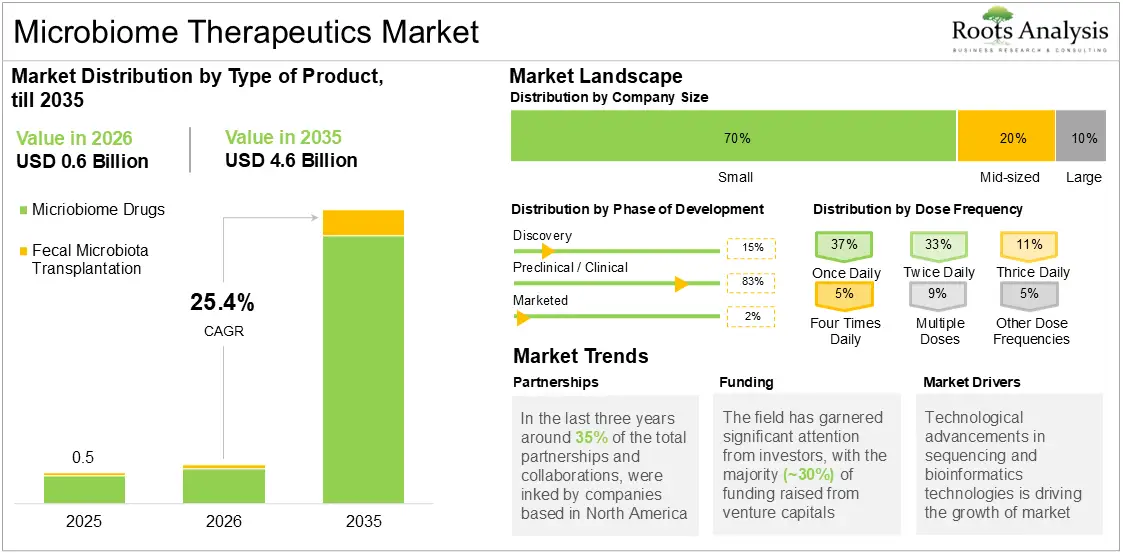
The global microbiome therapeutics market, valued at USD 0.5 billion in 2025, is projected to reach USD 0.6 billion in 2026 and USD 4.6 billion by 2035, representing a CAGR of 25.4% during the forecast period 2026 to 2035.
To learn more about this report, request a free sample copy
Microbiome therapeutics represent a transformative paradigm in modern medicine, leveraging the human body’s trillions of symbiotic microorganisms to treat and prevent disease. The field has evolved beyond traditional probiotics and fecal microbiota transplantation (FMT) to include defined bacterial consortia, live biotherapeutic products (LBPs), and genetically engineered microbial therapies. These advancements are being enabled by breakthrough technologies, including single-cell genomic analysis, transcriptomics, and machine learning, which allow researchers to better understand and map host-microbe interactions with unprecedented precision.
The clinical success of microbiome therapeutics is most evident in the treatment of recurrent Clostridioides difficile (rCDI), where FMT demonstrates 70-91% cure rates, far surpassing traditional antibiotics that show 25-30% recurrence rates. This progress led to the FDA approval of pioneering microbiome therapeutics, including Rebyota and VOWST established important regulatory precedents for future microbiome-based therapies. Beyond gastrointestinal disorders, various therapeutics are now in clinical pipelines, targeting new disease areas including inflammatory bowel disease, cancer, metabolic disorders, and neurological conditions.
Emerging evidence highlights the microbiota-gut-brain axis as a promising therapeutic target for neurodegenerative disorders, demonstrating bidirectional communication between gut microbiome and central nervous system that regulates glial functions. Concurrently, the field is evolving beyond donor-dependent fecal microbiota transplantation (FMT) towards defined microbial consortia, such as VE303. This drug offers greater standardization, scalability, and reduced donor-related variability.
Further advancing the field, next-generation platforms, such as intelligent responsive bacteria for diagnosis and therapy (iROBOT), integrate therapeutic and diagnostic capabilities. These capabilities enable bacteria to detect localized inflammatory signals, modulate host responses through targeted molecule production, and enable non-invasive monitoring of inflammation within affected tissues.
| Product | Company | YoE | HQ (Region) | Indication | Administration | Status (June 2026) | Key Notes |
| Rebyota | Ferring Pharmaceuticals | 1950 | Europe | Prevention of recurrent C. difficile infection (rCDI) | Rectal enema | FDA Approved (Nov 2022) | First FDA-approved microbiome therapeutic. Strong real-world data; widely used in the US. |
| VOWST | Seres Therapeutics | 2010 | North America | Prevention of recurrent C. difficile infection (rCDI) | Oral capsules | FDA Approved (Apr 2023) | First and only oral microbiome therapeutic approved by FDA. Commercialized globally by Nestlé. |
| VE303 | Vedanta Biosciences | 2010 | North America | Prevention of recurrent C. difficile infection (rCDI) | Oral capsules | Phase 3 (RESTORATiVE303 ongoing) | Defined 8-strain bacterial consortium. Enrollment progressing; topline data expected 2026. |
| MaaT013 | MaaT Pharma | 2014 | Europe | Steroid-refractory acute Graft-vs-Host Disease (aGvHD) with GI involvement | Rectal enema | Phase 3 completed; MAA under EMA review (re-examination ongoing) | Positive pivotal ARES Phase 3 results. Potential first EU approval in microbiome for oncology supportive care (decision expected H2 2026). |
Abbreviations: YoE: Year of Establishment and HQ: Headquarters
Based on the research, we have segmented the Microbiome Therapeutics Market into type of product, route of administration, therapeutic area, end user and geographical regions.
By Type of Product
By Route of Administration
By Target Indication
By Therapeutic Area
By End User
By Geographical Regions
Precision microbiome manufacturing is becoming the next innovation wave in the life sciences industry, driven by advances in synthetic biology, artificial intelligence (AI), multi-omics technologies, and gene-editing tools such as CRISPR. Unlike conventional probiotics, next-generation microbiome interventions are being designed to selectively modulate microbial communities, deliver therapeutic molecules, and respond dynamically to disease-specific biomarkers. Recent industry trends include the development of programmable probiotics, live biotherapeutic products (LBPs), AI-enabled microbiome profiling platforms, and personalized microbial therapeutics tailored to individual patient microbiomes.
Driven by the escalating prevalence of chronic diseases linked to microbiome dysbiosis, such as metabolic disorders and certain autoimmune conditions, the microbiome therapeutics industry is expected to grow in the near future.
Dr. Gabriel Leventhal (Chief Scientific Officer, PharmaBiome), stated that, “The microbiome represents a new frontier for modern medicine. Traditional therapies typically focus on “fixing” problems by modifying the human body, for example clearing clogged arteries, removing pathogens, or even editing defects to our genetic code. The microbiome is fundamentally different in that it functions as an essential ‘support system’ – both integral to the functioning and health of our bodies, and external to us. While we don’t have full control over which bacteria live inside our guts, we can control the environment that microbes experience there, which might favor some strains more and others less.”
Discussions with multiple stakeholders in this domain influenced the opinions and insights presented in this study. The market report includes transcripts of the following discussions:
In addition, the market report includes transcripts of the following other third-party discussions:
This segment highlights the distribution of market value for microbiome therapeutics across various types of products, such as fecal microbiota transplantation and microbiome drugs.
Currently, the fecal microbiota transplantation segment captures the majority of the overall market share. This dominance is primarily due to its established clinical efficacy and early commercialization advantage in the treatment of recurrent Clostridioides difficile infections (rCDI). Moreover, the regulatory approvals of standardized FMT-based products have accelerated physician adoption and payer acceptance, enabling broader integration into clinical practice compared to emerging microbiome modalities.
In contrast, microbiome drugs are expected to register the highest CAGR during the forecast period. This accelerated growth is fueled by the industry’s transition towards defined, scalable, and precision-engineered microbial therapeutics. Unlike conventional FMT, microbiome drugs offer standardized formulations, controlled manufacturing processes, and stronger intellectual property protection, making them highly attractive to pharmaceutical investors and strategic partners. Additionally, growing advancements in synthetic biology, strain engineering, and microbiome profiling are enabling the development of targeted therapies across various therapeutic areas, thereby substantially expanding the addressable market.
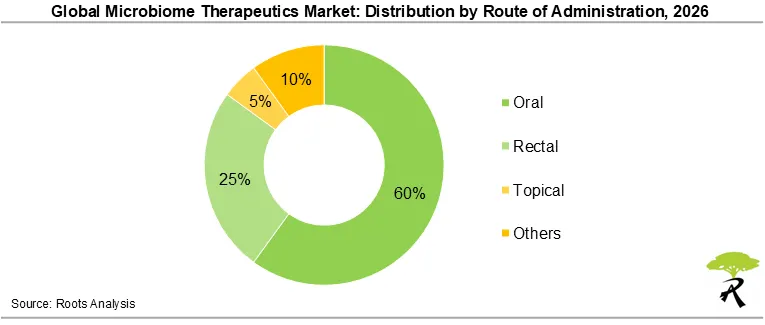
Based on the route of administration method, the global market is segmented into oral, rectal, topical and others.
Presently, the oral route sub-segment is likely to capture the majority (around 60%) of the microbiome therapeutics market size. This stems from several benefits offered by oral administration which align with the fundamental therapeutic objective of directly modulating the gut microbiome through a patient-friendly and scalable delivery mechanism. Oral formulations, including capsules containing microbiome consortia, offer significant advantages in terms of patient compliance, outpatient administration, manufacturing standardization and commercial distribution.
Moreover, it is worth highlighting that, as per the microbiome therapeutics market analysis, the market share for oral route sub-segment is likely to grow at a relatively higher CAGR during the forecast period. This is primarily owing to the recent advancements in encapsulation technologies and targeted-release systems which have significantly improved microbial viability and delivery efficiency, enhancing clinical confidence in oral microbiome therapies.
Based on the target indication, the global market is segmented into Clostridioides difficile infection, Crohn’s disease, diabetes, inflammatory bowel disease and other target indications.
According to our market analysis, Clostridioides difficile infection occupies the highest market share and is likely to witness the highest growth rate in the microbiome therapeutics market. This is largely because it is the most clinically established and commercially validated indication for microbiome-based intervention. Moreover, the high recurrence rates associated with CDI, coupled with the limitations of conventional antibiotic therapies in restoring microbial balance have created a strong demand for microbiome-targeted treatment. This addresses the underlying cause of disease rather than symptoms alone.
Additionally, regulatory approvals of microbiome therapeutics specifically for recurrent CDI have further accelerated physician adoption, reimbursement coverage and healthcare system acceptance. This positions CDI as the primary entry point for commercialization within the overall market landscape.
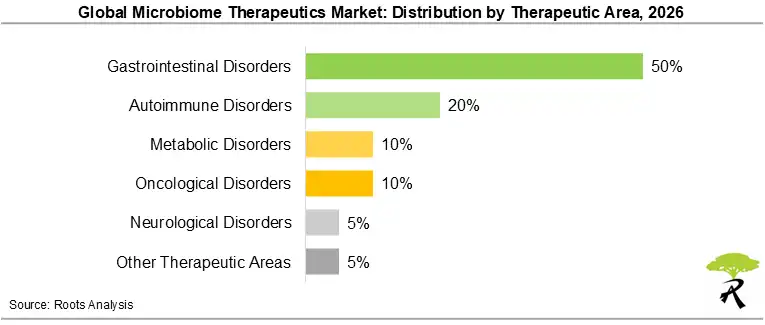
On the basis of therapeutic area, the global market is distributed into autoimmune disorders, gastrointestinal disorders, metabolic disorders, neurological disorders, oncological disorders and other therapeutic areas.
Currently, the gastrointestinal disorders sub-segment occupies the highest share in the overall market primarily because the gut microbiome has a direct and well-established role in the pathogenesis and progression of gut-related disorders. Some of these include recurrent Clostridioides difficile infection, inflammatory bowel disease (IBD), irritable bowel syndrome (IBS) and other gastrointestinal disorders. In addition, gastrointestinal disorders provide measurable clinical endpoints and relatively shorter development timelines, making them attractive targets for microbiome drug developers.
Moreover, it is worth highlighting that, as per microbiome therapeutics market analysis, the market share for oncological disorders is likely to grow at a relatively higher CAGR during the forecast period. This is due to the fact that cancer is one of the most active areas of microbiome research, with growing evidence linking the microbiome to disease progression and treatment response. In addition, the segment remains relatively underpenetrated, leaving substantial room for growth as personalized medicine and microbiota-targeted therapies gain broader clinical acceptance.
In terms of geographical regions, the global market is distributed across North America, Europe, Asia-Pacific, Middle East and Africa, and Latin America.
According to our microbiome therapeutics market forecast model, North America is likely to capture the majority (around 50%) of the overall market share in the current year, and this trend is unlikely to change. This market dominance is attributable to the region's advanced regulatory framework and robust clinical research ecosystem. The USFDA granted the world’s first regulatory approvals for microbiome-based therapies, including Rebyota and VOWST, establishing a clear commercialization pathway for live biotherapeutic products. Moreover, the region hosts the presence of leading microbiome drug developers, such as Seres Therapeutics, Finch Therapeutics, and Vedanta Biosciences, which continue to advance extensive clinical pipelines that further catalyse market expansion. Additionally, the high prevalence of microbiome-associated diseases is driving therapeutic demand. For instance, the US alone reports around 500,000 annual Clostridioides difficile (C. diff) infections and an estimated 35,000 deaths attributable to antimicrobial resistance (AMR) each year. This underscores the critical unmet clinical need that microbiome therapeutics meet.
The market in Asia-Pacific is likely to grow at a high CAGR during the forecast period till 2035. This accelerated expansion is driven by heightened awareness of gut health and a rising incidence of chronic diseases across the region, including inflammatory bowel disease (IBD), metabolic disorders, and antibiotic-resistant infections. Further, robust government support for biotechnology innovation is substantially advancing market growth. Notable examples include China’s leadership in genomic sequencing research, accounting for 42% of global research papers, and India’s Genome India Project, which has successfully sequenced over 10,000 genomic samples to establish a national genomic database for advanced therapeutic development.
| Key Report Attribute | Details | |
| Historical Trend | Since 2022 | |
| Forecast Period | Till 2035 | |
| Market Size 2026 | $0.6 Billion | |
| Market Size 2035 | $4.6 Billion | |
| CAGR (Till 2035) | 25.4% | |
| Segments Covered |
|
|
| Key Players |
|
|
| PowerPoint Presentation (Complimentary) |
Available | |
| Customization Scope | 15% Free Customization | |
| Excel Data Packs (Complimentary) |
Available | |