North America AI in Clinical Trials Market Size, Share, Trends & Strategic Industry Analysis Report, 2026-2035
North America AI in Clinical Trials Market by Trial Phase (Phase I, Phase II and Phase III), Type of Offering (Software and Services), Deployment Mode (Cloud-based and On-premises), Therapeutic Area (Oncological Disorders, Infectious Diseases, CNS Disorders, Metabolic Disorders, Immunological Disorders, Cardiovascular Disorders and Other Disorders), Technology Exposure, End-user and Countries – Trends and Forecast, 2026-2035
-
Lowest Price Guaranteed
-
Pages
186 -
Last Updated
October 2026 -
View Count
9325 -
Market Outlook
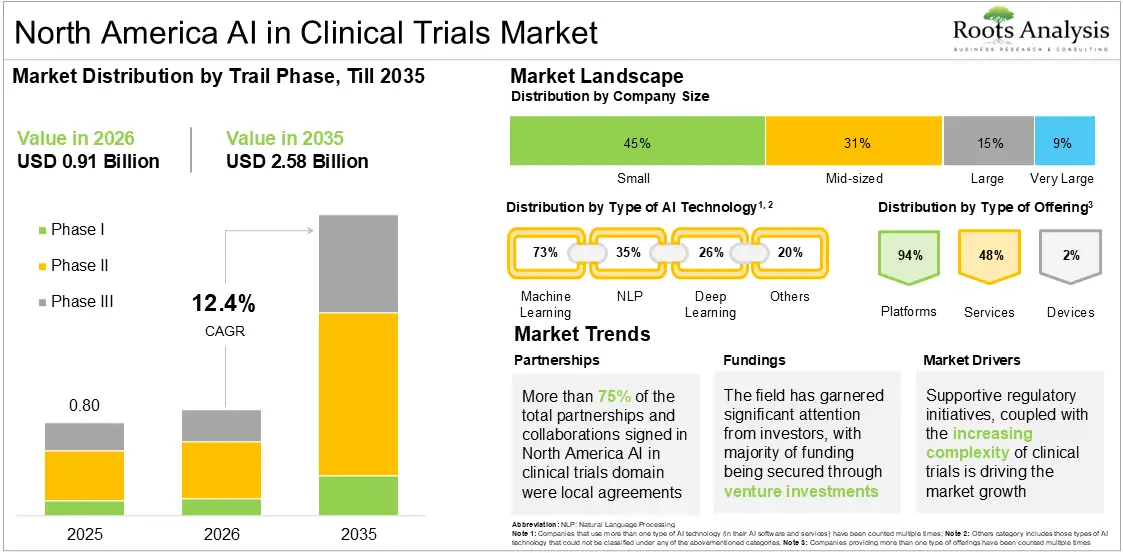
The North America AI in clinical trials market, valued at USD 0.80 billion in 2025, is projected to reach USD 0.91 billion in 2026 and USD 2.58 billion by 2035, with a CAGR of 12.4% during the forecast period, 2026 to 2035.
To learn more about this report, request a free sample copy
Market Report: Key Takeaways
Market Size and Trends
- In terms of trial phase, phase II holds the largest share of the current market.
- With respect to type of offering, the services segment dominates (around 55%) the current market.
- Based on the deployment mode, cloud-based AI solutions capture the largest share of the current market, and the trend is unlikely to change in the future.
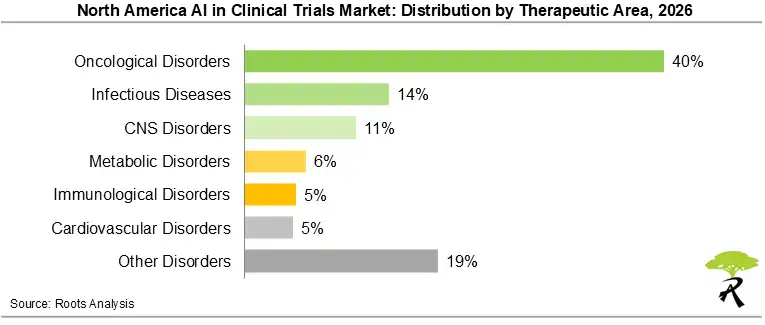
- In terms of therapeutic areas, oncological disorders are likely to hold the largest market share (40%) in 2026.
- With respect to technology exposure, machine learning dominates (around 40%) the current market.
- Based on the end-user, biotechnology and pharmaceutical companies capture the largest share of the current market, and the trend is unlikely to change in the future.
Key Market Statistics
- Market Size in 2026: $0.91 billion
- Estimated Market Size in 2035: $2.58 billion
- CAGR (Till 2035): 12.4%
Market Introduction
The growing complexity of clinical research, escalating development costs, and increasing pressure to accelerate drug approvals have established artificial intelligence (AI) as a transformative force across the entire clinical trial value chain. AI empowers sponsors to optimize protocol design, identify suitable patients, predict enrollment risks, automate data management, and enable real-time decision-making. These capabilities significantly enhance trial efficiency while shortening timelines and reducing operational costs. As the biopharmaceutical industry embraces data-driven drug development, AI has evolved from a supplementary analytical tool into a core strategic capability that is fundamentally reshaping how clinical trials are planned, executed, and monitored.
This transformation is particularly evident in North America, which has emerged as a prominent market for AI-enabled clinical trials. The region benefits from a highly mature life sciences ecosystem comprising global pharmaceutical companies, contract research organizations (CROs), AI technology providers, academic medical centers, and extensive, high-quality healthcare datasets. Moreover, a supportive regulatory environment in the region provides greater clarity on the responsible use of AI in drug development. For instance, in January 2025, the US Food and Drug Administration (FDA) released its first draft guidance on the use of AI-generated information to support regulatory decision-making for drugs and biological products, marking a significant milestone in the integration of AI into regulated clinical development.
As regulatory confidence continues to strengthen, AI adoption across North America's clinical research landscape is rapidly progressing from proof-of-concept initiatives to enterprise-wide deployment. Technology providers are increasingly embedding AI into core clinical development workflows to streamline study start-up, improve operational efficiency, and reduce execution risks. For instance, in February 2026, New York-based Medidata reported that its AI technologies had supported more than 500 clinical studies, including over 120 AI-enabled studies launched in 2025 alone. The company has integrated generative AI to automatically configure electronic data capture (EDC) and clinical outcome assessment (COA) systems directly from study protocols, significantly reducing the study set-up period before patient enrolment begins.
Looking ahead, the North America AI in clinical trials market is well positioned for sustained growth as sponsors increasingly leverage AI to minimize protocol amendments, optimize patient recruitment, and generate trial-ready evidence from diverse multimodal datasets.
Leading Companies in North America AI in Clinical Trials Market
| Company | Headquarters | YoE | AI Clinical Trial Platform | Core Use Case |
| Medidata | New York, US | 1999 | Medidata AI / Medidata Platform | Trial design, execution, data management and lifecycle automation |
| Saama | California, US | 1997 | Saama AI / Site360 | Clinical analytics, patient data review and site selection |
| Medable | California, US | 2015 | Medable AI / Agentic AI clinical trial platform | eCOA, decentralized trials, site workflows and AI-enabled study operations |
| Tempus AI | Illinois, US | 2015 | Tempus TIME, Next Trials, Deep 6 AI | AI-enabled trial matching and precision oncology enrollment |
| Unlearn | California, US | 2017 | AI-generated digital twins | Trial design, external controls and sample-size optimization |
Abbreviation: YoE: Year of Establishment
Market Segmentation
Based on the research, we have segmented the North America AI in clinical trials market report into trial phase, type of offering, deployment mode, therapeutic area, technology exposure, end-user, and countries.
By Trial Phase
- Phase I, Phase II, Phase III
By Type of Offering
- Software and Services
By Deployment Mode
- Cloud-based and On-premises
By Therapeutic Area
- Oncological Disorders, Infectious Diseases, CNS Disorders, Metabolic Disorders, Immunological Disorders, Cardiovascular Disorders, Other Disorders
By Technology Exposure
- Machine Learning, Molecular Modeling and Simulation, Deep Learning, Omics Integration, Generative Model, Other Technologies
By End-user
- Biotechnology and Pharmaceutical Companies, Academic Research Institutes, Other End-users
By Countries
- US and Canada
Key Market Insights
What Factors are Driving Increased Adoption of AI in Clinical Trials within North America?
- Expansion of Precision Medicine and Biomarker-Driven Trials: Oncology, neuroscience, and rare disease studies increasingly require the analysis of genomic, molecular, imaging and clinical information to identify narrow patient subgroups. AI enables sponsors to combine these datasets and determine which patients are most likely to respond to an investigational treatment. For example, in May 2026, US-based Tempus AI expanded its collaboration with Bristol Myers Squibb to apply AI, multimodal real-world data and data science to optimize trial design and improve the probability of success across five initial oncology and neuroscience development programs.
- Scaling AI from Pilot Use Cases Across the Trial-Lifecycle: Pharmaceutical companies and contract research organizations are increasingly integrating AI across the complete trial lifecycle rather than using it for isolated experiments. Applications now extend from protocol development and study start-up to patient recruitment, monitoring, data management and evidence generation. In April 2026, Worldwide Clinical Trials entered a strategic partnership with Medidata to deploy enterprise-level AI across its study, data and patient-experience operations, illustrating the growing adoption of AI by North American CROs.
What are the Main Challenges in North America AI in Clinical Trials Market Growth?
- Fragmented and Non-standardized Clinical Data: Clinical-trial AI systems often need to combine electronic health records, laboratory results, imaging, genomic information, and study data collected across multiple institutions. However, inconsistent terminology, formats and data structures make integration expensive and time-consuming.
- High Implementation Costs and Integration with Legacy Clinical Trial Infrastructure: Despite the long-term efficiency gains offered by AI, implementing AI solutions requires substantial upfront investment in cloud infrastructure, data engineering, software integration, cybersecurity, workforce training, and change management. Moreover, many pharmaceutical companies and CROs still rely on legacy clinical trial systems that were not designed to support AI-driven workflows.
Recent Developments in North America AI in Clinical Trials Market
- In June 2026, Florence Healthcare released Model Context Protocol access for its full clinical operations application suite at DIA 2026. The agent-ready infrastructure lets AI agents interact with 11 workflow tools across 65,000 research sites and 30,000 active protocols.
- In June 2026, Medable launched its Digital Data Flow Agent to convert static clinical trial protocols into structured, machine-readable data. The agent supports CDISC USDM 4.0 JSON outputs for downstream clinical development workflows.
- In May 2026, Tempus AI unveiled the next generation of Lens, its agentic AI platform for oncology drug development and research. The platform supports clinical trial design, biomarker validation and real-world evidence workflows using multimodal oncology datasets.
Industry Experts on North America AI in Clinical Trials Market
Driven by the increasing complexity of clinical development and the growing need to improve trial efficiency, the North America AI in clinical trials market is poised for transformative growth over the coming years.
Jennifer Duff (Executive Vice President and General Manager of Zelta) stated that, "AI is going to optimize efficiency, bring down costs and manual effort, and improve traceability and quality. It will also bring together really good science between the human experts and the added controls on the AI side. There's a significant amount of investment in this domain right now. Once we stand up the ability to support ingestion and implementation of this, and integrate with downstream workflows, that adoption will add immediate value."
Discussions with multiple stakeholders in this domain influenced the opinions and insights presented in this study. The market report includes transcripts of the following discussions:
- Co-founder, Chief Executive Officer and Chief Technology Officer, Small Company, Switzerland
- Founder and Chief Executive Officer, Mid-Sized Company, US
- Founder and Chief Executive Officer, Small Company, US
- Co-founder and Executive Director, Mid-Sized Company, US
- Chief Technology Officer, Chief Commercial Officer, Chief Delivery Officer, Head of Marketing, Mid-Sized Company, US
In addition, the market report includes transcripts of the following third-party discussions:
- Chief Science Officer, Large Company, US; Co-Founder and Chief Executive Officer, Mid-Sized Company, US; Chief Executive Officer, Mid-Sized Company, US; Associate Professor and Blue Cross California Distinguished Professor, Large Organization, US
- EVP, Chief Information, Technology, and Product Officer, Large Company, US
- Co-Founder and Chief Executive Officer, Mid-Sized Company, US
- Chief Technology Officer, Mid-Sized Company, US
- Director of the Office of Medical Policy (CDER), Large Organization, US
- Professor of Medicine, Large Organization, US; Program Manager, Large Organization, US; Director, Bioethics Lead, Large Company, US; Associate Dean, Human Research Protections and Director of the Human Research Protections Program, Large Organization, US; Executive IRB Chair and VP of IBC Affairs, Large Company, US
- Hematologist, AI Specialist, and Research Group Leader, Large Organization, Germany
- Cardiologist and Associate Director of the Accelerator for Clinical Transformation Research Group, Large Organization, US
- Heart Failure Cardiologist and Researcher, Large Organization, US
- Senior Community Development Manager, Mid-Sized Company, Netherlands
Market Share Insights
Which Type of Offering Accounts for the Largest Market Share?
- Based on the North America AI in clinical trials market analysis, the services sub-segment is likely to occupy the highest (around 55%) market share in 2026. This dominance is due to the fact that successful deployment of AI in clinical trials requires far more than software procurement; it necessitates extensive support for data integration, model development, validation, regulatory compliance, workflow customization, and ongoing performance monitoring. Moreover, given the complexity of clinical trial data environments and the stringent regulatory requirements governing drug development, sponsors often rely on specialized service providers to design, implement, and manage AI-enabled solutions across the clinical development lifecycle.
- The software sub-segment is anticipated to be the fastest-growing segment in this industry, with an annualized growth rate (CAGR) of 10.5% during the forecast period. This growth is primarily attributable to the increasing shift from customized, service-led AI projects toward scalable cloud-based platforms that can be deployed across multiple studies, therapeutic areas and research sites. For instance, in September 2025, California-based Saama introduced modular clinical AI agents capable of performing reasoning, planning and multi-step clinical-development workflows, with integration into either Saama's platform or sponsors' existing systems.
Which Therapeutic Area Accounts for the Largest North America AI in Clinical Trials Market Share?
- In 2026, oncological disorders are likely to capture the highest (40%) market share. Further, this segment is likely to witness a significant growth rate during the forecast period.
- This dominance is primarily attributable to the complexity and data intensity of oncology trials, which frequently require sponsors to combine genomic profiles, pathology images, radiology scans, electronic health records, and treatment-response data to identify narrowly defined patient populations. Moreover, the growing use of biomarker-driven therapies, antibody drug conjugates and precision-oncology combinations has made conventional patient screening increasingly resource-intensive, creating strong demand for AI-enabled trial design, biomarker discovery, site selection, and patient-matching solutions. In fact, the US FDA's Oncology Center of Excellence has established a dedicated Oncology Artificial Intelligence Program and formed an AI Council in 2025, reflecting the expanding use of AI across oncology drug development and regulatory review.
Based on Technology Exposure, Which Segment Captures the Largest Share of the North America AI in Clinical Trials Market?
- Currently, the machine learning sub-segment occupies a higher (around 40%) share of the North America AI in Clinical Trials Market. This is primarily due to its widespread deployment across commercially mature clinical trial applications, including patient recruitment, site selection, enrollment prediction, protocol optimization, and risk-based trial monitoring. Moreover, its superior versatility in processing complex clinical datasets, powering advanced predictive modeling, and generating real-time actionable insights enables CROs to improve trial efficiency and reduce operational risks.
- The generative model sub-segment is likely to grow at a higher CAGR (16.1%) during the forecast period. This growth is primarily attributable to the ability of generative AI to automate the document-intensive and language-based activities that consume substantial time throughout clinical development. For instance, in February 2026, Medidata reported that its generative AI-enabled Study Build capability could use a trial protocol to configure Rave EDC and eCOA systems, reducing the time required to move from protocol development to study start-up.
Key Players in the North America AI in Clinical Trials Market
Examples of key companies profiled in this market report, arranged in alphabetical order, include ConcertAI, IQVIA, LabCorp, Medidata, Microsoft, PathAI, ServiceNow, Signant Health, and TransPerfect Life Sciences. The complete list of companies is available in the full report, which also includes an easily searchable Excel database of North America AI in clinical trials software and service providers worldwide. Additional named organizations referenced elsewhere in this report's underlying data, reflect funding and partnership activity tracked across the broader North America AI in clinical trials ecosystem, not an endorsement relationship with Roots Analysis.
Report Deliverables and Customization
Alongside the core market report, purchasers receive complimentary Excel data packs covering the North America AI in clinical trials software and service providers market landscape, clinical trial analysis, partnerships and collaborations analysis, funding and investment analysis, big pharma analysis, cost saving analysis, and market sizing and opportunity analysis. The report also includes a complimentary PowerPoint presentation summarizing the key findings and offers 15% free customization upon request.
Report Authorship
Author(s): This report was co-authored by Simriti Gupta, Pemba Lahmo, both part of Roots Analysis's healthcare and pharma research practice. All findings are based on proprietary databases, executive interviews, and regulatory analysis, subject to internal peer review prior to publication.
Independence and Non-Affiliation
Roots Analysis is an independent market research and consulting firm. This report draws on publicly available information, primary interviews, and proprietary analysis. Roots Analysis is not affiliated with, endorsed by, or a representative of the USFDA, the European Medicines Agency, or any of the companies, technologies, or individuals named in this report. Figures are derived from primary interviews with industry stakeholders combined with secondary research and are not directly comparable to market-sizing studies published by other research firms.
Clients evaluating this report alongside competing market studies should weigh how the publisher defines the segment boundary, since North America AI in clinical trial market sizing is not standardized across research firms and some studies fold in adjacent manufacturing or CDMO revenue that this report treats separately.