North America Aseptic Fill Finish Manufacturing Market
North America Aseptic Fill Finish Manufacturing Market by Type of Molecule (Biologics and Small Molecules), Type of Biologic Manufactured (Antibodies, Cell Therapies, Gene Therapies, Oligonucleotides, Recombinant Proteins, Vaccines, and Other Biologics), Type of Packaging Container (Ampoules, Bags, Cartridges, Syringes, and Vials), Scale of Operation, Company Size, Type of Product, Therapeutic Area, Country – Trends and Forecast 2026-2035
-
Lowest Price Guaranteed
-
Pages
267 -
Last Updated
October 2026 -
View Count
3148 -
Market Outlook
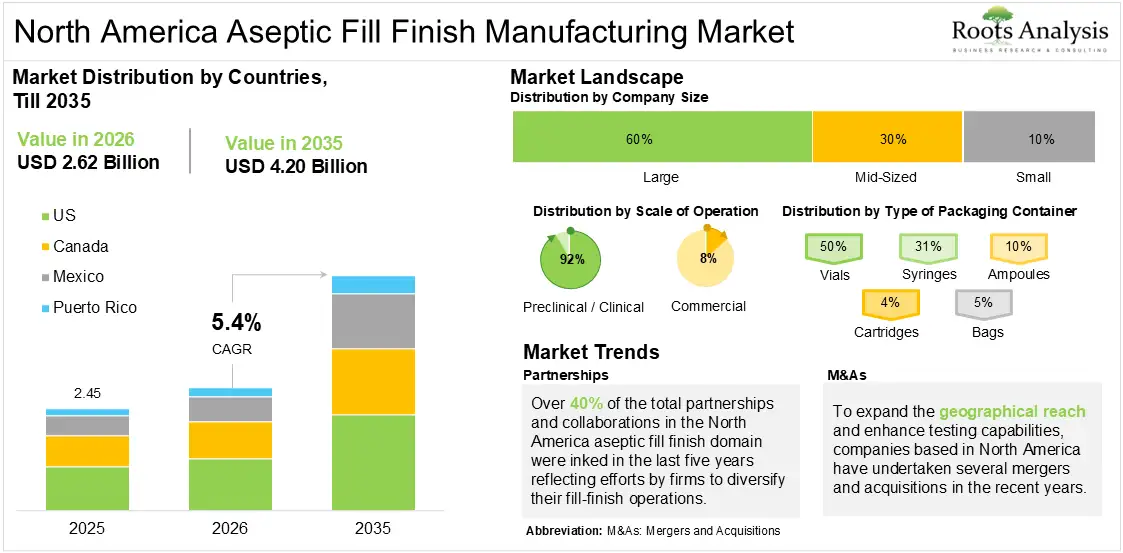
The North America aseptic fill finish manufacturing market, valued at USD 2.45 billion in 2025, is projected to reach USD 2.62 billion in 2026 and USD 4.20 billion by 2035, representing a CAGR of 5.4% during the forecast period 2026 to 2035.
To learn more about this report, request a free sample copy
Market Report: Key Takeaways
Market Size & Trends
- The biologics segment accounts for the largest share of the North America aseptic fill finish manufacturing market by molecule type, driven by the critical need to preserve product quality and stability throughout sterile manufacturing processes.
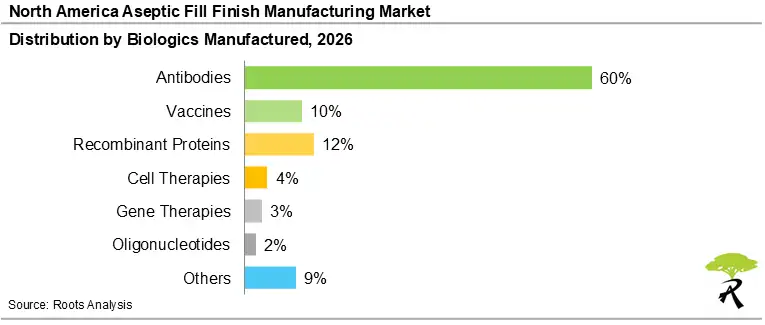
- Antibodies represent both the leading and fastest-growing category among types of biologics manufactured, supported by their broad therapeutic applications.
- Vials account for the dominant share by packaging container type, owing to their versatility for both liquid and lyophilized drug products.
- Large companies dominate the overall current market share, reflecting the high capital required for equipment and commercial lines.
- Commercial operations hold the leading share and are projected to register the fastest growth, as approved products require recurring manufacturing campaigns to meet sustained market demand.
- Branded products hold the leading share and are expected to witness the fastest growth within the approved product classification, driven by continued demand for established marketed therapies.
- Oncological disorders dominate the current North America aseptic fill finish market, owing to the rising prevalence of cancer across different regions.
- The United States is the leading market and is also expected to register the fastest growth during the forecast period; this trend is due to its extensive biopharmaceutical manufacturing base, sustained aseptic fill finish capacity, and ongoing investments in biologics and advanced manufacturing infrastructure.
Key Market Statistics
- Market Size in 2026: $2.62 Billion
- Estimated Market Size in 2035: $4.20 Billion
- CAGR (2026-2035): 5.4%
- US: Largest market and fastest-growing country market during 2026-2035
Market Introduction
Aseptic fill finish manufacturing covers the final sterile drug-product operations required when pharmaceutical and biological products cannot rely on terminal sterilization. The service chain typically includes formulation or compounding, sterile filtration, aseptic filling into vials, syringes, cartridges, ampoules or bags, lyophilization where required, inspection and secondary finishing. FDA guidance places aseptically manufactured sterile drug and biological products within stringent CGMP requirements intended to control microbial contamination.
Demand is expanding as the injectable pipeline becomes more diverse and technically demanding. The FDA approved 46 novel drugs in 2025, while Health Canada reported 15 new drug submissions authorized between April and June 2026, including seven biologics. The addressable manufacturing base increasingly includes monoclonal antibodies, advanced therapies, oligonucleotides, potent oncology products and drug-device combinations, creating demand for flexible clinical-to-commercial aseptic capacity.
Manufacturing technology is simultaneously shifting toward isolators, robotics, ready-to-use containers, automated inspection and lower-intervention filling architectures. FDA recognizes modern isolator and closed-system approaches as important tools for reducing operator-related contamination risk, although such technologies do not eliminate the need for rigorous process control. PCI, Kindeva and other North American manufacturers are installing isolator-based lines capable of handling multiple sterile container formats.
The principal constraint remains the difficulty of adding qualified sterile capacity quickly. FDA notes that injectable shortages can be exacerbated by limited production lines, manufacturing complexity and long lead times for increasing output. Manufacturers therefore need resilient facilities, faster technology transfer, strong contamination-control programs and sufficient redundancy to convert growing injectable pipelines into reliable commercial supply.
Market Segmentation
Based on the research, we have segmented the North America aseptic fill finish manufacturing market into type of molecule, type of biological manufactured, type of packaging container, scale of operation, company size, type of product, therapeutic area, and countries.
- By Type of Molecule: Biologics and Small Molecules
- By Type of Biologic Manufactured: Antibodies, Cell Therapies, Gene Therapies, Oligonucleotides, Recombinant Proteins, Vaccines, and Other Biologics
- By Type of Packaging Container: Ampoules, Bags, Cartridges, Syringes, and Vials
- By Scale of Operation: Commercial and Preclinical / Clinical
- By Company Size: Large, Mid-sized, and Small
- By Type of Product: Branded and Generic
- By Therapeutic Area: Autoimmune Disorders, Cardiovascular Disorders, Genetic Disorders, Infectious Diseases, Metabolic Disorders, Neurological Disorders, Oncological Disorders, and Other Disorders
- By Geography: US, Canada, Mexico, Puerto Rico
North America Aseptic Fill Finish Manufacturing Market Key Insights
What Are the Key Growth Drivers in the North America Aseptic Fill Finish Manufacturing Market?
- Complex Biologics are Increasing the Value of Specialized Sterile Manufacturing: Biologics and other complex modalities place demanding requirements on formulation, sterile filtration, container compatibility, temperature control and aseptic handling. Recipharm announced a US investment in June 2026 specifically to expand sterile fill finish capabilities for biologics and advanced therapies. PCI's US infrastructure also supports antibodies, proteins, oligonucleotides and other complex injectable modalities alongside multiple container formats. These requirements expand the commercial role of fill finish providers beyond straightforward filling. Sponsors increasingly require formulation development, analytical transfer, lyophilization, inspection and device-ready presentations from the same manufacturing partner. The result is higher service intensity per program and greater demand for flexible sites that can maintain product quality while moving a molecule from development through commercial supply.
- Domestic Supply-Chain Priorities are Accelerating US Capacity Investment: Pharmaceutical companies are placing greater strategic weight on US sterile manufacturing capacity and sourcing redundancy. Halo Pharma linked its USD 45 million New Jersey investment to demand from US pharmaceutical companies seeking domestic sterile manufacturing partners, while PCI's 2026 investment program emphasized US supply-chain resilience. Curia formally opened its USD 200 million Albuquerque expansion in September 2026, adding two isolated filling lines and additional lyophilization, inspection and packaging capabilities. This investment cycle creates revenue opportunities for CDMOs while giving sponsors more options for contingency planning and technology transfer. It also increases competition among manufacturers to provide qualified capacity, short transfer timelines and multi-format platforms capable of supporting both clinical and high-volume commercial products.
Recent Developments in North America Aseptic Fill Finish Manufacturing Market
- In September 2026, Curia inaugurated its expanded Albuquerque, New Mexico aseptic fill finish campus following a USD 200 million investment. The expansion added 70,000 square feet and two isolated filling lines for syringes, cartridges, and pharmaceutical vials, complemented by lyophilization, automated visual inspection, and packaging capabilities.
- In August 2026, Jubilant HollisterStier received FDA approval for the first commercial sterile injectable manufactured on its Line 3 isolator fill-finish line in Spokane, Washington, validating the line's commercial readiness as part of the company's USD 300 million-plus sterile manufacturing expansion.
- In June 2026, AGC Biologics partnered with Pyramid Pharma Services to establish an integrated U.S. drug-substance and sterile fill-finish offering, supporting liquid and lyophilized vials, prefilled syringes, and cartridges, alongside device assembly and clinical finishing services.
Industry Experts on North America Aseptic Fill Finish Manufacturing Market
The North America aseptic fill finish manufacturing market is benefiting from increasing demand for biologics and advanced therapies, encouraging CDMOs to expand sterile manufacturing capacity and provide integrated support from development through commercial production.
In June 2026, Recipharm announced a multi-million-dollar investment to expand its U.S. sterile manufacturing footprint and fill-finish capabilities. Highlighting the need for expanded capacity and technical capabilities, Greg Behar, Chief Executive Officer of Recipharm, stated, "The demand for biologics and advanced therapies continues to accelerate, and manufacturers must be ready to meet that challenge with the right capacity, expertise and technology. By expanding our sterile manufacturing capabilities, we are investing in the infrastructure needed to support the next wave of pharmaceutical innovation."
Detailed transcripts were prepared from discussions with senior stakeholders across the aseptic fill finish manufacturing value chain, including chief executives and business, commercial, formulation-development and technology leaders.
- Ex-Chief Commercial Officer, Large Company, Germany
- Ex-Vice President Business Development & Marketing, Mid-sized Company, US
- Vice President and Head of Formulation Development, Very Large Company, India
- Head of Business Development, Mid-sized Company, Czech Republic
- Ex-Technology Watch Manager, Mid-sized Company, France
- International Business Developer, Mid-sized Company, Netherlands
Market Share Insights
Which Type of Molecule Accounts for the Largest Share of the North America Aseptic Fill Finish Manufacturing Market?
Biologics currently hold the largest share by molecule type due to the sensitivity of many biologic formulations to terminal sterilization, which creates demand for aseptic processing and controlled drug-product manufacturing. These products often require specialized, product-specific filling processes to maintain product quality throughout manufacturing.
Which Type of Biologic Manufactured Leads the North America Aseptic Fill Finish Manufacturing Market?
Antibodies currently hold the largest share by biologics manufactured and are expected to record the fastest growth during the forecast period due to established injectable antibody therapies, expanding treatment programs, and increasing adoption of additional product presentations.
Which Therapeutic Area Leads the Market?
Oncological disorders currently hold the largest share by therapeutic area due to the extensive use of injectable cancer therapies, including monoclonal antibodies, targeted therapies, and immunotherapies. These products often require specialized capabilities such as aseptic filling, lyophilization, and containment, supporting demand for oncology-focused fill-finish services.
Which Scale of Operation Leads the North America Aseptic Fill Finish Manufacturing Market?
Commercial operations currently hold the largest share by scale of operation and are expected to record the fastest CAGR during the forecast period due to recurring manufacturing requirements for marketed products, including consistent specifications, scheduled production, and reliable supply replenishment. These requirements create sustained demand for commercial-scale fill-finish services.
Regional Analysis: North America's Leading Aseptic Fill Finish Manufacturing Market
US is expected to grow the fastest during the forecasted period
The US currently represents the leading country market and is expected to record the fastest growth during the forecast period due to its established sterile manufacturing infrastructure, strong pharmaceutical development activity, and continued investment in commercial and development-stage capabilities. Facilities operated by Jubilant HollisterStier in Spokane and Piramal Pharma Solutions in Lexington further demonstrate the availability of sterile manufacturing capabilities in the country.
Key Players Profiled in North America Aseptic Fill Finish Manufacturing Market
The North America aseptic fill finish manufacturing market is served by a broad base of CDMOs and packaging-technology suppliers, including AbbVie Contract Manufacturing, Simtra BioPharma Solutions, Catalent, Patheon, Pfizer CentreOne, PiSA Farmaceutica, Sharp Services, and West Pharmaceutical Services.
Report Deliverables and Customization
The report includes complimentary Excel data packs covering market landscape analysis, company competitiveness, partnerships and collaborations, recent expansions, capacity analysis, demand analysis, market impact analysis, value chain analysis, and market sizing and forecast analysis. A complimentary PowerPoint presentation is available, and up to 15% customization can be requested subject to data availability.
Report Authorship
Author(s): Simriti Gupta and Pemba Lahmo. Both authors contribute to Roots Analysis's healthcare and pharma research practice, covering biologics discovery, development, and manufacturing market studies.
Independence and Non-Affiliation
This report is an independent work of market research and analysis published by Roots Analysis. It is not affiliated with, sponsored by, endorsed by, or reviewed by Eli Lilly, Pfizer, Merck, or any other pharmaceutical company, drug brand, or regulatory body referenced within it. No content in this report should be construed as medical advice. Roots Analysis maintains its own proprietary primary research process, and does not receive compensation from any company profiled within the report, in exchange for inclusion or favorable characterization.