Market Outlook
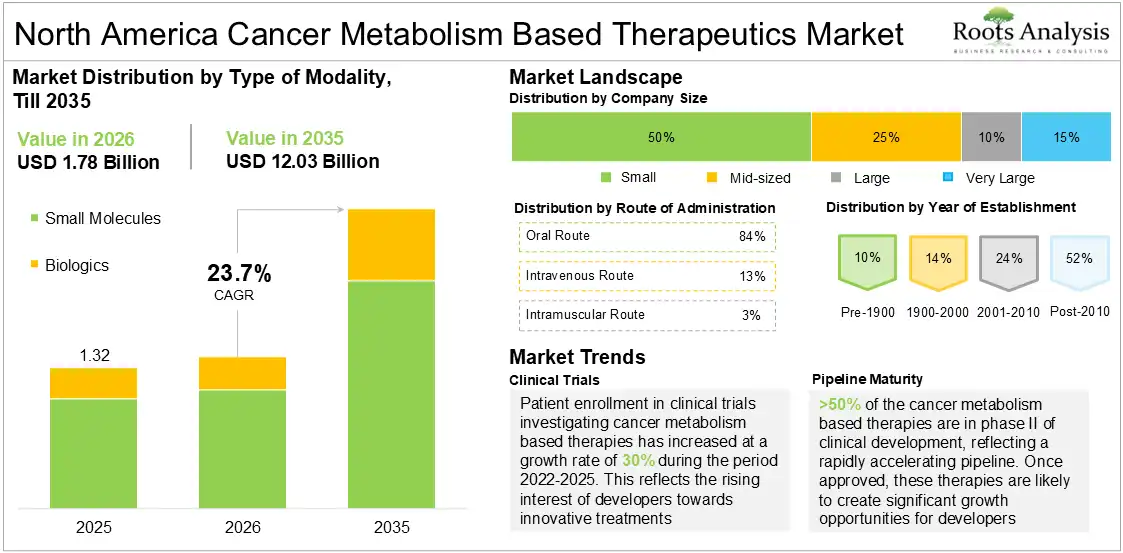
The North America cancer metabolism based therapeutics market, valued at USD 1.32 billion in 2025, is projected to reach USD 1.78 billion in 2026 and USD 12.03 billion by 2035, with a CAGR of 23.7% during the forecast period 2026 to 2035.
To learn more about this report, request a free sample copy
Market Report: Key Takeaways
Market Size and Trends
- In terms of type of modality, small molecules are likely to hold the highest share of the market in 2026; this trend is unlikely to change in the future.
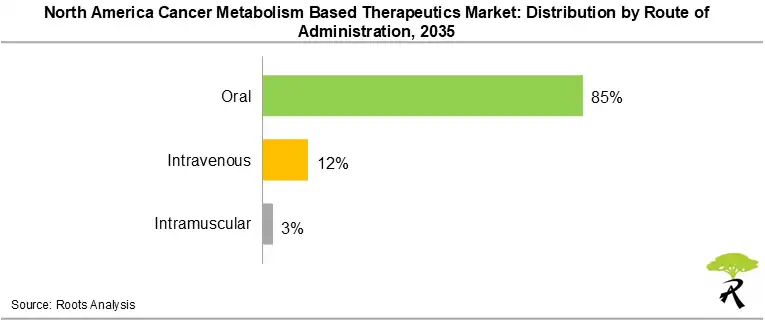
- With respect to the route of administration, the oral route (close to 85%) will dominate the market in 2035.
- Based on the target disease indication, in 2026, breast cancer captures the largest North America cancer metabolism based therapeutics market value.
Key Market Statistics
- Market Size in 2026: $1.78 billion
- Estimated Market Size in 2035: $12.03 billion
- CAGR (Till 2035): 23.7%
Market Introduction
Cancer remains one of the leading causes of morbidity and mortality worldwide, placing a significant clinical and economic burden on healthcare systems. Despite remarkable advances in targeted therapies and immuno-oncology, treatment resistance, tumor heterogeneity, and disease recurrence continue to limit long-term therapeutic success. These challenges have intensified interest in understanding the metabolic adaptations that enable cancer cells to sustain uncontrolled proliferation, evade immune surveillance, and survive under nutrient-deprived conditions. Consequently, targeting altered metabolic pathways has emerged as a promising therapeutic strategy, giving rise to a new generation of cancer metabolism based therapeutics. Within this workflow, NAMPT inhibitor targets NAD metabolism as a vulnerability in selected cancer cells.
North America has established itself as a global leader in the development of cancer metabolism therapeutics, supported by a high cancer burden, a mature biotechnology ecosystem, and substantial investments in oncology research. According to the American Cancer Society, more than 2 million new cancer cases are expected to be diagnosed annually in the United States, underscoring the need for innovative treatment modalities. The region also benefits from extensive funding from agencies such as the National Institutes of Health and the presence of leading academic cancer centers that continue to advance the understanding of tumor metabolism and identify novel metabolic targets.
The North American market has witnessed increasing research activity focused on disrupting key metabolic pathways, including glutamine metabolism, lipid metabolism, and mitochondrial energy production, to improve therapeutic outcomes across a broad range of malignancies. Several biotechnology companies are advancing first-in-class and next-generation metabolism-targeting candidates. For instance, Faeth Therapeutics is evaluating metabolism based combination therapies designed to enhance the efficacy of standard cancer treatments, while Cornerstone Pharmaceuticals has developed glutamine antagonist-based approaches targeting the metabolic vulnerabilities of solid tumors. Such innovations reflect the growing momentum toward precision oncology strategies that integrate metabolic modulation with existing treatment regimens.
As the understanding of tumor metabolic reprogramming continues to evolve, cancer metabolism based therapeutics are anticipated to become an integral component of next-generation oncology treatment paradigms across North America.
Market Segmentation
Based on the research, we have segmented the North America Cancer Metabolism Based Therapeutics Market Report into type of modality, route of administration, target disease indication, and sales forecast of therapies.
By Type of Modality
- Small Molecules
- Biologics
By Route of Administration
- Oral
- Intravenous
- Intramuscular
By Target Disease Indication
- Breast Cancer
- Non-small Cell Lung Cancer
- Acute Myeloid Leukemia
- Brain Cancer
- Cholangiocarcinoma
- Bile Duct Cancer
- Myelodysplastic Syndromes
- Malignant Mesothelioma
- Soft Tissue Sarcoma
- Hepatocellular Carcinoma
- Pancreatic Cancer
By Sales Forecast of Therapies
- Daraxonrasib
- Gedatolisib
- Olomorasib
- Inavolisib
- Vorasidenib
- STX-478
- AZD 5363
- AG-120
- Selpercatinib
- ADI-PEG 20
- Augtyro
- Taletrectinib
- Piqray
- TAS-120
- Rezlidhia
- AG-221
Key Market Insights
What Factors are Driving Increased Adoption of Cancer Metabolism Based Therapeutics in North America?
- Growing Clinical Validation of Metabolism-Targeted Drugs: The North America cancer metabolism based therapeutics market growth is driven by the commercial success and regulatory acceptance of IDH inhibitors that have helped validate cancer metabolism as an actionable therapeutic area. For example, the FDA approved enasidenib for relapsed / refractory AML with IDH2 mutations, ivosidenib for IDH1-mutated cholangiocarcinoma, and vorasidenib for IDH-mutant grade 2 astrocytoma or oligodendroglioma. Moreover, the approval of vorasidenib was particularly important, as it became the first FDA-approved systemic therapy for grade 2 IDH-mutant glioma.
- Growing Cancer Burden: North America continues to report a substantial oncology disease burden, creating sustained demand for therapies that can address difficult-to-treat and genetically defined cancers. In the US alone, around 2.11 million new cancer cases and 626,140 cancer deaths are projected in 2026, while Canada is expected to record around 254,100 new cancer cases in 2026. This large patient pool supports the uptake of novel therapeutic approaches, including drugs that target tumor-specific metabolic dependencies.
What are the Main Challenges in North America Cancer Metabolism Based Therapeutics Market Growth?
- Patient Selection and Biomarker Testing Barriers: Cancer metabolism based therapeutics often require accurate molecular profiling to identify eligible patients, such as those with IDH1 or IDH2 mutations. However, access to timely biomarker testing is still uneven across North America. In the US, underserved communities continue to face gaps in biomarker testing and access to precision medicine therapies, while Canadian studies also highlight challenges in equitable and timely access to biomarker testing and reporting.
- Complex Tumor Metabolism and Risk of Therapeutic Resistance: Cancer metabolism is highly adaptive. Tumors shift between glucose, glutamine, lipid, and mitochondrial pathways depending on nutrient availability, hypoxia, treatment pressure, and tumor microenvironment conditions. This metabolic plasticity makes it difficult for a single metabolism-targeted drug to produce durable responses across broad patient groups.
Recent Developments in North America Cancer Metabolism Based Therapeutics Market
- In June 2026, the USFDA approved Merck's WELIREG® (belzutifan), a HIF-2α inhibitor, in combination with pembrolizumab for adjuvant treatment of adults with renal cell carcinoma with a clear cell component at intermediate-high or high risk of recurrence. This approval expands the role of hypoxia pathway-targeted cancer metabolism therapeutics in earlier-stage kidney cancer management.
- In June 2026, Arcus Biosciences entered into a clinical trial collaboration and supply agreement to evaluate casdatifan, its investigational HIF-2α inhibitor, with pumitamig in advanced renal cell carcinoma. Casdatifan will be evaluated in the Bristol Myers Squibb-sponsored Phase 1/2 ROSETTA RCC-208 trial, supporting continued development of HIF-2α inhibition in kidney cancer.
- In March 2026, Persevere Therapeutics launched as a clinical-stage oncology company with misetionamide, also known as GP-2250, as its lead Phase 1b / 2a-ready asset. Misetionamide is designed to selectively disrupt cancer cell energy metabolism through c-MYC modulation and is being advanced initially for platinum-resistant ovarian cancer.
Industry Experts on North America Cancer Metabolism Based Therapeutics Market
The market for cancer metabolism based therapies in North America has a transformative future and is likely to remain progressive. A key driver of progression is the success of specialized treatments like Selpercatinib.
Jennifer Simpson (Chief Executive Officer, Panbela Therapeutics), stated that, "We believe that the addition of ivospemin, or SBP-101, to the standard-of-care regimen of gemcitabine and nab-paclitaxel has the potential to significantly improve outcomes for patients with metastatic pancreatic ductal adenocarcinoma, beyond the incremental benefit observed with the recently approved therapy. The early indications from the ASPIRE trial support this belief, and we remain committed to advancing this important study"
The North America cancer metabolism based therapeutics market report includes detailed discussions of multiple stakeholders in this domain, which have influenced the opinions and insights presented in this study. The market report includes transcripts of the following third-party discussions:
- President and Chief Executive Officer, Mid-sized Company, US
- President and Chief Executive Officer, Mid-sized Company, US
- Chief Executive Officer, Mid-sized Company, US
- Chief Financial Officer, Mid-sized Company, US
- Associate Professor, Very Large Company, US
- Medical Oncologist, Very Large Company, US
- Associate Professor, Large Company, Germany
- Former Vice President, Head of Research and Translational Sciences, Large Company, US
- Postdoctoral Researcher, Very Large Company, US
- Consultant Dietitian
Market Share Insights
Which Type of Modality Accounts for the Largest Market Share?
- Based on the North America cancer metabolism based therapeutics market analysis, the small molecules segment is likely to occupy highest market share in 2026. This trend stems from the favorable pharmacokinetic properties, oral bioavailability, and ability of small molecules to selectively target key metabolic pathways involved in tumor growth, including glutamine metabolism, glycolysis, and lipid metabolism.
- The biologics segment is likely to witness a higher CAGR in the future. This is driven by the increasing development of enzyme-based therapies, monoclonal antibodies, cytokines, and other biologic agents designed to selectively modulate tumor metabolism with improved target specificity and reduced off-target toxicity.
Which Route of Administration Accounts for the Largest North America Cancer Metabolism Based Therapeutics Market Share?
- In 2035, the oral dosage segment is likely to occupy the highest (~85%) market share. Further, this segment is likely to witness a significant growth rate during the forecast period. This can be attributed to their non-invasive nature, convenience of drug administration, and increased patient compliance as compared to other routes.
- The intramuscular segment is likely to witness a higher CAGR in the future. This is due to the fact that the intramuscular route allows controlled, slow release of metabolic inhibitors over weeks or months, ensuring stable therapeutic blood levels resulting in reduced dosing frequency.
Among the Target Disease Indications, Which Segment Holds the Highest Share in the North America Cancer Metabolism Based Therapeutics Market?
- Currently, the breast cancer segment occupies a larger share of the North America cancer metabolism based therapeutics market. This is primarily because breast cancer represents one of the largest oncology patient pools in North America, supported by high diagnosis rates, broad screening coverage, and strong clinical adoption of biomarker-driven targeted therapies. In the US, breast cancer remains the most common cancer diagnosed among women, while in Canada, it is estimated to account for 26% of all new cancer cases in women in 2026.
- The non-small cell lung cancer segment is likely to grow at a higher CAGR during the forecast period. This is primarily because NSCLC represents the dominant form of lung cancer and continues to carry a high disease burden across North America. In fact, according to the American Cancer Society, non-small cell lung cancer (NSCLC) accounts for about 80% of all lung cancer cases in the United States, making it the most common primary lung malignancy.
Scope of North America Cancer Metabolism Based Therapeutics Market Report
| Key Report Attribute |
Details |
| Historical Trend |
Since 2021 |
| Forecast Period |
Till 2035 |
| Market Size 2026 |
USD 1.78 Billion |
| Market Size 2035 |
USD 12.03 Billion |
| CAGR (Till 2035) |
23.7% |
| Segments Covered |
- Type of Modality
- Route of Administration
- Target Disease Indication
- Sales Forecast of Therapies
|
| Key Players Profiled |
(A complete list of companies captured is available in the report) |
PowerPoint Presentation
(Complimentary) |
Available |
| Customization Scope |
15% Free Customization |
Excel Data Packs
(Complimentary) |
Available |
Frequently Asked Questions
What is cancer metabolism based therapeutics?
Cancer metabolism based therapeutics are targeted therapies that exploit the unique, altered metabolic pathways of cancer cells to stop their growth without harming normal cells.What are the key drivers of North America cancer metabolism based therapeutics market?
The key growth drivers include the rising incidence of cancer, advancements in targeted therapies, and increased research and development in this domain. Additionally, growing demand for personalized therapies also contributes to the market growth.How big is the North America cancer metabolism based drugs market?
The market opportunity is substantial, with significant growth and wide global reach. The market size is projected to reach USD 12.03 billion by 2035.What is the North America cancer metabolism based therapeutics market growth?
The market is expected to grow at an annual rate of 23.7% from 2026 to 2035.Which cancer types receive the main focus in the worldwide market for cancer metabolism based therapeutics?
Breast cancer, non-small cell lung cancer, and acute myeloid leukemia are major targets for which cancer metabolism based therapies are being developed globally.Who are the leading North American companies developing cancer metabolism based therapeutics?
Bristol Myers Squibb, Celcuity, Cornerstone Pharmaceuticals, Eli Lilly, IDEAYA Biosciences and Polaris.