Oligonucleotide Synthesizer Market Overview
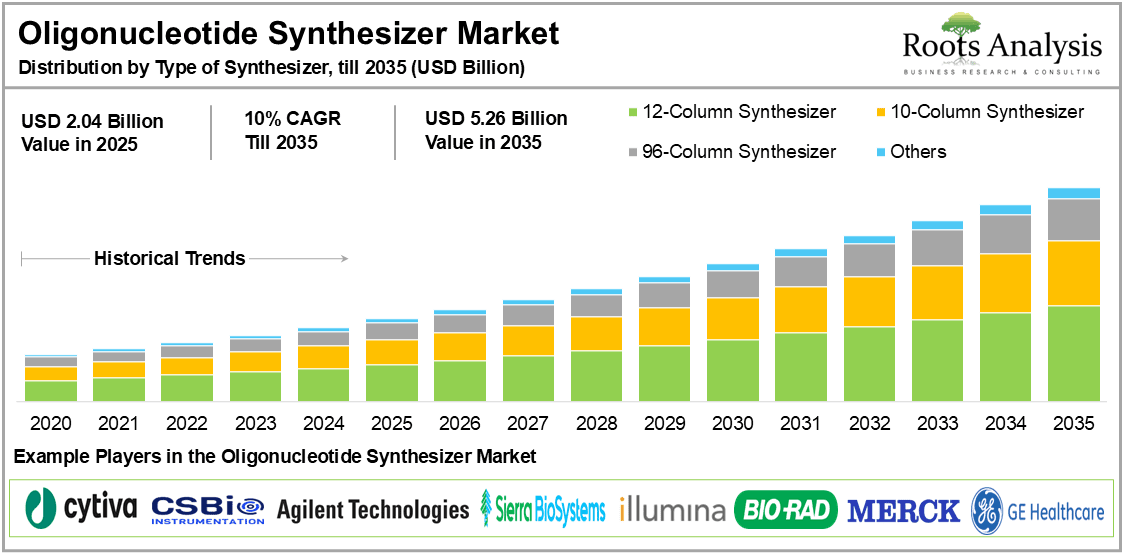
The global oligonucleotide synthesizer market size, valued at USD 1.82 billion in 2024, is projected to reach USD 2.04 billion in 2025 and USD 5.26 billion by 2035, representing a CAGR of 10% during the forecast period.
To learn more about this report, request a free sample copy
Oligonucleotide Synthesizer Industry: In Summary
- The global shift towards personalized healthcare (where treatments are tailored to an individual's genetic profile) directly fuels the need for customized oligonucleotide sequences. The oligonucleotide synthesizer market is expected to grow at a higher CAGR of 10% till 2035.
- Oligonucleotides are fundamental in various genomic technologies, including Next-Generation Sequencing (NGS), CRISPR-based genome editing, and quantitative polymerase chain reaction (qPCR). Their widespread adoption across research laboratories, clinical diagnostics, and biotechnology firms is likely to fuel the demand for oligonucleotide synthesizers.
- Increasing strategic initiatives from governments and private organizations, coupled with rising private investments in gene therapy and nucleic acid-based drug development, stimulates the demand for high-throughput oligonucleotide synthesizers.
- 12-column synthesizers segment currently holds the largest share (45%) due to their capacity for handling large quantities and broad adoption in research. Moreover, the 96-column synthesizer segment is anticipated to show lucrative growth. This is attributed to its higher efficiency in producing hundreds to thousands of oligonucleotides at once, making it ideal for future research, pharmaceutical, and biotechnology industry needs.
- Research & Development (R&D) dominates the market (35% share) due to expanding research in genomics, drug discovery, gene therapies, and proteomics. This segment is expected to maintain its high CAGR, driven by the growing adoption of synthesizers for gene function and proteomics studies due to their accuracy, cost-effectiveness, and speed.
- The North America region is dominating the oligonucleotide synthesizer market, driven by the increasing technological innovations, and partnerships between industrial players to develop portable oligonucleotide synthesizers.
- The future of oligonucleotide synthesis is set for significant advancements with the emergence of portable synthesizers and the integration of artificial intelligence (AI). However, the primary focus of industrial players will be on portable devices that enable on-demand oligonucleotide production in diverse settings to foster greater accessibility and accelerating personalized medicine. This convergence promises a more accessible, efficient, and intelligent ecosystem for oligonucleotide synthesis, driving breakthroughs in diagnostics, therapeutics, and fundamental biological research.
Oligonucleotide Synthesizer Market Introduction
Oligonucleotide synthesizer is a form of specialized instrument that helps to synthesize short, single-stranded DNA or RNA molecules with desired sequences. Notably, the oligonucleotide fragments serve as an essential tools in molecular biologic application, including antisense oligonucleotide, primer for polymerase chain reaction, small interfering RNAs, and probes for molecular diagnostics. The core utility lies in their ability to precisely control the sequence and modifications of these molecules, enabling highly specific interactions within biological systems.
It is worth noting that the growing foundational research on diseases, genomics, gene therapies and targeted drugs has necessitated the demand for oligonucleotide synthesizers in the upcoming years. In addition, the need for advanced diagnostic technologies due to the rising risk of chronic diseases is fueling the demand for oligonucleotide synthesizers.
Considering the ongoing demand, several industrial players are encouraging strategic initiatives to develop next generation oligonucleotide synthesizers. The launch of new products and rising demand for specialized instruments for research are likely to maintain long term competitiveness in oligonucleotide synthesizer market.
Oligonucleotide Synthesizer Market: Report Attributes
| Key Report Attributes |
Details |
| Historical Trend |
Since 2020 |
| Forecast Period |
Till 2035 |
| Market Size 2025 |
USD 2.04 Billion |
| Market Size 2035 |
USD 5.26 Billion |
| CAGR (Till 2035) |
10% |
One of the key objectives of the oligonucleotide synthesizer market report was to estimate the current size, opportunity, and the market growth potential, over the forecast period, till 2035. We have provided informed estimates on the likely evolution of the market for the forecast period.
The global oligonucleotide synthesizer market analysis also features the likely distribution of the current and forecasted opportunity within the market across various segments, such as type of synthesizer, application area, type of technology, type of form factor, end user, geographical regions, and leading players.
In order to account for future uncertainties associated with some of the key parameters and to add robustness to our model, we have provided three market forecast scenarios, namely conservative, base, and optimistic scenarios, representing different tracks of industry’s evolution.
Recent Developments in Oligonucleotide Synthesizer Market
Several recent developments in the field of oligonucleotide synthesizer industry have occurred, and we outlined some of these below.
- In June 2025, Tsingke Biotech (China) showcased its integrated “The Great Gene Factory” model at TIDES USA 2025, an international event for oligonucleotide and peptide therapeutics. This model offers precise oligonucleotide synthesis solution from early discovery to large-scale manufacturing. Tsingke Biotech new model Syn-HYC Series (12P / 19P / 768B), offer high-throughput oligo production for CRISPR and research requirements.
- In May 2025, Telesis Bio (US) announced licensing agreement with Regeneron to adopt Gibson SOLA™ platform for faster oligonucleotides, on-site DNA and gene synthesis.
- In May 2025, Ribbon Bio (Austria) announced the launch of MiroSynth™ DNA (commercially designed product) to develop highly accurate synthetic DNA molecules.
Oligonucleotide Synthesizer Market Segmentation Insights
The market report provides comprehensive information on oligonucleotide synthesizer industrial players who are currently active across various segments of the industry as mentioned in the table below.
Oligonucleotide Synthesizer Market: Market Segmentation
| Market Segmentations |
Details |
| Type of Synthesizer |
- 12-Column Synthesizer
- 10-Column Synthesizer
- 96-Column Synthesizer
- Others
|
| Application Area |
- Research & Development
- Diagnostic Applications
- Therapeutic Applications
- Forensic Applications
|
| Type of Technology |
- Solid-Phase Synthesis
- Liquid-Phase Synthesis
- Microarray Technology
- Polymerase Chain Reaction (PCR) Based Methods
|
| End User |
- Academic Institutions
- Pharmaceutical Companies
- Biotechnology Companies
- Diagnostic Laboratories
|
| Geographical Regions |
- North America
- Europe
- Asia-Pacific
- Middle East and North Africa
- Latin America
|
| Market in North America |
|
| Market in Europe |
- France
- Germany
- Italy
- Spain
- UK
- Rest of Europe
|
| Market in Asia-Pacific |
- China
- India
- Japan
- South Korea
- Rest of the Asia-Pacific
|
| Market in Middle East and North Africa |
- Egypt
- Saudi Arabia
- United Arab Emirates
|
| Market in Latin America |
|
Oligonucleotide Synthesizer Market Share Insights
Market Share by Type of Synthesizer: 12-Column Synthesizer Holds Largest Share
- Based on the type of synthesizer, the global market is segmented into 12-column synthesizer, 10-column synthesizer, 96-column synthesizer, and others. According to the oligonucleotide synthesizer market report, presently the 12-column synthesizer segment is dominating the market by holding 45% of the overall revenue share. This can be attributed to the fact that 12-coulmn synthesizer has the potential to handle large quantities of oligonucleotides and broadly adopted in research areas.
- It is worth noting that 96-column synthesizer segment is likely to show lucrative growth, anticipated to grow at a higher CAGR during the forecast period. This is potentially due to the higher efficiency to produce 100-1000s of oligonucleotides at one time. Owing to higher efficiency and speed, 96-column synthesizers are able to handle oligonucleotides for research, pharmaceutical and biotechnology industries, making it a preferable choice for synthesizing oligonucleotides in future.
Market Share by Application Area: Why Research & Development Segment Is Securing Highest Share of the Market?
- The global market is segmented across different types of application area, such as research & development, diagnostic applications, therapeutic applications, and forensic applications. Currently, research & development (R&D) segment holds 35% of the overall oligonucleotide synthesizer market share. The expanding research on genomics, drug discovery, gene therapies and proteomics are likely to fuel the demand for oligonucleotide synthesizers for research and development activities.
- It is worth noting that scientists are broadly adopting oligonucleotide synthesizers to study gene functions and proteomics. The high accuracy, cost-effectiveness and speed are key factors for the highest adoption rate. Owing to the growing adoption, this segment will continue to grow at a higher CAGR during the forecast period.
Market Share by Type of Technology: Solid Phase Synthesis Holds the Highest Share
- Based on the type of technology, the global market is segmented into solid-phase synthesis, liquid-phase synthesis, microarray technology, and polymerase chain reaction (PCR)-based methods. According to the oligonucleotide synthesizer market analysis, solid-phase synthesizer segment holds maximum share of the market. This can be attributed to the fact that solid-phase synthesis technology can help to synthesize different types of oligonucleotides simultaneously, which is likely to grow its demand for research purposes. Moreover, this technology is highly compatible with automated oligonucleotide synthesizers for higher precision and productivity by reducing manual work.
- Notably, with the growing shift towards molecular technologies for generating oligonucleotides, polymerase chain reaction (PCR)-based methods segment is likely to grow at a higher CAGR during the forecast period.
Market Share by Type of Floor Factor: Automated Synthesizers Holds the Largest Share
- The global market is segmented across different types of floor factor, such as bench-top synthesizers, portable synthesizers, modular synthesizers, and automated synthesizers. Currently, the automated synthesizers segment holds the dominating position in the market and the trend is likely to remain unchanged. This can be ascribed as automated oligonucleotide synthesizers offer unparalleled efficiency, throughput, and reproducibility, which are crucial for research labs, biotech companies, and especially for therapeutic oligonucleotide production where large quantities of high-purity oligonucleotides are needed.
- It is worth mentioning that the portable synthesizers segment is likely to grow at a higher CAGR during the forecast period. This can be attributed to the fact that portable synthesizers are cost-effective, easy-to-handle and designed to handle lower volume of therapeutic-grade oligonucleotides during research work.
Market Share by End User: Which End User is Widely Using Oligonucleotide Synthesizers and Secure Highest Share?
- Based on the end user, the global market is segmented into academic institutions, pharmaceutical companies, biotechnology companies, and diagnostic laboratories. According to the oligonucleotide synthesizer market forecast, presently the biotechnology companies hold 50% of the market share. This dominance is attributed to significant investments in drug development, a growing pipeline of oligonucleotide-based therapies, and increasing collaborations within the industry for the development of advanced therapeutic drugs.
- Notably, the academic institutes segment is likely to grow at the fastest CAGR during the forecast period. This is driven by the ongoing genomic studies, fundamental research, and various R&D initiatives.
Market Share by Geographical Regions: Why North America Is Hub for Technological Innovations in Oligonucleotide Synthesizers Industry?
- The global market is categorized across different geographical regions, such as North America, Europe, Asia-Pacific, Middle East and North Africa, and Latin America. According to the oligonucleotide synthesizer market outlook, currently North America is dominating the market, and the trend is likely to remain unchanged during the forecast period. This regional leadership is driven by robust R&D investments by pharmaceutical and biotechnology companies, well-established regulatory frameworks, advanced manufacturing capabilities, and the early adoption of gene-based therapies.
- In Asia-Pacific, the market is expected to grow at a higher CAGR during the forecast period. This rapid growth is fueled by increasing government support for R&D, a burgeoning pharmaceutical industry, growing investments in healthcare and biotechnology infrastructure, and a rising emphasis on customized treatments.
Oligonucleotide Synthesizer Market: Report Deliverables
| Report Deliverables |
Details |
Excel Data Packs
(Complimentary) |
Available |
| Key Oligonucleotide Synthesizer Companies Profiled |
- Agilent Technologies (US)
- Applied Biosystems (US)
- BioAutomation (US)
- Bio-Rad (US)
- Biolytic Lab Performance (US)
- Cytiva (US)
- CSBio (US)
- GE Healthcare (US)
- Illumina (US)
- Merck (Germany)
- OligoMaker (Denmark)
- Sierra BioSystems (US)
(A complete list of companies captured is available in the report) |
PowerPoint Presentation
(Complimentary) |
Available |
| Customization Scope |
15% Free Customization |
Oligonucleotide Synthesizer Market Major Takeaways
The “Oligonucleotide Synthesizer Market Report: Industry Trends and Global Forecasts, till 2035” market report features an extensive study of the current market landscape, market size, market share, market growth, market trends, market value, market forecast, market outlook, statistics, and future opportunities for oligonucleotide synthesizer industry players. The market research report lays emphasis on the oligonucleotide synthesizers products / technologies that are being developed for pharmaceutical and healthcare industry. Key takeaways of the market report are briefly discussed below.
Oligonucleotide Synthesizer Market Competitive Landscape
The market landscape is characterized by a dynamic and highly competitive environment, comprising a diverse array of well-established and new industrial players. Notably, the leading players in the oligonucleotide synthesis industry are actively pursuing strategic initiatives to solidify their market presence and expand their capabilities to develop oligonucleotide synthesizers. These efforts include collaborations, mergers, acquisitions, and continuous product line innovation.
Oligonucleotide Synthesizer Market Size Analysis
In 2025, the oligonucleotide synthesizer market is valued at USD 2.04 billion and is projected to reach USD 5.26 billion by 2035. This lucrative growth is likely due to the growing shift towards oligonucleotide based therapies to treat wide range of disease conditions. In terms of region, North America will remain dominant in the future due to the ongoing technological innovations to develop high-throughput oligonucleotide synthesizer for genomics and other research purposes.
Oligonucleotide Synthesizer Market Drivers
The oligonucleotide synthesis market is propelled by several factors that are listed below:
Rising Demand for Personalized Medicine and Targeted Therapies
The global healthcare landscape is increasingly shifting towards personalized approaches, where treatments are tailored to an individual's unique genetic profile. This paradigm shift directly amplifies the need for oligonucleotide sequences to synthesize customized fragments of DNA / RNA. These synthetic molecules are critical components in the development of antisense oligonucleotides (ASOs), siRNAs, and mRNA platforms, which are central to addressing complex conditions such as cancer, rare diseases, and various genetic disorders.
Expanding Applications in Genomics and Molecular Diagnostics
Oligonucleotides serve as fundamental building blocks for a wide array of genomic technologies, including next-generation sequencing (NGS), CRISPR-based gene editing, and quantitative polymerase chain reaction (qPCR). Thus, oligonucleotides synthesis technologies are experiencing widespread adoption across research laboratories, clinical diagnostics, and biotechnology firms. Moreover, biotechnology companies are also increasingly using oligonucleotide synthesizers for research on drugs.
Oligonucleotide Synthesizer Market Challenges
Despite immense demand, the global market for oligonucleotide synthesizer is experiencing several challenges that are listed below:
High Production Costs and Raw Material Volatility
The initial cost of installing oligonucleotide synthesizer is high, which poses a significant barrier for widespread adoption across small biotechnology companies and academic institutes. Additionally, the high cost of specialized reagents, the complexity of purification steps, and the necessity of adhering to stringent quality benchmarks, particularly for therapeutic applications, may further enhance the overall cost of oligonucleotide synthesizers. The reliance on imported, sensitive, and costly chemicals for the synthesis process, especially phosphonamidite chemistry, renders the supply chain vulnerable to global disruptions. These challenges in oligonucleotide synthesizer supply chain and regulatory compliance will remain a significant barrier for the market players.
Need for Skilled Personnel and Expertise
The intricate nature of oligonucleotide synthesizer demands highly skilled personnel to operate and maintain specialized equipment, manage complex chemical processes, and ensure quality control. Thus, the shortage of skilled personnel in pharmaceutical companies can shift companies to outsource these operations, which, while beneficial for efficiency, may impact direct control over workflows and intellectual property.
Oligonucleotide Synthesizer Marker Trends
Advancements in Automated Synthesis and Customization Technologies
The oligonucleotide synthesizer manufacturers are continuously accelerating innovation in synthesis chemistry, automation, and instrumentation are significantly enhancing the scalability, speed, and accuracy of oligonucleotide synthesizer production capabilities. Furthermore, techniques such as high-throughput parallel synthesis, refined solid-phase phosphoramidite chemistry, and the integration of artificial intelligence for sequence optimization are collectively reducing the time-to-market for both therapeutic and research-grade oligonucleotides. Notably, the technological innovations for the advancements in automated and benchtop oligonucleotide synthesizers further offer enormous opportunities to industrial players for innovation in this industry.
Increased Investments in Biotechnology and Pharmaceutical R&D
The oligonucleotide synthesizer market is likely to get benefits from substantial financial backing from both governmental bodies and private organizations. This funding, coupled with increased private investments in gene therapy and nucleic acid-based drug development, stimulates the demand for high throughout oligonucleotide synthesizers. Furthermore, the rising research funding on genomics is also propelling the demand for oligonucleotide synthesizers that helps to provide multiple oligonucleotides at one time.
Oligonucleotide Synthesizer Market Report Coverage
The market report presents an in-depth analysis, highlighting the capabilities of various stakeholders in the oligonucleotide synthesizer industry, across different geographies. Amongst other elements, the market report includes:
- An Infographic Executive Summary
- Competitive Landscape
- Company Competitiveness Analysis
- Company Profiles
- SWOT Analysis
- Market Impact Analysis
- Market Forecast and Opportunity Analysis
Glossary
- Oligonucleotide (Oligo): It refers to the short synthetic strands of DNA or RNA, typically 5-100 nucleotides in length, utilized as primers, probes, or therapeutic agents. These oligonucleotides are widely used in research and development of targeted drugs.
- Antisense Oligonucleotide (ASO): Antisense refers to the short / single-stranded nucleic acids that are specifically designed to bind to messenger RNA (mRNA) targets, commonly employed to inhibit gene expression.
- siRNA (small interfering RNA): SiRNA stands for the double-stranded RNA molecules that interfere with the expression of specific genes by triggering the degradation of complementary mRNA.
- mRNA (messenger RNA): mRNA is a type of RNA molecule that carries genetic information from DNA to ribosomes, where it serves as a template for protein synthesis. This is a key component in novel vaccine technologies.9
- Solid-Phase Synthesis: A synthetic methodology where the growing oligonucleotide chain is anchored to an insoluble solid support, which simplifies the removal of excess reagents and byproducts during the synthesis process.
- Next-Generation Sequencing (NGS): High-throughput DNA sequencing technologies that have transformed genomics research and diagnostics, requiring substantial quantities of high-quality oligonucleotides for various applications.
From the Author’s Desk
Author’s View on Oligonucleotide Synthesizer Market
The oligonucleotide synthesizer market represents a compelling opportunity, fundamentally driven by its unique technological advantages, such as the ability to create short fragments of DNA, high-throughput, speed and precision. Further, the current market landscape has been strengthened by the growing partnerships and collaborations between industrial players for technological innovations. While regulatory hurdles remain a considerable challenge for market growth, several trends, such as integration of smart sensors, and AI technology offer lucrative opportunities for future growth.
Frequently Asked Questions
What is oligonucleotide synthesizer?
It refers to a device / instrument that automates the systems of short fragments of DNA / RNA, also known as oligonucleotides.What is the projected size of the global oligonucleotide synthesizer market by 2035?
The market for oligonucleotide synthesizer is expected to reach USD 5.26 billion by 2035.Which regions dominate the oligonucleotide synthesizer market globally?
North America is dominating the market for oligonucleotide synthesizer and is likely to remain dominant in the future.What are the main types of oligonucleotide synthesizers available in the market?
Benchtop oligonucleotide synthesizer, portable synthesizers, modular synthesizers, and automated synthesizers.How does genomics research influence oligonucleotide synthesizer demand?
Genomics involves studying entire genomes, which requires a vast array of custom-designed DNA and RNA sequences (oligonucleotides) for various applications. The rapid increase in the genomic research for designing tailored drugs has increased the demand for oligonucleotide synthesizers.What are the key drivers for oligonucleotide synthesizer market growth?
Rising genomic research, and demand for personalized medicine are the key growth factors of the market.What challenges affect oligonucleotide synthesizer production and supply?
Oligonucleotide synthesizers require extremely precise fluidic control, temperature regulation, and dispensing mechanisms to ensure accurate and efficient synthesis. This demands high-end engineering, specialized components, and rigorous quality control during manufacturing. In addition, manufacturers face the challenge of scaling up production of synthesizers while maintaining quality and consistency.How is the rise of personalized medicine impacting the oligonucleotide synthesizer market?
The rise of personalized medicine may positively impact the market. This shift in healthcare from one-size-fits-all approach to treatments tailored to an individual's unique genetic makeup directly increases the demand for custom-synthesized oligonucleotides and, consequently, the sophisticated instruments that produce them.Who are the leading manufacturers in the oligonucleotide synthesizer market?
Agilent Technologies (US), Applied Biosystems (US), BioAutomation (US), Bio-Rad, Biolytic Lab Performance (US), Cytiva (US), CSBio (US), Illumina (US), Merck (Germany), OligoMaker (Denmark), and Sierra BioSystems (US).