
Lowest Price Guaranteed
Slides
216
Last Updated
January 2026
View Count
13123
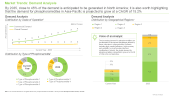
The phosphoramidite market, valued at USD 1.0 billion in 2025, is projected to reach USD 1.1 billion in 2026 and USD 2.7 billion by 2035, with a 10.4% CAGR during the forecast period 2026 to 2035.

To learn more about this report, request a free sample copy
Phosphoramidites (or amidites) are chemically modified nucleosides containing a phosphite group and several protecting groups that serve as the building blocks of oligonucleotide synthesis, thus playing a pivotal role in creating custom DNA and RNA sequences. Introduced in 1981, phosphoramidite chemistry has revolutionized molecular biology by enabling sequential, controlled and automated DNA / RNA synthesis.
 |
 |
 |
The versatility of phosphoramidite chemistry lies in its efficiency, high yield and ability to incorporate modified nucleotides. This has made it indispensable in various fields, including molecular biology, biotechnology and medicine. The well-defined stability and reactivity of phosphoramidites under specific conditions have made them the cornerstone of modern oligonucleotide synthesis , facilitating the production of oligonucleotides for a broad range of applications including synthetic chemistry, molecular diagnostics and personalized therapeutics.
 |
 |
 |
In the coming future, phosphoramidites are likely to play a vital role in gene therapy and personalized medicine as well as in novel drug development. As technology advances, the applications of phosphoramidites will continue to expand, ultimately driving the innovation in research and development within molecular biology.
 |
 |
 |
| Key Report Attributes | Details | |
| Historical Trend | Since 2023 | |
| Forecast Period | Till 2035 | |
| Market Size in 2026 | $ 1.1 Billion | |
| Market Size in 2035 | $ 2.7 Billion | |
| CAGR (Till 2035) | 10.4% | |
The phosphoramidite market analysis also features the likely distribution of the current and forecasted opportunity across various segments, such as type of phosphoramidite, type of oligonucleotide synthesized, application area, therapeutic area and geographical regions.
We have created three market forecast scenarios, conservative, base and optimistic, to account for future uncertainties in key parameters and enhance the robustness of our model. These scenarios represent different tracks of the industry's evolution.
In conclusion, phosphoramidites have become indispensable in the field of molecular biology. Their unique chemical properties and synthetic versatility have made them the preferred choice for oligonucleotide synthesis. As research continues to evolve, the development of new phosphoramidite derivatives and modified chemistries will further expand their applications, opening new avenues in molecular biology.
Several recent developments have taken place in the field of phosphoramidites, and we have outlined some of these below. These developments, even if they arose after our market report’s release, support the overall phosphoramidite market trends detailed in our analysis.
The market research report presents an in-depth analysis of the various companies providing phosphoramidites across different segments, as defined in the table below:
| Market Segmentations | Details | |
| Type of Phosphoramidite |
|
|
| Type of Oligonucleotide Synthesized |
|
|
| Application Area |
|
|
| Therapeutic Area |
|
|
| Geographical Regions |
|
|
| Market in North America |
|
|
| Market in Europe |
|
|
| Market in Asia-Pacific |
|
|
| Market in Latin America |
|
|
| Market in Middle East and North Africa |
|
|
Owing to the cost efficiency and broader applicability of phosphoramidites in the development of large volumes of DNA, RNA and modified oligonucleotides, we believe that the global market for phosphoramidite is likely to grow at a steady rate during the forecast period.Owing to the cost efficiency and broader applicability of phosphoramidites in the development of large volumes of DNA, RNA and modified oligonucleotides, we believe that the global market for phosphoramidite is likely to grow at a steady rate during the forecast period.
| Report Deliverables | Details | |
| Excel Data Packs (Complimentary) |
|
|
| Phosphoramidite Market Key Players Profiled |
(A complete list of 85 companies is available in the report) |
|
| PowerPoint Presentation (Complimentary) |
Available | |
| Customization Scope | 15% Free Customization | |
The “Phosphoramidite Market: Industry Trends and Global Forecasts, till 2035” market report features an extensive study of the current competitive landscape, company competitiveness analysis, recent developments, patent analysis, market impact analysis, demand analysis and market size and future opportunities within the industry, during the forecast period.
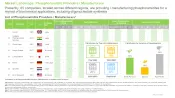
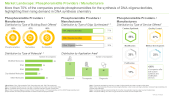
The current market landscape features close to 85 companies including very large, large, mid-sized and small companies. These companies have the required expertise to provide both phosphoramidite manufacturing and products, across different geographical regions.
Notably, 82% of the phosphoramidite providers / manufacturers offer phosphoramidite building blocks, followed by nucleotide building blocks (67%). In addition to this, close to 90% of the providers / manufacturers are offering custom synthesis services for the synthesis of various oligonucleotides.
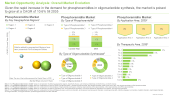
The global market size is likely to be worth $ 1.1 billion in 2026 and will reach $ 2.7 billion by 2035. In terms of the type of oligonucleotide synthesized, siRNA oligonucleotides segment holds the largest share of the phosphoramidite market. This is ascribed to their ability to enable targeted gene silencing using the natural RNA interference (RNAi) pathway, offering high specificity and efficacy for personalized treatments.
Further, the market size for antisense oligonucleotides is likely to grow at a relatively higher CAGR of 11.2% during the forecast period. The increase in research efforts to develop novel antisense oligonucleotides for wide range of disorders using phosphoramidite chemistry are the primary drivers of this market.
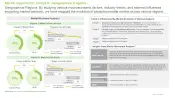
North American companies will likely dominate the global market in 2035, owing to the robust research and development activities, coupled with increasing high-purity phosphoramidites demand for its utilization in the synthesis of oligonucleotides for various applications. Furthermore, the rising investment for technological advancements, drug discovery and development in DNA sequencing field has further contributed towards the growth of this region.
The market in Asia-Pacific is likely to grow at a relatively high CAGR (11.8%), during the forecast period till 2035. This is primarily due to the fact that Asian countries, such as China, India, South Korea and Japan are receiving massive investment from government organizations and regulatory authorities for innovative drug discovery, which is likely to be the key reason for highest growth rate. Additionally, the growing population with chronic conditions has contributed to a surge in the demand for advanced drugs and diagnostics procedures, which has in turn raised the requirement for phosphoramidites.
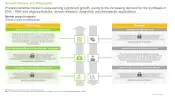
Ongoing advancements in oligonucleotide, RNA and DNA synthesis technologies such as emergence of automated DNA synthesizers and improved manufacturing chemistry have demonstrated potential in reducing costs and enhancing manufacturing efficiency. This has supported the wide adoption of phosphoramidites, thereby driving the overall phosphoramidite market growth.
It is worth mentioning that the emergence of next generation therapeutic approaches, including antisense oligonucleotides, RNA-based scaffolds and gene editing technologies are likely to contribute towards the increased demand for chemically modified phosphoramidites, presenting lucrative growth opportunities for manufacturers / providers.
Despite their several benefits, the use of phosphoramidites presents several challenges. One of the most significant issues is ensuring the quality and purity of phosphoramidites for reliable oligonucleotide synthesis, especially for therapeutic applications, since impurities can impact the efficacy and safety of the drug. The manufacturing of highly pure compounds is quite challenging, requiring stringent regulatory compliance and safety assessments.
Additionally, the phosphoramidite method has dominated the oligonucleotide synthesis market. However, this approach has limited applicability in the synthesis of large and complex sequences, required for large scale analysis of genome structure and cell function, presenting a challenge to their widespread adoption.
Further, there have been recent advancements in the enzymatic DNA synthesis market. This has resulted in the emergence of various startups in this space, such as DNA Script, Molecular Assemblies, Ansa Biotechnologies and Camena Bioscience. These companies have garnered significant interest from venture capitalists and may impede the investment in phosphoramidite market.
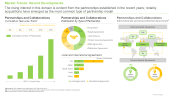
Stakeholders in this domain have entered into numerous partnerships and collaborations, allowing them to expand their respective product and service portfolios and enhance their capabilities and visibility. Notably, in the last five years, companies based in Asia-Pacific have inked close to 35% of these partnerships to strengthen their phosphoramidite capabilities.
Further, monetary assistance from venture capitalists and funding schemes of various public and private organizations / funds, along with assistance from regulatory authorities, have allowed start-ups / small companies to progress their R&D efforts in the phosphoramidites industry. Notably, in the past five years, phosphoramidite providers / manufacturers have raised a total amount worth around $2.4 billion for research and development activities in order to expand their product and service portfolio.
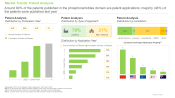
In the past few years, around 195 patents have been granted / filed, demonstrating substantial efforts of researchers in this domain. Notably, the majority of the patents in this domain include patent applications (77%), followed by granted patents (19%). Interestingly, most of the patents (79%) are filed by industry players in this field.
A range of novel phosphoramidite platforms are being developed to support the automated synthesis of thiophosphoramidate (TMO) and phosphoramidate (MO) morpholino oligonucleotides. Given such innovations, the growing need for efficient, accurate and accessible method to develop morpholino antisense oligonucleotides, can be efficiently met in the future.
The market report presents an in-depth analysis, highlighting the capabilities of various stakeholders in the phosphoramidites industry, across different geographies. Amongst other elements, the market report includes:
Phosphoramidites are key chemical building blocks in the solid-phase synthesis of DNA and RNA, and their importance has grown with the increasing adoption of gene therapies, antisense oligonucleotides and mRNA-based vaccines. Over the years, extensive research and development in this domain has led to the development and commercialization of novel phosphoramidites such as dye-labeled and chemically modified phosphoramidites. Additionally, collaborations between biotech firms and research institutions are fostering innovation in meeting the high-purity phosphoramidites demand. With these advancements, the phosphoramidite market is likely to grow at a substantial rate in the near future.
Lead Author: Dhriti Gulati
Lead Reviewer: Prachi Bhalla
Chief Editor:Aashima Bhalla