Pen Injectors Market
Pen Injectors Market: Industry Trends and Global Forecast, Till 2035 - Distribution By Type of Injector (Disposable and Reusable), Type of Needle Length (Short Needles (6mm), Medium Needles (6-12mm), Long Needles (>12mm)), Type of Dosage (Fixed and Variable), Type of Advanced Features (Dose-Adjustment Capabilities, Integrated Safety Mechanisms, Smart Pen Technology, and Connected Pen Devices), Type of Therapy, End User, Geographical Regions, and Leading Players
-
Lowest Price Guaranteed
-
Pages
199 -
Last Updated
July 2025 -
View Count
13918 -
How Big is the Pen Injectors Market?
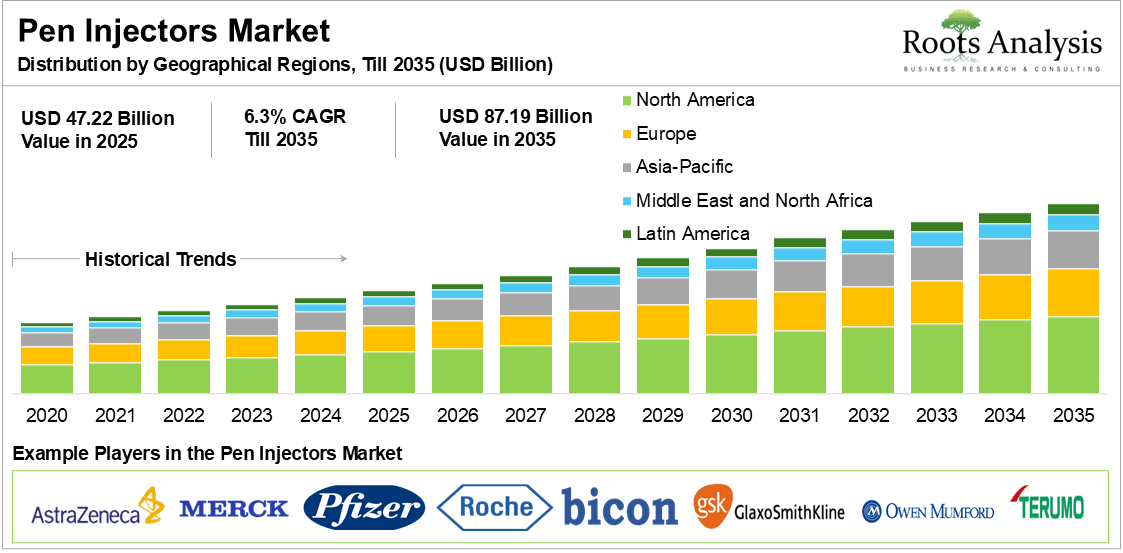
The global pen injectors market size, valued at USD 43.85 billion in 2024, is projected to reach USD 47.22 billion in 2025 and USD 87.19 billion by 2035, representing a CAGR of 6.3% during the forecast period.
 |
To learn more about this report, request a free sample copy
Pen Injector Market: In Summary
- Rising cases of diabetes, osteoporosis, and hormonal disorders are driving demand for user-friendly, self-administered drug delivery devices, such as pen injectors.
- The integration of AI, smart connectivity, dose adjustment features, and safety mechanisms is reshaping pen injector designs, enhancing accuracy and patient safety.
- The pen injectors market is projected to grow from USD 47.22 billion in 2025 to USD 87.19 billion by 2035, at a CAGR of 6.3%.
- Reusable injectors and 6mm short needles currently dominate due to cost-effectiveness and lower pain at the time of injection, respectively, while fixed dosage injectors also lead in market share.
- North America holds the largest share (41%), notably, Asia-Pacific is expected to see the highest growth due to increasing chronic illness rates and expanding healthcare access.
- Patient preference for convenience, cost-efficiency, and remote care is fueling growth in the homecare segment over hospitals and clinics.
- Major players like Novo Nordisk (Denmark), Sanofi (France), Eli Lilly (US), and Pfizer (US) are focusing on partnerships, biosimilars, and smart injector innovations to maintain competitiveness and expand market share.
- The market is facing competition from other drug delivery devices such as autoinjectors and wearable injectors, which will keep the market growth in single digits.
What are Pen Injectors and What are their Advantages?
The pen injectors industry is on the brink of innovation owing to the rising demand for self-administered dosage management solutions. It is a form of device specifically designed with fixed or variable dosage for safe, convenient and accurate self-administration of medications. Injection pens are helpful in managing chronic diseases, such as diabetes, hormonal disorders and osteoporosis.
It is worth mentioning that the rising prevalence of chronic conditions creates an immense burden on the healthcare industry. Moreover, International Diabetes Federation estimated that in 2025, around 11.1% (around 589 million) of the global adult population (20-69 years) is having diabetes. Notably, health conditions like diabetes require prolong management with regular dosage. However, it can be challenging for patients to visit hospitals multiple times which is time-consuming and expensive, thereby underscoring the need for self-administering dosage solutions.
Pen injectors are user-friendly, portable and allow patients to get their doses without taking assistance from healthcare practitioners. This new innovation has sparked a pathway to allow patients to live a quality life while managing their chronic conditions.
Considering the benefits, various pharmaceutical companies are actively taking initiatives to launch their injectables in pen injectors. For instance, Novo Nordisk’s weight loss drug Wegovy is sold in pen injectors for subcutaneous administration. Likewise, industrial players are focusing on advancing their portfolios with smart, connected, and AI-powered pen injectors, which is expected to drive pen injectors industry in the coming years.
Pen Injectors Market: Report Attributes
| Key Report Attributes | Details | |
| Historical Trend | Since 2020 | |
| Forecast Period | Till 2040 | |
| Market Size 2025 | USD 47.22 Billion | |
| Market Size 2035 | USD 87.19 Billion | |
| CAGR (Till 2035) | 6.3% | |
One of the key objectives of the pen injectors market report was to estimate the current size, opportunity, and the market growth potential, over the forecast period, till 2035. We have provided informed estimates on the likely evolution of the market for the forecast period.
The global market analysis report also features the likely distribution of the current and forecasted opportunity within the market across various segments, such as type of injector, type of needle, type of dosage, type of advanced feature, type of therapy, end user, geographical regions, and leading players.
In order to account for future uncertainties associated with some of the key parameters and to add robustness to our model, we have provided three pen injectors market forecast scenarios, namely conservative, base, and optimistic scenarios, representing different tracks of industry’s evolution.
The growing prevalence of chronic conditions has necessitated the demand for pen injectors. Furthermore, technological innovations, such as integration of AI technologies and customized designs, are shaping industrial growth.
What are the Recent Developments in Pen Injectors Market?
Several recent developments have taken place in the field of pen injectors, and we outlined some of these below.
- In April 2025, Novo Nordisk announced its plans to launch its Wegovy pen injectors in India.
- In April 2025, Meitheal Pharmaceuticals (based in the US), a fully integrated biopharmaceutical company announced the launch of the FDA approved liraglutide injection (18mg / 3 ml), a generic equivalent of Victoza®2 in the US. It is a glucagon-like peptide-1 (GLP-1) receptor agonist injector pen.
- In April 2025, Ypsomed (based in Switzerland) announced to carved out diabetes care business focuses on the trade of its insulin pump development arm and self-injectors for subcutaneous drug delivery, including GLP-1 medication.
How is Pen Injectors Market Segmented?
The market report provides comprehensive information on pen injectors providers who are currently active across various segments of the industry as mentioned in the table below.
Pen Injectors Market: Market Segmentation
| Market Segmentations | Details | |
| Type of Injector |
|
|
| Type of Needle |
|
|
| Type of Dosage |
|
|
| Type of Advanced Features |
|
|
| Type of Therapy |
|
|
| End User |
|
|
| Geographical Regions |
|
|
| Market in North America |
|
|
| Market in Europe |
|
|
| Market in Asia-Pacific |
|
|
| Market in Middle East and North Africa |
|
|
| Market in Latin America |
|
|
Pen Injectors Market Share Insights
Market Share by Type of Injector: Reusable Injector Hold the Highest Share
- The global market is segmented into disposable and reusable. According to the pen injectors market forecast, currently reusable injector segment holds the highest pen injectors market share (63.4%), and the trend is likely to remain unchanged.
- Reusable pen injectors are easy to use and cost-effective, patients do not require to make multiple purchases for dosage administration. Owing to its cost-effectiveness, this segment will continue to dominate the market. Examples of some approved reusable pen injectors include NovoPen 4 and NovoLog FlexPen from Novo Nordisk and Humalog KwikPen from Eli Lilly.
- It is worth mentioning that disposable injector segment is likely to show lucrative growth in the future, anticipating registering high CAGR. This can be attributed to the growing preferences for single use disposable injectors to prevent infection transmission.
Market Share by Type of Needle: Short Needles (6mm) Segment is Dominate the Market
- The global market is distributed based on the type of needle into short needles (6mm), medium needles (6-12mm), and long needles (>12mm). As per pen injectors market analysis, short needles (6mm) segment is occupying the highest share. The rising preferences for subcutaneous drug delivery to minimize the pain and discomfort is likely to surge the demand for short needles based pen injectors.
- Notably, long needles (>12mm) segment is expected to register a higher CAGR in the future. This is likely to be the result of increasing usage of deep subcutaneous and intramuscular injections to deliver dosage in patients with diabetes and obesity, specifically those with thick skin.
Market Share by Type of Dosage: Fixed Dosage Segment Holds the Highest Share
- This segment further highlights the distribution of global market across types of dosage, such as fixed and variable. Among these, the fixed segment holds the highest pen injectors market share. This is potentially due to the availability of pen injectors with fixed dosage for patients with chronic conditions.
- Interestingly, in the future variable segment is likely to show lucrative growth and is poised to register a higher CAGR during the forecast period. This can be attributed to rising demand for pen injectors with dosage adjustment features so patients can adjust their doses to manage disease condition.
Market Share by Type of Advanced Feature: Dose Adjustment Segment Holds the Largest Share
- Based on the type of advanced feature, the global market is segmented into dose-adjustment capabilities, integrated safety mechanisms, smart pen technology, and connected pen devices. According to our pen injectors market report, presently the dose-adjustment capabilities segment holds the largest share, and the dominance is likely to remain unchanged in the future. Dose adjustment capabilities help to set the desired dosage for the patients to manage their chronic conditions.
- However, in the future, smart pen and integrated safety mechanisms segments are likely to show robust growth, expecting to grow at a higher CAGR during the forecast period. Smart insulin pens such as NovoPen® 6 & NovoPen Echo® Plus allow easier diabetes management.
- Integrated safety mechanism and smart pen helps to reduce the risk of accidental injections and minimize the misuse risk, ensuring patient safety. Moreover, smart pen technology helps to track patient data which allows patients to adhere to medication and monitor disease progression.
Market Share by Type of Therapy: Diabetes Holds the Largest Share
- On the basis of therapy type, this segment is categorized across diabetes, anaphylaxis, growth hormone therapy, fertility, arthritis, osteoporosis, and others. Currently, diabetes segment accounts for the highest share (44%) of pen injectors market growth. This is likely to be the result of the high prevalence of diabetes that necessitated the demand for self-administer injectors to manage disease.
- Driven by the high demand for auto-injectors to get regular doses of insulin, diabetes segment is likely to remain dominant and is anticipated to grow at a higher CAGR during the forecast period.
Market Share by End User: Homecare Segment Holds the Highest Share
- This segment further divided into homecare and hospitals & clinics. According to the pen injectors market analysis, currently homecare segment holds the highest share. This is likely to be the result of growing preferences for self-administration injectors to manage disease conditions at home.
- It is worth noting that the rising preferences for remote monitoring and home healthcare, this segment will continue to dominate in the future and show higher CAGR.
Market Share by Geographical Regions: North America is Dominating the Market
- The global market is distributed across different regions, such as North America, Europe, Asia-Pacific, Middle East and North Africa, Latin America and rest of the world. According to our pen injectors market analysis, presently North America is dominating the market by holding 41% share.
- Several factors, such as rising incidence of chronic conditions, robust regulatory pathway and increasing preferences of patients for self-administer drug delivery devices are likely to fuel the market growth in North America.
- In Asia-Pacific, the market for pen injectors is likely to grow at a higher CAGR during the forecast period. This can be attributed to the growing incidence of chronic conditions, such as diabetes and obesity in this region. Furthermore, government organizations are supporting the initiatives to develop auto-injectors so patients can get their dosage independently to manage diseases.
Pen Injectors Market: Report Deliverables
| Report Deliverables | Details | |
| Excel Data Packs (Complimentary) |
Available | |
| Key Pen Injectors Companies Profiled |
|
|
| PowerPoint Presentation (Complimentary) |
Available | |
| Customization Scope | 15% Free Customization | |
What are the Major Takeaways from the Pen Injectors Market Report?
The “Pen Injectors Market: Industry Trends and Global Forecasts, till 2035” report features an extensive study of the current market landscape, market size, market share, market growth, market trends, market value, market forecast, market outlook, statistics, and future opportunities for pen injectors manufacturers. The market research report lays emphasis on the pen injectors that are being offered to pharmaceutical companies. Key takeaways of the market report are briefly discussed below.
Is Pen Injectors Market Competitive?
With growing preferences for self-injection devices, numerous market players are showing keen interest in this field which makes this market highly competitive. Overall, the market landscape features the presence of several large, mid-sized and small companies who are presently aiming for technological innovation. In order to leverage a competitive edge, several industrial players are leveraging active partnerships and collaborations.
The pen injector manufacturers have also expanded their portfolios to include auto injectors, which also allow easy self-administration. Original Equipment Manufacturers (OEMs) such as SHL Medical, Owen Mumford and Ypsomed Delivery Systems manufacture the pen injectors, which are licensed by pharmaceutical companies for development of a drug device combination product.
What are the Main Factors Driving the Growth of the Pen Injectors Market?
Several factors that propel the market growth are listed below:
Rise in Chronic Diseases Influence Demand for Injection Pens
Notably, the rising incidence of chronic diseases, such as diabetes, osteoporosis, and hormonal disorders, which require regular medication administration consistently is propelling the market. With the availability of pen injectors, patients can independently administer their doses to manage their disease conditions. Moreover, it allows medication adherence, which is further likely to fuel the demand in the future.
The surge in chronic diseases, especially diabetes and arthritis, is a major driver for injection pens. With the global prevalence of diabetes, it is projected to reach 643 million by 2030. Furthermore, the significant increases in countries like India, the demand for convenient, accurate, and safe drug delivery devices is accelerating, which is further expected to positively influence the injections pens market.
Recent Advancements in Drug Delivery Technology
Currently, the industrial players are widely emphasizing the technological innovations to make pen injectors user-friendly and accuracy. Moreover, market players are aiming to integrate safety mechanisms to reduce the needle phobia in patients and enhance its acceptance, which further anticipates driving the market in the future.
How Will Technological Advancements Impact Future Pen Injector Designs?
It is interesting to note here that technological advancements are revolutionizing the pen injectors industry, making drug delivery devices more efficient, accurate and safe. Industrial players, such as Pfizer (based in the US), GSK (based in the UK), Medtronic (based in Ireland) and Merck (based in the US) are aiming to develop smart injection pens, AI-powered injectors and connectivity features, such as Bluetooth and app integration, for better patient engagement and compliance. With integration of AI technology, patients can easily optimize their doses and support precise medication.
Moreover, digital health solution integration enables real-time data tracking so patients can transfer data to healthcare providers for on-time consultation. For instance, in February 2025, the new UVA clinical trial is aiming to simplify diabetes management by testing a newly launched AI-powered device design to automate insulin delivery.
Which Regions are Expected to See the Highest Growth in Pen Injector Sales?
North America currently leads the market due to high chronic disease prevalence, advanced healthcare infrastructure, and favorable reimbursement policies. Interestingly, Europe also remains a significant market, supported by strong regulatory frameworks and aging populations.
It is worth mentioning that Asia Pacific is expected to witness the highest growth rate, driven by increasing healthcare expenditure, rising awareness, and government initiatives to improve healthcare access.
What Opportunities Exist for Innovation in Smart or Connected Injection Pens?
The current opportunities lie in the integration of digital health platforms, AI-driven dose adjustments, wearable injectors and enhance cybersecurity features. Notably, several companies are striving to enhance technological advancements to make injection pens more innovative, data-driven and safe. Some of the latest focus areas where industrial players are accelerating their innovations are listed below.
| Company | Key Technological Innovation Focus | Product / Device Name | ||
| NEST | Disposable, automatic injection; suitable for most patient groups, and ease of use | NEST PFS Automatic Pen Injector | ||
| Nemera | Spring-assisted, variable dose platform; multi-dose capability; patient safety and ease of use | PenDIA (Variable Dose) | ||
| Nemera | Reusable, cost-effective for GLP-1 injections; sustainability and multi-use | PenDURA AD | ||
| Novo Nordisk | Prefilled, weight loss / obesity indication; advanced drug delivery, digital health integration | Wegovy (Semaglutide Pen) | ||
| Medtronic | Integration with real-time CGM; smart insulin dose tracking and digital health | InPen with Guardian Connect | ||
| Eli Lilly, Sanofi, Ypsomed | AI-Powered Insulin Pens | AI-Powered Insulin Pens | ||
How Does the Aging Population Influence Pen Injector Adoption Rates?
The aging population is more prone to chronic diseases requiring regular medication, increasing the need for user-friendly, self-administered drug delivery solutions. Pen injectors, with their ease of use and dosing accuracy, are increasingly adopted by elderly patients for home-based care.
What Role Do Reimbursement Policies Play in Market Growth?
It is important to highlight here that favorable reimbursement policies, especially in developed regions like North America and Europe, significantly boost market growth by making injection pens more affordable and accessible to patients. Moreover, the availability of reimbursement policies for pen injectors helps patients to adopt pen injectors for managing diseases without worrying about hefty medical bills.
How are Personalized Medicine Trends Shaping Pen Injector Development?
Personalized medicine is driving the development of pen injectors that can deliver tailored doses based on individual patient needs. AI and digital connectivity enable real-time monitoring and adjustment, supporting more precise and effective treatments. Moreover, personalized medicine trend is driving the development of auto-injectors with connected devices for dosage adjustment, which allow patients to administer their doses precisely.
Why is Home Care Becoming a Dominant Setting for Injection Pen Use?
Home care is growing as a dominant setting due to several reasons. Some of the potential reasons are rising healthcare costs and the shift toward outpatient and home-based treatments. Furthermore, patients’ preferences for convenience and privacy is likely to fuel the demand for pen injectors for homecare. Additionally, advancements in self-administration technology, reducing the need for frequent hospital visits, which is further expected to be a key reason for the high growth of the homecare segment.
What Impact Do Safety Features Like Needlestick Injury Reduction Have on Market Expansion?
Safety features such as needle retraction and shielding mechanisms reduce the risk of needlestick injuries, improving patient and caregiver safety. These features enhance market acceptance and adoption, particularly in home and outpatient settings.
Moreover, companies like Nemera, Novo Nordisk and Duoject are continuously advancing their portfolios with smart, connected, and AI-powered pen injectors. However, their main innovation focus is on digital integration, AI-driven dose tracking, and patient-centric design.
What is Covered in the Pen Injectors Market Report?
The market report presents an in-depth analysis, highlighting the capabilities of various stakeholders in the pen injectors industry, across different geographies. Amongst other elements, the market report includes:
- An Infographic Executive Summary
- Market Landscape of Pen Injectors Providers
- Company Competitiveness Analysis
- Company Profiles
- SWOT Analysis
- Market Impact Analysis
- Market Forecast Analysis
From the Author’s Desk
Author’s View on Pen Injectors Market
The pen injectors industry is poised for continued growth, driven by chronic disease prevalence, technological innovation, and the shift toward home-based care. Future success will depend on the ability to integrate digital health solutions, ensure patient safety, and address the needs of an aging population.
Glossary
- Autoinjector: A device that automatically delivers a pre-set dose of medication.
- Biosimilar: A biological medical product highly similar to an existing approved product.
- Digital Health Integration: The incorporation of digital technologies into healthcare devices for data tracking and sharing.