Peptide Therapeutics Contract Manufacturing Market
Peptide Therapeutics Contract Manufacturing Market by Type of Service Offering (Peptide Drug Substance Manufacturing, Peptide Drug Product Manufacturing, Analytical and Regulatory, and Other Services), Type of Peptide Manufactured (Conventional Linear Peptides, Conventional Cyclic and Macrocyclic Peptides, Modified Peptides, Peptide Conjugates, and Personalized and Neoantigen Peptides), Scale of Operation, Size of Peptide, Therapeutic Area and Geographical Regions- Trends and Forecast, 2026-2035
-
Lowest Price Guaranteed
-
Pages
552 -
Last Updated
August 2026 -
View Count
5622 -
Peptide Therapeutics Contract Manufacturing Market to Reach USD 10.79 Billion by 2035
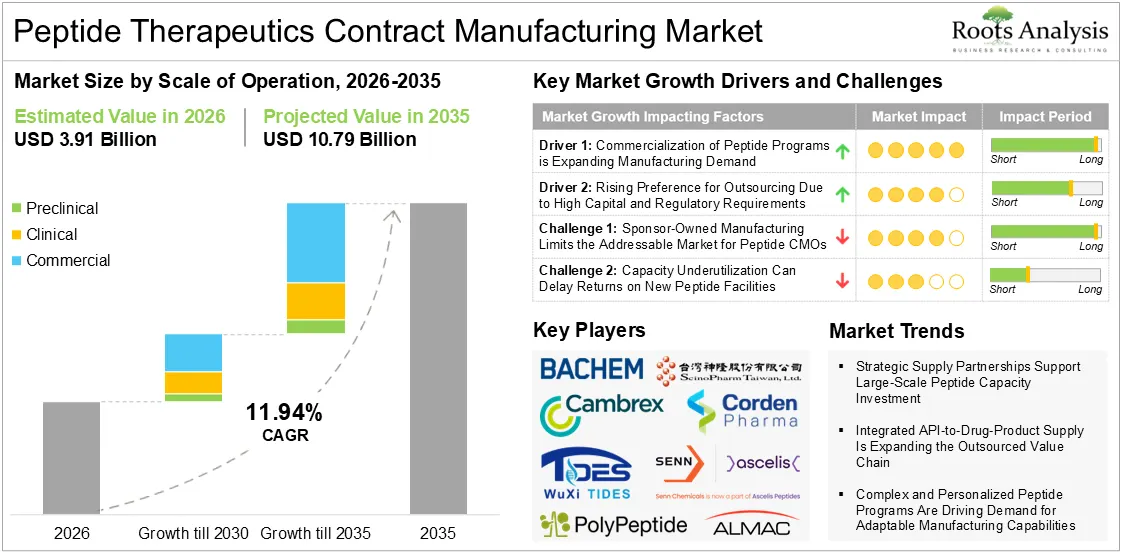
The peptide therapeutics contract manufacturing market was valued at USD 3.38 billion in 2025 and is estimated at USD 3.91 billion in 2026. It is projected to reach USD 10.79 billion by 2035, representing a CAGR of 11.94% during 2026-2035. Growth is being supported by the expanding commercial pipeline for peptide therapeutics and greater reliance on specialized external manufacturing capacity.
To learn more about this report, request a free sample copy
Market Report: Key Takeaways
- Market Share by Type of Service Offering: Peptide drug substance / API manufacturing accounts for 45.0% of the current year's revenue, while the peptide drug product manufacturing segment is projected to expand fastest during the forecast period.
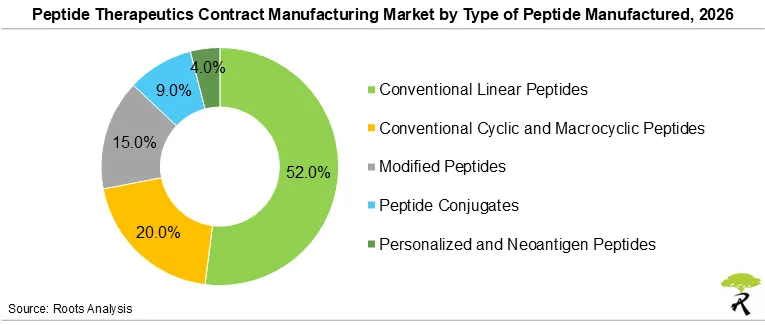
- Market Share by Type of Peptide Manufactured: In the current market, conventional linear peptides lead with a 52.0% share, while personalized and neoantigen peptides are poised to grow at a faster pace (higher CAGR) till 2035.
- Market Share by Scale of Operation: Commercial manufacturing holds the majority share of the market in the current year and is expected to sustain its dominance through 2035, growing with a relatively higher CAGR.
- Market Share by Size of Peptide: Medium-sized peptides dominate the market in current scenario, while small peptides are projected to record the fastest growth through 2035.
- Market Share by Therapeutic Area: Currently, the metabolic disorders segment accounts for the largest share within the global market, while the oncology segment is expected to experience a faster pace of growth during the forecast period.
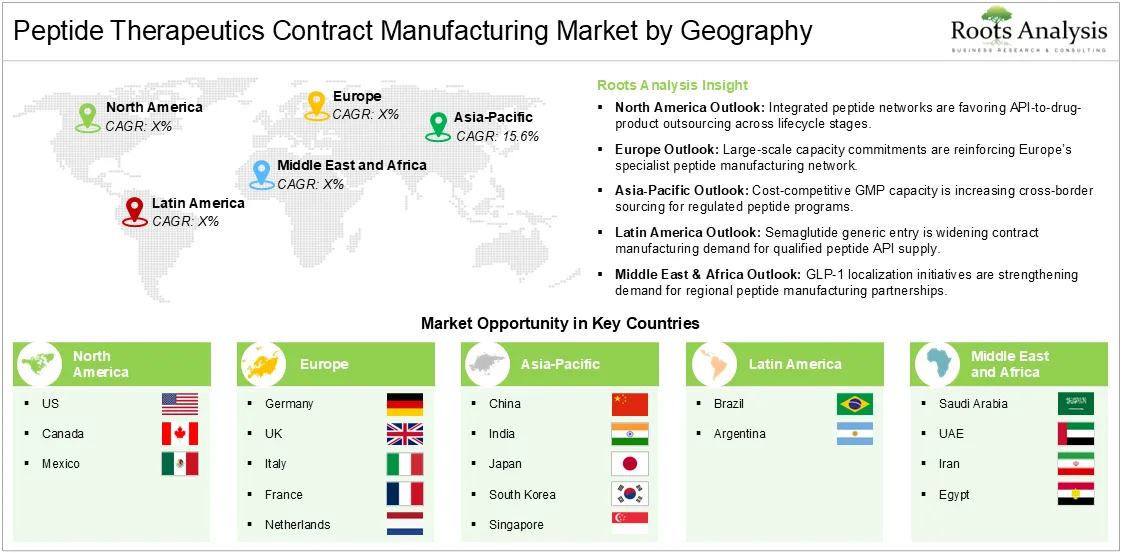
- Regional Outlook: North America leads the market, capturing a majority (44.0%) share in the current year, while Asia-Pacific is projected to grow at a faster CAGR of 15.6% till 2035.
Market Overview: Peptide Outsourcing is Advancing Toward Commercial-Scale and Integrated Supply
Peptide therapeutics are gaining commercial relevance as clinical development expands across metabolic disorders, oncology and other disease areas, while growing commercial adoption is increasing the scale, frequency and reliability requirements of market supply. This progression is increasing demand for contract manufacturers that can translate complex peptide drug candidates into reproducible, regulated and scalable production. Manufacturing capability is therefore becoming more closely linked to development feasibility, commercialization timing and the ability to maintain reliable clinical and market supply.
The market is evolving alongside improvements in peptide synthesis, purification, analytical control, formulation and dosage-form manufacturing. These advances are enabling CMOs and CDMOs to assume greater responsibility as candidates move from early development into larger clinical batches and routine commercial production. At the same time, cyclic, modified, conjugated and personalized peptide therapeutics are raising the technical requirements associated with process design, impurity control and product-specific scale-up. Recent large-scale capacity investments supported by long-term supply agreements indicate that peptide manufacturing is moving beyond project-based synthesis toward more structured and enduring outsourced supply arrangements.
Current regulatory progress and the expansion of GMP-capable commercial facilities indicate that peptide contract manufacturing is moving toward larger and more standardized commercial operations, although the ability to execute complex processes reliably remains an important source of differentiation. Future outsourced value is likely to extend beyond synthesis capacity toward manufacturing models that reduce transfer risk, accommodate evolving product requirements and support dependable progression into commercial supply. Competitive advantage will increasingly depend on combining peptide-specific scientific expertise with validated scale, reliable execution and the ability to support a therapeutic asset as its manufacturing demands become more complex.
Executive Market Insights
How Does the Outsourced Peptide Manufacturing Ecosystem Operate?
Peptide-focused contract manufacturers and integrated CDMOs form the core of the outsourced manufacturing ecosystem, translating requirements commissioned by peptide therapeutic sponsors and developers into coordinated development and production activities. Specialist peptide manufacturers typically develop and manufacture the peptide drug substance, including synthesis, purification and analytical testing, while integrated CDMOs may also formulate the peptide and manufacture the finished dosage form. Depending on the product and its stage of development, these activities may be handled by one CDMO or divided among several providers. Effective execution across this network depends on compatible specifications, transfer of peptide-specific process knowledge, aligned analytical methods and controlled handoffs between drug-substance and drug-product operations for clinical and commercial supply.
Peptide Therapeutics Contract Manufacturing Providers: Facility Footprint, Service Scope and GMP Status
| Company Name | Facility Location | Service Offerings | Scale of Operation |
| Bachem | Switzerland, US | Peptide NCE and process development; SPPS, LPPS and TAPS; purification and API analytics; CMC and regulatory support; clinical and commercial API manufacturing | Early development; clinical-to-commercial GMP supply; small-to-large commercial API scale |
| PolyPeptide Group | Belgium, France, Sweden, India, US | Synthetic peptide APIs and intermediates; process and analytical-method development; stability studies; cGMP clinical and commercial manufacturing; regulatory support | Research and pre-GMP; preclinical; Phase I-III; commercial |
| CordenPharma | Germany, Italy, Switzerland, US, China | Peptide process development; SPPS, LPPS and TAPS; purification and analytics; clinical-to-commercial API manufacturing; sterile fill-finish; oral solid-dose development and manufacturing | Early development and Phase I-II; late-stage and commercial API/FDF |
| WuXi AppTec (WuXi TIDES) | China, Switzerland, US | Peptide discovery synthesis; API process development and manufacturing; oral and parenteral formulation and manufacturing; analytical validation and release; regulatory dossiers; clinical supply and packaging | Discovery; preclinical-to-commercial API/FDF; Phase I-IV clinical supply |
| Cambrex | US | SPPS, LPPS and hybrid route development; process and analytical development; purification and lyophilization; clinical and commercial API manufacturing; technology transfer | Proof-of-concept and early development; Phase I-II; late Phase II-to-commercial manufacturing |
| CPC Scientific | China | Custom and GMP peptide synthesis; CMC process and analytical development; peptide API manufacturing; peptide conjugates; generic APIs; regulatory support | Discovery; preclinical; Phase I-III; commercial; research-to-metric-ton GMP production |
| ScinoPharm Taiwan | Taiwan, China | SPPS, LPPS and hybrid synthesis; process and analytical development; purification; cGMP API manufacturing; injectable formulation, aseptic filling and packaging; regulatory support | Early development; preclinical and clinical manufacturing; commercial API and injectable production |
| Senn Chemicals (part of Ascelis Peptides) | Switzerland | SPPS and solution-phase synthesis; route and process development; scale-up and validation; analytical-method development; cGMP peptide API manufacturing | Research; preclinical; Phase I-III; commercial; gram-to-multi-100-kilogram production |
Abbreviations: NCE: New Chemical Entities, SPPS: Solid-Phase Peptide Synthesis, LPPS: Liquid-Phase Peptide Synthesis, TAPS: Tag-Assisted Peptide Synthesis, API: Active Pharmaceutical Ingredient, CMC: Chemistry, Manufacturing and Controls, cGMP: current Good Manufacturing Practice, FDF: Finished Dosage Form
Market Trends Shaping the Peptide CMO and CDMO Industry
Strategic Supply Partnerships Support Large-Scale Peptide Capacity Investment
Strategic supply partnerships are increasingly supporting large-scale peptide capacity investment through advance commitments and customer prepayments. Large-scale manufacturing assets require heavy upfront capital, long qualification cycles and credible visibility into future volumes, prompting sponsors to secure future manufacturing access and CDMOs to gain stronger demand visibility before committing capital to new facilities. For instance, Bachem's Sisslerfeld program combines a strategic supply collaboration, customer prepayments and long-term volume commitments with more than CHF 500 million of planned investment, while PolyPeptide has likewise paired major capital expenditure with customer prepayments. Capacity competition is therefore shifting toward the ability to secure, finance and govern multi-year supply programs, not simply announce additional equipment or facility space.
Integrated API-to-Drug-Product Supply is Expanding the Outsourced Value Chain
As peptide assets progress from drug substance into injectable and oral formats, outsourcing demand is no longer confined to isolated synthesis contracts. Sponsors increasingly need API scale-up, formulation, analytical transfer, sterile fill-finish, oral dosage development and commercial supply to remain aligned across the same program. CordenPharma's VK2735 engagement illustrates this transition by combining large-scale peptide API manufacturing, injectable fill-finish and oral solid-dose manufacturing within one multi-year relationship. This expands the outsourced value chain by creating several coordinated service layers around one asset, while reducing fragmented supplier management without removing site qualification, technology-transfer or execution risk. The significance lies in contracted coordination, not promotional claims of service breadth.
Complex and Personalized Peptide Programs are Driving Demand for Adaptable Manufacturing Capabilities
Peptide pipelines are diversifying into programs that require manufacturing strategies to accommodate changing batch sizes, molecular complexity and development-stage requirements. Personalized programs introduce small, variable batches, while cyclic structures and non-canonical residues can increase coupling, impurity-control and purification demands; an early-stage process may therefore require further optimization as production scales. Cambrex's recent expansion in Waltham, for example, combining SPPS, LPPS and hybrid-process development within a GMP-oriented platform, reflects investment in process-development depth and adaptable scale-up capabilities. Provider differentiation is consequently shifting from synthesis capacity alone toward the ability to refine, transfer and scale a suitable process across the product lifecycle. This gives sponsors a clearer path from early clinical production to reproducible commercial supply.
Industry Experts on Peptide Therapeutics CMO Market
As peptide therapeutics progresses toward larger clinical and commercial programs, manufacturing requirements are becoming more demanding across synthesis, purification, analytical control and process reproducibility. This is particularly relevant as peptide pipelines increasingly incorporate longer sequences, non-canonical amino acids and more complex molecular designs, placing greater emphasis on process-development and analytical capabilities that can support reliable scale-up. In a 2026 Cambrex interview focused specifically on the evolving peptide manufacturing landscape, Dr. Matt Bio, Chief Scientific Officer at Cambrex and President of Snapdragon Chemistry, highlighted this complexity, stating, "Peptide synthesis results in several impurities that are analytically challenging, which makes HPLC method development complex and time-consuming."
Discussions with multiple stakeholders in this domain influenced the opinions and insights presented in this study. The peptide therapeutics contract manufacturing market report includes transcripts of the following discussions:
- Founder and Owner, Small Company, Germany
- Chief Scientific Officer, Co-Founder, Small Company, India
- Chief Financial Officer, Small Company, Germany
- Chief Business Officer, Small Company, US
- Vice President, Peptides, Large Company, Ireland
- Senior Director of Scientific Affairs and Technical Marketing, Small Company, US
- Senior Manager, Peptide Business Project Leader, Large Company, Japan
In addition, the peptide therapeutics contract manufacturing market report includes transcripts of the following third-party discussions:
- Chief Executive Officer and Managing Director, Large Company, India
- Chief Executive Officer and Chief Discovery Officer, Mid-sized Company, US
- Chief Commercial Officer and Co-founder, Mid-sized Company, UK
- President and Chief Drug Hunter, Small Company, US
- Chief Scientific Officer, Large Company, UK
- Chief Scientific Officer, Large Company, US
- Chief Scientific Officer, Small Company, China
- Senior Vice President and Global Head of Sales, Large Company, Switzerland
- Senior Manager of Pharma & Biopharma Market Development and Collaborations, Very Large Company, US
Segmentation Analysis of Global Peptide Therapeutics Contract Manufacturing Market
Market Segments
Based on the research, we have segmented the peptide therapeutics contract manufacturing market into various key segments outlined below.
| Market Segments | Sub-segment Details | |
| Type of Service Offering | Peptide Drug Substance / API Manufacturing, Peptide Drug Product Manufacturing, Development, Analytical and Regulatory Support, and Packaging, Labeling and Other Ancillary Services | |
| Type of Peptide Manufactured | Conventional Linear Peptides, Conventional Cyclic and Macrocyclic Peptides, Modified Peptides, Peptide Conjugates, and Personalized and Neoantigen Peptides | |
| Scale of Operation | Preclinical, Clinical, and Commercial | |
| Size of Peptide | Small Peptides, Medium Peptides, and Large Peptides | |
| Therapeutic Area | Metabolic Disorders, Oncology, Cardiovascular Diseases, Endocrine and Reproductive Disorders, Neurological Disorders, Infectious Diseases, and Other Therapeutic Areas | |
| Geographical Regions | North America, Europe, Asia-Pacific, Latin America, and Middle East and Africa | |
Market Share Insights
Regional Market Share: North America Leads While Asia-Pacific Builds Faster Contract-Manufacturing Momentum
North America accounts for 44.0% of the market in the current year, reflecting its mature concentration of peptide-development expertise, GMP manufacturing infrastructure and clinical-to-commercial supply capabilities. This established base allows sponsors to access process development, scale-up, regulatory support and commercial manufacturing within a well-developed outsourcing ecosystem. Current investment continues to reinforce this position; for instance, in May 2026, CordenPharma announced the acquisition of AmbioPharm, adding peptide API capacity in South Carolina to its US manufacturing footprint. Continued investment in qualified infrastructure, regulatory experience and commercial supply capability reinforces North America's current leadership.
Asia-Pacific is projected to grow at a faster pace (with a CAGR of 15.6%) during 2026-2035, supported by the expansion of peptide manufacturing capacity for recently commercialized therapeutics and improving regulatory readiness across the region. WuXi AppTec's Taixing site, for example, completed an FDA pre-approval inspection in 2025 for commercial manufacture of a peptide therapeutic, while CPC Scientific filed a US FDA DMF for tirzepatide API from its Hangzhou facility in 2026. As manufacturing scale, technical capability and regulatory readiness deepen across the region, Asia-Pacific is positioned to support internationally regulated peptide manufacturing programs, underpinning faster growth during the forecast period.
Peptide Drug Substance / API Manufacturing Lead the Market by Type of Service Offered, While Drug-Product Services Expand Faster
Peptide drug substance / API manufacturing holds a dominant share of the market in 2026, reflecting the central role of qualified drug substance across peptide development and commercialization. Before a peptide can progress into formulation or finished dosage manufacture, sponsors require API produced to the necessary quality specifications, supported by synthesis, purification, impurity characterization and analytical control. These specifications apply across preclinical, clinical and commercial-stage requirements and form the core manufacturing work performed by specialist peptide CMOs and CDMOs. Their broad applicability across the product lifecycle therefore supports the segment's position as the largest source of outsourced peptide manufacturing revenue.
Peptide drug product manufacturing is projected to expand at a faster rate (CAGR) during 2026-2035 as advancing programs add formulation, sterile fill-finish, oral dosage development, stability and release requirements beyond API supply. CordenPharma's multi-year engagement with Viking Therapeutics for VK2735 demonstrates this progression, with the contract spanning peptide drug substance, injectable fill-finish and oral solid-dose manufacturing. As more peptide assets progress toward injectable and oral commercial formats, these additional downstream activities increase the amount and range of drug-product work available for external manufacturing, supporting the projected faster growth of Peptide Drug Product Manufacturing.
Commercial Manufacturing Dominates as Late-Stage Programs Convert into Recurring Supply
Commercial manufacturing accounts for the largest market share in 2026, reflecting the greater continuity and revenue intensity associated with post-approval peptide supply. Once a therapeutic enters commercial production, manufacturing extends beyond development-stage batch requirements into validated routine production, release testing, change control, lifecycle support and inventory planning under cGMP conditions. These activities recur as products remain on the market and require sustained quality and supply performance. Consequently, commercial-stage contracts typically involve a broader and more persistent manufacturing requirement than preclinical or clinical work, supporting commercial manufacturing as the largest segment by operational scale.
Commercial scale manufacturing is also expected to experience a relatively higher growth rate (CAGR) during 2026-2035. The projected rapid growth is supported by rising approvals of late-stage peptide programs and a shift from intermittent development orders to launch supply and ongoing replenishment. This progression increases the duration and recurrence of outsourced manufacturing requirements, as commercial products require sustained production across successive supply cycles rather than time-bound development batches. The resulting expansion of recurring contracted work supports the faster growth of Commercial manufacturing over the forecast period.
Which Type of Peptide Therapeutics Dominates the Current Contract Manufacturing Market?
Conventional linear peptides account for 52.0% of the market in the current year, supported by their broad presence across development and commercial peptide portfolios and the extensive manufacturing experience established around their synthesis, purification and analytical control. Manufacturers have accumulated process knowledge and quality-control experience across a wide range of linear peptide products, supporting efficient progression from development quantities to larger validated production requirements. This combination of established manufacturing know-how, wider commercial representation and recurring production requirements sustains the current revenue leadership of Conventional Linear Peptides.
Personalized and neoantigen peptides are projected to grow at a relatively higher CAGR during the forecast period as patient-specific therapies create manufacturing requirements that differ from conventional repeat production. Fred Hutchinson Cancer Center's Phase I PNV21-001 study (NCT05098210), for example, evaluates a personalized multi-peptide neo-antigen vaccine and illustrates the need to manufacture multiple patient-specific peptide components within an individual treatment approach. The approved evidence for this program includes the use of 10-20 patient-specific long synthetic peptides. These multi-peptide, patient-specific requirements increase the number and coordination of manufacturing and quality-control activities, supporting the projected faster growth of Personalized and Neoantigen Peptides even where individual production volumes remain comparatively small.
Market Share by Therapeutic Area: Metabolic Disorders Anchor Demand as Oncology Broadens Specialized Manufacturing Requirements
Peptide-based therapies being developed for metabolic disorders hold the largest share of the market in the current year, reflecting the strong role of peptide therapeutics in diabetes and obesity. GLP-1 and dual GIP/GLP-1 therapies such as semaglutide and tirzepatide have expanded the use of peptides across chronic metabolic care, creating recurring requirements for API synthesis, formulation and commercial supply. In fact, WHO's 2025 guidance on GLP-1 therapies for obesity also highlighted the need to expand manufacturing to improve access. ScinoPharm's current semaglutide and tirzepatide pipeline illustrates how peptide manufacturers are aligning development and supply capabilities with this sustained therapeutic demand.
Market for peptide therapeutics targeting oncology disorders is projected to grow at the fastest pace till 2035 as peptide-based cancer therapy programs diversify across personalized vaccines, synthetic long peptides and other specialized formats. These approaches require patient-specific sequence selection, multiple peptide components and coordinated manufacturing and analytical release. Washington University School of Medicine's recruiting NCT06529822 study, which uses synthetic long-peptide personalized cancer vaccines across several solid-tumor cohorts, illustrates this development model. As oncology peptide programs diversify, the resulting increase in specialized manufacturing assignments supports faster growth in Oncology contract manufacturing, even where individual batch volumes remain comparatively small.
Market Dynamics
What are the Key Factors Which Drive Peptide Contract Manufacturing Industry Growth?
- Commercialization of Peptide Programs is Expanding Recurring Outsourced Manufacturing Demand: As peptide therapeutics progress from clinical development into launch and routine supply, manufacturing demand changes from intermittent development batches to validated production, release testing and recurring replenishment. The scale of this transition is visible in semaglutide injections, which remained on the FDA drug-shortage list from 2022 until February 2025 because increased demand exceeded available supply. Such demand conditions increase the importance of sustained manufacturing capacity once peptide programs reach broader commercial use. Where production is outsourced, commercialization can extend manufacturing engagements beyond development campaigns into repeat API, drug-product and quality-control requirements. As more late-stage peptide assets enter routine supply, recurring commercial assignments are likely to account for a larger share of peptide contract-manufacturing demand.
- Rising Preference for Outsourcing Due to High Capital and Regulatory Requirements: Industrial-scale peptide manufacturing requires substantial investment in synthesis, purification, utilities, analytical systems and qualified GMP infrastructure before capacity can support regulated supply. CordenPharma's planned peptide facility near Basel represents an investment exceeding EUR 500 million and is designed with more than 5,000 L of SPPS reactor capacity, illustrating the capital required to establish large-scale capability. Maintaining comparable infrastructure internally is harder to justify where portfolio volumes are insufficient to support dedicated assets and their fixed operating costs. As the capital and qualification threshold for peptide production rises, access to established external capacity retains a structural role in supporting development, scale-up and commercial manufacturing without requiring equivalent manufacturing infrastructure to be recreated across every drug-development organization.
What are the Challenges Limiting the Contract Manufacturing Market Growth for Peptide Therapeutics?
- Sponsor-Owned Manufacturing Limits the Addressable Market for Peptide CMOs: Growth in peptide therapeutics does not translate automatically into equivalent growth in outsourced manufacturing revenue because large pharmaceutical companies can limit external manufacturing capture by investing directly in peptide production. In December 2025, Lilly announced a USD 6 billion Alabama facility for synthetic and peptide medicines, including its oral GLP-1 program, demonstrating the scale at which sponsor-owned peptide capacity can be developed. Manufacturing absorbed within such facilities remains outside the third-party CMO / CDMO revenue pool. Peptide production volumes and peptide contract-manufacturing revenue can therefore follow different growth trajectories when a larger portion of incremental demand is captured internally, limiting the externally addressable share of an otherwise expanding therapeutic market.
- Capacity Ramp-Up and Underutilization Can Delay Returns on New Peptide Facilities: New peptide facilities do not become fully productive when construction is completed. Commissioning, regulatory qualification, technology transfer and customer onboarding must occur before commercial volumes can utilize installed capacity efficiently, while staffing and other fixed operating costs are already incurred. Bachem's Building K completed regulatory inspection at the end of 2025 and entered a gradual commercial production ramp-up during 2026, with the company identifying successful ramp-up as important to its 2026 sales objectives. Delays in qualifications, program transfers or volume uptake can therefore create a gap between announced manufacturing capacity and effective revenue-generating supply, causing new facilities to contribute to market growth later than headline capacity additions alone might suggest.
Future Innovation and Market Opportunity: Green Chemistry and Process Intensification Are Enabling Higher Peptide Output with Lower Resource Intensity
Peptide manufacturing is moving toward greener and more process-efficient production approaches as rising volumes increase the solvent, reagent and waste burden associated with conventional synthesis. In fact, research on wash-free SPPS has demonstrated that eliminating intermediate wash steps can reduce waste generation by up to 95% compared with traditional SPPS, while commercial peptide manufacturers are advancing complementary approaches such as reduced-solvent washing, greener solvent systems, solvent recycling and alternative synthesis platforms. PolyPeptide is expanding greener-solvent use in process development and continues to deploy solvent-reduction and recycling initiatives across its operations, while CordenPharma's TAPS platform reduces organic solvent waste by more than 90% and materially lowers reagent requirements. These developments indicate the progression of sustainable process design from technical experimentation into practical peptide-manufacturing adoption.
The opportunity extends beyond lowering the environmental footprint of peptide synthesis. Reducing wash steps, solvent consumption and raw-material intensity improves process efficiency while allowing more productive use of synthesis equipment as manufacturing volumes increase. This enables CMOs / CDMOs to accommodate a larger share of future peptide demand without relying exclusively on proportional additions of reactors, utilities and facility space, while also responding to growing customer requirements for lower-impact manufacturing. As greener solvents, recycling and intensified synthesis become more deeply integrated into GMP process development and scale-up, resource efficiency is emerging as an additional basis of contract manufacturer differentiation alongside physical manufacturing capacity.
Recent Developments in the Peptide Therapeutics Contract Manufacturing Market
- Samsung Biologics and PolyPeptide Group: In July 2026 Samsung announced a tender offer to acquire PolyPeptide Group, a specialized global CDMO for peptide-based APIs. The proposed transaction signals increasing strategic interest in established peptide manufacturing platforms and could reshape competitive scale and ownership within the global peptide CDMO landscape.
- CPC Scientific: In May 2026 the company completed a US FDA Drug Master File filing for its self-developed tirzepatide API, manufactured at its Hangzhou-based CGMP facility. The filing demonstrates increasing regulatory and commercial readiness among Asia-based peptide manufacturers serving globally regulated metabolic-therapy programs.
- Lupin Manufacturing Solutions and PolyPeptide Group: In December 2025, the companies formed a long-term strategic alliance covering expanded sourcing, integrated procurement and supply planning for selected peptide materials. The collaboration strengthens supply-chain resilience and manufacturing readiness as commercial demand for peptide APIs, including those supporting metabolic therapies, continues to expand.
Peptide Therapeutics Contract Manufacturing Market Report Coverage
Research Scope and Methodology
The study examines contract manufacturing services supporting peptide therapeutics, including peptide drug substance / API manufacturing, drug-product manufacturing, development, analytical and regulatory support, and separately attributable ancillary services. The analysis uses the proprietary Roots Analysis research framework, supported by proprietary databases and repositories, company disclosures, regulatory publications, clinical and product information, scientific literature and secondary sources. Market estimates and forecasts were tested against company activity, manufacturing-capacity development, therapeutic commercialization, outsourcing patterns, captive manufacturing, technology evolution and operational risks. For further details, see the complete research methodology adopted by Roots Analysis across its market reports.
Business Intelligence for Strategic Decision-Making in the Peptide Contract Manufacturing Market
- Market & Growth Intelligence: The report provides annual market estimates from 2022 to 2035 and evaluates growth across type of service offering, type of peptide manufactured, scale of operation, size of peptide, therapeutic area and geographical regions. These segmentation views compare current revenue concentration with faster-growing areas of outsourced demand, including commercial-scale manufacturing, drug-product services, specialized peptide formats and regional expansion. The analysis also examines how commercialization, recurring supply requirements and outsourcing intensity influence market development, supporting assessment of service portfolios, capacity allocation, therapeutic exposure and geographic priorities.
- Competitive Landscape & Company Insights: Competitive analysis evaluates peptide CMOs and CDMOs by facility footprint, service scope, development-to-commercial capabilities, GMP status, drug-substance manufacturing and downstream drug-product support. It also examines process-development and analytical capabilities, capacity additions, strategic supply relationships, acquisitions and integrated outsourcing models. The assessment considers how infrastructure, technical depth, commercial readiness and service integration shape provider positioning, supporting benchmarking, partner due diligence, service-positioning assessment and evaluation of internal capabilities versus external partnerships or broader manufacturing networks.
- Technology & Innovation Insights: The report evaluates manufacturing requirements influencing peptide process development, scale-up and commercial execution, including synthesis, purification, impurity control, analytical characterization, technology transfer and drug-product manufacturing. It also considers sterile fill-finish, oral dosage requirements, process intensification, lower-solvent methods and other efficiency improvements. Technology developments are assessed according to their effect on manufacturability, process robustness, throughput, transferability and productive capacity, enabling comparison of manufacturing readiness across complex peptide formats and stages of the product lifecycle.
- Strategic Business Intelligence: The report integrates market forecasts with outsourcing economics, capital requirements and operating constraints affecting external CMO/CDMO revenue capture. It examines sponsor-owned versus outsourced manufacturing, validated capacity, facility ramp-up and utilization, strategic supply commitments, integrated API-to-drug-product outsourcing, technology-transfer requirements and regional expansion. The analysis also assesses how technical complexity, commercialization and captive investment influence third-party demand, supporting evaluation of make-versus-buy dynamics, capacity strategy, partnership structures, geographic prioritization and investment timing.
Peptide Therapeutics Contract Manufacturing Market: Report Attributes
| Key Report Attributes | Details | |
| Historical Trends | Since 2022 | |
| Forecast Period | Till 2035 | |
| Market Size 2026 | USD 3.91 Billion | |
| Market Size 2035 | USD 10.79 Billion | |
| CAGR (till 2035) | 11.94% | |
| Forecasted Regions |
|
|
| Key Companies Profiled |
|
|
| PowerPoint Presentation (Complimentary) |
|
|
| Customization Scope |
|
|
| Excel Data Packs (Complimentary) |
|
|