Rapid Protein Quantification Process Analyzer Systems Market by Intended Workflow Supported (Upstream Development, Downstream Development, Commercial Manufacturing, Process Characterization, Cell Line Development, Clonal Selection, Scale Up, Pilot Manufacturing and Real Time Release Testing), Mode of Operation (At-line, In-line and On-line), Degree of Automation (Semi-automated, Fully Automated and Manual), End Users, and Geographical Regions – Trends and Forecast 2026-2035
A $885 Million Opportunity by 2035
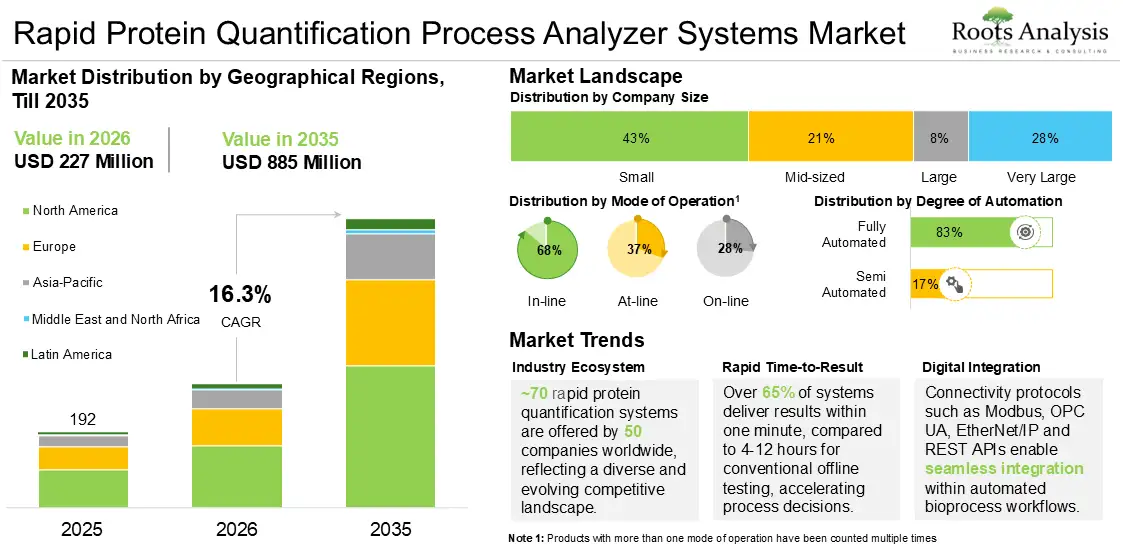
The global rapid protein quantification process analyzer systems market, valued at USD 192 million in 2025, is projected to reach USD 227 million in 2026 and USD 885 million by 2035, representing a CAGR of 16.3% during the forecast period 2026 to 2035. The market growth is supported by increasing demand for rapid and more reproducible protein concentration and titer measurements, wider adoption of process analytical technology (PAT), and the shift toward process-integrated, automated analytical workflows across biopharmaceutical development and manufacturing.
See What's in the Full Report – Request Your Complimentary Insights!
Market Report: Key Takeaways
Market Size & Trends
- In terms of intended workflow supported, upstream development accounts for the largest share of the market in 2026.
- Based on mode of operation, at-line currently holds the leading market share, accounting for around 50% of the market in 2026.
- In terms of degree of automation, semi-automated represents the largest segment of the market in 2026.
- The biopharmaceutical companies account for the highest market share of the market in 2026.
- North America currently holds the largest share, accounting for close to 45% of the global market in 2026, due to its established biopharmaceutical manufacturing infrastructure and widespread adoption of advanced process analytical technologies.
Key Market Statistics
- Market Size in 2026: $227 Million
- Estimated Market Size in 2035: $885 Million
- CAGR (2026-2035): 16.3%
- North America: Largest market in 2026
- Asia-Pacific: Fastest growing region
What are Rapid Protein Quantification Process Analyzer Systems?
Rapid protein quantification process analyzer systems are analytical technologies used to measure protein concentration or product titer with short turnaround times across biopharmaceutical research, process development and manufacturing. Depending on the platform, measurement may be based on surface plasmon resonance (SPR), localized surface plasmon resonance (LSPR), near-infrared or Raman spectroscopy, refractive-index sensing, interferometric / photonic approaches, particle-motion sensing or other process-compatible optical methods.
The systems may be developed at-line, on-line or in-line. At-line configurations analyze samples removed from the process near the manufacturing line; on-line configurations use automated sampling loops or connected analyzers; and in-line systems use sensors or probes positioned directly in the process stream or vessel. These configurations support workflows such as cell-line and clone selection, upstream titer monitoring, downstream recovery, process characterization, scale-up, pilot manufacturing and commercial process monitoring.
The demand for rapid protein quantification systems is increasing as biopharmaceutical manufacturers seek to improve process efficiency, optimize protein yields and reduce analytical turnaround times. Conventional workflows often involve sample collection, preparation and laboratory analysis, resulting in delays between measurement and process adjustments. A study published in Biotechnology and Bioengineering evaluated online ultra-performance liquid chromatography and fluorescence spectroscopy for measuring protein concentration in co-formulated monoclonal antibody products, demonstrating reduced analytical turnaround time. Despite challenges associated with analytical validation, integration and measurement accuracy across complex sample matrices, continued advancements in automated and process-integrated analytical technologies are likely to support wider adoption across biopharmaceutical development and commercial manufacturing.
Scope, Methodology and Industry Experts Interviews
This report defines rapid protein quantification process analyzer systems as analytical technologies designed for rapid measurement of protein concentration or titer across biopharmaceutical research, process development and manufacturing workflows. The study includes systems that support at-line, on-line or in-line measurement and evaluates adoption across upstream development, downstream development, process characterization, scale-up, pilot and commercial manufacturing, and real-time release testing workflows where analytically and regulatorily appropriate.
The findings were developed through structured secondary research, proprietary databases, company disclosures, regulatory guidance, peer-reviewed scientific literature and primary research. Market assumptions were triangulated across installed systems, workflow coverage, mode of operation, automation, end-user adoption, regional activity and technology-development trends. The report includes detailed transcripts of interviews conducted with the following industry participants:
- Chief Executive Officer and Business Development, Small Organization, Germany
- Chief Executive Officer, Managing Director, Small Organization, Sweden
Ruizhi Wang (Founder and CEO, Abselion), stated that, "One of the main challenges today is long turnaround times. Even for relatively simple titer measurements, results can take one to two weeks in large organizations. This is not due to limitations in the science itself, but rather workflow, logistics, and the way current technologies are used.
Looking ahead, the biggest improvement would be to fully integrate analytics into the production process. At the moment, analytics is often treated as a separate step, rather than part of the core workflow."
In addition, the market report includes transcripts of the following third-party discussions:
- Chief Executive Officer and Founder, Small Organization, UK
- Chief Executive Officer and Founder, Small Organization, UK
- Chief Executive Officer and Founder, Small Organization, UK
- Co-founder, Small Organization, Switzerland
- Senior Director of Analytical Sciences, Mid-sized Organization, US
- Senior Product Application Specialist, Very Large Organization, US
- Senior Principal Product Manager, Very Large Organization, US
- Senior Process Analytical Technology Scientist, Large Organization, Iceland
- Senior Product Applications Specialist, Very Large Organization, US
- Life Science Product Marketing Manager, Very Large Organization, Switzerland
Your Business is Unique – Why Shouldn't Your Report Be?
What is Driving Rapid Protein Quantification Process Analyzer Systems Market Growth?
- Increasing Need for Faster Protein Titer Measurements: Biopharmaceutical developers require frequent titer measurements to assess cell-culture productivity, compare clones, optimize feeding strategies and monitor process performance. Rapid analyzers can reduce dependence on delayed laboratory workflows and provide information closer to the point of decision-making.
- Growing Adoption of PAT and Process-Integrated Analytics: FDA's PAT framework defines PAT around timely measurement of critical quality and performance attributes during processing. This regulatory and quality-by-design orientation is encouraging manufacturers to evaluate analytical tools that can be integrated more directly into bioprocess development and manufacturing control strategies.
- Expansion of Monoclonal Antibody and Biosimilar Manufacturing: Antibody development and commercial production require repeated measurement of titer and protein concentration across upstream and downstream workflows. Expansion of biologics and biosimilar capacity therefore increases demand for analytical platforms that can deliver rapid, reproducible measurements across multiple process stages and sites.
- Transferable Analytical Models Can Reduce Re-development Burden: A Biotechnology Progress study published in April 2026 demonstrated a Raman-based monoclonal-antibody titer model transferable between two cell lines with different metabolic profiles. The study highlights the potential of high-throughput experiments, chemometrics and process knowledge to improve model transferability and shorten analytical-development timelines.
Pay Only for What You Need – The Best Way to Optimize
Recent Developments in the Rapid Protein Quantification Process Analyzer Systems Market
- In September 2026, Nirrin Technologies showcased its tunable-laser near-infrared platform at the BPI Conference & Exhibition. The platform combines TALOS™ rapid protein quantitation and ATLAS® multi-analyte workflows on a common architecture that can be configured for at-line or in-line use.
- In June 2026, Researchers from Novartis and IRUBIS published a comparative study of mid-infrared, Raman and variable-pathlength ultraviolet spectroscopy for inline monitoring of protein and excipient concentrations during ultrafiltration / diafiltration, highlighting the growing evaluation of multiple spectroscopic approaches for downstream PAT.
- In June 2026, FUJIFILM and HORIBA announced the co-development of a high-sensitivity inline Raman measurement system for continuous, real-time monitoring of component concentrations during cell culture and purification. In model purification experiments, the companies reported approximately 10% higher antibody yield compared with their conventional UV-Vis-based process-control method.
- In June 2026, Nirrin Technologies commercially launched TALOS™, a direct protein-quantitation system based on fixed-path near-infrared measurement of the peptide backbone, with deployment options spanning at-line, in-line and in situ bioprocess workflows.
Rapid Protein Quantification Process Analyzer Systems Market Trends
- Shift Towards In-line and Real-Time Process Visibility: Biopharmaceutical manufacturers are evaluating process-integrated analytics to reduce manual sampling, shorten analytical delays and improve visibility across cell culture and purification. A review by Carvalho et al., published in Biotechnology and Bioengineering 2025, evaluated quantitative process analytical technologies for real-time monoclonal antibody characterization during continuous downstream processing, highlighting their role in process monitoring and control. Additionally, Vaisala has demonstrated the application of in-line refractive-index measurement for monitoring protein concentration during ultrafiltration and diafiltration processes. These developments reflect the industry's focus on improving process visibility, reducing analytical delays and supporting continuous biopharmaceutical manufacturing.
- Broader Use of Chemometrics and Predictive Models: Modern spectroscopic workflows increasingly rely on multivariate analysis and predictive models to convert complex spectral data into estimates of titer, protein concentration and related process attributes. The quality of these models depends on representative calibration data, process knowledge and controlled model maintenance.
- Movement Toward Continuous and Intensified Bioprocessing: Continuous upstream and downstream processes increase the value of timely analytical data because process conditions can change without the clear batch boundaries used in conventional workflows. Rapid protein quantification can therefore support tighter process monitoring and faster response to process drift.
- Integration of Automation and Digital Bioprocessing: Developers are combining automated sampling, sensors, spectroscopy, data acquisition and analytics to reduce manual intervention and improve reproducibility. As these systems become more connected, software validation, cybersecurity, data integrity and interoperability with manufacturing data systems become more important buying criteria. A study by Chan et al., published in Biotechnology Journal in July 2025, demonstrated an automated analytical platform integrating protein titer measurement, purification and quality assessment within a single workflow. Another study by Cunha et al., published in Talanta in 2025, investigated an automated, label-free optical sensor using UV-Vis spectroscopy to quantify therapeutic monoclonal antibodies. Such developments highlight the growing interest in reducing manual intervention, simplifying analytical workflows and improving measurement consistency across biopharmaceutical development and manufacturing applications.
How is the Rapid Protein Quantification Process Analyzer Systems Market Segmented?
Based on the research, we have segmented the rapid protein quantification process analyzer systems market into intended workflow supported, mode of operation, degree of automation, end user and geographical regions.
- By Intended Workflow Supported: Upstream Development, Commercial Manufacturing, Downstream Development, Process Characterization, Cell-Line Development, Clonal Selection, Scale Up, Pilot Manufacturing and Real Time Release Testing
- By Mode of Operation: At-line, In-line and On-line
- By Degree of Automation: Semi-automated, Fully Automated and Manual
- By End User: Biopharmaceutical Companies, CROs / CDMOs and Academic & Research Institutes
- By Geographical Regions: North America, Europe, Asia-Pacific, Middle East and North Africa and Latin America
Rapid Protein Quantification Process Analyzer Systems Market Share Insights
Which Intended Workflow Holds the Largest Market Share?
Upstream development currently accounts for the largest share of the rapid protein quantification process analyzer systems market, due to the frequent requirement for protein titer measurements during cell culture optimization, process development and productivity assessment. Real time release testing is projected to grow at a higher CAGR during the forecast period, due to the increasing adoption of process analytical technologies, greater emphasis on real-time quality monitoring and growing efforts to reduce dependence on conventional offline testing.
Which Mode of Operation Leads the Global Rapid Protein Quantification Process Analyzer Systems Market?
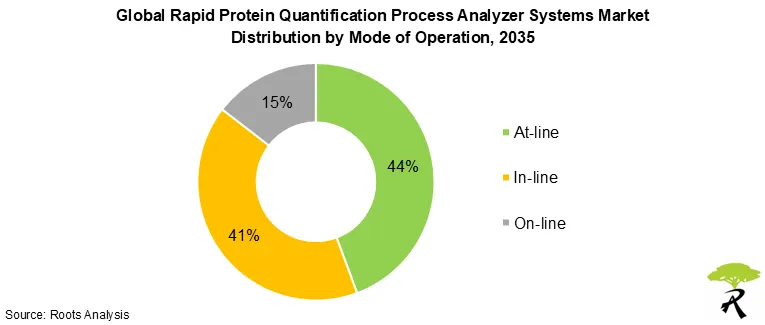
At-line systems currently account for the largest share (around 50%) of the rapid protein quantification process analyzer systems market, due to their ability to shorten analytical turnaround without requiring the level of process modification associated with direct in-line deployment. In-line systems are projected to grow at a higher CAGR of 18.4% as manufacturers pursue automated sampling reduction, real-time visibility and tighter integration of analytics with manufacturing workflows.
Which Degree of Automation Holds the Largest Share of Rapid Protein Quantification Process Analyzer Systems Market?
Semi-automated systems currently account for majority of the rapid protein quantification process analyzer systems market. These platforms balance automated measurements with operator-controlled sampling and can be easier to integrate into existing development laboratories and manufacturing environments. Fully automated systems are likely to grow at a higher CAGR during the forecast period, due to increasing efforts to minimize manual intervention, improve reproducibility and connect analytical outputs more directly with process-control decisions.
Which End User Segment Leads the Rapid Protein Quantification Process Analyzer Systems Market?
Biopharmaceutical companies currently account for the largest share of the rapid protein quantification process analyzer systems market. Their demand spans cell-line development, upstream and downstream process development, scale-up and commercial manufacturing. CROs / CDMOs are projected to grow at a higher CAGR during the forecast period, supported by expanding outsourced development and manufacturing activities and the requirement to deploy analytical platforms across multiple client processes.
Market Regional Insights
North America Dominates the Rapid Protein Quantification Process Analyzer Systems Market
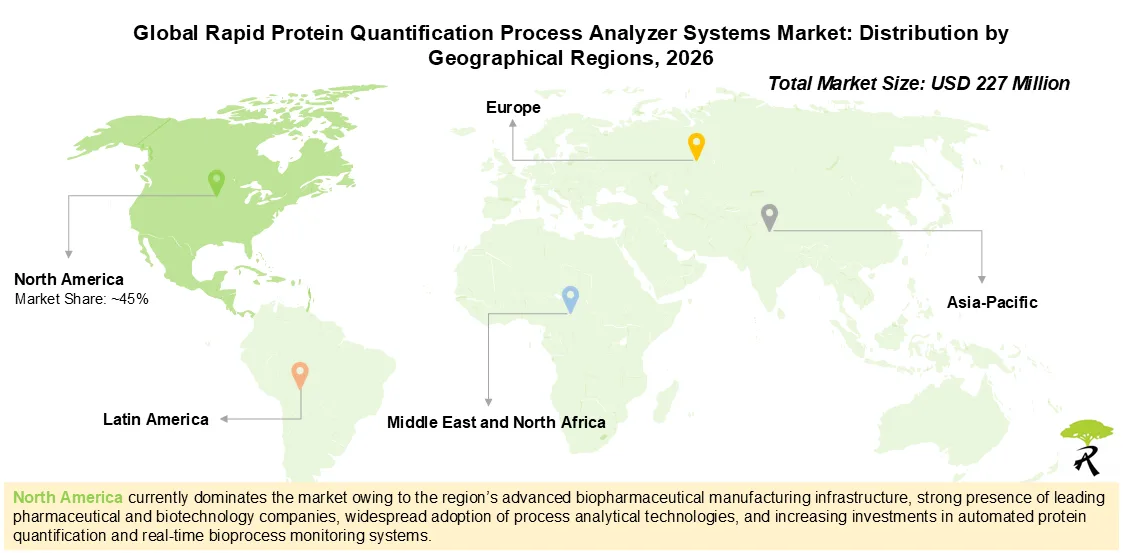
North America is projected to account for the largest share (close to 45%) of the rapid protein quantification process analyzer systems market in 2026, due to established biopharmaceutical manufacturing infrastructure, strong presence of leading biotechnology companies, extensive biologics R&D activity, early adoption of PAT and advanced analytical technologies, and the presence of developers and end users investing in process intensification and digital bioprocessing.
Asia-Pacific is Expected to Witness the Fastest Market Growth
Asia-Pacific is projected to register the highest CAGR of 19.1% through 2035. This growth is being supported by expansion of biologics and biosimilar manufacturing, investment in modern bioprocessing facilities and increasing adoption of automated analytical technologies across China, India, South Korea and other regional manufacturing hubs.
Get an Instant Quote in 10 Minutes. Lowest Price Guaranteed
Who Are the Key Players Profiled in the Rapid Protein Quantification Process Analyzer Systems Market?
Examples of companies profiled in this market report include Abselion, ArgusEye, Causeway Sensors, Cytiva, Helia Biomonitoring, IRUBIS, Kemtrak, Nirrin Technologies, RedShift BioAnalytics and Repligen. The complete market landscape covers 68 rapid protein quantification process analyzer systems developed by 50 companies, with an easily searchable Excel database providing detailed information on commercially available and emerging systems worldwide. The competitive analysis evaluates measurement principle, workflow coverage, deployment mode, automation, product positioning and process-integration capabilities rather than treating all analyzer systems as technically equivalent.
Report Deliverables and Customization
Alongside the core market report, clients receive complimentary Excel data packs covering the rapid protein quantification process analyzer systems market landscape, product competitiveness analysis, partnerships and collaborations and market forecast and opportunity analysis. A complimentary PowerPoint presentation summarizing the full report is also included, along with 15% free customization scope. The report is designed to support biopharmaceutical manufacturers, PAT and analytical-development teams, CROs / CDMOs, technology providers, procurement teams, business-development professionals and investors evaluating technology fit, vendor capabilities and market opportunities.
Report Authorship
This report was authored by Pemba Lahmo, part of Roots Analysis healthcare and pharmaceutical research practice, with research coverage spanning bioprocess analytics, process analytical technology, protein quantification, biopharmaceutical development and manufacturing. Findings are based on proprietary databases, expert discussions, regulatory guidance and secondary research and are subject to internal review prior to publication.
Independence and Non-Affiliation
Roots Analysis is an independent market research and consulting firm. This report is not affiliated with, endorsed by, or produced on behalf of any company, analytical-technology provider, regulatory authority or individual named within the study. Company and product names are used solely for factual market analysis and benchmarking.
Market estimates and segment shares are developed from Roots Analysis's proprietary methodology, primary discussions and secondary research. They may not be directly comparable with other published studies that define rapid protein quantification, PAT analyzers or process-monitoring systems differently.


