
Lowest Price Guaranteed
Pages
423
Last Updated
August 2026
View Count
5645
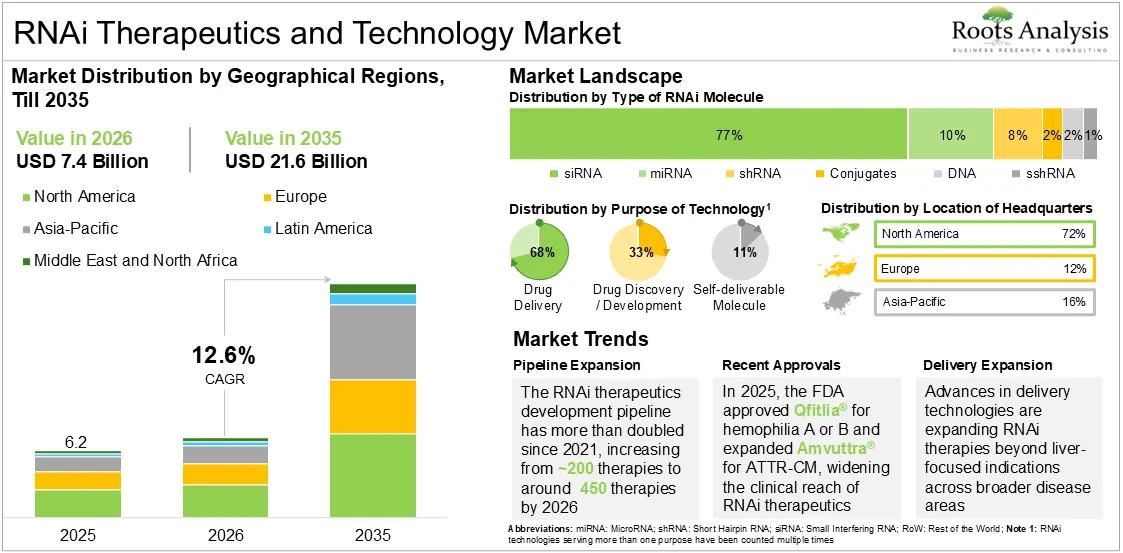
The global RNAi therapeutics and technology market, valued at USD 6.2 billion in 2025, is projected to reach USD 7.4 billion in 2026 and USD 21.6 billion by 2035, representing a CAGR of 12.6% during the forecast period 2026 to 2035.
To learn more about this report, request a free sample copy
RNA interference (RNAi) represents a powerful gene-silencing approach that enables selective suppression of disease-associated genes at the messenger RNA (mRNA) level. By silencing pathogenic transcripts, RNAi-based platforms have created new therapeutic opportunities across genetic, metabolic, cancer-related, hematological, ophthalmic, and other complex disorders. The growing clinical and commercial success of RNAi therapeutics has also strengthened interest in RNAi technologies as enabling platforms for target validation, drug discovery, diagnostics, and next-generation therapeutic development.
The RNAi therapeutics and technology market is expanding due to advances in RNAi molecule design, delivery systems, and target-specific drug development. Delivery technologies, including lipid nanoparticles (LNPs), conjugate systems, polymer-based platforms, emerging nanomaterials, and viral vectors, are improving stability, tissue targeting, and clinical applicability. To maximize the efficiency of these delivery methods, developers are increasingly using AI-enabled design and discovery platforms to improve RNAi candidate selection and accelerate early-stage development. For instance, in June 2026, Alnylam and Inceptive formed a strategic collaboration valued at up to USD 2.0 billion to accelerate the discovery of RNAi therapeutics using generative AI and foundation-model capabilities.
Despite strong progress, the market continues to face challenges related to targeted delivery, off-target effects, immunogenicity, manufacturing complexity, and regulatory requirements. Developers must also address the need for reliable delivery beyond liver-focused indications to unlock broader therapeutic potential. However, improvements in drug delivery technologies, growing clinical validation, and increasing investment from pharmaceutical companies are expected to create significant opportunities for stakeholders operating in the RNAi technology and therapeutics domain.
Based on the research, we have segmented the RNAi Therapeutics and Technology Market into type of RNAi molecule, delivery technology, therapeutic area, type of payment, end user, and geographical regions.
By Type of RNAi Molecule
By Delivery Technology
By Therapeutic Area
By Type of Payment
By End User
By Geographical Regions
Driven by advances in RNAi delivery technologies and growing clinical validation of gene-silencing therapies, the RNAi therapeutics and technology domain is entering a new phase of expansion beyond liver-targeted indications.
Emphasizing this shift, Patrick Lu (Founder, President and Chief Executive Officer, Sirnaomics), stated, "The next step in the evolution of RNAi as a leading therapeutic will be the ability to safely target organs outside the liver such as lung, brain, etc. This will revolutionize disease treatments if the industry can demonstrate similar data sets for non-liver targets as we have seen in liver-based diseases."
Discussions with multiple stakeholders in this domain influenced the opinions and insights presented in this study. The market report includes transcripts of third-party discussions:
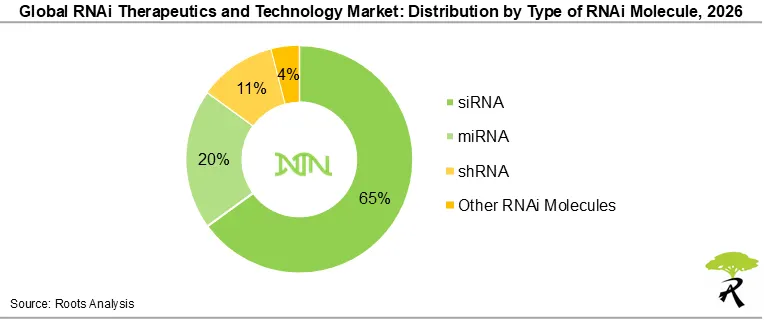
Based on the type of RNAi molecule, the global RNAi therapeutics and technology market is segmented into siRNA, miRNA, shRNA, and other RNAi molecules.
Currently, siRNA accounts for the largest share of the overall market, capturing 65% of market share. This leading position stems from the molecule's well-characterized gene-silencing mechanism and its high compatibility with modern chemical modification strategies. These structural modifications protect siRNA molecules from enzymatic degradation while minimizing off-target effects and toxicity risks. Because pharmaceutical and biotechnology companies have successfully integrated these molecules into standardized, scalable synthesis protocols across diverse disease indications, this segment maintains its dominance over less commercially mature RNAi modalities.
The shRNA segment is likely to grow at the highest rate during the forecast period. This growth is supported by its ability to enable longer-lasting gene silencing through vector-based delivery, making it attractive for applications requiring sustained therapeutic effects. Developers are increasingly evaluating shRNA-based approaches for complex and chronic disease indications where durable target suppression can offer clinical advantages. As vector engineering, delivery technologies, and gene therapy manufacturing capabilities continue to improve, shRNA-based platforms are likely to gain stronger traction within the RNAi therapeutics and technology industry, although vector-related safety, durability, and regulatory considerations remain important.
Based on delivery technology, the global RNAi therapeutics and technology market is segmented into lipid nanoparticles, emerging nanomaterials, polymer and conjugate systems, viral vectors, and other delivery technologies.
Currently, polymer and conjugate systems account for the largest share of the global market. This dominance is primarily due to the widespread industry adoption of conjugate-based delivery platforms, particularly GalNAc conjugates, which optimize cellular uptake in hepatocytes. These systems offer distinct pharmacokinetic advantages, such as enhanced metabolic stability, precise tissue targeting, reduced dosing frequency, and improved patient adherence compared to earlier formulation approaches. As the commercial pipeline relies heavily on these ligand-linker architectures, this segment continues to serve as the structural backbone of advanced RNAi development.
Emerging nanomaterials are likely to grow at the highest rate during the forecast period. This growth is supported by increasing research focused on improving extrahepatic delivery, cellular uptake, endosomal escape, and organ-specific biodistribution. As developers seek to expand RNAi applications beyond liver-focused indications, nanomaterial-based delivery platforms are likely to gain traction for improving delivery precision and supporting next-generation RNAi therapeutics.
Based on therapeutic area, the global RNAi therapeutics and technology market is segmented into oncological disorders, genetic disorders, metabolic disorders, hematological disorders, ophthalmic disorders, and other disorders.
Metabolic disorders account for the largest share of the current market. This dominance is due to the natural physiological alignment between advanced delivery systems and liver-specific disease pathways, as hepatocytes readily absorb therapeutic oligonucleotides via receptor-mediated endocytosis. By intercepting disease-causing proteins at their source in the liver, these therapies effectively modulate systemic lipid disorders, amyloidosis, and cardiovascular risks. This precise mechanism of action supports the segment's position as the primary focus of large-scale chronic disease pipelines.
Oncological disorders are likely to grow at the highest rate during the forecast period. This growth is supported by increasing research into RNAi-based approaches for silencing cancer-associated genes, overcoming treatment resistance, and enabling more targeted cancer therapeutics. As delivery technologies improve and developers explore RNAi applications across solid tumors and hematological malignancies, oncology-focused RNAi programs are expected to gain stronger traction within the market.
Based on type of payment, the global RNAi therapeutics and technology market is segmented into upfront payments and milestone payments.
Currently, milestone payments account for the larger share of the overall market. This dominance is due to the structure of RNAi licensing, discovery, and co-development agreements, where a significant portion of the total deal value is linked to development, regulatory, and commercialization milestones. As RNAi programs advance through clinical development and approach commercialization, milestone-based structures allow companies to share risk while retaining future value if programs succeed.
Milestone payments are also likely to grow at the highest CAGR during the forecast period. This growth is supported by the increasing number of RNAi programs progressing into clinical and late-stage development, where achievement of predefined clinical, regulatory, and commercial targets can trigger additional payments. As pharmaceutical companies continue to enter RNAi platform and pipeline-focused agreements, milestone-based deal structures are likely to remain central to value creation in the market.
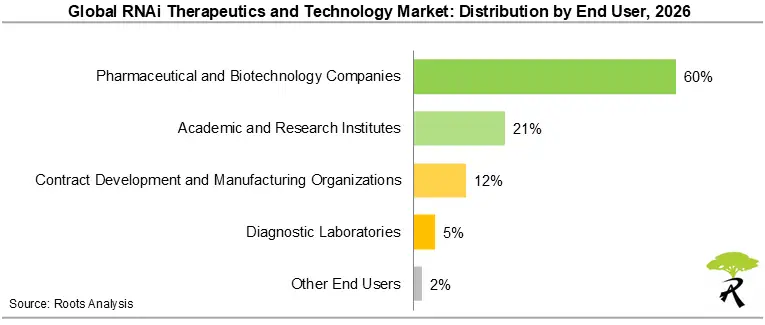
Based on end user, the global RNAi therapeutics and technology market is segmented into pharmaceutical and biotechnology companies, academic and research institutes, contract development and manufacturing organizations, diagnostic laboratories, and other end users.
Pharmaceutical and biotechnology companies account for the largest share (close to 60%) of the current market. This dominance is due to their strong involvement in RNAi-based drug discovery, clinical development, delivery technology optimization, and commercialization of RNAi therapeutics. These companies possess the financial resources, technical expertise, and clinical development infrastructure required to advance RNAi platforms across genetic, metabolic, oncological, and other complex disorders.
Contract development and manufacturing organizations (CDMOs) are likely to witness significant growth during the forecast period. This growth is supported by the increasing outsourcing of RNAi development, formulation, analytical testing, and manufacturing activities by therapy developers. As RNAi programs become more complex and require specialized capabilities in oligonucleotide synthesis, delivery formulation, and quality control, CDMOs are likely to play an increasingly important role in supporting RNAi therapeutics and technology development.
In terms of geographical regions, the global RNAi therapeutics and technology market is segmented into North America, Europe, Asia-Pacific, Latin America and Middle East and North Africa.
Currently, North America accounts for the largest share of the global market. This dominance is due to the strong presence of established RNAi developers, advanced biotechnology infrastructure, mature clinical trial networks, and a supportive regulatory environment for RNA-based therapeutics. The region also benefits from sustained investment in RNA-based drug discovery, platform innovation, and delivery technology development. Companies such as Alnylam Pharmaceuticals and Arrowhead Pharmaceuticals continue to strengthen North America's leadership through active RNAi pipeline development, technology partnerships, and continued investment in next-generation RNAi platforms.
The RNAi therapeutics and technology market in Asia-Pacific is likely to grow at the highest rate during the forecast period. This growth is supported by expanding biotechnology capabilities, rising clinical development activity, growing regional manufacturing capabilities, and increasing participation of countries such as China, Japan, South Korea, and Australia in RNA-based therapeutics. The region is also witnessing broader commercial access to RNAi therapies, as reflected by Arrowhead Pharmaceuticals receiving Therapeutic Goods Administration (TGA) approval for REDEMPLO® in Australia. In addition, increasing regional investment in RNA therapeutics research and advanced drug delivery technologies is likely to support the growth of RNAi therapeutics and technology adoption across Asia-Pacific.
| Key Report Attribute | Details | |
| Historical Trend | Since 2022 | |
| Forecast Period | Till 2035 | |
| Market Size 2026 | USD 7.4 Billion | |
| Market Size 2035 | USD 21.6 Billion | |
| CAGR (Till 2035) | 12.6% | |
| Segments Covered |
|
|
| Key Players |
|
|
| PowerPoint Presentation (Complimentary) |
Available | |
| Customization Scope | 15% Free Customization | |
| Excel Data Packs (Complimentary) |
Available | |