


 Download Free Sample
 Buy Now
Global Small Scale Bioreactors Market Size
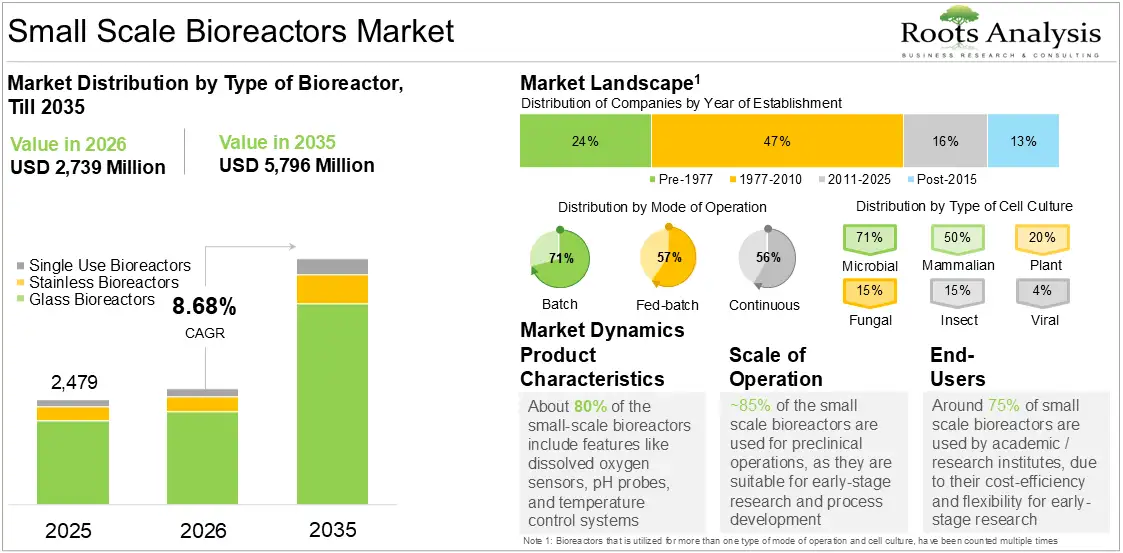
The small scale bioreactors market is estimated to grow from USD 2,479 million in 2025 to reach USD 2,739 million in 2026 and USD 5,796 million by 2035, representing a CAGR of 8.68% during the forecast period 2026 to 2035.
See What’s in the Full Report – Request Your Complimentary Insights!
Over time, biologics have gained significant popularity owing to their therapeutic efficacy, safety profiles and ability to treat a wide variety of disease indications that are often difficult to manage with conventional therapies. The clinical and commercial success of these therapies has contributed to the increased demand, encouraging stakeholders to advance and improve biologics manufacturing technologies.
The increased demand for enhancing productivity, operational flexibility, greater profitability and faster time to market is driving the transition from traditional manufacturing equipment to innovative production technologies. Consequently, a variety of advanced technologies and process analytical tools have been developed to accelerate the overall manufacturing process.
One such advancement is the adoption of small bioreactors, also known as microbioreactors, in modern biopharmaceutical manufacturing. Small-scale bioreactors provide high-throughput solutions for process development by enabling rapid evaluation of multiple critical parameters essential for the optimization of industrial bioprocesses. In addition, small bioreactors facilitate the scaling-down of mammalian and microbial cell culture processes, delivering increased experimental throughput at relatively lower costs. As a result, these advantages contribute to minimizing the downtime and increase the number of batches produced in a given period of time.
However, despite these advancements, significant challenges remain in optimizing culture media, refining process development and enhancing overall manufacturing efficiency.
Small Scale Bioreactors Market: Report Attributes
| Key Report Attributes | Details | |
| Historical Trend | Since 2021 | |
| Forecast Period | Till 2035 | |
| Market Size 2026 | $ 2,739 Million | |
| Market Size 2035 | $ 5,796 Million | |
| CAGR till 2035 | 8.68% | |
The small scale bioreactors market analysis also features the likely distribution of the current and forecasted opportunity within the domain across various segments, such as capacity of bioreactors, type of cell culture, mode of operation, type of bioreactor, end-user, scale of operation, geographical regions and key players.
We have created three market forecast scenarios, conservative, base and optimistic, to account for future uncertainties in key parameters and enhance the robustness of our model. These scenarios represent different tracks of the industry's evolution.
The miniature bioreactor systems have the same flexibility as laboratory scale bioreactors and can be customized to specific demands of various bioprocesses. The use of small media volume lowers the operational expenses and makes these systems suited for diverse applications, such as screening studies, media optimization, process optimization, microbial and cell culture, batch, fed-batch, perfusion and continuous cultivation.
Recent Developments in Small Scale Bioreactors Market
- In April 2025, Project Nexus (launched as a collaboration among Photocentric, Sartorius, Metamorphic, and the Centre for Process Innovation (CPI), with academic partners Imperial College London and the University of Sheffield’s Advanced Manufacturing Research Centre (AMRC)), received USD 2.5 million in funding from Innovate UK. The initiative seeks to tackle environmental challenges in bioprocessing by creating greener, reusable alternatives to single-use equipment like bioreactors, reducing plastic waste and boosting sustainability in the biopharmaceutical sector.
- In April 2025, Thermo Fisher Scientific launched the 5L DynaDrive single-use bioreactor, with scalability ranging from 1L to 5,000L with an aim to accelerate the time-to-market for the therapies. This bioreactor delivers increased throughput and minimizes product loss.
- In January 2025, Biosphere secured USD 8.8 million in seed funding in order to develop cost effective UV-sterilized bioreactors for the biomanufacturing industry.
Small Scale Bioreactors Market Segmentation Insights
The market research report presents an in-depth analysis of the various small scale bioreactors companies, across different segments, as defined in the table below:
Small Scale Bioreactors Market: Market Segmentation
| Market Segmentation | Details | |
| Capacity of Bioreactor |
|
|
| Type of Cell Culture |
|
|
| Mode of Operation |
|
|
| Type of Bioreactor |
|
|
| End-user |
|
|
| Scale of Operation |
|
|
| Geographical Regions |
|
|
The miniaturization of cultivation equipment depicts tremendous advancements in accelerating bioprocess development and establishing robust cell factories. Among these advancements, various types of small-scale bioreactors have emerged, equipped with prospective sensor systems for convenient online monitoring, and supporting automated bioprocesses fed batch cultivation. By bridging the gap between laboratory-scale experiments and large-scale fermentation, these fermenters and bioreactors facilitate more rapid process development and help lower overall production costs.
Industry Experts on Small Scale Bioreactors Industry Outlook
Discussions with multiple stakeholders in this domain influenced the opinions and insights presented in this study. The market report includes transcripts of the following other third-party discussions:
- Chief Executive Officer and Co-founder, Mid-sized Organization, Germany
- Chief Executive Officer, Small Organization, US
- Chief Executive Officer, Mid-sized Organization, UK
- Director, Mid-sized Organization, US
- Head of Business Operations, Large Organizations, Germany
The Director of the Advanced Biofuels and Bioproducts Process Development Unit (ABPDU), Deepti Tanjore emphasizes the critical role of small-scale bioreactors in bridging the gap between early-stage research and commercial-scale production. She explains, “One of the biggest challenges in scale up is that the scientific work that is conducted by researchers is often conducted at milliliters and even nanoliter scales. So, the technologies are often not tested in bioreactors, which is more representative of commercial-scale production. That environment is completely different due to mixing, aeration, and other factors. So often enough what I think we offer is an education to entrepreneurs who develop the technologies at milliliter scale into what commercial scale production looks like.”
Small Scale Bioreactors Market Share Insights
Market Share by Capacity of Bioreactors: 1-3 L Bioreactors Hold the Largest Share
- In 2026, 1-3 L segment is likely to dominate the market (~25%) as per small scale bioreactors market analysis for process development. Bioreactors with this volume range are often used for detailed studies and pilot-scale production, enabling scientists to small product batches, conduct testing, refine bioprocesses and gather data for scale-up.
- The market for the capacity of bioreactors upto 300 mL is likely to grow at a higher growth rate (9.22%) during the forecast period, driven by several advantages, such as rapid perfusion process development for optimizing therapeutic antibody production.
Market Share by Type of Cell Culture: Mammalian Culture is the Widely Used Culture in Small Scale Bioreactors Market
- As per our estimates, mammalian culture holds the major share (~35%) in the current year. This can be attributed to the critical role of mammalian cultures in producing complex proteins, such as recombinant glycoproteins, which require post-translational modifications.
- In the coming years, the viral segment is likely to grow at a relatively higher CAGR (13.05%) during the forecast period, owing to the increasing significance of viral cultures in optimizing and scaling up manufacturing processes for vaccines and gene therapy.
Market Share by Mode of Operation: Batch / Fed Batch Captures the Largest Share
- Currently, the batch / fed batch mode of operation dominated the market and is estimated to hold 90% of the overall revenue share by 2035. Fed batch bioreactors provide controlled nutrient environment, preventing accumulation of inhibitory byproducts that can limit cell growth.
- Continuous manufacturing market segment shows decent growth potential, growing at a higher growth rate (9.59%) during the forecast period. This rapid growth can be attributed to its potential in minimizing the production cost by reducing the downtime, streamlining of the sequential steps, resource utilization and minimizing the risks of contamination.
Your Business is Unique – Why Shouldn’t Your Report Be?
Market Share by Type of Bioreactor: Single Use Bioreactors Segment Holds the Largest Share
- According to our projections, in 2026, single use bioreactors segment (~80%) dominates the market and is likely to grow at a relatively higher CAGR (9.64%), during the forecast period.
- It is important to note that single use bioreactors offer significant environmental benefits, such as reduced water consumption and decreased energy consumption in facilities owing to their shorter down time compared to other types of bioreactors, contributing to cost efficiency and sustainability.
Market Share by End-user: Biopharmaceutical Companies Segment Dominates the Small-Scale Bioreactors Market
- According to our projections, in the current year small scale bioreactors market for biopharmaceutical companies segment (~85%) dominates the market and is likely to grow at a relatively higher CAGR (9.14%), during the forecast period.
- This dominance is driven by the increasing demand for advanced biologics and personalized therapies to treat a wide range of diseases.
Market Share by Scale of Operation: Discovery and Clinical Stage Biopharma Companies Holds the Largest Share
- Discovery and clinical stage biopharma companies segment hold majority of the small-scale bioreactors manufacturing market size (with ~85% share) in 2026 primarily because these bioreactors are extensively utilized in research, development, and early-stage process optimization.
- Commercial stage biopharma companies are projected to grow at a relatively higher CAGR (9.85%) in the small-scale bioreactors market. This growth can be attributed to the increasing adoption of single-use technologies that enhance flexibility and efficiency in commercial-scale production.
Regional Outlook: Asia-Pacific to Propel the Small Scale Bioreactors Sector in the Coming Years
- As per small scale bioreactors market forecast, the North American market is likely to capture majority share of 35%. This is due to the strong presence of biopharmaceutical companies, well-established research infrastructure, favorable regulatory environment, and high investment in biotechnological innovation.
- It is worth highlighting that the small scale bioreactors market in Asia-Pacific is expected to grow at a relatively faster growth rate of 11.71%.
Small Scale Bioreactors Market: Report Deliverables
| Report Deliverables | Details | |
| Excel Data Packs (Complimentary) |
|
|
| Key Small Scale Bioreactor Companies Profiled |
|
|
| PowerPoint Presentation (Complimentary) | Available | |
| Customization Scope | 15% Free Customization | |
Small Scale Bioreactors Market Key Takeaways
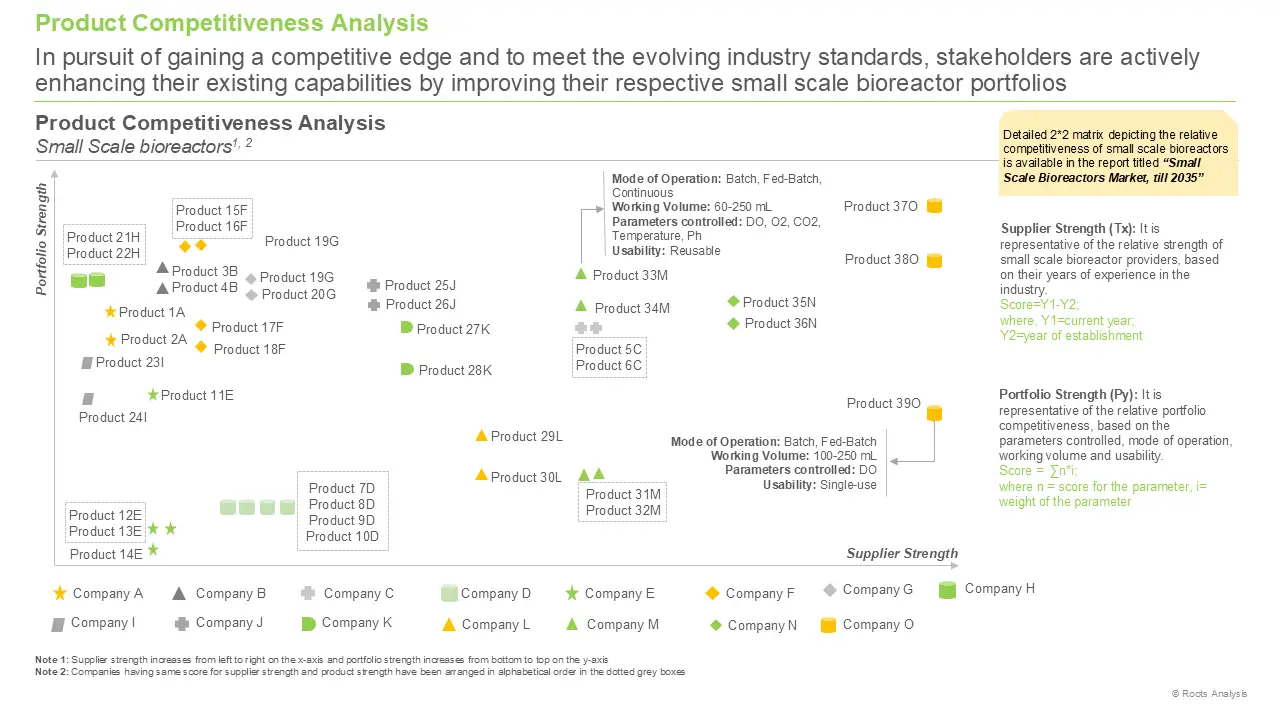
The “Small Scale Bioreactors Market (2nd Edition): Industry Trends and Global Forecasts, till 2035” market report features an extensive study of the current market landscape of small scale bioreactor developers, along with product competitiveness analysis, patent analysis, and market size and future opportunities within the small scale bioreactors industry, during the forecast period.
Competitive Landscape of Small Scale Bioreactor Companies
Presently, more than 95 players are developing over 370 small scale bioreactors, ranging from 100 mL to 2000 L. These small scale bioreactors are utilized for high-throughput media cultivation, process development, and optimization. Further, the current market landscape is highly fragmented, featuring the presence of small, mid-sized, and large players.
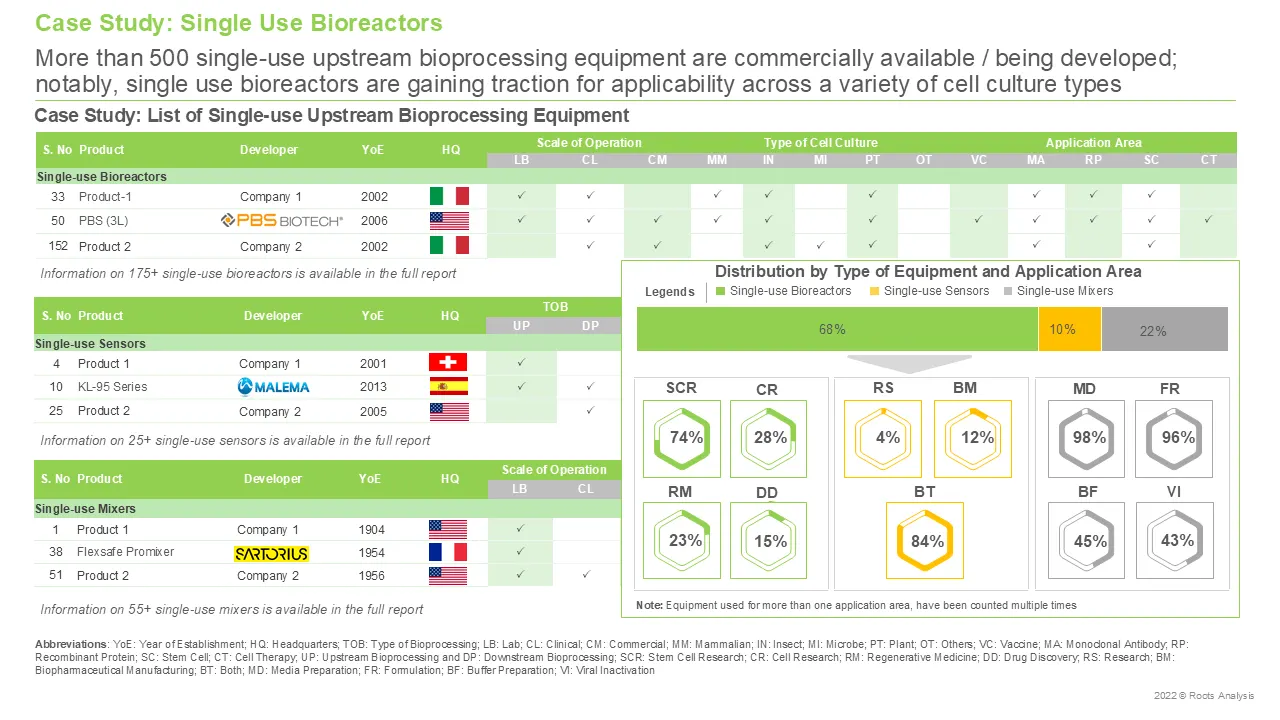
It is worth highlighting that the stakeholders active in this domain are taking various initiatives to integrate a wide range of single use sensors for monitoring various parameters, such as dissolved oxygen, carbon dioxide levels, pH, and temperature. This enables researchers to analyze and determine the optimal conditions required for the cultivation of culture cells.
Additionally, the increasing small scale bioreactor adoption for personalized medicine development has led to surge in the demand for small scale production systems with fast turn-around time. Due to the rising need for faster process development and manufacturing solutions, the small scale bioreactor market will grow substantially.
How are single-use bioreactors impacting the competitive landscape of the overall bioreactors market?
Single-use bioreactors are significantly reshaping the competitive landscape of the overall bioreactors market by offering various advantages, such as reduced contamination risks, faster turnaround times, and lower capital expenditure.
Pay Only for What You Need – The Best Way to Optimize
Market Drivers: Increasing Research on Biologics as Targeted Therapies
The growing use of diverse biopharmaceutical products to treat a broad spectrum of diseases has driven the demand for advanced high-throughput systems capable of maintaining optimal growth conditions. Further, small scale reactors are convenient to use and offer flexibility to produce a broad spectrum of biologics. The advantages have contributed to the widespread adoption of small scale bioreactors within the biopharmaceutical industry. Driven by the increasing research on biologics and widespread adoption, it is believed that the small scale bioreactors market will grow substantially during the forecast period.
Market Trends Analysis: Integration of Automation and Advance Sensors
Ongoing technological advancements and the integration of automated control systems have demonstrated enormous growth opportunities for manufacturers. The integration of automated controlled systems in small-scale bioreactors enables precise monitoring and optimization of parameters such as pH, temperature, and dissolved oxygen level. This allows researchers to optimize the cell culturing environment and enhance overall manufacturing efficiency.
Additionally, the key players in this industry are increasingly integrating advanced sensors and analytic capabilities for real time monitoring of cell growth and determining deep insights about cell behavior during bioproduction processes.
Market Size Analysis: What is the Opportunity for the Small Scale Bioreactors Market?
The global (italic) market for small scale bioreactors is around $ 2,739 million in 2026 and is expected to grow at a CAGR of 8.68% during the forecast period. Owing to the increasing demand for high-throughput technologies for screening and identification of pharmaceutical leads, the market is expected to grow at a steady rate.Further, in terms of type of bioreactor, single use bioreactors hold the largest share in the market.
Regional Analysis: Which Region Holds the Largest Small Scale Bioreactors Market Share?
North America is Leading the Market
North America is estimated to capture more than 35% of the market share in 2026 and this trend is likely to remain unchanged during the forecast period. This dominance is attributed to the region's well-established biopharmaceutical industry, advanced research infrastructure, and strong investment in bioprocessing technologies.
What opportunities exist in emerging markets, such as Asia-Pacific for small scale bioreactor adoption?
The small scale bioreactors market in Asia-Pacific holds significant potential driven by the rising demand for biopharmaceuticals, expanding research and development, and a move toward sustainable bioprocessing.
Want Information on Specific Region / Segment?
Notably, more than 40% of the key companies engaged in the small-scale bioreactors market have been established in Asia-Pacific. Further, in the coming years, small scale bioreactor market in Asia-Pacific is anticipated to grow at a higher CAGR of 11.71% during the forecast period.
Small Scale Bioreactors Market Report Coverage
- An Infographic Executive Summary
- Market Landscape of Small Scale Bioreactor Developers
- Product Competitiveness Analysis of Small Scale Bioreactors
- Patent Analysis
- Company Profiles
- Market Forecast Analysis
Have Questions? Let’s Get Them Answered.
From the Author’s Desk
Author’s View on Small Scale Bioreactors Market
The miniaturization of cultivation equipment plays a crucial role in accelerating bioprocess development and creating robust cell factories. Various small-scale bioreactors, integrated with advanced sensor systems for convenient online monitoring, support automated bioprocesses and fed-batch cultivation. These bioreactors effectively bridge the gap between small-scale experiments and large-scale fermentation, facilitating faster process development while reducing costs. Over time, small-scale bioreactors have established their significance as effective tools in various fermentative bioprocesses.
About Authors
Lead Author: Shreeya Agrawal
Lead Reviewer: Rupanshi Sharma
Chief Editor: Prachi Bhalla
Glossary
- Continuous Manufacturing: A production method where materials are fed into a system and transformed into finished products in a continuous, uninterrupted flow.
- Single Use Bioreactors: Fermenters and bioreactors that utilize a disposable plastic bag as the culture vessel instead of a traditional, reusable stainless steel vessel are single use bioreactors.
- Single Use Sensors: Single use sensors in bioprocess units transmit the information to the controller, which further instructs the valves of the bioreactor to maintain the desirable environmental conditions in the overall manufacturing process. These sensors are intended for one-time use.


