Fill Finish Pharmaceutical Contract Manufacturing Market by Type of Fill Finish Service Offered (Aseptic Filling, Blow-Fill-Seal and Terminal Sterilization), Type of FDF (Generic FDF and Originator FDF), API Potency (Low Potent API and High Potent API), Type of Primary Packaging Container (Ampoules, Cartridges, Prefilled Syringe, Vials, and Other Containers), Scale of Operation (Clinical and Commercial), Company Size, Geographical Regions and Leading Players – Trends and Forecast 2026-2035
Market Outlook
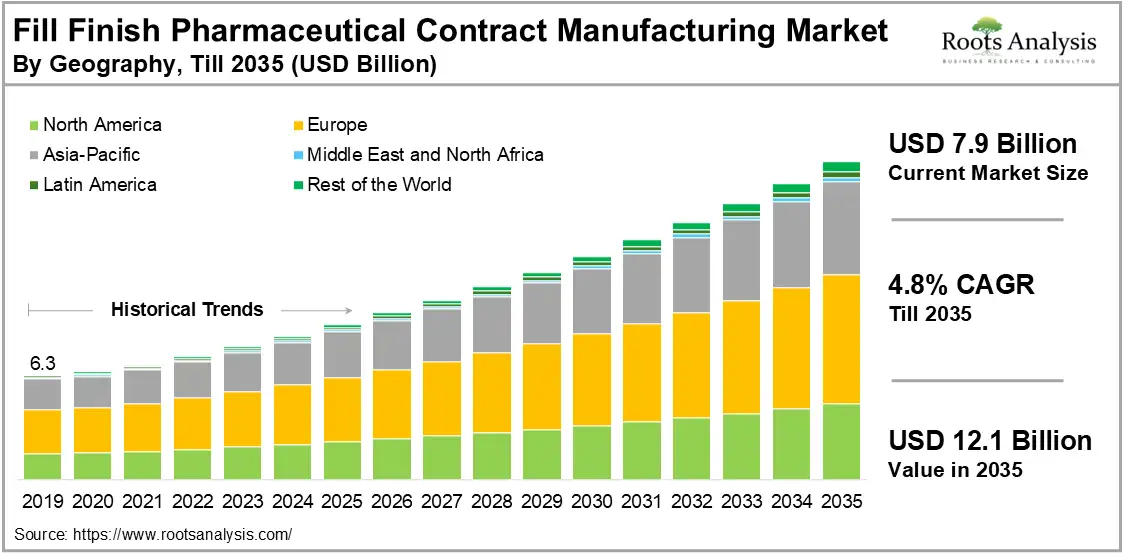
The global fill finish pharmaceutical contract manufacturing market size, valued at USD 7.5 billion in 2025, is projected to reach USD 7.9 billion in 2026 and USD 12.1 billion by 2035, representing a CAGR of 4.8% during the forecast period 2026 to 2035. The market growth is driven by rising pharmaceutical outsourcing, increasing demand for complex injectable formulations, and expanding biologics pipelines. Growing investments in advanced manufacturing technologies and capacity expansion further support market development.
See What's in the Full Report – Request Your Complimentary Insights!
Fill Finish Pharmaceutical Contract Manufacturing Market: Scope, Methodology and Industry Expert Interviews
Roots Analysis segments the fill finish pharmaceutical contract manufacturing market by type of fill finish service offered, type of FDF, API potency, type of primary packaging container, scale of operation, company size, geographical regions, and key players. The study combines secondary research across company disclosures, regulatory filings, industry publications and proprietary databases with primary interviews, followed by data triangulation to validate market size, segment shares, capacity estimates and forecast assumptions.
The opinions and insights presented in this study were informed by discussions with multiple stakeholders across the market value chain, including business development and procurement teams, R&D and regulatory affairs professionals, and representatives from CMOs and CDMOs. These discussions informed the assessment of partnership activity, funding, regulatory considerations and commercial opportunities. The stakeholder roles considered in the research have been listed below:
- Senior Executive Director, Global Sales and Marketing, Large Company, US
- President and Chief Executive Officer, Corporate Strategy and Business Development, Mid-sized Company, US
- Former Chief Executive Officer, Large Company, Switzerland
- Former Vice President Business Development, Marketing, and IP, Mid-sized Company, Israel
- Director, Operations, Mid-sized Company, India
- Former Director of Business Development, Large Company, US
- Former Director, Commercial Development, Cell Therapy, Mid-sized Company, Switzerland
- Former Director, Pharmaceuticals Marketing, Large Company, France
- Digitalization and Artificial Intelligence Manager, Large Company, Switzerland
Primary interviews indicate that finished dosage form (FDF) outsourcing remains a central feature of pharmaceutical manufacturing strategies. Allison Vavala (Former Director of Business Development of Helsinn Group) stated, "Most pharma clients are outsourcing the manufacturing of drug products (FDF). This can be attributed to the fact that a lot of companies already have in-house drug substance manufacturing capabilities. In addition, some companies end up building their own facilities to produce the drug substance, while a product candidate is in the clinical development phases. Moreover, the drug substance manufacturing process takes more time. It can take a few months to manufacture the drug substance, whereas drug product manufacturing is usually a one-day task."
Market Segments
Based on the research, we have segmented the Fill Finish Pharmaceutical Contract Manufacturing Industry into type of fill finish service offered, type of FDF, API potency, type of primary packaging container, scale of operation, company size, geographical regions, and key players.
- Type of Fill Finish Service Offered: Aseptic Filling, Blow-Fill-Seal, and Terminal Sterilization
- Type of FDF: Generic FDF and Originator FDF
- API Potency: Low Potent API and High Potent API
- Type of Primary Packaging Container: Ampoules, Cartridges, Prefilled Syringes, Vials, and Other Containers
- Scale of Operation: Clinical and Commercial
- Company Size: Small and Mid-sized Companies and Large / Very Large Companies
- Geographical Regions: North America, Europe, Asia-Pacific, Latin America, Middle East and North Africa
Your Business is Unique – Why Shouldn't Your Report Be?
What is Fill Finish Pharmaceutical Contract Manufacturing?
The fill finish pharmaceutical contract manufacturing market encompasses outsourced services associated with the final stages of drug-product manufacturing, wherein formulated bulk drug products are filled into primary packaging containers, such as vials, prefilled syringes, cartridges and ampoules, and subsequently subjected to finishing activities, including visual inspection, labeling and packaging. Depending on the characteristics and sterility requirements of the drug product, contract manufacturing organizations (CMOs) and contract development and manufacturing organizations (CDMOs) may employ aseptic filling, terminal sterilization or blow-fill-seal (BFS) technology.
For sterile products, fill finish operations require stringent contamination control, validated manufacturing processes and compliance with applicable good manufacturing practice (GMP) requirements and regulatory expectations from authorities such as the US FDA and EMA. This market primarily covers outsourced fill finish services for small-molecule drug products across clinical and commercial scales. Biologics, including monoclonal antibodies and biosimilars, have distinct formulation stability, handling and aseptic-processing requirements and therefore represent an adjacent, but operationally different, fill finish manufacturing segment.
Market Report: Key Takeaways
Market Size & Trends
- The terminal sterilization segment currently holds the highest share of the market.
- In terms of the type of FDF, the originator FDF segment captures the largest share, accounting for more than 45% of the share.
- Based on API potency, the low potent API segment currently holds the largest market share (close to 85%).
- By type of primary packaging container, the ampoules segment currently dominates the global market.
- With respect to scale of operation, commercial segment captures the highest share (close to 95%) in 2025.
- Based on the company size, the large and very large companies hold the majority of the market share.
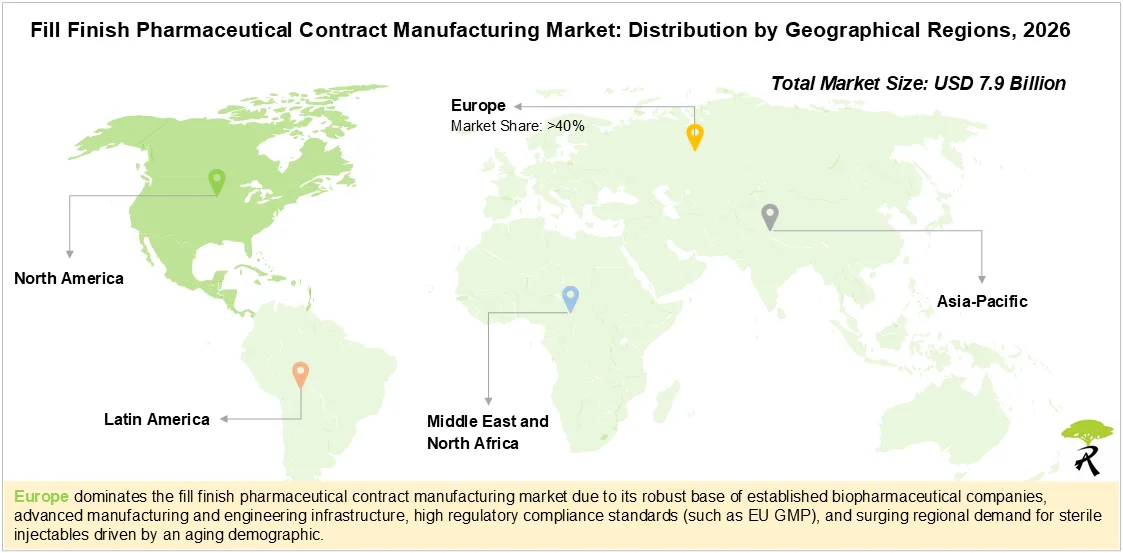
- In terms of geographical regions, Europe captures more than 40% of the current market share.
Key Market Statistics
- Market Size in 2026: USD 7.9 billion
- Estimated Market Size in 2035: USD 12.1 billion
- CAGR (2026-2035): 4.8%
- Largest market, 2026: Europe
Market Overview
Fill finish represents one of the most critical stages in pharmaceutical manufacturing, as the drug product transitions from bulk formulation to its final presentation for clinical or commercial use. Maintaining sterility, product integrity and dose consistency during this stage requires specialized filling equipment, controlled manufacturing environments, validated processes and experienced technical personnel. These requirements become particularly important for sterile and complex small-molecule formulations, where contamination, packaging compatibility or process deviations can affect product quality and regulatory compliance.
The technical and capital-intensive nature of fill finish operations has encouraged pharmaceutical companies to increasingly rely on specialized CMOs and CDMOs rather than establishing dedicated in-house infrastructure. Outsourcing enables drug developers to access established filling capacity, regulatory expertise and multiple packaging formats while retaining flexibility to scale production from clinical batches to commercial volumes. In parallel, service providers are investing in aseptic isolators, restricted access barrier systems (RABS), robotic filling lines, real-time environmental monitoring and single-use technologies to reduce operator intervention, strengthen contamination control and improve manufacturing efficiency. For companies operating in regulated markets, a service provider's quality systems, inspection history and ability to meet applicable FDA and EMA GMP expectations are becoming increasingly important alongside installed capacity and pricing.
The competitive landscape is also shaped by differences in API potency, finished dosage form, primary packaging container, scale of operation and regional manufacturing capacity. Vials remain an important packaging format, while prefilled syringes and other ready-to-use formats are gaining attention as manufacturers seek greater convenience and manufacturing efficiency. Further, fill finish requirements extend beyond the filling line itself; products requiring controlled temperatures may also depend on validated cold-chain management and coordinated distribution, making integrated manufacturing and logistics capabilities increasingly relevant when selecting an outsourcing partner. Together, these factors are strengthening demand for flexible, compliant and technologically advanced fill finish manufacturing capacity across major pharmaceutical markets.
Recent Developments
- In June 2026, Maiva Pharma inaugurated a new sterile injectable manufacturing facility in Shoolagiri, Tamil Nadu, India. The 22-acre facility is planned to house six manufacturing lines for sterile injectable formats, including vials, prefilled syringes, cartridges, suspensions and lyophilized products.
- In May 2026, Recipharm announced a multi-million investment in a new Blow-Fill-Seal (BFS) manufacturing line to expand its sterile drug-product manufacturing capacity. The expanded BFS capability is designed to support customer programs from early feasibility and clinical supply through commercial manufacturing, strengthening Recipharm's integrated sterile fill-finish offerings.
- In April 2026, PCI Pharma Services announced a major expansion of its US sterile fill-finish and drug-device delivery capabilities across its US and European operations. The expansion includes high-speed isolator filling lines for prefilled syringes, cartridges and vials and is intended to support both small-molecule and biologic drug products from development through commercial manufacturing and packaging.
Pay Only for What You Need – The Best Way to Optimize
Market Trends
- Focus on Hyper-Automation and Robotics: Hyper-automation is becoming increasingly important for sterile fill finish operations. Aseptic isolators and restricted access barrier systems (RABS) physically separate operators from the critical filling zone, while robotic filling, capping and container-handling systems reduce repetitive manual interventions and support greater precision and sterility assurance.
- Adoption of Single-Use Technology: Single-use filling needles, bags and tubing are being adopted to simplify changeovers and reduce the cleaning and sterilization burden between batches. Their use can also lower cross-contamination risk, making disposable components particularly attractive for flexible multi-product facilities and smaller batch sizes.
Market Share Insights
Terminal Sterilization Will Hold the Largest Share of the Market
The terminal sterilization segment currently captures the largest share (~45%) owing to the fact that it provides the highest level of sterility assurance, is more reliable and cost-effective; this trend is unlikely to change during the forecast period.
Originator FDF to Account for the Largest Market Share
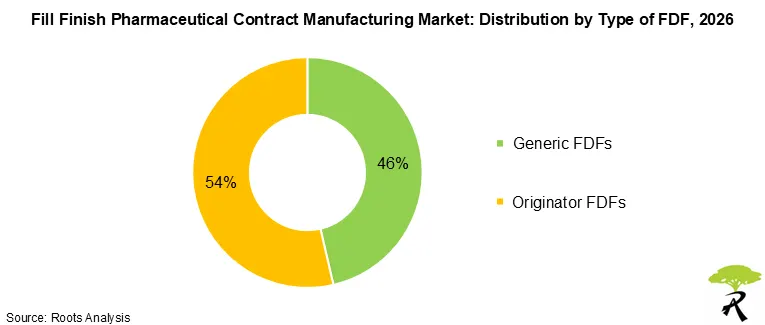
The originator FDF segment accounts for 54% of the market in 2026. This share reflects the estimated value of outsourced fill-finish services associated with originator drug products. This growth stems from the cost effectiveness, competitive pricing and quality standards maintained by such contract manufacturers.
Among all the Type of Primary Packaging Containers, Ampoules Will Hold the Largest Market Share
The ampoules segment currently captures the largest market share. Ampoules provide a hermetically sealed primary-container format suitable for eligible sterile drug products and can withstand applicable terminal-sterilization processes. The prefilled syringes segment is anticipated to grow at a relatively faster CAGR of 5.1% during the forecast period.
Market Share by API Potency
The low potent API segment captures comparatively larger market share, owing to the higher demand, less complex manufacturing requirements, and lower overall production costs associated with low potent API as compared to high potent API.
Market Insights
Advantages of Outsourcing Fill Finish Manufacturing Operations
Outsourcing fill finish manufacturing operations to CMOs allows the drug developers / pharmaceutical companies to focus on their core competencies, including research and development, marketing, and distribution. Further, outsourcing the manufacturing processes to specialized firms provides drug developers access to well-established fill finish facilities and expertise, thereby enhancing efficiency and cost-effectiveness. Additionally, outsourcing can facilitate flexibility in scaling production capacity according to clinical and commercial demands.
Competitive Landscape of Fill Finish Pharmaceutical Contract Manufacturing Market
The current landscape features the presence of close to 390 CMOs offering fill finish manufacturing services for small molecules. It is worth mentioning that there has been a steady rise in the number of small molecules fill finish contract manufacturing companies over the past decade, indicating a growing demand for both novel and conventional drugs. Further, a significant proportion of companies (93%) offer services for aseptic filling to various small molecules developers; notable examples include AbbVie Contract Manufacturing, Bankyo, BirgiMefar, Corden Pharma, Gland Pharma, Jubilant HollisterStier, Nephron Pharmaceuticals, Plastikon Healthcare and Societal CDMO. Kindly note that company names and trademarks are referenced solely for market-analysis purposes; inclusion in this report does not imply affiliation, endorsement or sponsorship.
Capacity Analysis: Fill Finish Manufacturing Capacity Installed in Facilities Owned by Large and Very Large Companies
Majority (48%) of the small molecules fill finish capacity for ampoules is installed at facilities located in Europe. Within Europe, close to 20% of the ampoule filling capacity is available with the facilities based in France. Moreover, for cartridges, close to 50% of the capacity is installed in Europe. Of these, more than 30% of the capacity is installed in the facilities located in France. Further, it is worth mentioning that, over the past few years, the vial filling capacity in Asia-Pacific has increased at a substantial pace. This growth can be attributed to the technological advancements, low labor costs and socio-economic reforms favoring the growth of specialty industries, such as the sterile fill finish industry in this region.
Regional Market Analysis
Europe Emerged as the Hub of Fill Finish Pharmaceutical Contract Manufacturing Market
Majority of the companies operational in this market are headquartered in Europe. In current year, Europe will capture more than 40% of the overall fill finish pharmaceutical contract manufacturing market share. The rising demand for small molecule drugs in Europe can be attributed to the growing interest of the healthcare industry in personalized medicines, which has further driven a surge in R&D investments in this region.
Get an Instant Quote in 10 Minutes. Lowest Price Guaranteed
Key Players
The fill finish pharmaceutical contract manufacturing market is served by a broad base of companies. Companies profiled in the full report include Alcami, Amanta Healthcare, Aurigene Pharmaceutical Services, Batterjee Pharma, Burrard Pharmaceuticals, Curida, Eriochem, Fresenius Kabi, GlaxoSmithKline, Nextage Therapeutics (formerly Nextar Chempharma Solutions), Pfizer CentreOne, Plastikon Healthcare, Procaps, Recipharm, ROMMELAG CMO, Sharp, Sypharma, Teva Pharmaceuticals, and WuXi AppTec. A complete list of 390+ companies captured is available within the full report.
Report Deliverables and Customization
Alongside the core market report, clients receive complimentary Excel data packs covering market landscape analysis, company competitiveness analysis, capacity analysis, and market forecast and opportunity analysis. A complimentary PowerPoint presentation summarizing the full report is also included, and 15% free customization scope is available on request. The report is designed to support pharmaceutical business development, procurement, R&D and regulatory affairs teams evaluating outsourcing partners, as well as CMOs and CDMOs benchmarking their capabilities, capacity and competitive positioning.
Report Authorship
Author: Rupali Chaudhary, Healthcare and Pharmaceutical Research Practice, Roots Analysis
Her work focuses on drug development and manufacturing, competitive intelligence, company benchmarking and market forecasting.
Independence and Non-Affiliation
Roots Analysis is an independent secondary and primary market research publisher. This report is not affiliated with, endorsed by, or produced on behalf of any company named or profiled within it, including all key players, CDMOs, and industry expert interviewees referenced above.
Roots Analysis' findings draw on a combination of secondary research and primary interviews with industry experts, of the kind referenced above, to validate market sizing, segment shares, and forecast assumptions independently of any single company's disclosures.


