


 Download Free Sample
 Buy Now
Sustainable Drug Manufacturing Market Overview
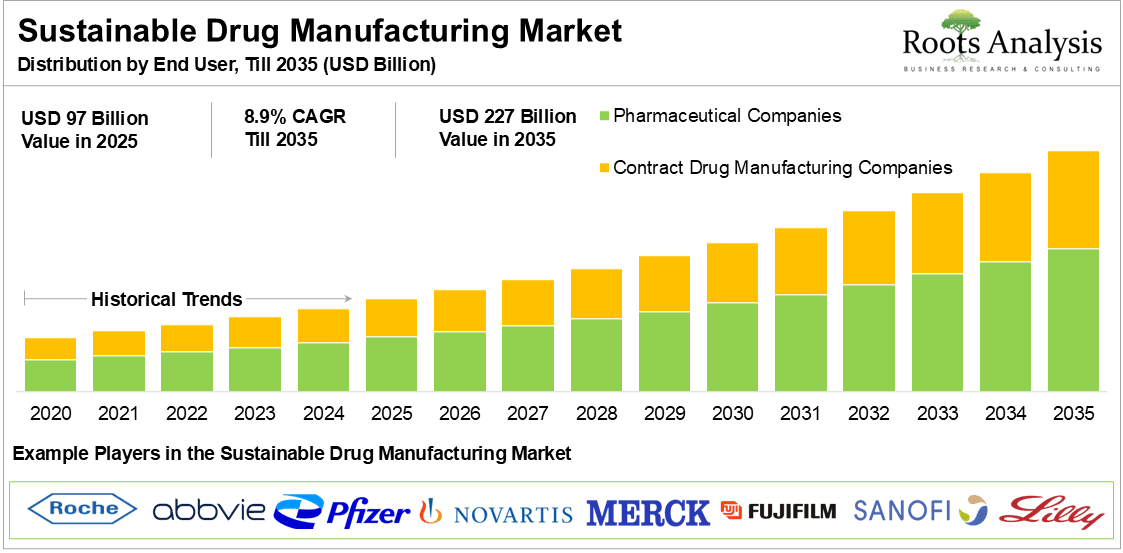
The global sustainable drug manufacturing market size, valued at USD 88 billion in 2024, is projected to reach USD 97 billion in 2025 and USD 227 billion by 2035, representing a CAGR of 8.9% during the forecast period.
 |
Sustainable Drug Manufacturing Market: In Summary
- The sustainable drugs manufacturing industry is shifting from traditional, resource-intensive methods to more environmentally friendly and cost-effective practices. This transition is driven by a combination of factors, including increasing pressure from governments and regulatory bodies like the USFDA, growing demand for eco-friendly products, and a desire to reduce waste and carbon emissions.
- Some major drivers of the market are the increasing focus on sustainability, stricter regulations, and rising consumer demand for eco-friendly products. Companies are adopting new practices to meet these demands and improve operational efficiency.
- Small molecules dominate the market, holding a 58% revenue share due to the adoption of bio-based solvents and catalysts. However, the biosimilars are expected to see the fastest growth in the future.
- Continuous manufacturing is the leading process segment. Companies are adopting it to reduce their carbon footprint. AI-driven quality assurance is expected to be the fastest-growing segment in the future as digital technologies become more integrated into the industry.
- North America holds the largest market share (40%), driven by its focus on energy efficiency and strict environmental regulations. The Asia-Pacific region is anticipated to be the fastest-growing due to rising government initiatives and the growth of local pharmaceutical industries.
- Major players like AstraZeneca (UK), Pfizer (US), Merck (US), and Roche (Switzerland) are making significant investments to achieve sustainability goals and reduce their environmental impact. They are adopting strategies such as green chemistry, renewable energy integration, and upgrading manufacturing facilities.
- Roche (Switzerland) has committed a massive investment of USD 50 billion over five years into its US pharmaceutical and diagnostics operations. This investment includes expanding and upgrading manufacturing facilities, as well as new R&D sites.
- The company's future roadmap includes investments in sustainable buildings, waste and chemical reduction, and the ongoing implementation of green solvents and solvent recovery systems across multiple global sites.
Have Questions? Let's Get Them Answered
Sustainable Drug Manufacturing Market Introduction
Pharmaceutical industry is an important for economic well-being. It plays a crucial role in drug discovery, development and commercialization for the treatment and prevention of diseases. Notably, the manufacturing of drugs with traditional approach demand staggering expertise, massive upfront investment, and multi-phase process which is time consuming. Each step of drug manufacturing is highly resource intensive and generate waste. It is important to highlight here that the production of active pharmaceutical ingredients (APIs) also generate toxic chemicals, high amount of carbon and non-biodegradable material, which is released into the water and air, leading to environment pollution.
Considering these challenge with traditional manufacturing approach, several government and regulatory authorities, such as the USFDA are encouraging pharmaceutical companies to reduce carbon emission and minimize toxic chemical generation. Therefore, the pharmaceutical industry is shifting to sustainable drug manufacturing practices to reduce waste generation and enhance cost-effectiveness. The current focus of industrial player is one integrating advanced technologies, implementing green chemistry and carbon-neutral operations.
Moreover, pharmaceutical industry is adopting continuous manufacturing and adding purifying byproducts solutions to reduce waste and energy consumption. Furthermore, several market players are aiming to integrate the digital manufacturing tools for better resource planning, supply chain efficiency and production scheduling. Owing to the ongoing need for sustainability and rising initiatives by pharmaceutical industry players, it is likely to drive the sustainable drug manufacturing market growth in the upcoming years.
See What’s in the Full Report – Request Your Complimentary Insights!
Sustainable Drug Manufacturing Market: Report Attributes
| Key Report Attribute | Details |
| Historical Trend | Since 2020 |
| Forecast Period | Till 2035 |
| Market Size 2025 | USD 97 Billion |
| Market Size 2035 | USD 227 Billion |
| CAGR (Till 2035) | 8.9% |
One of the key objectives of the sustainable drug manufacturing market report was to estimate the current size, opportunity, and the market growth potential, over the forecast period, till 2035. We have provided informed estimates on the likely evolution of the market for the forecast period.
The global sustainable drug manufacturing market analysis also features the likely distribution of the current and forecasted opportunity within the market across various segments, such as type of product, type of process, type of formulation, end user, geographical regions, and leading players.
In order to account for future uncertainties associated with some of the key parameters and to add robustness to our model, we have provided three market forecast scenarios, namely conservative, base, and optimistic scenarios, representing different tracks of industry's evolution.
Do You Know That Lifecycle Assessment (LCA) for Pharmaceuticals Has Become a Mandatory Approach?
The ongoing necessity of sustainability in drug manufacturing has strategically catered the attention of pharmaceutical industrial players. It is worth noting that pharmaceutical giants, such as Pfizer (US), Novartis (Switzerland), Merck (US), and AstraZeneca (UK) are following lifecycle assessment approach to quantifies sustainability metrics at different stages of drug manufacturing. This analysis includes raw material extraction, drug formulation, synthesis, packaging, and market distribution. The key findings of this analysis helps to implement sustainable strategies to minimize waste generation up to 50% and carbon emission up to 30%.
Recently, AstraZeneca (UK) has incorporated net-zero carbon emission strategies, water conservation programs and closed loop recycling system to reduce energy consumption, environmental pollution, and waste generation. This significant analysis indicate that global pharmaceutical industrial players are focusing on renewable energy integration in pharma plants, indicating a broad scope of sustainable drug manufacturing.
Recent Developments in Sustainable Drug Manufacturing Market
Several recent developments in the eco-friendly pharmaceutical production market have occurred and we have outlined some of these below:
- In May 2025, Eli Lily (US) and Purdue University (US) announced a strategic alliance where Eli Lily is planning to invest up to USD 250 million in the collaboration for the next eight years. This strategic alliance will focus on discovering medicines, accelerating innovations and sustainability at every stage of pharmaceutical pipelines and supply chain.
- In March 2025, the World Business Council for Sustainable Development (WBCSD), in collaboration with leading pharmaceutical companies and supported by PwC UK, has published the Roadmap to Nature Positive: Foundations for the Pharmaceutical Sector (Roadmap). This publication highlight the efforts to understand its nature-related impacts and dependencies and identify key actions to drive nature-positive outcomes.
- In April 2025, Akums Drugs and Pharmaceuticals (India) signed a strategic Memorandum of Agreement (MoA) with the Tamil Nadu Agricultural University (TNAU, India). This collaboration marks a significant milestone towards leveraging agri-based research for advanced, sustainable healthcare solutions.
Sustainable Drug Manufacturing Market Segmentation Insights
The market report presents an in-depth analysis of sustainable drug manufacturers who are currently active across various segments of the industry as mentioned below:
Sustainable Drug Manufacturing Market: Market Segmentation
| Market Segmentation | Details |
| Type of Product |
|
| Type of Process |
|
| Type of Formulation |
|
| End User |
|
| Geographical Regions |
|
| Market In North America |
|
| Market In Europe |
|
| Market in Asia-Pacific |
|
| Market in Middle East & Africa |
|
| Market in Latin America |
|
Industry Experts on Sustainable Drug Manufacturing Market
Industry experts anticipated that the pharmaceutical companies mastering sustainable operations will benefit from lower costs, resource optimization, and improved market access.
During an interview, the Diane Holdorf (Executive Vice President, The World Business Council for Sustainable Development (WBCSD)) highlighted that, 'The Roadmap offers pharmaceutical companies a crucial tool to understand, manage, and mitigate their impacts on nature. By adopting a value chain-wide approach, it fosters innovation and resilience, boosting competitiveness and amplifying impact. With CBD COP16 behind us and UNFCCC COP30 ahead, the priority now is turning ambition into measurable action. At WBCSD, we stand ready to support our members and partners in making this a reality.'
Sustainable Drug Manufacturing Market Share Insights
Market Share by Type of Products: Which Product Dominate the Market in the Future?
- The global market is categorized across different type of products, such as small molecules, biosimilars, generic drugs, vaccines, over-the-counter medicines, and other products. Based on the sustainable drug manufacturing market report, the small molecules segment is dominating the market by holding 58% of the overall revenue share. This growth stems from the rising adoption of bio-based solvents and catalysts for drug production, specifically small molecules.
- It is important to note that the biosimilars segment will show a lucrative growth and register a higher CAGR in the future. The increasing patented drugs expiration and rising prevalence of chronic diseases are driving the demand for biosimilar, which further encourage the adoption of low-carbon API synthesis and purification systems.
Market Share by Type of Process: What is the Future Scope of Continuous Manufacturers?
- The global market is categorized across different type of process, such as green chemistry, continuous manufacturing, single-use systems, ai-driven quality assurance, and others. According to the sustainable pharma manufacturing market forecast, the continuous manufacturing segment is dominating the market. Pharmaceutical companies are rapidly adoption continuous manufacturing for lower carbon footprint which is likely to increase its demand in the future.
- In the future, AI-driven quality assurance segment is likely to gain momentum at a higher CAGR during the forecast period. This dominance in the future stems from the rising penetration of digital technologies for data analysis during drug discovery and clinical studies.
Market Share by Type of Formulation: How Sustainable Manufacturing is Adopting for Tablets Formulation?
- This segment highlight the distribution of global market across different type of drug formulation, such as tablets, capsules, injectables, topical & transdermal, nasal & pulmonary sprays, and others. According to the sustainable drug manufacturing market report, the tablets segment is dominating the market by holding 30% of the market share. This is driven by the widespread usage for disease treatment and rising patient preferences for oral route drug formulations.
- Notably, in the future injectables segment is likely to grow at a higher CAGR during the forecast period. The growing focus on smart injections, needle-free injections, and self-administration devices are likely to drive the demand for injectables in the future.
Market Share by End User: Which Companies Lead the Sustainable Drug Manufacturing Market (Pharma, CDMO, Tech)?
- Based on end user, the global market is segmented into pharmaceutical companies and contract drug manufacturing. According to our projection, the pharmaceutical companies segment holds nearly 69% of the market share. This highest share stems from the rising adoption of low-carbon API synthesis and purification, and renewable energy in pharma facilities to minimize the waste generation.
- It is worth noting that the contract drug manufacturing segment is likely to propel at the fastest CAGR in the future. This is driven by the growing focus on sustainability, net-zero emission, green solvents and solvent recovery systems for optimal resource utilization within pharmaceutical contract manufacturing organizations.
Market Share by Geographical Regions: Which Regions Lead Adoption and Which Grow Fastest?
- The global market is distributed across North America, Europe, Asia-Pacific, Middle East and Africa, and Latin America. According to the market analysis, the North America region is dominating the market by securing 40% of the sustainable pharma manufacturing market size. This dominance is due to the rising focus on energy efficiency, waste management and stringent guidelines for environmental sustainability. Pharmaceutical companies are required to follow these federal laws to ensure sustainable and green drug manufacturing.
- In Asia-pacific, the market for sustainable drug manufacturing is likely to grow at a higher CAGR in the future. This can be attributed to the rising government initiatives to support green chemistry, adoption of automation to meet quality standards and resource optimization. Moreover, the rising local pharmaceutical industries, and initiatives, such as API self-reliance in domestic API manufacturing are some of the key factors propelling market in this region.
Want Information on Specific Region / Segment?
Sustainable Drug Manufacturing Market: Report Deliverables
| Report Deliverables | Details |
| Excel Data Packs (Complimentary) |
|
| Key Sustainable Drug Manufacturing Companies Profiled |
(A complete list of companies captured is available in the report) |
| PowerPoint Presentation (Complimentary) | Available |
| Customization Scope | 15% Free Customization |
Sustainable Drug Manufacturing Market Key Takeaways
The "Sustainable Drug Manufacturing Market Report: Industry Trends and Global Forecasts, till 2035" market report features an extensive study of the current market landscape, market size, market share, market growth, market trends, market value, market forecast, market outlook, statistics, and future opportunities for market players. The market research report lays emphasis on the process intensification in drug production that are being adopted for waste minimization. Key takeaways of the market report are briefly discussed below.
Competitive Landscape: Is Market for Sustainable Drug Manufacturing Competitive?
The sustainable drug manufacturing market landscape is immensely competitive with a broad focus on sustainability and net-zero waste generation. Major pharmaceutical industrial players, such as Amgen (US), AstraZeneca (UK), and Merck (US) are combining environmental stewardships with green chemistry, and high quality production.
In addition, the biotech contract drug manufacturing organizations are adopting next generation manufacturing methods, including renewable energy, and continuous manufacturing for sustainable pharma. The tech giants, such as Microsoft (US) and Amazon (US) are also entering into the pharmaceutical industry to offer AI-powered tools for data analysis, and digital supply chain optimizations to enhance operational agility. Overall, the dynamic initiatives of industrial players in this market is likely to maintain a long term competitiveness in the future.
Pay Only for What You Need – The Best Way to Optimize
Market Drivers: What Factors are Driving the Eco-Friendly Pharmaceutical Production Market?
- The shift towards sustainability in drug manufacturing process is the key driver for the market. Some other notable factors that are propelling the market are listed below:
- The regulatory agencies, such as the USFDA and the EMA are increasingly focusing on environmental sustainability beyond just drug safety and efficacy. Pharmaceutical companies are required to follow the federal laws, such as the Clean Water Act, Resource Conservation and Recovery Act that are set as stringent standards to maintain sustainability in drug manufacturing.
- Rising demand for eco-friendly products is likely to be another key factors which is expected to drive the sustainable drug manufacturing market. It is important to highlight here that the adoption of environmentally friendly practices such as using renewable resources, minimizing waste, and eliminating hazardous materials are further supporting the growth of market in the upcoming years.
Do You Know the Global Sustainable Drug Manufacturing Market Size Will Reach to USD 227 Billion by 2035?
In 2025, the global sustainable drug manufacturing market is valued at USD 97 billion and is projected to reach USD 227 billion by 2035. This unprecedented growth is driven by the growing emphasis on environment protection and minimizing waste generation during drug manufacturing. The current focus on industrial players will be on waste minimization and byproduct valorization in pharma. This proactive approach helps to redesign manufacturing processes to ensure optimal usage of raw materials and reduce production of byproducts.
Which Pharma and CDMOs Have Highest Sustainability Capex / Roadmaps?
Several pharmaceutical companies and CDMOs are undertaking initiatives such as high capital expenditure and ambitious sustainability roadmaps. These massive investments and roadmaps have been initiated to enhance energy efficiency to achieve net-zero emission and operational decarbonization to reduce carbon emission. Some of the sustainability Capex / roadmaps that are taken by the industrial players are listed below:
| Company | Strategic Focus | Key Capex / Roadmaps |
| Merck (US) | Environment sustainability and energy efficiency to achieve next-zero emission | Green investment in energy efficiency initiatives, renewable energy, and upgrading drug manufacturing sites for reducing environment impact |
| Pfizer (US) | The strong focus to reduce scope 1 / 2 / 3 emissions reduction in pharma supply by 46% by 2030 and net-zero by 2040. | With a strong focus on environmental, social and governance (ESG) measure, this company has made a massive investment to decarbonize its supply chain, promote green packaging, and ensure 64% of key suppliers set science-based reduction targets. |
| Roche (Switzerland) | Roche consistently focusing on sustainability and chemical reduction (for ulcerative colitis analysis) | This company roadmap includes investments in sustainable buildings (LEED certified), waste and chemical reduction, and ongoing implementation of green solvents and solvent recovery systems across multiple global sites. In 2025, Roche announced a USD 50 billion capex over five years, prioritizing both innovative pharma and sustainability initiatives. |
| STADA (Germany) | Focus on decarbonization among generic drug manufacturers, and greenhouse gases emission reduction. | The company is making significant investment in eco-friendly manufacturing and sustainable packaging solutions. |
Market Challenges: Is There any Challenges That Can Hinder the Market Growth?
- It is worth noting that transition from traditional manufacturing to sustainable manufacturing require significant upfront investment. The high investment for infrastructure and advanced technologies may create a financial burden on pharmaceutical companies, thereby impacting the market growth.
- The stringent regulatory guidelines associated with quality control; drug safety and environmental sustainability may create challenges for the market players. Adhering to these guidelines while ensuring drug safety is a lengthy process, which create a gap between drug manufacturing and commercialization.
What are the Top Future Sustainability Drug Manufacturing Market Trends?
Circular Economy Initiatives: Better Waste Management
Notably, the government organizations are focusing on circular waste valorization from API byproducts to minimize waste management and reduce landfill impact. In addition, the pharmaceutical companies are rising focus on water reuse and zero liquid discharge in pharma during production and supply chain are likely to be the key growth factor for the market. Moreover, the use of biodegradable materials further helps to minimize the waste generation during drug manufacturing.
Sustainability Commitment: Digitization and Process Optimization
The future focus will be on the integration of AI technologies and digital applications for process optimization in supply chain. It is worth mentioning that digital technologies, such as AI, machine learning, and digital twins enable real-time monitoring and optimization of manufacturing processes. This also helps to reduce energy consumption, raw material waste, and water usage. This makes operations more optimized and eco-friendlier than traditional manufacturing approach.
Sustainability Drug Manufacturing Market Report Coverage
The market report presents an in-depth analysis, highlighting the capabilities of various stakeholders in the sustainability drug manufacturing industry, across different geographies. Amongst other elements, the market report includes:
- An Infographic Executive Summary
- Regulatory Scenario
- Comprehensive Database of Leading Players
- Competitive Landscape
- Company Competitiveness Analysis
- Startup Ecosystem in the Sustainability Drug Manufacturing Market
- Company Profiles
- Porter’s Five Forces Analysis
- Patent Analysis
- Partnerships and Collaborations
- Grant Analysis
- Funding and Investment Analysis
- Clinical Trial Analysis
- Market Forecast and Opportunity Analysis
- Adjacent Market Analysis
- Key Winning Strategies
- SWOT Analysis
Glossary
- Green Chemistry: This refers to the design of chemical processes and products to reduce or eliminate hazardous substances.
- Continuous Manufacturing: It is a process of production where materials are continuously in motion, increasing efficiency and minimizing waste.
- CDMO: Contract Development and Manufacturing Organization providing services to pharma companies.
- Biosimilars: This refers to the biological products that are highly similar to already approved reference products, offering similar efficacy and safety.
- Waste Valorization: The process of reusing, recycling, or composting waste materials and converting them into more useful products, including materials, chemicals, fuels, or other sources of energy, thereby giving economic value to waste.
From the Author’s Desk
Author’s View on Sustainable Drug Manufacturing Market
The sustainable drug manufacturing market is experiencing a dynamic transition driven by the growing focus on environmental stewardship and operational optimization. The market is characterized by robust growth across its constituent segments; green manufacturing platforms, sustainable packaging, green chemistry chemicals, continuous manufacturing, and sustainable API production. Digitalization, particularly through AI and IoT, is a critical enabler, providing the tools for real-time monitoring, optimization, and transparent reporting necessary for effective green practices. In addition, the shift towards a circular economy, coupled with advancements in green chemistry and continuous manufacturing, promises not only reduced environmental impact but also improved product quality and supply chain resilience.
Customization Opportunities
At Roots Analysis, we genuinely care about your success and understand that your business requirements are unique. While our market research reports provide valuable insights, we recognize that they might not cover every aspect you need to make well-informed strategic decisions. To account for that, we offer 15% free report customization tailored to your specific needs. Whether you require additional quantitative analysis, qualitative insights, or any other information related to the electric vehicles market, reach out to us today at support@rootsanalysis.com


