
Lowest Price Guaranteed
Pages
237
Last Updated
September 2026
View Count
5465
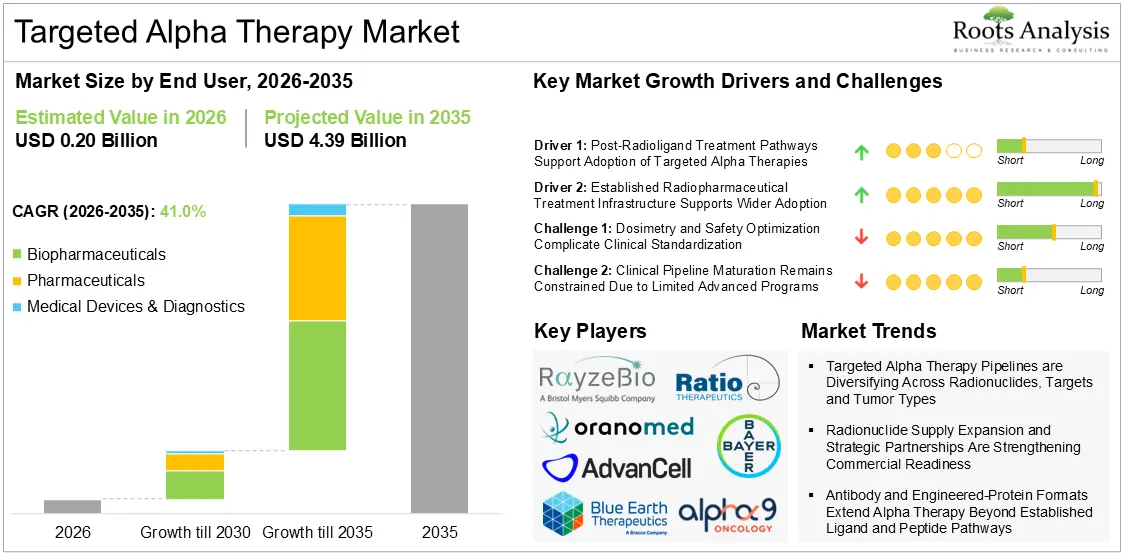
The targeted alpha therapy market was valued at USD 0.22 billion in 2025 and is estimated to reach USD 0.20 billion in 2026. The market is projected to reach USD 4.39 billion by 2035, growing at a CAGR of 41.0% during 2026-2035. Market growth is expected to accelerate as late-stage Ac-225 and Pb-212 therapies advance toward commercialization alongside expanding radiopharmaceutical treatment and isotope infrastructure.
To learn more about this report, request a free sample copy
Targeted alpha therapy (TAT) is attracting sustained oncology interest because alpha emitters deposit very high linear-energy-transfer radiation over a short path length. When an alpha-emitting radionuclide reaches a tumor through a molecular ligand, peptide, antibody-derived construct or a disease-specific physiologic route, the resulting energy deposition can create dense DNA damage within a tightly localized area. This combination of potency and spatial precision is particularly relevant for biomarker-defined disease, micrometastatic lesions and treatment-resistant tumor cells, where limiting irradiation of surrounding tissue can improve the therapeutic outcome for patients undergoing radiopharmaceutical interventions.
Commercial adoption is still at an early stage anchored by Xofigo, which provides an established Ra-223 treatment base in metastatic castration-resistant prostate cancer (mCRPC) with symptomatic bone metastases, while newer Ac-225 and Pb-212 candidates are extending targeted alpha approaches into receptor-defined prostate cancer and neuroendocrine tumor settings. Programs such as AAA817 and RYZ101 are being evaluated in latest treatment sequences built around prostate-specific membrane antigen (PSMA) or somatostatin receptor (SSTR) biology, and a broader development pipeline is testing additional targets, radionuclides and vector formats. This expanding clinical activity is gradually shifting targeted alpha therapy from a single established product toward a more diverse therapeutic modality.
Looking ahead, broader commercial market expansion depends on the ability to convert rising clinical trial activity into repeatable, scalable treatment delivery. Sponsors and care networks must align isotope availability, dose optimization, GMP radiolabeling, time-sensitive distribution, qualified treatment sites and multidisciplinary radiation-safety capabilities. Existing radiopharmaceutical therapy infrastructure can shorten the adoption path for some PSMA- and SSTR-directed products, but alpha-specific dosimetry and supply requirements remain substantial. Over the forecast period, growth is therefore expected to concentrate around programs that combine convincing benefit-risk evidence with reliable manufacturing and treatment-center execution, rather than around the number of therapies entering clinical stages of development.
TAT development begins with matching tumor biology to an actionable molecular target or physiologic uptake mechanism, followed by selection of a targeting vector, chelation strategy and alpha-emitting radionuclide. Preclinical biodistribution, organ-exposure and dosimetry studies enable precise dose design before clinical trials establish safety, administered activity and antitumor response. As a drug candidate approaches broader clinical use, the process becomes increasingly operational and includes coordination between precursor supply, radiolabeling, quality release, transport windows and treatment-site preparation so that a released radioactive dose reaches an eligible patient within the isotope-specific time window.
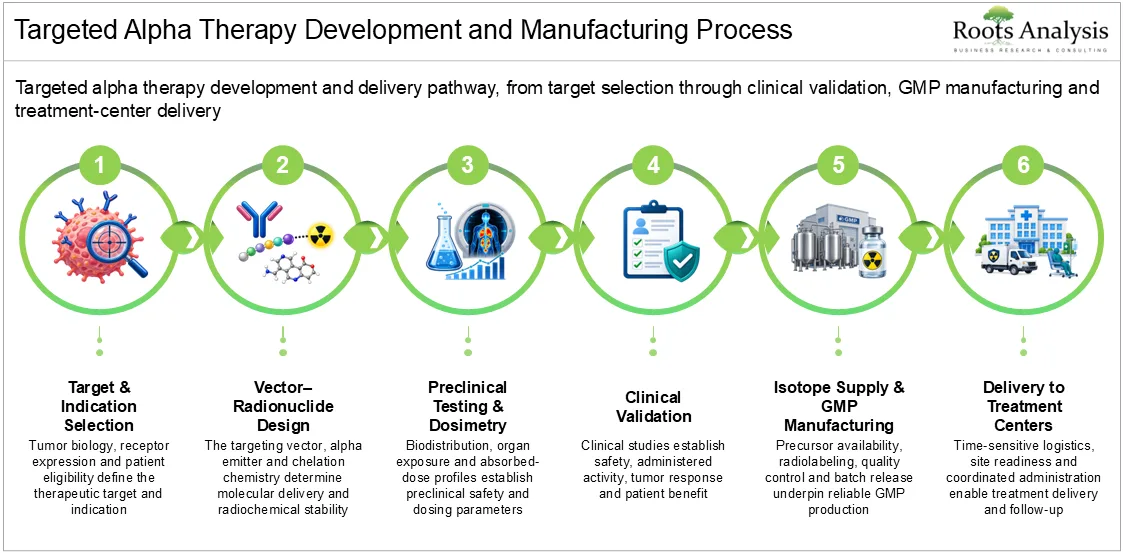
The targeted alpha therapy ecosystem spans medical isotope and precursor producers, radiopharmaceutical developers, radiochemistry and manufacturing organizations, regulators, clinical-trial networks, specialty logistics providers and authorized nuclear medicine and oncology centers. Their roles are interdependent because radionuclide availability affects manufacturing schedules, manufacturing release determines the usable delivery window, and site readiness determines whether a dose can be administered safely and on time. Ac-225 offers a longer distribution window than Pb-212, while Pb-212's shorter half-life favors closer coordination between production and treatment locations. Commercial readiness therefore depends on a connected value chain enabling reproducible dose supply and patient access.
| Lead Therapy | Developer / Collaborator | Stage of Development | Drug Designation | Type of Radionuclide | Targeting Vector | Target Indication |
| Xofigo | Bayer | Commercial / Approved | - | Ra-223 | Physiologic bone targeting | mCRPC with symptomatic bone metastases and no known visceral metastases |
| RYZ101 | Bristol Myers Squibb / RayzeBio | Phase III ACTION-1 recruiting | - | Ac-225 | SSTR-targeted peptide | SSTR-positive GEP-NET after Lu-177 SSA progression |
| AAA817 / [225Ac]Ac-PSMA-617 | Novartis | PSMAcTION Phase II/III and AcTFirst Phase III recruiting | - | Ac-225 | PSMA-targeted small molecule | PSMA-positive mCRPC after Lu-177 PSMA therapy and frontline mCRPC settings |
| AlphaMedix | Orano Med / Sanofi / RadioMedix | Phase II completed; next-study protocol finalized July 2026 | FDA Breakthrough Therapy Designation | Pb-212 | SSTR-targeted peptide | SSTR-positive unresectable / metastatic progressive GEP-NET |
| [212Pb]VMT-alpha-NET | Perspective Therapeutics | Phase I /IIa; preparing Phase III path | FDA Fast Track and European Orphan Designation | Pb-212 | SSTR2-targeted peptide | SSTR2-positive NETs / GEP-NETs |
| [212Pb]Pb-ADVC001 | AdvanCell | Phase 2 expansion | - | Pb-212 | PSMA-targeted ligand | PSMA-positive metastatic prostate cancer / mCRPC |
Abbreviations: Ac-225: actinium-225, FDA: Food and Drug Administration, GEP-NET: gastroenteropancreatic neuroendocrine tumor, Lu-177: lutetium-177, mCRPC: metastatic castration-resistant prostate cancer, NET: neuroendocrine tumor, Pb-212: lead-212, PSMA: prostate-specific membrane antigen, Ra-223: radium-223, SSA: somatostatin analog, SSTR/SSTR2: somatostatin receptor/subtype 2
Clinical development is expanding beyond the earliest Ra-223 and PSMA/SSTR programs into a wider range of alpha emitters, molecular targets and targeting vectors. Ac-225 and Pb-212 candidates are being evaluated across PSMA, SSTR2, FAP, CD33 and MC1R pathways, using antibody, peptide, small-molecule and engineered proteins. In July 2026, Blue Earth Therapeutics and University College London initiated a Phase 1 clinical trial of Ac-225 rhPSMA-10.1 in mCRPC, adding another PSMA-directed small-molecule program to the clinical landscape. Together with programs from Actinium Pharmaceuticals, Perspective Therapeutics, Ratio Therapeutics, AdvanCell and Alpha-9 Oncology, this activity shows that the field is evolving into a multi-platform clinical pipeline capable of testing alpha therapy across broader tumor biology, subject to program-specific efficacy, safety and manufacturability.
Radionuclide supply capabilities are expanding across feedstock access, medical isotope production, radiolabeling and distribution to support a growing base of clinical programs and future commercial demand. TerraPower Isotopes planned cGMP Ac-225 facility, and the NorthStar-QSA Global Ra-226 agreement illustrate efforts to increase production capacity and secure starting material, while long-term supply arrangements and Pb-212 manufacturing investments are improving continuity across therapeutic production.
In parallel, targeted alpha therapy developers are using partnerships to combine specialized capabilities that are difficult to establish independently. AdvanCell's collaboration with 48Hour Discovery and Orano Med's alliances with Molecular Partners and Roche link targeting-vector discovery with isotope access, radiochemistry and clinical development. Together, these activities are strengthening both supply reliability and development efficiency across an increasingly interconnected radiopharmaceutical ecosystem.
The growing range of targeted alpha programs is being accompanied by larger translational initiatives that combine clinical development with isotope and manufacturing capability. Australia's government-backed prostate cancer program involving AdvanCell is one example of this shift toward coordinated development infrastructure.
Anna Karmann, MD PhD, Chief Medical Officer of AdvanCell, stated in April 2025, "Targeted alpha therapies are among the most promising in oncology." Her view reflects the alpha-emitting radiopharmaceuticals' potential to extend precision radiotherapy into additional tumor settings; however, realizing that potential will depend on late-stage clinical evidence, optimized dosing, reliable radionuclide supply and treatment networks that can deliver these therapies consistently.
The targeted alpha therapy market report includes transcripts of the following third-party discussions:
Based on the research, we have segmented the TAT market into various key segments outlined below. Together, these segment views highlight the market distribution based on both the current commercial structure and the areas expected to gain importance as newer radioligand programs progress.
| Market Segments | Sub-segment Details | |
| Type of Radionuclide | Actinium-225 (Ac-225), Radium-223 (Ra-223), Lead-212 (Pb-212), Other alpha-emitting radionuclides | |
| Targeting Vector | Small-molecule ligands, Peptides, Antibodies / antibody-derived vectors, No exogenous vector / physiologic targeting, Other targeting vectors | |
| Therapeutic Area | Prostate cancer, Neuroendocrine tumors, Hematological malignancies, Other solid tumors | |
| End User | Hospitals & academic medical centers, Specialty cancer & nuclear medicine centers, Other authorized treatment facilities | |
| Geography | North America, Europe, Asia-Pacific, Rest of the World | |
Radium-223 dominates the 2026 targeted alpha therapy market revenue, driven by Xofigo's established regulatory and commercial position in mCRPC with symptomatic bone metastases. Its calcium-mimetic behavior directs activity to areas of increased bone turnover, giving Ra-223 a clinically validated role in metastatic castration-resistant prostate cancer with symptomatic bone metastases without requiring an external targeting vector. Investigational Ac-225 and Pb-212 therapies are broadening the field; however, they have not yet established comparable routine treatment use. Bayer's 2026 PEACE-3 update further illustrates continued clinical development around Ra-223 combinations, supporting an established treatment pathway that remains distinct from the still-emerging use of other alpha emitters.
Actinium-225 is the fastest-growing radionuclide, with a relatively higher post-launch CAGR through 2035. Growth is supported by late-stage programs such as RYZ101 and AAA817, a broader pipeline across PSMA, SSTR2, FAP and hematologic targets, and expanding isotope infrastructure. TerraPower Isotopes' March 2026 announcement of a cGMP Ac-225 facility designed to increase its production capacity twentyfold provides a current capacity signal supporting this trajectory. Ac-225's approximately 9.9-day half-life also provides greater manufacturing and distribution flexibility than very short-lived alpha emitters, while Pb-212 requires tighter production-to-treatment coordination because of its 10.6-hour half-life.
Hospitals and academic medical centers lead the current end-user market because targeted alpha therapy depends on multidisciplinary capabilities that are most consistently concentrated in larger institutions. Nuclear medicine expertise, oncology oversight, radiation-safety governance, dosimetry or physics support, trained staff, radioactive-material handling and clinical-trial infrastructure all influence whether complex treatment can be delivered safely. SNMMI Radiopharmaceutical Therapy Centers of Excellence criteria reflect these requirements through their emphasis on authorized users, certified nuclear medicine technologists, imaging access and radiation-safety support. Specialty and other authorized facilities may provide selected radiopharmaceutical services, but hospitals and academic centers are better equipped to manage investigational protocols, higher-acuity patients and evolving treatment requirements, sustaining their leadership during the market's early commercial phase.
Specialty cancer and nuclear medicine centers are expected to grow fastest, with a 45.9% CAGR, as radiopharmaceutical treatment becomes more standardized and delivery capabilities extend beyond academic institutions. Clearer operating protocols, supplier-supported logistics, staff training and established referral networks can allow qualified specialty sites to manage a greater share of scheduled treatment once authorization, hot-lab capability and radiation-safety systems are in place. SNMMI's registered therapy-site framework already includes community and specialty settings, showing that radiopharmaceutical therapy can extend beyond academic institutions when appropriate authorization, trained personnel and operating procedures are in place. As treatment protocols mature, specialty centers can take on more routine administration, although reliable dose delivery and continued access to specialist clinical and technical support remain important operating requirements. Hospitals are likely to retain a structural advantage for trials, high-acuity care and multidisciplinary case management.
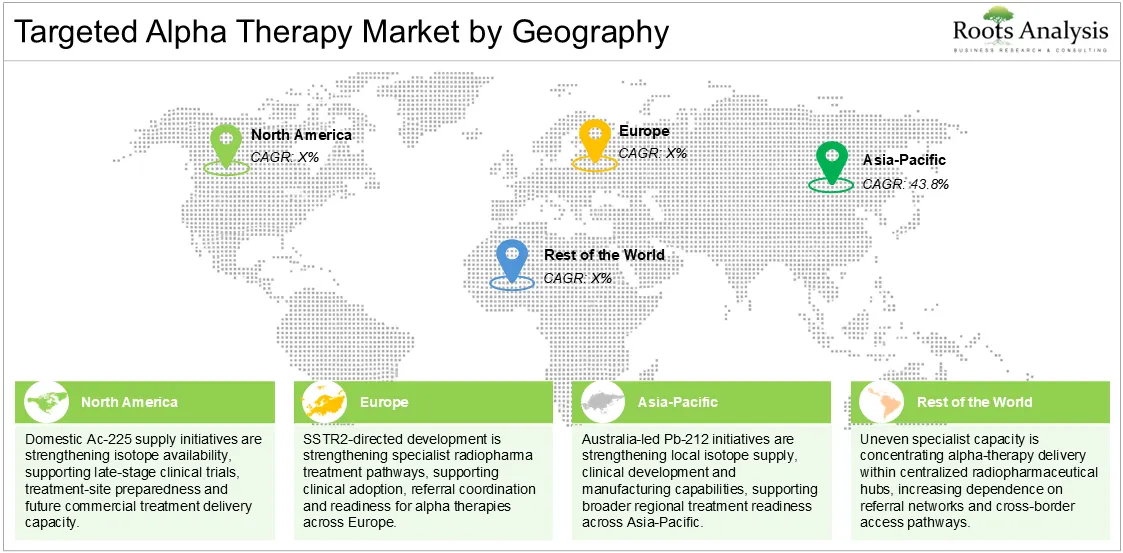
North America accounts for 43.46% of the market in 2026, supported by extensive radiopharmaceutical treatment infrastructure, concentrated late-stage clinical activity, domestic manufacturing capacity and established medical-isotope capabilities. The region also has specialist nuclear medicine and oncology centers capable of supporting complex therapeutic workflows, while ongoing isotope initiatives are strengthening domestic supply resilience. In May 2026, the US Department of Energy reported recovery of legacy Ra-226 feedstock intended to strengthen domestic medical-radioisotope supply, while, in August 2025 FDA's draft guidance on dosage optimization for therapeutic radiopharmaceutical provides greater regulatory direction on administered activity and treatment schedules. Together, these clinical, supply and regulatory capabilities provide a comparatively mature environment for conducting trials, preparing treatment sites and progressing successful alpha therapies into broader treatment use.
Asia-Pacific is projected to be the fastest-growing regional market, expanding at a CAGR of 43.8% during 2026-2035. Radiopharmaceutical treatment networks and local alpha-isotope capabilities remain less mature across several Asia-Pacific markets, allowing new clinical programs, treatment sites and domestic supply initiatives to contribute more materially to regional capacity as they develop. This progression is evident in Australia, where the Medical Research Future Fund supports a targeted alpha therapy prostate cancer program and the federal CRC-P 'Mines to Medicines' project is developing a domestic Pb-212 supply chain from thorium-228 derived from industrial waste. These initiatives demonstrate how local clinical-development activity and radionuclide production can advance in parallel, although the pace of adoption will continue to vary with reimbursement, regulatory pathways and specialist treatment-center capacity across Asian countries.
Most advanced targeted alpha programs currently rely on small-molecule ligands or peptides, clustering the late-stage activity around PSMA- and SSTR-directed disease. Antibodies, antibody-derived constructs and engineered proteins extend targeting to hematologic antigens and solid-tumor markers that are less suited to these established formats. Clinical evaluation of Ac-225-labeled lintuzumab in AML, Pb-212 pretargeted radioimmunotherapy and emerging engineered-protein approaches demonstrates this broader targeting scope. Their development requires careful alignment of circulation kinetics, marrow exposure, radionuclide half-life, dosimetry and manufacturing. These formats therefore represent an important route for extending alpha-emitting therapy into additional hematologic malignancies and solid-tumor settings beyond the indications dominating current late-stage development.
This study evaluates global revenue generated by sales of marketed and likely to be approved / commercialized targeted alpha therapeutic products. The analysis uses the proprietary Roots Analysis research framework, supported by proprietary databases and repositories, company disclosures, regulatory publications, clinical and product information, scientific literature and secondary sources. Commercial and pipeline evidence is triangulated with primary research, where applicable. Estimates and forecasts use bottom-up assessment of therapy assets, eligible treatment populations, pricing, adoption, commercialization timing and geographic access. For further details, see the complete research methodology adopted by Roots Analysis across its market reports.
| Key Report Attributes | Details | |
| Historical Trends | Since 2022 | |
| Forecast Period | Till 2035 | |
| Market Size 2026 | USD 0.20 Billion | |
| Market Size 2035 | USD 4.39 Billion | |
| CAGR (till 2035) | 41.0% | |
| Key Companies Profiled | Bayer, Bristol Myers Squibb (including RayzeBio, its wholly owned subsidiary), Novartis, Orano Med (Orano Group subsidiary), Sanofi, RadioMedix, Perspective Therapeutics, AdvanCell, Ratio Therapeutics, Actinium Pharmaceuticals, Blue Earth Therapeutics (part of the Bracco family), Alpha-9 Oncology | |
| PowerPoint Presentation (Complimentary) | Available | |
| Customization Scope | 15% Free Customization | |
| Excel Data Packs (Complimentary) |
|
|