Ulcerative Colitis Market
Ulcerative Colitis Market by Drug Class (Biologics, Amino Salicylates, Antibiotics, Corticosteroids, Immunomodulators, and Others), Disease Type (Ulcerative Proctitis, Proctosigmoiditis, Left-sided Colitis, Pancolitis or Universal Colitis, Fulminant Colitis), Route of Administration (Subcutaneous, Intravenous and Oral), Distribution Channel (Hospital Pharmacy, Retail Pharmacy and Online Pharmacy) and Geographical Regions – Trends and Forecast 2026-2035
-
Lowest Price Guaranteed
-
Slides
211 -
Last Updated
August 2026 -
View Count
9863 -
Market Size
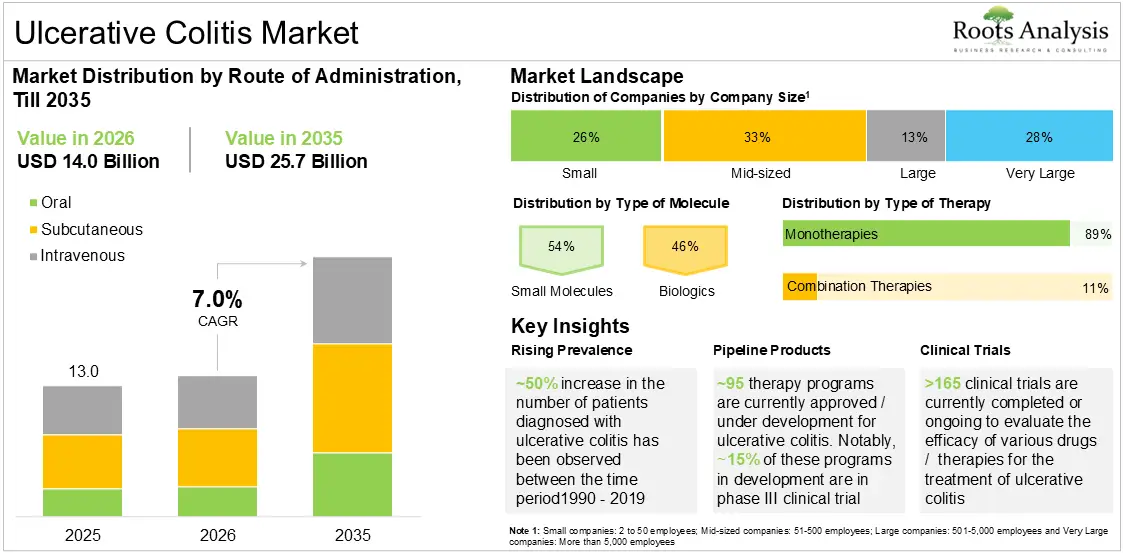
The global ulcerative colitis market size, valued at USD 13.0 billion in 2025, is projected to reach USD 14.0 billion in 2026 and USD 25.7 billion by 2035, representing a CAGR of 7.0% during the forecast period 2026 to 2035.
To learn more about this report, request a free sample copy
Market Report: Key Takeaways
Market Size & Trends
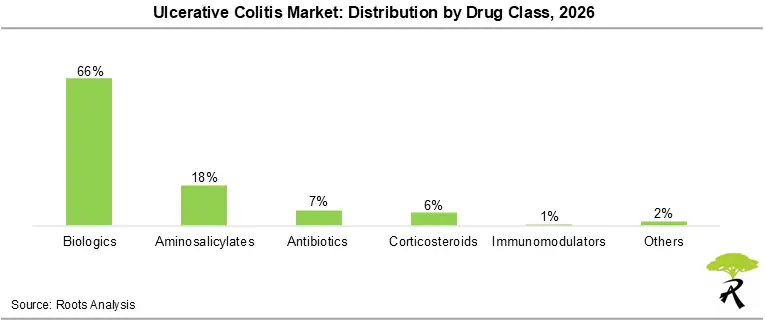
- In terms of drug class, biologics are likely to dominate the current and future market, securing the largest market share (more than 65%) by 2035.
- Based on route of administration, the subcutaneous route dominates (more than 40%) the current market; this trend is unlikely to change in the future.
- With respect to distribution channels, hospital pharmacies are expected to capture most of the future ulcerative colitis market share.
- In terms of geographical regions, North America currently holds the highest market share while Asia-Pacific is expected to grow with a higher CAGR through 2035.
Key Market Statistics
- Market Size in 2026: $14.0 Billion
- Estimated Market Size in 2035: $25.7 Billion
- CAGR (2026-2035): 7.0%
- North America: Largest market in 2026
- Asia Pacific: Fastest growing region
Market Introduction
Inflammatory bowel disease represents a group of chronic, relapsing inflammatory disorders of the gastrointestinal tract, primarily encompassing Crohn's disease and ulcerative colitis. These conditions arise from a complex interplay of genetic, environmental, and immune factors, wherein the body's immune system mistakenly attacks the intestinal lining, triggering recurrent inflammatory flares.
As one of the two primary forms of IBD, ulcerative colitis (UC) is characterized by continuous mucosal inflammation that originates in the rectum and extends proximally in a contiguous pattern throughout the colon. Unlike Crohn's disease, which can affect any segment of the gastrointestinal tract with skip lesions, ulcerative colitis is confined exclusively to the colon and rectum, presenting with symptoms including bloody diarrhea, abdominal pain, and urgency. The global prevalence of ulcerative colitis has risen substantially over the past four decades, with current estimates indicating approximately 5 million individuals affected worldwide. Notably, around 60% of these cases have been reported in North America, followed by Europe and Asia-Pacific.
Historically, ulcerative colitis treatment has relied heavily on aminosalicylates, corticosteroids, and foundational biologic therapies, such as anti-TNF agents. However, profound unmet clinical needs persist. Despite a wide array of available treatments, nearly 50% of patients fail to achieve sustained clinical remission with conventional biologics. Many experience a secondary loss of response, endure severe adverse effects, or ultimately require a colectomy due to inadequate disease control. Furthermore, access to advanced therapies remains limited in emerging markets due to cost constraints, inadequate healthcare infrastructure, and diagnostic delays, leaving a substantial proportion of the global patient population without optimal management options.
These persistent clinical gaps are catalyzing substantial innovation and investment within the global ulcerative colitis therapeutics market. The sector is undergoing a profound shift, heavily driven by the maturation of a rich clinical pipeline and a strategic transition toward highly targeted, steroid-sparing therapies. Next-generation biologics (such as IL-23 inhibitors) and novel oral small molecules (including S1P receptor modulators) are rapidly reshaping historical treatment algorithms. As pharmaceutical developers increasingly prioritize therapies that offer durable mucosal healing and patient-friendly administration routes, the UC landscape is positioned for transformative commercial growth and rapidly evolving competitive dynamics.
Market Segmentation
Based on our research, we have segmented the Ulcerative Colitis Market into drug class, disease type, route of administration, distribution channel, and geographical regions.
By Drug Class
- Biologics
- Amino salicylates
- Antibiotics
- Corticosteroids
- Immunomodulators
- Others
By Disease Type
- Ulcerative Proctitis
- Proctosigmoiditis
- Left-sided Colitis
- Pancolitis or Universal Colitis
- Fulminant Colitis
By Route of Administration
- Subcutaneous
- Intravenous
- Oral
By Distribution Channel
- Hospital Pharmacies
- Retail Pharmacies
- Online Pharmacies
By Geographical Regions
- North America
- US
- Canada
- Europe
- Germany
- UK
- France
- Spain
- Italy
- Rest of Europe
- Asia-Pacific
- China
- Japan
- Australia
- India
- South Korea
- Rest of Asia Pacific
- Middle East and Africa
- Saudi Arabia
- Israel
- United Arab Emirates
- Egypt
- Latin America
- Brazil
- Mexico
- Argentina
Ulcerative Colitis Market Key Insights
What are the Opportunities for Ulcerative Colitis Market Growth?
- Robust Pipeline of Novel Therapies: A robust late-stage pipeline is advancing for ulcerative colitis treatment, featuring multiple targeted biologics, small molecules, and advanced modalities anticipated to launch in the coming years. Some promising therapies, including Mirikizumab (Eli Lilly) and Tulisokibart (MSD), are expected to offer better efficacy, reduced steroid dependence, and improved safety, ultimately driving adoption of these therapies.
- Focus on Advanced Modalities: The continuous focus on advanced modalities, such as cell therapies, can lead to drug-free remission and outpatient administration. At present, emerging approaches in the pipeline for ulcerative colitis feature cell therapies, including mesenchymal stem cells, regulatory T cells, and CAR-T cell therapy. Notable examples of cell therapies under clinical evaluation include ABX464 (Abivax), CYP-001 (Cynata Therapeutics), and Autologous CAR-T (Hebei Senlang Biotechnology).
- Incentivization Associated with Drug Designations: Given the increasing recognition of ulcerative colitis, the drugs being developed for its treatment may qualify for incentives across various drug designations. These incentives offer user-fee exemption, tax credits, and grant funding to drug developers, thereby encouraging continued advancements of their pipeline assets. Moreover, such regulatory benefits help mitigate the high R&D costs associated with novel mechanism of action, by offering extended market exclusivity and expedited review timelines to accelerate commercialization.
- Rising Incidence and Prevalence: In the past few years, rising incidence and prevalence of ulcerative colitis have been observed globally, particularly in newly industrialized regions undergoing rapid urbanization and westernization of lifestyle. According to the US National Health and Nutrition Examination Survey (NHANES), inflammatory bowel disease, including ulcerative colitis and Crohn's disease affected an estimated 1.2% of the US population, equivalent to 2.3 million people. Within this group, ulcerative colitis alone accounted for 1% of the population, or approximately 1.9 million individuals.
What are the Factors Restraining the Growth of Ulcerative Colitis Market?
- High Treatment Costs: The high cost associated with the treatment of ulcerative colitis limits patient access and hinders adoption of advanced therapies. Biologic drugs, such as Skyrizi and Entyvio, cost tens of thousands of dollars annually, driving up healthcare expenditure and straining both patients and healthcare systems. Moreover, limited insurance coverage and reimbursement policies further lower the overall adoption of these therapies in many regions.
- Complex Diagnosis and Delayed Treatment: The challenges in the diagnosis of ulcerative colitis and delays in treatment hinder market growth. This causes irreversible bowel damage, reducing overall patient pool entering the treatment funnel. According to the Crohn's & Colitis Foundation, the broad spectrum of non-specific ulcerative colitis symptoms often mimic other conditions, resulting in an average diagnostic delay of nearly two years among adults.
- Disease Complexity and Heterogeneity: Bowel disease, including ulcerative colitis, is a highly heterogeneous autoimmune disorder with gastrointestinal involvement along with extraintestinal manifestations in joints and skin. This leads to unpredictable progression, recurrent flares, and variable severity. Such variability drives diverse patient responses to therapies, making it difficult to create universally effective therapies.
Recent Approvals for Ulcerative Colitis
| S. No. | USFDA Approval Date | Drug Name | Developer Name | Indication |
| 1 | October 2025 | Omvoh (mirikizumab) | Eli Lilly and Company | Moderately to Severely Active Ulcerative Colitis |
| 2 | September 2025 | Tremfya (guselkumab) | Johnson & Johnson | Moderately to Severely Active Ulcerative Colitis |
Application of AI for Treatment of Ulcerative Colitis
Artificial intelligence is transforming ulcerative colitis treatment through AI-powered endoscopic and histologic image analysis, enabling objective disease activity assessments and robust biomarker discovery. Further, drug developers are increasingly leveraging AI to identify novel therapeutic targets and accelerate the design of highly optimized precision drug candidates. Notable examples include Absci's ABS-101 (the first AI-designed biologic antibody for inflammatory bowel disease) and Athos Therapeutics' ATH-063 (a first-in-class G9A methyltransferase inhibitor developed specifically for biologics-resistant inflammatory bowel disease). These innovations highlight AI's dual role in both enhancing precision medicine diagnostics and rapidly generating novel therapeutic agents for ulcerative colitis.
Recent Developments in Ulcerative Colitis Market
- In June 2026, Spyre announced positive Part A induction data for SPY002, an extended half-life anti-TL1A antibody, from its Phase II SKYLINE trial for treatment of moderate-to-severe ulcerative colitis.
- In March 2026, Teva Pharmaceuticals secured USD 400 million from Blackstone Life Sciences aimed to advance the clinical development of duvakitug intended for the treatment of ulcerative colitis and Crohn's disease.
- In March 2026, Sandoz announced a partnership with Samsung Bioepis, focused on the development of five biosimilars, including vedolizumab biosimilar for the treatment of adult patients with Crohn's disease, ulcerative colitis or pouchitis.
- In August 2025, Cosmo Pharmaceuticals announced the renewal of a manufacturing and supply agreement with Takeda for the development of Mesalazine, intended for patients with ulcerative colitis.
Industry Experts on Ulcerative Colitis Market
The ulcerative colitis treatment market is projected to expand rapidly, driven by rising disease prevalence and lack of effective treatment options. Validating this trend, Dr. Robert Ehehalt (Gastroenterologist) stated that, "The inflammation of a chronic inflammatory bowel disease does not usually go away on its own. The disease is caused by polygenetic components and additional environmental components, which ultimately trigger the whole thing. Depending on the disease, the entire gastrointestinal tract can be affected, in Crohn's disease from the oral cavity to the anus, and in ulcerative colitis, the other form of IBD, only the large intestine is affected."
Discussions with multiple stakeholders in this domain influenced the opinions and insights presented in this study. The market report includes transcripts of the following third-party discussions:
- Founder, Public Hospital, US
- Gastroenterologist, Mid-sized Company, Germany
- Gastroenterologist and Head of the Clinical Pharmacology, Public University, Portugal
- Gastroenterology and Assistant Professor of Medicine, Public University, US
- Clinical Pharmacy Coordinator, Non-Profit Organization, US
- Gastroenterologist, Public Hospital, Spain
- Gastroenterologist, Public Hospital, Germany
- Gastroenterologist, Public Hospital, US
- Gastroenterologist, Public University, US
- Assistant Professor, Public University, US
Market Share Insights
Which Type of Drug Class Accounts for the Largest Ulcerative Colitis Market Share?
- In 2035, the biologics market segment is projected to account for the highest market share (more than 65%) and is likely to grow at a relatively faster CAGR of 7.4% during the forecast period.
- It is important to note that several biologics, including Afimkibart and Tulisokibart, are currently undergoing Phase III clinical trials. Upon receiving market approval, these therapies are anticipated to achieve blockbuster status, thereby driving significant growth in the ulcerative colitis market in the coming years.
Regional Analysis: Which Regions are Showing the Fastest Growth in Ulcerative Colitis Industry?
Asia-Pacific: Likely to Grow at a CAGR of 8.7%
According to our projections, Asia-Pacific is likely to capture (~20%) of the ulcerative colitis market share in 2026 and is likely to witness the highest CAGR during the forecast period. Notably, Asian countries, such as China, Japan, India, and South Korea, collectively account for approximately 20% of global inflammatory bowel disease treatment volume.
Further, expanding healthcare infrastructure, substantial government healthcare spending, along with rising urbanization, is accelerating disease diagnosis and treatment access. Along with this, the emergence of biosimilars and localized manufacturing is effectively addressing cost-sensitive market dynamics, while substantial research and development investment by key industry players in ulcerative colitis therapies continues to drive market expansion.
What is the Market Opportunity for Hospital Pharmacies within Ulcerative Colitis Industry?
- Based on the ulcerative colitis market forecast, the hospital pharmacies are expected to occupy the largest market share in 2026. This is because hospital pharmacies serve as critical distribution channels for biologic therapies and advanced therapies requiring special handling, including cold-chain storage and prior authorization management. Additionally, the rising number of hospital admissions due to complications in ulcerative colitis, integration of specialized inflammatory bowel disease centers within hospitals, and direct interactions with pharmaceutical manufacturers for price negotiations, further drive the ulcerative colitis market.
- Further, the online pharmacies segment is expected to witness a higher CAGR of 12.4% during the forecast period. Various factors, such as increasing prevalence of telemedicine consultations, rising internet accessibility, and the growing availability of self-administered prefilled syringes and pens (such as subcutaneous formulations of vedolizumab, ustekinumab, and risankizumab) drive market growth. Additionally, competitive pricing structures, online discounts, and increasing patient comfort with mail-order pharmacy services for chronic condition medication management are driving the expansion of the ulcerative colitis market.
Which Route of Administration Accounts for the Largest Share of Market?
- In 2026, the subcutaneous route segment occupies the largest market share (more than 40%), owing to the various advantages offered by the subcutaneous route, such as increased convenience and patient adherence through self-administration at home using prefilled syringes or pens, eliminating the need for frequent hospital visits required for intravenous infusions.
- The oral medications segment is likely to witness an annual growth rate of 8.6% during the forecast period. This is a result of their non-invasive nature; convenience of drug administration and increased patient compliance as compared to other routes. It is worth highlighting that in June 2026, Abivax announced the positive results obtained from Phase III clinical trial for their oral medication, Obefazimod, in moderately to severely active ulcerative colitis.
Scope of Ulcerative Colitis Market Report
| Key Report Attribute | Details | |
| Historical Trend | Since 2023 | |
| Forecast Period | Till 2035 | |
| Market Size 2026 | $ 14.0 Billion | |
| Market Size 2035 | $ 25.7 Billion | |
| CAGR (Till 2035) | 7.0% | |
| Segments Covered |
|
|
| Key Players |
|
|
| PowerPoint Presentation (Complimentary) |
Available | |
| Customization Scope | 15% Free Customization | |