Wireless Electronic Health Records Market
Wireless Electronic Health Records Market, till 2035 - Distribution by Type of Wireless, Type of Component, Application Area, Type of Deployment, Type of Technology, Type of Specialty, End Users, Geographical Regions (North America, Europe, Asia-Pacific, Middle East and North Africa, and Latin America), and Leading Players: Industry Trends and Global Forecasts
-
Lowest Price Guaranteed
-
Slides
193 -
Last Updated
October 2026 -
View Count
10549 -
Wireless Electronic Health Records Market Overview
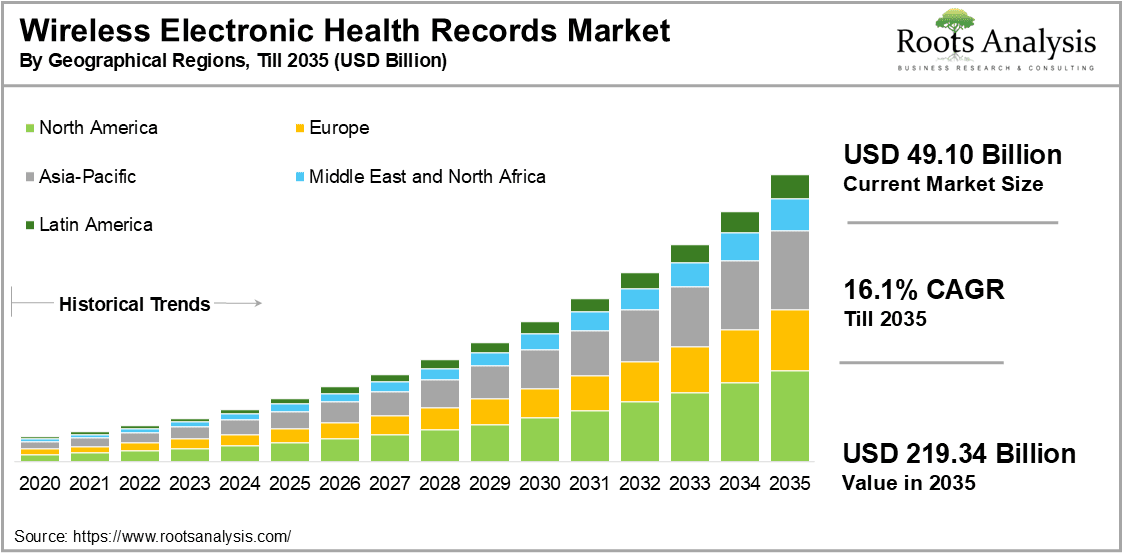
The global wireless electronic health records market, valued at USD 40.78 billion in 2024, is projected to reach USD 49.10 billion in 2025 and USD 219.34 billion by 2035, representing a CAGR of 16.1% during the forecast period.
 |
Electronic health records (EHR) system has become an integral part of healthcare sector to facilitate real-time data access. With integration of electronic health record devices, healthcare professionals can access patients’ medical history, allergies, ongoing medications, laboratory reports and treatment plans in real-time to improve patient outcomes.
Certainly, the traditional electronic health records system requires a fixed computer system and requires manual data entry to update records which leads to inefficiencies, human errors, and delay in access. Moreover, the traditional electronic health record system has interoperability problems which may create difficulties in sharing information between patients and healthcare providers. To overcome these challenges, the healthcare sector has shifted to wireless electronic health records software and devices.
Wireless electronic health records systems facilitate a seamless communication channel for sharing information to different healthcare systems without require any hardware system. Furthermore, wireless electronic health record systems offer greater flexibility to access patients’ medical EHR history from anywhere in real-time to make an informed treatment decision.
Additionally, the availability of 5G connectivity and wireless networks has further bolstered the adoption of wireless electronic health record systems. Owing to the emerging requirement, several industrial players are focusing on the development of wireless electronic health record systems with advanced automation technologies. For instance, in October 2024, Oracle revealed next-generation electronic health record platform integrated with artificial intelligence technology and maximum security to streamline information exchange between healthcare providers and payers to optimize financial performance, regulatory compliance and increase the adoption of value-based care.
Furthermore, several industrial players are focusing on strategic partnerships to accelerate the development and deployment of electronic health records. For instance, in October 2024, Ozarks Healthcare entered a strategic partnership with Avo (AvoMD) to integrate Avo’s advanced AI clinical decision support platform with its MEDITECH electronic health record system. Under this partnership, Avo’s innovative technology is to improve patient care and administrative workflow across its healthcare facilities.
Driven by ongoing initiatives, we believe that the market for wireless electronic health records is expected to grow at a steady rate during the forecast period.
Wireless Electronic Health Records Market Segmentation Insights
The market report provides comprehensive information on wireless EHR providers who are currently active across various segments of the industry as mentioned in the table below.
Wireless Electronic Health Records Market : Report Attributes / Market Segmentation
| Key Report Attributes | Details | |
| Historical Trend | Since 2020 | |
| Forecast Period | Till 2035 | |
| Market Size in 2025 | USD 49.10 Billion | |
| Market Size in 2035 | USD 219.34 Billion | |
| CAGR (till 2035) | 16.1% | |
| Type of Wireless Electronic Health Record |
|
|
| Type of Component |
|
|
| Application Area |
|
|
| Type of Deployment |
|
|
| Type of Technology |
|
|
| Type of Specialty |
|
|
| End Users |
|
|
| Geographical Regions |
|
|
| Key Companies Profiled |
|
|
| PowerPoint Presentation (Complimentary) |
Available | |
| Customization Scope | 15% Free Customization | |
| Excel Data Packs (Complimentary) |
Available | |
One of the key objectives of the wireless electronic health records market report was to estimate the current size, opportunity, and the market growth potential, over the forecast period, till 2035. We have provided informed estimates on the evolution of the market for the forecast period.
The market analysis report also features the likely distribution of the current and forecasted opportunity within the market across various segments, such as type of wireless electronic health record (wireless EHR software and wireless EHR devices), type of component (hardware, software and services), application area (hospitals, clinics, diagnostic centers, administration, radiology, nursing, laboratory and other healthcare applications), type of deployment (on-premise and cloud-based), type of technology (wireless LANs, commercial sensors, Bluetooth, radio frequency identification (RFID), satellites, WiMAX, Internet of Medical Things (IoMT), mobile health applications, and artificial intelligence and machine learning integration), type of specialty (neurology, cardiology, urology, orthopedic, pediatrics, ophthalmology, oncology, general surgery, obstetrics and gynecology, and other specialties), end users (healthcare providers, healthcare payers and patients), geographical regions (North America, Europe, Asia-Pacific, Middle East and North Africa, and Latin America) and leading players.
In order to account for future uncertainties associated with some of the key parameters and to add robustness to our model, we have provided three wireless EHR market forecast scenarios, namely conservative, base, and optimistic scenarios, representing different tracks of industry’s evolution.
All actual figures have been sourced and analyzed from publicly available information forums and primary research discussions. The financial figures mentioned in this market report are in USD, unless otherwise specified.
Wireless Electronic Health Records Market Share Insights
Market Share by Type of Product
Based on the type of product, the global market is segmented into wireless EHR software and wireless EHR devices. According to our wireless electronic health records market report, presently the wireless EHR software segment accounts for the highest share (70%) of the market. This can be attributed to the fact that wireless EHR software offers excellent interoperability with existing healthcare systems, mobile devices, and smartphone technologies. Thus, greater flexibility helps to collect vast amounts of data from anywhere in real-time, allowing healthcare professionals to design a custom treatment plan.
However, with the growing adoption of wearable technologies for the collection of health information, wireless EHR devices segment is likely to gain traction at a higher CAGR during the forecast period.
Market Share by Type of Component
This segment highlights the distribution of global market across several types of components, such as software, hardware, and services. According to our wireless electronic health records market size, presently software segment accounts for the highest share of the market. This is likely to be the result of growing acceptance of EHR software for managing patient healthcare.
Furthermore, software is easy to use and offers flexibility to use on multiple platforms which further increases its demand across the healthcare industry. Driven by the ongoing demand, this segment will continue to maintain its dominance and is poised to grow at a higher CAGR during the forecast period.
Market Share by Application Area
The global market is further bifurcated across different application areas, such as hospitals, clinics, diagnostic centers, administration, radiology, nursing, laboratory, and other healthcare applications. Presently, clinics’ segment accounts for the largest share of the wireless electronic health records market. This can be attributed to the growing usage of electronic health records to manage clinical functions, such as health information, diagnostic report result management, and decision support.
The integration of electronic health record software and platforms helps to minimize the redundancy in compiling information and accessing in real-time. Driven by the growing adoption of EHR for clinical purposes, this segment will continue to remain dominant and is likely to grow to a higher CAGR during the forecast period.
Market Share by Type of Deployment
Based on the type of deployment, the global market is segmented into on-premises and cloud-based. According to our wireless electronic health market analysis, currently cloud-based deployment accounts for the highest share of the market. This can be attributed to the fact that cloud-based deployment offers flexibility, cost-effectiveness and allows remote access to patient information, empowering healthcare providers in analyzing data in real-time. Owing to flexibility and higher adoption, this segment is expected to register a higher CAGR during the forecast period.
Market Share by Type of Technology
Based on the type of technology, the global market is categorized across wireless LANs, commercial sensors, Bluetooth, radio frequency identification (RFID), satellites, WiMAX, Internet of Medical Things (IoMT), mobile health applications, and artificial intelligence and machine learning integration (deep learning). According to our wireless electronic health records market size, presently the wireless LANs segment occupies the highest share of the market. This can be attributed to the growing adoption of location-based healthcare services, handheld devices and remote patient monitoring devices that demand wireless LANs network for information exchange.
Additionally, wireless LANs can easily deploy across healthcare software and systems so healthcare teams can access information easily. It is worth mentioning that this segment will continue to maintain dominance and is projected to register a higher CAGR during the forecast period.
Market Share by Type of Specialty
The global market is distributed across different type of specialties, such as neurology, cardiology, urology, orthopedic, pediatrics, ophthalmology, oncology, general surgery, obstetrics and gynecology, and other specialties. According to our projection, the cardiology segment is dominating the wireless electronic health records market, and the trend of dominance is likely to remain unchanged during the forecast period. The rising prevalence of cardiovascular disorders across the globe and adoption of remote patient monitoring devices to provide accurate information about patient’s health has bolstered the demand for wireless electronic health records. It is worth mentioning that the data generated using wireless electronic health records help healthcare professionals in planning treatment to manage cardiovascular disorders.
It is worth mentioning that the oncology segment is likely to grow at a higher CAGR during the forecast period. This can be attributed to the growing research on oncology and rising incidence of cancer that necessitated the demand for advanced data management solutions for real-time analysis and treatment planning.
Market Share by End User
Based on the end user, the global market is segmented into healthcare providers, healthcare payers and other end users. According to wireless electronic health records market report, presently the healthcare provider’s segment holds the highest share of the market. This dominance is likely to be the result of widespread adoption of wireless electronic health records by healthcare providers to manage patient data.
Additionally, the growing trend of devices for remote patient monitoring, handheld diagnostic devices and telehealth services has further fueled the demand for wireless electronic health records in hospital settings. Driven by the growing adoption of wireless electronic health records in hospitals, this segment is likely to maintain dominance and grow at a higher CAGR during the forecast period.
Market Share by Geographical Regions
Based on the geographical regions, the global market is distributed across North America, Europe, Asia-Pacific, Middle East and North Africa, and Latin America. Presently North America accounts for the highest wireless EHR market share (35%). This dominance is due to the growing adoption of digital technologies in the healthcare sector to streamline administrative workflow, patient disease monitoring, and telehealth consultation to manage diseases remotely.
In Asia-Pacific, the market for wireless electronic health records is likely to grow at a higher CAGR during the forecast period. This can be attributed to the increasing expenditure on healthcare IT infrastructure and adoption of advanced technologies for managing patient data to make an informed treatment decision.
Wireless Electronic Health Records Market Dynamic Insights
The “Wireless Electronic Health Records Market: Industry Trends and Global Forecasts, till 2035” market report features an extensive study of the current market landscape, market size, market share, market growth, market trends, market value, market forecast, market outlook, statistics, and future opportunities for wireless EHR providers. The market research report lays emphasis on the wireless electronic health records products and technologies that are being developed. Key takeaways of the market report are briefly discussed below.
Wireless Electronic Health Records Market Competitive Landscape
Currently, the market landscape for wireless EHR providers is witnessing a wide array of well-established and new entrants. Notably, the market players, such as Oracle, Medtronic and GE Healthcare are leveraging strategic initiatives to strengthen their product portfolio and enhance their global reach. Moreover, several small, mid-sized and large companies are taking advantage of collaborations and partnerships to drive the development of next-generation wireless electronic health record software, systems, and platforms. For instance, in October 2024, Net Health and Tali announced a strategic technology partnership to combine Net Health EHR software with Tali’s voice-enabled AI assistance.
This revolutionary integration helps to enhance accuracy and efficiency in managing EHR documentation. Similarly, several industrial players are focusing on integrating advanced EHR solutions, which are expected to maintain competitiveness over the forecast period.
Wireless Electronic Health Records Market Drivers : Rising Adoption of Digital Technologies, such as Mobile EHR Solutions for Cardiology Clinics and Prevalence of Chronic Conditions
Some of the notable wireless EHR market drivers are growing adoption of digital technologies, acceptance of wearable devices for health parameters information collection and prevalence of chronic conditions. Notably, healthcare professionals are adopting digital healthcare solutions to manage chronic conditions remotely with a real-time analysis approach.
Additionally, the growing focus on delivering value-based care / point-of-care to the patients has further necessitated the demand for wireless electronic health record for accessing to patient health information remotely and make an informed treatment decision. Furthermore, the favorable government policies to accept digital healthcare technologies for delivering optimal care to patients is another key driver for the market.
Wireless Electronic Health Records Market Challenges : Data Security and Privacy Concerns
Although the wireless EHR market is witnessing an upward trajectory, there are several challenges that need to be addressed. Some of the major concerns are patient data privacy and security concerns. It is worth noting that the wireless electronic health record utilizes wireless LANs, Internet of Things, and internet networks. These open networks raise concerns of patient data security and privacy concerns. According to the HIPAA Journal report, in April 2025, around 1,90,000,000 individuals have been affected by data hacking and IT incidents.
Driven by the growing concern, there is a requirement for advanced healthcare cybersecurity measures to ensure data security and safety during transmission from one person to another.
Wireless Electronic Health Records Market Trends : AI Technology, Cloud Computing, and Improved Cybersecurity Measures
Some of the top trends that are accelerating market growth include adoption of AI technology to enhance automation in data management and collection. Furthermore, the growing integration of cloud computing solutions in wireless electronic health records software and platforms to enhance data access and storage offer enormous opportunities to develop advanced cloud computing solutions for electronic health record software and platforms. Additionally, the market players are focusing on integrating advanced cyber security measures, such as zero factor authentication and multiple factor authentication to improve security and safety of patient data.
Wireless Electronic Health Records Market Size Analysis
The global wireless electronic health records industry is estimated to be valued at USD 49.10 billion in 2025 and is projected to reach USD 219.34 billion by 2035, representing a CAGR of 16.1% during the forecast period. This unprecedented growth is likely to be the result of growing shift towards digital technologies to collect patient data to make an informed decision.
It is worth mentioning that the industrial players are focusing on the development of advanced wireless electronic health record software and platforms. For instance, in September 2024, Avo launched Ask Avo (the first-of-its-kind), customizable AI consulting tool that can easily integrated with electronic health record systems to leverage patient data to help clinicians in responding to relevant clinical questions, analyze care gaps analysis, patient medical history before visit, and more.
Leading Wireless EHR Providers in this Domain
Examples of key players engaged in this domain (which have also been captured in this report) include Abbott Laboratories, GE Healthcare, Honeywell International, Johnson & Johnson, Medtronic, Oracle Health, Philips, Roche, St. Jude Medical Schiller (Part of Abbott), Siemens Healthcare, Veradigm (Allscripts Healthcare Solutions) and Welch Allyn. This market report includes an easily searchable excel database of all the companies focusing on the development of wireless electronic health records.
Wireless Electronic Health Records Market Report Coverage
The market report presents an in-depth analysis, highlighting the capabilities of various companies engaged in this domain across different segments. Amongst other elements, the market report includes:
- A preface providing an introduction to the full report, Wireless Electronic Health Records Market, 2020-2024 (Historical Trends), and Future Forecast till 2035 (Forecasted Estimates).
- An outline of the systematic research methodology adopted to conduct the study on the market for wireless electronic health records, providing insights on the various assumptions, methodologies, and quality control measures employed to ensure the accuracy and reliability of our findings.
- An overview of economic factors that impact the global wireless electronic health records market, including historical trends, currency fluctuation, foreign exchange impact, recession, and inflation measurement.
- An executive summary of the insights captured during our research. It offers a high-level view of the current state of the wireless electronic health records industry and its evolution in the mid-and long-term.
- A detailed assessment of the wireless EHR providers landscape is based on several relevant parameters, including years of experience, company size, headquarters location, and ownership structure.
- Elaborated profiles of prominent players engaged in offering wireless electronic health records, featuring information on their year of establishment, location of headquarters, company size, company mission, company footprint, management team, contact details, financial information, operating business segments, wireless electronic health records product portfolio, recent developments, and an informed future outlook.
- A discussion on affiliated trends, key drivers, and challenges under a SWOT framework, which is likely to impact the industry's evolution, along with a Harvey ball analysis, highlighting the relative effect of each SWOT parameter on the overall wireless electronic health records industry.
- A market impact analysis features a discussion on the factors that can impact the wireless electronic health records market growth.
- A detailed estimate of the current market size and the future growth potential of the wireless EHR market over the next decade. Based on multiple parameters, we have provided an informed estimate of the market's evolution during the forecast period till 2035. The report also features the likely distribution of the current and forecasted opportunities within the wireless electronic health records industry. Further, in order to account for future uncertainties and to add robustness to our model, we have provided three forecast scenarios, namely conservative, base, and optimistic scenarios, representing different tracks of the industry’s growth.
- Detailed projections of the current and future market for wireless electronic health records across various types of electronic health record, including wireless EHR software and wireless EHR devices.
- Detailed projections of the current and future wireless electronic health records market size across various types of components, including hardware, software, and services.
- Detailed projections of the current and future wireless EHR market size across various application areas, including hospitals, clinics, diagnostic centers, administration, radiology, nursing, laboratory, and other healthcare applications.
- Detailed projections of the current and future wireless electronic health records industry across various types of deployment, including on-premises and cloud based.
- Detailed projections of the current and future market for wireless electronic health records across various types of technology, including wireless LANs, commercial sensors, Bluetooth, radio frequency identification (RFID), satellites, WiMAX, Internet of Medical Things (IoMT), mobile health applications, and artificial intelligence and machine learning integration.
- Detailed projections of the current and future global wireless electronic health records market across various types of specialties, including neurology, cardiology, urology, orthopedic, pediatrics, ophthalmology, oncology, general surgery, obstetrics and gynecology, and other specialties.
- Detailed projections of the current and future wireless EHR market across various types of end user, including healthcare providers, healthcare payers and patients.
- Detailed projections of the current and future market for wireless electronic health records across various key geographical regions, such as North America (US, Canada and Mexico), Europe (France, Germany, Italy, Spain, UK and Rest of Europe), Asia-Pacific (China, India, Japan, South Korea, and Rest of the Asia-Pacific), Middle East and North Africa (Egypt, Saudi Arabia and UAE), and Latin America (Argentina and Brazil).
Recent Developments in Wireless Electronic Health Records Market
Several recent developments have taken place in the field of wireless electronic health records. We have outlined some of these recent initiatives below.
- In October 2024, athenahealth introduced athenaOne for Orthopedics (an EHR, revenue and practice management, and patient engagement solution) specifically designed to meet unmet requirement of orthopedists.
- In October 2024, eClinicalWorks announced the launch of healow® Genie (first-of-its-kind, fully HER-integrated AI powered contact center solution). This latest solution helps to connect patients with the information and healthcare assistance they need via voice call, chatbot, and text.
- In May 2024, Fusion Health announced a landmark contract with the Illinois Department of Corrections (IDOC). Under this agreement, Fusion Health will implement an industry-leading FusionEHR platform at all 29 state-run correctional facilities.
- In March 2024, Health Information Management Systems launched AxiomEHR (AI-powered electronic health record solution) that helps to make data-based treatment decisions, offer flexible care coordination and drive quality-based care.