Software Defined Radio Market: Industry Trends and Global Forecasts, Till 2035 - Distribution by Type of Radio (Adaptive Radio, Cognitive/Intelligent Radio, General Purpose Radio, Joint Tactical Radio System, and Terrestrial Trunked Radio), by Type of Component (Hardware, Software), by Type of Frequency Band (HF, UHF, and VHF), by Type of Platform (Airborne, Ground, Naval and Space), by Areas of Application (Commercial and Military & Defense), by Type of Enterprise (Large Enterprises, Small and Medium Enterprises (SMEs)), and Key Geographical Regions
Software Defined Radio Market Size
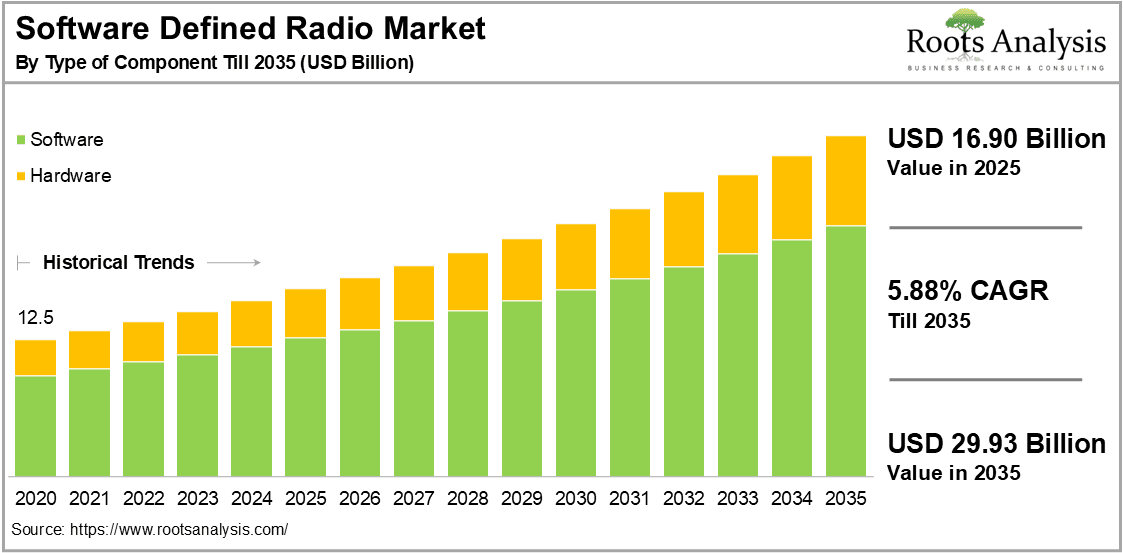
The global software defined radio market, valued at USD 15.9 billion in 2024, is projected to reach USD 16.9 billion in 2025 and USD 29.93 billion by 2035, representing a CAGR of 5.88% during the forecast period.
See What’s in the Full Report - Request Your Complimentary Insights!
The new research study consists of detailed analysis, mega trends, patent analysis, porter five forces, SWOT analysis, value chain analysis and other strategic frameworks.
Software defined radios (SDR) are a collection of software and hardware technologies where a number of radio operating functions are implemented through firmware or modifiable software operating across programmable processing technologies. SDRs include analog to digital and digital to analog converters, mixer, antenna, filter, digital signal processing technology, application-specific integrated circuit, field-programmable gate arrays (FPGA), a general-purpose processor, and software.
The future trends in wireless communication and SDR solutions, including 5G, IoT, and satellite communication , are what’s fueling the market. SDRs offer flexibility to support multiple communication standards with the help of software-based modulation techniques. This makes them an ideal choice for diverse applications in telecommunications.
In addition to this, there is a growing emphasis on interoperability among different communication systems. SDRs are designed to facilitate seamless integration with both legacy and modern communication networks, enhancing operational effectiveness, which is further driving the adoption of market growth.
Your Business is Unique – Why Shouldn’t Your Report Be?
Software Defined Radio Market Segmentation Insights
The software defined radio industry report presents an in-depth analysis of the various companies that are involved in offering, software defined radio solutions across different segments, as defined in the table below:
Software Defined Radio Market: Report Attributes / Market Segmentations
| Key Report Attributes | Details | |
| Historical Trend | Since 2020 | |
| Forecast Period | Till 2035 | |
| Market Size 2025 | $ 16.9 Billion | |
| Market Size 2035 | $ 29.93 Billion | |
| CAGR (Till) 2035 | 5.88% | |
| Type of Radio |
|
|
| Type of Component |
|
|
| Type of Frequency Band |
|
|
| Type of Platform |
|
|
| Areas of Application |
|
|
| Type of Enterprise |
|
|
Geographical Regions |
|
|
| Leading Market Players |
|
|
| PowerPoint Presentation (Complimentary) |
Available | |
| Customization Scope | 15% Free Customization | |
| Excel Data Packs (Complimentary) |
|
|
Have Questions? Let’s Get Them Answered.
What Are the Key Segments of the Software Defined Radio Industry?
The key segments for the software defined radio industry are defined as below-
Market Share by Type of Radio
The market is segmented into various types of radios such as adaptive radio, cognitive/intelligent radio , general purpose radio, joint tactical radio system, and terrestrial trunked radio.
According to our global software defined radio market analysis, the joint tactical radio system is set to take the lead with the largest market share of over 34.56% by the next decade. The impact of military spending on the software defined radio is fueling the market growth as these machines play a critical role in this sector’s applications. JTRS are responsible for providing secure, interoperable communication across various platforms, enabling real-time data sharing among allied forces and enhancing operational effectiveness. Further, the increase in demand for seamless, adaptable communication in defense, especially with rising geopolitical tensions, has led to heavy investments in JTRS, making it a priority for defense agencies worldwide, which is in return fueling the JTRS market.
Market Share by Type of Component
The market is segmented into various types of components such as hardware and software. According to our software defined radio growth forecast, the services segment is expected to see the fastest growth (7.78%) in the forecasted period, thanks to their ability to keep the SDR systems up to date with new software capabilities and in sync with shifting standards.
The complexity of SDR systems, especially as they evolve to meet diverse needs across defense, telecom, and industrial IoT, is further fueling the demand for specialized services. Further, as the organizations expand their SDR applications, the need for consulting, training, and technical support intensifies, which in return, drives the segment growth.
Market Share by Type of Frequency Band
The market is fragmented into various types of frequency bands, namely HF, UHF, and VHF. According to our software defined radio industry analysis, this high frequency (HF) segment will increase the market share by 72.34% during the forecast period. The increasing traction of this segment is largely due to the important role these frequencies play for long-range communication capabilities, particularly in the military software defined radio market, maritime, and aviation sectors.
HF signals travel vast distances by reflecting off the ionosphere, which is essential for operations in remote or international settings where satellite communication may not be possible. This capability makes HF SDR systems highly valuable for defense, where secure, reliable, and global communication is needed, as well as for emergency response and rural infrastructure projects. These versatile and resilient properties of high frequency SDR systems are fueling market growth.
Market Share by Type of Platform
The market is fragmented into various types of platforms, namely airborne, ground, naval and space. According to our global software defined radio market forecast, the ground segment will increase the market share by 62.34% during the forecasted period. The increasing traction of this segment is largely due to the adaptability and scalability ground-based SDR systems provide. These properties are of utmost importance in applications such as base stations, emergency response networks, and military command centers which require reliable, high-capacity communication solutions. The demand for resilient, multi-frequency communication systems has been especially high in defense and emergency services, where ground SDRs provide interoperability and quick adaptation to changing operational requirements as well as military communications technology.
Market Share by Areas of Application
The market is fragmented into various software defined radio applications, namely commercial and military & defense. According to our analysis, the commercial segment will see the fastest growth (6.78%) during the forecast period. The increasing traction of commercial software defined radio market is largely due to the scalability and support SDRs offer for multiple communication standards, making them ideal for commercial applications that need to adapt to evolving connectivity requirements. For instance, SDRs make network upgrades as easy and smooth as possible in the telecom industry, such as the transition to 5G. Here, they enabled the equipment to handle different protocols through software updates rather than costly hardware changes.
Market Share by Geographical Regions
According to our regional analysis, Asia currently exhibits dominance with 37.69% software defined radio market share. This dominance is largely due to the growing tension among major economies, which is leading to higher expenditure on defense for enhancing social awareness. Military modernization initiatives prioritize adaptable communication systems, aligning with SDR’s capabilities. A big chunk of the investments is being directed towards modernizing the land, air, and sea platforms. In addition to this, investments are also being directed towards procuring advanced communication systems that are bound to enhance the battlefield capabilities and situational awareness of the military personnel .
See What’s in the Full Report – Request Your Complimentary Insights!
Software Defined Radio Market Trends and Key Insights
The “Software Defined Radio Market, Till 2035: Industry Trends and Global Forecasts” report features an extensive study of the current market landscape, market size and future opportunity within market forecast period. The market report highlights the efforts of several stakeholders involved in this rapidly emerging segment of the service providers industry. Key takeaways of the global software defined radio industry report are briefly discussed below.
What are the Key Drivers for Software Defined Radio Adoption?
The software defined radio technology market is being driven by several key factors that make it increasingly appealing across various sectors. One major driver is the flexibility and upgradability of SDRs; they can be easily updated through software changes, allowing users to adapt to new communication standards without needing to replace hardware. This not only saves costs but also extends the lifespan of the equipment.
Additionally, there's a growing demand for interoperability, as organizations seek solutions that can seamlessly communicate across different devices and networks. The rise of advanced communication technologies like 5G and the Internet of Things (IoT) further fuels this trend, as SDRs are well-suited to handle multiple protocols and frequencies.
What Strategies Are Companies Using to Gain Software Defined Radio Market Share?
Companies in the software defined radio industry are using smart strategies to stay ahead. Big players are focusing on partnerships, acquisitions, joint ventures, and innovations to strengthen their position while also investing in R&D to bring innovative and novel products to the market. Launching new technologies and expanding into regions where the adoption of SDRs is growing are key moves helping them capture more market share.
For instance, in October 2024, BAE Systems was awarded a contract worth USD 460 million by the US Army to provide multi-mode aviation radio sets, which are essential for enhancing communication capabilities in military operations. In reference to this, Amber Dolan, director of Adaptive Communications and Sensing at BAE Systems stated that this airborne radio design will enable the U.S. Army to upgrade their rotary-wing fleet with the latest secure waveform that can be tailored for each mission for years to come.
What Are the Challenges Facing the Software Defined Radio Market?
Despite the strong market growth projection, there are several challenges facing the players active in the software defined radio industry. One of the biggest hurdles is the high upfront cost related to the development, deployment and maintenance of SDR systems, which can specifically affect the adoption of SDRs by SMEs. Additionally, cyber security risks pose a major concern, as SDRs rely heavily on software-based processing, making them easier to hack and interfere with the signal. Moreover, the demand for skilled professionals to manage these advanced systems adds another layer of difficulty .
Unlock Deeper Insights – Schedule Your Personalized Workshop Today!
Who are the Key Players in Software Defined Radio Market?
Examples of leading software defined radio manufacturers (which have also been captured in this market report, arranged in alphabetical order) include Analog Devices, Anaren, Aselsan, BAE Systems, Collins Aerospace, Data Device, DataSoft, Elbit Systems, General Dynamics, Harris, Huawei, Indra Sistemas, L3Harris, Leonardo, Microchip Technology, National Instruments, Northrop Grumman, Renesas Electronics, Rockwell Collins, Rohde & Schwarz, RTX, STMicroelectronics, Texas Instruments, Thales Group, Ultra Electronics, Viasat, ZTE.
What Are the Latest Innovations in Software Defined Radio Industry?
- In February 2025, Comtech launched industry-first multipath radio platform (MPR). MPR is the first-of-its-kind terrestrial high data rate over the horizon integrated radio, which is designed to empower first responders, warfighters, and commercial operators with new high data rate communications capabilities on a single antenna agnostic platform.
- In June 2024, L3Harris Technologies, secured a significant order from the U.S. Marine Corps for multi-channel handheld and vehicular radio systems valued at over USD 120 million, raising total program orders to more than USD 600 million.
- In May 2024, Collins Aerospace delivered the first TruNet TM AR-1500 networked communications airborne radio to the Polish Ministry of Defense for its C-130H Hercules fleet. This software defined radio is designed to provide secure communication capabilities in line with NATO standards.
Glossary of Software Defined Radio Market
- Analog to Digital Converter (ADC): A device that converts analog signals into digital form for processing by a computer or digital signal processor.
- Cognitive Radio: An advanced form of SDR that can intelligently detect available channels in a wireless spectrum and adapt its transmission parameters accordingly.
- Digital Signal Processor (DSP): A specialized microprocessor designed for the efficient processing of digital signals, used in SDR systems to perform complex computations quickly.
- Interoperability: The ability of different systems or devices to work together seamlessly, which is a key advantage of SDR technology.
- Modulation: The process of varying one or more properties of a carrier signal (such as amplitude, frequency, or phase) to encode information for transmission.
- Software-Defined Radio (SDR): A radio communication system where traditional hardware components (like mixers and amplifiers) are replaced or supplemented by software, allowing for flexibility and adaptability in communication protocols.
- Waveform: The shape and form of a signal wave, which can be modified to carry different types of information in communication systems.
Software Defined Radio Market Report Coverage
The market report presents an in-depth analysis, highlighting the capabilities of various companies engaged in this domain, across different segments. Amongst other elements, the market report includes:
- A preface providing an introduction to the full report, software defined radio market, 2020-2024 (Historical Trends) and 2025-2035 (Forecasted Estimates).
- An outline of the systematic research methodology adopted to conduct the study on the software defined radio software and hardware, providing insights on the various assumptions, methodologies, and quality control measures employed to ensure the accuracy and reliability of our findings.
- An overview of economic factors that impact the overall software defined radio industry, including historical trends, currency fluctuation, foreign exchange impact, recession, and inflation measurement.
- An executive summary of the insights captured during our research. It offers a high-level view of the current state of the software defined radio market and its likely evolution in the mid-long term.
- A detailed assessment of the software defined radio companies landscape, based on several relevant parameters, including year of experience, company size, location of headquarters, and ownership structure.
- Elaborate profiles of prominent software defined radio companies, featuring information on their year of establishment, location of headquarters, company size, company mission, company footprint, management team, contact details, financial information, operating business segments, software defined radio market portfolio, moat analysis, recent developments, and an informed future of software defined radio.
- A qualitative assessment of the various megatrends ongoing in the software defined radio market, including growth in wireless communication technologies, demand for interoperable communication solutions and integration with artificial intelligence.
- An analysis highlighting the key unmet needs across software defined radio market industry, featuring market research on software defined radio generated from real-time data on unmet needs as identified from social media posts, recent publications, industry blogs and the views of key opinion leaders expressed on online platforms.
- An in-depth analysis of various patents that have been filed / granted related to software defined radio and its components, based on various parameters, such as type of patent, patent publication year, patent age and leading players.
- A detailed analysis of recent developments in the software defined radio industry, based on relevant parameters such as year of initiative, type of initiative (partnerships and collaborations, expansions, funding and product launches), geographical distribution and most active players (in terms of number of recent developments).
- Key winning strategies framework that helps in analyzing the level of competition within an industry, by tracing the key market activities including partnership, funding, expansion of leading players.
- A qualitative analysis, highlighting the five competitive forces prevalent in software defined radio industry, including threats for new entrants, bargaining power of suppliers, bargaining power of customers, threats of substitution and rivalry among existing competitors.
- A discussion on affiliated global SDR technology trends, key drivers and challenges, under a SWOT framework, which are likely to impact the industry’s evolution, along with a Harvey ball analysis, highlighting the relative effect of each SWOT parameter on the overall software defined radio market.
- A value chain analysis featuring a discussion on various stakeholders involved in the development of the software defined radio software and hardware, from suppliers to end-users.
- A detailed estimate of the current market size and the potential future of software defined radio industry over the next decade. Based on multiple parameters we have provided an informed estimate on the market evolution during the forecast period 2025-2035. The report also features the likely distribution of the current and forecasted opportunity within the software defined radio market. Further, in order to account for future uncertainties and to add robustness to our model, we have provided three forecast scenarios, namely conservative, base, and optimistic scenarios, representing different tracks of the industry’s growth.
- Detailed projections of the current and future market across various types of radio such as adaptive radio, cognitive/intelligent radio, general purpose radio, joint tactical radio system, and terrestrial trunked radio.
- Detailed projections of the current and future market across various types of component such as hardware and software.
- Detailed projections of the current and future market across various types of frequency band, namely HF, UHF, and VHF.
- Detailed projections of the current and future market across various types of platform, namely airborne, ground, naval and space.
- Detailed projections of the current and future market across various areas of application, namely commercial and military & defense.
- Detailed projections of the current and future market across two types of enterprises, namely large enterprises and small and medium enterprises.
- Detailed projections of the current and future software defined radio market across various geographical regions, such as North America (US, Canada, Mexico and other North American countries), Europe (Austria, Belgium, Denmark, France, Germany, Ireland, Italy, Netherlands, Norway, Russia, Spain, Sweden, Switzerland, UK and other European countries), Asia (China, India, Japan, Singapore, South Korea and other Asian countries), Middle East and North Africa (Egypt, Iran, Iraq, Israel, Kuwait, Saudi Arabia, UAE and other MENA countries), Latin America (Brazil, Chile, Colombia, Venezuela and other Latin American countries) and rest of the world (Australia, New Zealand and other countries).
Want Information on Specific Region / Segment?
Customization Opportunities
At Roots Analysis, we genuinely care about your success and understand that your business requirements are unique. While our software defined radio industry report provides valuable insights, we recognize that they might not cover every aspect you need to make well-informed strategic decisions. To account for that, we offer 10% free report customization tailored to your specific needs. Whether you require additional quantitative analysis, qualitative insights, or any other information related to the software defined radio market, reach out us today at: support@rootsanalysis.com


