


 Download Free Sample
 Buy Now
Technical Ceramics Market Overview
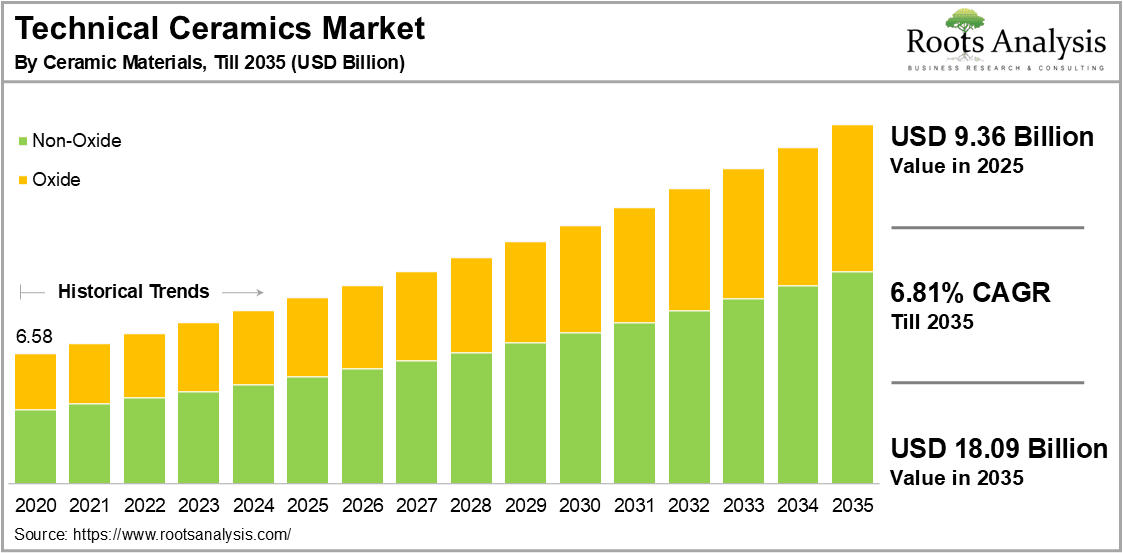
The global technical ceramics market size is expected to rise from USD 9.36 billion in 2025 to USD 13.90 billion by 2030, and USD 18.09 billion by 2035, representing an overall CAGR of 6.81% till 2035.
See What’s in the Full Report – Request Your Complimentary Insights!
Technical ceramics, also known as advanced or engineering ceramics, are a class of inorganic, non-metallic materials specifically designed for demanding technical applications. Unlike traditional ceramics, which are often used for decorative or structural purposes, technical ceramics are engineered for their exceptional mechanical, thermal, electrical, and chemical properties.
What sets technical ceramics apart is their ability to maintain high performance in environments where conventional materials fail. Their extreme hardness, often more than four times that of stainless steel, translates into outstanding wear resistance and longevity in service. This makes them indispensable in sectors such as aerospace, automotive, electronics, and medical devices, where reliability and durability are paramount.
Moreover, the ability to tailor the chemical composition and processing conditions means that technical ceramics can be optimized for unique challenges, whether it’s providing insulation in high-voltage electronics or serving as protective coatings in harsh industrial environments.
As the technical ceramics market demand for high-performance, sustainable materials grows, technical ceramics are poised to play a pivotal role in the next generation of industrial innovation. In fact, Phil Green, Sales Director, IPS Ceramics states that, just 5 years ago sales of technical ceramics accounted for 5% of their turnover. Today, that proportion has risen to 20% which is a testament to the continuous growth and profitability of this sector.
Recent Developments in the Technical Ceramics Market
- In June 2025, Jewelry and watch association partnered with Ceramitec to drive industry innovation, aimed at expanding the event’s reach into the jewelry and watch sectors.
- In May 2025, The AMRICC Academy launched a new educational hub to champion ceramics skills for the future, addressing emerging industry challenges and tackling a skills gap in both traditional and advanced ceramic materials.
- In March 2025, Corning launched Corning Gorilla Glass Ceramic to expand its renowned portfolio of tough cover materials. Chinese smartphone manufacturer Motorola is set to become India's first brand to launch a smartphone featuring this display protection.
- In March 2025, Lithoz announced the launch of LithaBite for translucent orthodontic ceramic brackets, at this year’s IDS 2025 dental industry trade fair that took place in Cologne, Germany.
- In January 2025, Samsung Galaxy S25 Ultra introduced the Corning Gorilla Armor 2, industry’s first anti-reflective glass ceramic for mobile devices.
Technical Ceramics Market Segmentation Insights
The technical ceramics market report 2025 presents an in-depth analysis of the various companies that are involved in offering technical ceramics solutions, across different segments, as defined in the table below:
Technical Ceramics Market: Report Attributes / Market Segmentations
| Key Report Attributes | Details | |
| Historical Trend | Since 2020 | |
| Forecast Period | Till 2035 | |
| Market Size 2025 | $ 9.36 Billion | |
| Market Size 2035 | $ 18.09 Billion | |
| CAGR till 2035 | 6.81% | |
| Type of Product |
|
|
| Ceramic Material |
|
|
| Raw Material |
|
|
| Application Area |
|
|
| End Use Industry |
|
|
| Geographical Regions |
|
|
| Leading Market Players |
|
|
| PowerPoint Presentation (Complimentary) | Available | |
| Customization Scope | 15% Free Customization | |
| Excel Data Packs (Complimentary) |
|
|
Want Information on Specific Region/Segment?
Technical Ceramics Market Share Insights
Which Type of Product Will Dominate the Technical Ceramics Market?
According to our technical ceramics market analysis, the monolithic ceramics sub-segment is set to take the lead, holding a significant share of 77.21% of the market.
The dominance of monolithic ceramics is being driven by its widespread adoption in the electronic industry. It finds applications in various electronic products, including capacitors, resistors, inductors, RF components and fuses, among others. The increasing adoption of ceramic components in electronics is leading to downsizing and improved functionality, which is a major factor driving the demand for monolithic ceramics.
However, the ceramic matrix composites (CMC) sub-segment will show robust growth at a CAGR of 6.93% during the forecast period.
How is the Non-Oxide Sub-Segment Dominating the Market?
Among various ceramic materials, the non-oxide segment really stands out as the leading one, holding a market share of 84%.
Non-oxide ceramics have a high covalence bonding content, which gives them excellent mechanical qualities even at high temperatures. As a result of their unique features, non-oxide ceramics such as silicon carbide ceramics have a wide range of applications in the automotive and technology industries, also fueling the growth of technical ceramics materials market. Rapid development in these industries as a result of technological breakthroughs has enhanced their productivity.
Which Raw Material Will have the Fastest CAGR?
Among the technical ceramics raw materials, the titanate sub-segment is set to witness the fastest CAGR (7.19%) during the forecast period.
Titanates are well known for the production of high-quality materials, including potassium titanate and sodium titanate, which are used as friction modifiers in brake pads and linings.
Additionally, the alumina sub-segment is expected to dominate the current technical ceramics market with a share of 37%.
Which Application Area Will Dominate the Technical Ceramics Market?
Of the industrial ceramics applications, the electronic devices segment is set to hold the largest current market share of around 34%.
Technical ceramics offer superior thermal and chemical properties, which have led to their extensive use in numerous applications in the electronics industry such as core materials, circuit carriers, and ceramic substrates. This has fueled the growth and adoption of technical ceramics in this sector, further contributing to the revenue share.
The bioceramics segment is expected to witness the fastest CAGR (7.31%) during the forecast period.
Which End Use Industry Will have the Fastest CAGR?
Of the end use industry, the medical sub-segment is set to witness the fastest CAGR (7.98%) during the forecast period.
Technical ceramics are effectively used in orthopedics to increase the quality of life with implant components for artificial hip joints and knee replacements. These are also employed in medical devices and equipment such as lithotripters, ultrasonic cleaners, and dental products.
The electronics & semiconductor sub-segment is expected to dominate the current market with a share of 37%.
Which Regions are Expected to See the Highest Demand for Technical Ceramics?
According to our technical ceramics market regional analysis, the Asian technical ceramics market exhibits dominance by capturing 49.86% of the overall current market share. This growth is primarily driven by rapid urbanization, a large and growing population, and strong government initiatives promoting affordable housing and infrastructure development, particularly in countries like China and India.
The region's booming construction industry, increasing demand for efficient and cost-effective building solutions, and advancements in technology such as automation and Building Information Modeling (BIM) further support its leadership position.
Have Questions? Let’s Get Them Answered.
Technical Ceramics Market Key Takeaways
The “Technical Ceramics Market: Industry Trends and Global Forecasts, Till 2035” report features an extensive study of the current market landscape, market size, and future opportunity within the global technical ceramics market, during the forecast period. The market report highlights the efforts of several stakeholders involved in this rapidly emerging segment of the service providers industry. Key takeaways of the market report are briefly discussed below.
Technical Ceramics Market Drivers and Challenges
What are the Main Drivers for Technical Ceramics Market Growth?
The technical ceramics market is experiencing robust growth due to several key drivers. Here are some significant factors contributing to this expansion:
- Growth in Electronics and Semiconductor Industry: The increasing demand for miniaturized and high-performance electronic devices drives the need for advanced technical ceramics with superior electrical insulation and thermal management properties, essential for capacitors, sensors, and circuit boards. This also fuels the advanced ceramics market.
- Automotive and Electric Vehicle Expansion: Technical ceramics are critical in automotive sensors, fuel cells, and battery components, supporting the industry's shift toward electric vehicles and stricter emission regulations by improving efficiency and durability.
- Aerospace and Defense Applications: High-temperature resistance and mechanical strength of technical ceramics make them indispensable for turbine blades, engine components, and protective coatings, fueling demand in aerospace and defense sectors.
- Medical Industry Growth: Bio-ceramics are increasingly used in implants and prosthetics due to their biocompatibility and wear resistance, supporting the expanding healthcare and medical device markets.
- Sustainability and Energy Efficiency Trends: Technical ceramics contribute to energy savings and reduced emissions in industrial processes and renewable energy systems, aligning with global environmental goals and regulatory pressures.
What are the Key Challenges in Manufacturing High-Performance Technical Ceramics?
The high-performance ceramics challenges are as follows:
- Raw Material Supply Disruptions: Geopolitical conflicts and supply chain constraints, notably due to the Russia-Ukraine war, have led to shortages and price volatility of critical raw materials like alumina and zirconia.
- High Production Costs: Complex ceramic components manufacturing processes and energy-intensive sintering increase costs, limiting adoption in price-sensitive markets.
- Technical Complexity: Achieving consistent quality and performance requires advanced technology and skilled labor, posing barriers for new entrants and smaller manufacturers.
- Environmental and Regulatory Compliance: Strict regulations on emissions and waste management impose additional costs and operational challenges on producers.
- Market Fragmentation and Competition: Numerous global and regional players intensify competition, pressuring margins and driving continuous innovation needs.
- Limited Awareness in Emerging Markets: Lack of knowledge about technical ceramics’ benefits in some regions slows market penetration and adoption.
What are the Key Drivers for Technical Ceramics Growth in Electronics and Automotive?
Growth is fueled by the miniaturization of electronic devices, demand for energy-efficient components, and the need for materials with superior thermal, electrical, and mechanical properties in both electronics and electric/autonomous vehicles.
What are the Advancements in Silicon Carbide and Zirconia Ceramics?
Recent innovations have improved the mechanical strength, thermal conductivity, and durability of silicon carbide and zirconia ceramics, expanding their use in high-stress applications such as semiconductors, energy storage, and advanced manufacturing.
What is the Role of Technical Ceramics in Renewable Energy Applications?
Technical ceramics are critical for renewable energy systems, serving in solid-state batteries, fuel cells, and thermal insulation due to their stability under extreme conditions and ability to enhance system efficiency and longevity.
What are the Leading Companies and Competitive Landscape in Technical Ceramics Market?
Technical ceramics companies are using smart strategies to stay ahead. Big players like CoorsTek, CeramTec and Kyocera are focusing on technical ceramics market opportunities in emerging economies, partnerships, acquisitions, joint ventures, and innovations to strengthen their position in the technical ceramics competitive landscape 2025 while also investing in R&D to bring innovative and novel products to the market.
Get an Instant Quote in 10 Minutes. Lowest Price Guaranteed
Technical Ceramics Market Report Coverage
The market report presents a guide to understanding different types of technical ceramics and their applications, highlighting the capabilities of various companies engaged in this domain, across different segments. Amongst other elements, the market report includes:
- An Infographic Executive Summary
- Market Landscape of Leading Players
- Company Competitiveness Analysis
- Startup Ecosystem Analysis
- Value Chain Analysis
- Company Profiles
- Key Winning Strategies
- In-depth View of Recent Developments
- Mega Trends
- Unmet Needs Analysis
- Patent Analysis
- Market Forecast and Opportunity Analysis
- Porter’s Five Forces Analysis
- SWOT Analysis`


