Electronically Scanned Arrays Market: Industry Trends and Global Forecasts, Till 2035 - Distribution by Type of Arrays (Active Electronically Scanned Array (AESA), Passive Electronically Scanned Array (PESA)), by Type of Platform (Air, Land, Marine), by Type of Array Geometry (Frequency Scanning Array, Linear Array, Planar Array), by Type of Component (Beamforming Network, Phase Shifters, Radar Data Processor, Signal Processing Module, Transceiver Module, and Other Components), by Type of Range (Long, Medium, Short) , by Type of Fit (Line Fit and Retrofit), by Type of Frequency Band (C-Band, Ka-Band, Ku-Band), by Type of Enterprise (Large Enterprises, Small and Medium Enterprises (SMEs)), and Key Geographical Regions (North America, Europe, Asia, Latin America, and Middle East and North Africa and Rest of the World)
Electronically Scanned Arrays Market Overview
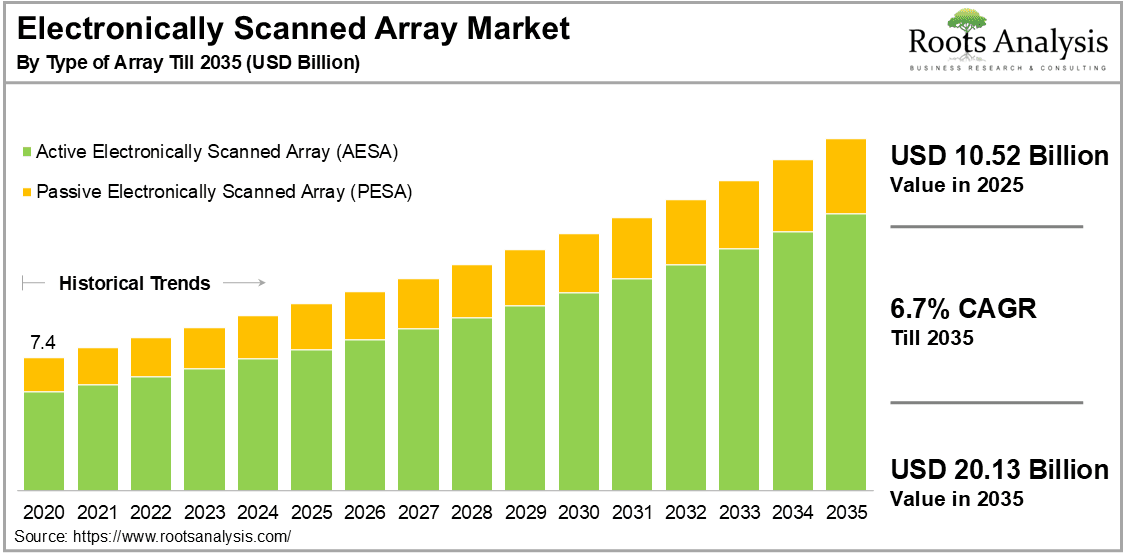
The global electronically scanned arrays market, valued at USD 9.8 billion in 2024, is projected to reach USD 10.52 billion in 2025 and USD 20.13 billion by 2035, representing a CAGR of 6.7% during the forecast period.
See What’s in the Full Report - Request Your Complimentary Insights!
The new research study consists of detailed analysis, mega trends, patent analysis, porter five forces, SWOT analysis, value chain analysis and other strategic frameworks.
An electronically scanned array (ESA) is a sort of phased array antenna system which uses computer control to electronically steer the radio wave beam to point in various directions without moving the antenna. Each antenna element in the ESA is linked to a micro-sized transmit/receive module (TRM) that is controlled by a computer and serves as the antenna’s transmitter and/or receiver.
The technology includes two main types: Passive ESAs, which rely on a single source for all elements, and Active ESAs, which rely on individual transmitters and receivers to achieve higher resolution and flexibility. These arrays play a vital role in modern military, weather, and satellite systems for their speed, accuracy and reliability.
One of the important factors that is fostering electronically scanned arrays market growth is the rising investment to strengthen the capabilities of air defense. Further, the integration of gallium nitride (GaN), an advanced material that allows radar components to be smaller and more energy-efficient, offers improved performance and cost efficiency, while government initiatives to modernize radars majorly drive the growth of the electronically scanned array industry. One of the key technological improvements is the shift from mechanically scanned arrays to electronically scanned arrays.
Your Business is Unique – Why Shouldn’t Your Report Be?
Further, the AESA radar is also believed to be a huge advancement from earlier mechanical radars which were more prone to jamming and other mechanical errors and failures. In reference to this, Major General Ravi Arora and Biley technologies state that the benefits of the AESA have become inescapable. Countries around the world are adding AESA radars into their military aircraft and vessels, and contractors around the world are rushing to meet the demand.
Electronically Scanned Arrays Market Segmentation Insights
The market report presents an in-depth analysis of the various companies that are involved in offering electronically scanned arrays, across different segments, as defined in the table below:
Electronically Scanned Arrays Market: Report Attributes / Market Segmentations
| Key Report Attributes | Details | |
| Historical Trend | Since 2020 | |
| Forecast Period | Till 2035 | |
| Market Size 2025 | $ 10.52 Billion | |
| Market Size 2035 | $ 20.13 Billion | |
| CAGR (Till 2035) | 6.7% | |
| Type of Array |
|
|
| Type of Platform |
|
|
| Type of Array Geometry |
|
|
| Type of Component |
|
|
| Type of Range |
|
|
| Type of Fit |
|
|
| Type of Frequency Band |
|
|
| Type of Enterprise |
|
|
| Geographical Regions |
|
|
| Leading Market Players |
|
|
| PowerPoint Presentation (Complimentary) | Available | |
| Customization Scope | 15% Free Customization | |
| Excel Data Packs (Complimentary) |
|
|
Have Questions? Let’s Get Them Answered.
Electronically Scanned Arrays Market Share Insights
Which Type of Array Will Dominate the Electronically Scanned Arrays Market?
When it comes to the global market for electronically scanned arrays, the active electronically scanned array (AESA) segment is set to take the lead, holding a significant market share of over 74.56% for the next decade. The AESA market growth is largely a result of the enhanced target tracking, electronic warfare capabilities, and greater resistance to jamming that AESA radars offer.
These properties make them a preferred choice for modern military aircraft, naval vessels, and ground-based systems. Furthermore, increased defense budgets worldwide, particularly in the U.S., China and India, are driving large-scale procurement and upgrades of AESA-equipped platforms.
Which Type of Platform will Witness the Fastest Growth Rate?
When it comes to the electronically scanned arrays market analysis, the air segment is expected to grow the fastest with a projected CAGR of 7.8% during the forecast period. Here’s why: defense forces worldwide are upgrading fighter jets, unmanned aerial vehicles (UAVs), and airborne early warning and control (AEW&C) aircraft with AESA for superior target detection, tracking, and electronic warfare capabilities increasing the airborne electronically scanned arrays. U.S., China and India are investing heavily in next-generation fighter programs incorporating AESA radars.
Which Type of Array Geometry is Most Popular?
The market is segmented into various types of array geometry, such as frequency scanning array, linear array and planar array. According to our analysis, the planar array segment is clearly the most popular choice. It is expected to boost the market share of electronically scanned array by an impressive 64.6% during the forecast period.
What exactly makes them appealing is their versatility and ability to provide high-resolution imaging and wide coverage, making it suitable for various electronically scanned arrays applications in both military and civilian sectors. Planar arrays are particularly advantageous for radar systems as they can efficiently manage multiple beams and facilitate rapid scanning capabilities without mechanical movement.
How is the Transceiver Module Segment Dominating Types of Components?
When we look at the components of electronically scanned arrays market, its segmented into beamforming network, phase shifters, radar data processor, signal processing module, transceiver module and other components. According to our electronically scanned arrays industry analysis, the transceiver module segment really stands out as the dominant player. In fact, it is expected to hold 37.62% market share of electronically scanned array during the forecast period.
The growth of this segment is being driven by increasing demand for advanced military radar and communication systems in defense and commercial applications. Transceiver modules, essential for signal transmission and reception, are being widely integrated into AESA and PESA systems for improved detection, tracking and jamming resistance.
Why is the Long Range Segment Gaining Traction in Type of Range Segment?
The electronically scanned arrays market by sales channel is segmented into long, medium and short ranges, where the long range segment is gaining the highest traction. According to our analysis, this segment will hold 74.67% market share of electronically scanned array domain during the forecast period. A big part of this growth is largely due to the critical role it plays in defense applications such as air surveillance, missile detection, and early warning systems. Long-range ESAs are increasingly prioritized by governments worldwide as part of military modernization efforts, driven by rising geopolitical tensions and the need for enhanced situational awareness.
Why is Asia Leading the Electronically Scanned Arrays Market?
According to our regional analysis, the Asia electronically scanned arrays market currently exhibits dominance with 35.49% of overall market share. This is mainly because the region is investing heavily in advanced radar technologies, particularly AESA, to enhance air defense, naval surveillance, and electronic warfare capabilities. Increasing indigenous defense production, supported by government initiatives driving the electronically scanned arrays industry, such as India’s “Make in India” and China’s military advancements, is fueling regional market growth. The commercial aviation and maritime sectors are also adopting electronically scanned arrays for improved safety and navigation.
See What’s in the Full Report – Request Your Complimentary Insights!
Electronically Scanned Arrays Market Key Insights
The “Electronically Scanned Arrays Market, Till 2035: Industry Trends and Global Forecasts” report features an extensive study on how to evaluate the growth of the electronically scanned arrays market, ESA market size and future opportunity within the forecast period. The market report highlights the efforts of several stakeholders involved in this rapidly emerging segment of the service providers industry. Key takeaways of the market report are briefly discussed below.
What are the Key Drivers for Electronically Scanned Array?
The electronically scanned array (ESA) market is primarily driven by several key factors, including significant impact of increased defense spending on the demand for electronically scanned arrays in an attempt towards defense modernization, future trends in radar technology and electronically scanned array solutions, and the increasing demand for sophisticated surveillance systems. As nations around the world enhance their military capabilities in response to rising geopolitical tensions, there is a growing need for advanced radar systems that offer improved detection, tracking, and electronic warfare capabilities.
The integration of technologies such as artificial intelligence and software-defined radar is further propelling market growth by enhancing the adaptability and performance of ESAs. Additionally, the commercial sector's adoption of ESAs for applications in aviation, maritime navigation, and autonomous vehicles is expanding the market's reach.
What Strategies are Companies Using to Gain Electronically Scanned Arrays Market Share?
Companies in the electronically scanned arrays industry are using smart strategies to stay ahead. Big players are focusing on partnerships, acquisitions, joint ventures, and innovations to strengthen their position while also investing in R&D to bring innovative and novel products to the market. Launching new technologies and expanding into regions with innovations in radar technology driving the ESA market, as well as regions where materials science, and signal processing techniques are growing, are the key moves helping them capture more market share.
What Are the Challenges in Developing and Deploying Electronically Scanned Array Systems?
The electronically scanned arrays market faces several challenges that can hinder its development and implementation. One of the primary issues is the high development and production costs associated with these advanced radar systems, which create substantial entry barriers for emerging players and limit adoption among smaller defense organizations or nations with constrained budgets.
Additionally, the complex integration of ESAs into existing defense and commercial systems requires specialized expertise, often leading to prolonged deployment timelines. Supply chain disruptions, particularly in semiconductor and microelectronics components, further impact manufacturing efficiency and can delay project timelines. Moreover, stringent regulatory policies and export restrictions on advanced radar technology market pose additional constraints on market expansion.
Unlock Deeper Insights – Schedule Your Personalized Workshop Today!
Who Are the Key Players in the Electronically Scanned Arrays Market?
Examples of leading electronically scanned array manufacturers (which have also been captured in this market report, arranged in alphabetical order) include Airbus, API Technologies, Aselsan, BAE Systems, Bharat Electronics, Blighter Surveillance Systems, CEA Technologies, Defence Research and Development Organization, General Dynamics, Hanwha Systems, HENSOLDT, Indra Company, Israel Aerospace, Jem Engineering, L3Harris Technologies, Leonardo, Lig Nex 1, Lockheed Martin, Mitsubishi Electric, Northrop Grumman, RADA Electronic, Raytheon Technologies, Saab, SRC, Telephonics, Teledyne Technologies, Thales, Toshiba, Vega Radio Engineering.
Recent Developments in Electronically Scanned Arrays Market
- In March 2025, Russian army received the new Pantsir-SM-SV with AESA radar.
- In March 2025, Indian Air Force signed a Rs 2,906 crore deal with BEL to strengthen air defense with indigenous ‘Ashwini’ AESA Radar.
- In February 2025, IAI announced the first delivery of new multi-mode, multi-role airborne surveillance radar, in which the C-catcher Radar family has employed the latest GaN and AESA technologies.
- In December 2024, HAL bagged Rs 13,500 crore defense contract for 12 Su-30 jets, boosting ‘Atmanirbhar Bharat’ initiative.
- In July 2024, Leonardo launched M-346 capability enhancement program, which includes AESA radar featuring fire control radar capability, to leverage system’s inherent growth to meet modern training and operational requirements.
Glossary of Electronically Scanned Arrays Market
- Active Electronically Scanned Array (AESA): A subtype of ESA that includes individual transmit/receive modules for enhanced performance, enabling the detection of multiple targets simultaneously.
- Airborne Early Warning and Control (AEW&C): Systems designed to detect and track aerial threats from a distance using radar technology mounted on aircraft, providing situational awareness for military operations.
- Array Geometry: The configuration of the antenna elements in an ESA, which can be frequency scanning, linear, or planar, affecting its performance and application.
- Electronically Scanned Array (ESA): A type of antenna system that uses multiple elements to control and direct radio wave beams electronically, allowing for rapid adjustment without physical movement.
- Gallium Nitride (GaN): A semiconductor material known for its high efficiency and power capabilities, commonly used in radar systems to enhance performance by allowing higher power output and improved thermal management.
- Geopolitical Tensions: Political conflicts between countries that can drive defense spending and technological advancements in military capabilities.
- Linear Array: An antenna configuration where elements are arranged in a straight line, typically used for specific directional applications but with limitations compared to planar arrays.
- Military Modernization: The process of upgrading and enhancing military capabilities through new technologies and systems, including radar and communication systems.
- Passive Electronically Scanned Array (PESA): Another subtype of ESA that does not have its own transmit/receive modules; instead, it relies on external sources for signal transmission.
- Phased Array: A type of antenna array that can steer its beam direction by adjusting the phase of the signals emitted from each antenna element.
- Planar Array: A type of antenna configuration where elements are arranged in a flat plane, allowing for efficient beam steering and broad coverage.
- Radar: A system that uses radio waves to detect and locate objects such as aircraft, ships, and vehicles by bouncing signals off them.
- Signal Processing: The analysis and manipulation of signals (like radar signals) to improve their quality and extract useful information.
- Unmanned Aerial Vehicles (UAVs): Aircraft that operate without a human pilot onboard, often equipped with advanced radar systems for surveillance and reconnaissance missions.
Electronically Scanned Arrays Market Report Coverage
The market report presents an in-depth analysis, highlighting the capabilities of various companies engaged in this domain, across different segments. Amongst other elements, the market report includes:
- A preface providing an introduction to the full report, electronically scanned arrays market, 2020-2024 (Historical Trends) and 2025-2035 (Forecasted Estimates).
- An outline of the systematic research methodology adopted to conduct the study on the electronically scanned arrays, providing insights on the various assumptions, methodologies, and quality control measures employed to ensure the accuracy and reliability of our findings.
- An overview of economic factors that impact the overall ESA market, including historical trends, currency fluctuation, foreign exchange impact, recession, and inflation measurement.
- An executive summary of the insights captured during our research. It offers a high-level view of the current state of the electronically scanned arrays industry and its likely evolution in the mid-long term.
- A detailed assessment of the electronically scanned arrays competitive landscape, based on several relevant parameters, including year of experience, company size, location of headquarters, and ownership structure.
- Elaborate profiles of prominent electronically scanned arrays companies, featuring information on their year of establishment, location of headquarters, company size, company mission, company footprint, management team, contact details, financial information, operating business segments, product portfolio, moat analysis, recent developments, and an informed future of electronically scanned arrays.
- A qualitative assessment of the various megatrends ongoing in the ESA market, including defense sector investments fuel market expansion, technological advancements in AESA and hybrid systems, shift to network-centric and electronic warfare (EW).
- An analysis highlighting the key unmet needs across ESA market, featuring electronically scanned arrays industry insights generated from real-time data on unmet needs as identified from social media posts, recent publications, industry blogs and the views of key opinion leaders expressed on online platforms.
- An in-depth analysis of various patents that have been filed / granted related to electronically scanned arrays and its components, based on various parameters, such as type of patent, patent publication year, patent age and leading players
- A detailed analysis of recent developments in the electronically scanned arrays market, based on relevant parameters such as year of initiative, type of initiative (partnerships and collaborations, expansions, funding and product launches), geographical distribution and most active players (in terms of number of recent developments).
- Key winning strategies framework that helps in analyzing the level of competition within an industry, by tracing the key market activities including partnership, funding, expansion of leading players
- A qualitative analysis, highlighting the five competitive forces prevalent in electronically scanned arrays industry, including threats for new entrants, bargaining power of suppliers, bargaining power of customers, threats of substitution and rivalry among existing competitors.
- A discussion on affiliated global electronically scanned arrays market trends, key drivers and challenges, under a SWOT framework, which are likely to impact the industry’s evolution, along with a Harvey ball analysis, highlighting the relative effect of each SWOT parameter on the overall ESA market.
- A value chain analysis featuring a discussion on various stakeholders involved in the development of the electronically scanned arrays, from suppliers to end-users.
- A detailed estimate of the current market size and the potential future of electronically scanned arrays market initiatives over the next decade. Based on multiple parameters we have provided an informed estimate on the market evolution during the forecast period 2025-2035. The report also features the likely distribution of the current and forecasted opportunity within the ESA market. Further, in order to account for future uncertainties and to add robustness to our model, we have provided three forecast scenarios, namely conservative, base, and optimistic scenarios, representing different tracks of the industry’s growth.
- Detailed projections of the current and future market across various types of arrays such as active electronically scanned arrays (AESA), and passive electronically scanned arrays (PESA).
- Detailed projections of the current and future market across various types of platforms such as air, land and marine.
- Detailed projections of the current and future market across various types of arrays geometry, such as frequency scanning arrays, linear arrays, and planar arrays.
- Detailed projections of the current and future market across various types of components, such as beamforming network, phase shifters, radar data processor, signal processing module, transceiver module, and other components.
- Detailed projections of the current and future market across various types of range, such as long, medium and short.
- Detailed projections of the current and future market across various types of fit, such as line fit and retrofit.
- Detailed projections of the current and future market across various types of frequency band, such as C-band, Ka-band, and Ku-band.
- Detailed projections of the current and future market across various types of enterprises such as large enterprises and small and medium enterprises.
- Detailed projections of the current and future electronically scanned arrays market across various geographical regions, such as North America (US, Canada, Mexico and other North American countries), Europe (Austria, Belgium, Denmark, France, Germany, Ireland, Italy, Netherlands, Norway, Russia, Spain, Sweden, Switzerland, UK and other European countries), Asia (China, India, Japan, Singapore, South Korea and other Asian countries), Middle East and North Africa (Egypt, Iran, Iraq, Israel, Kuwait, Saudi Arabia, UAE and other MENA countries), Latin America (Brazil, Chile, Colombia, Venezuela and other Latin American countries) and rest of the world (Australia, New Zealand and other countries).
Want Information on Specific Region/Segment?
About Authors
Lead Author: Anmol Bali
Lead Reviewer: Prachi Bhalla
Chief Editor: Ronit Sharma
Customization Opportunities
At Roots Analysis, we genuinely care about your success and understand that your business requirements are unique. While our market research reports provide valuable insights, we recognize that they might not cover every aspect you need to make well-informed strategic decisions. To account for that, we offer 10% free report customization tailored to your specific needs. Whether you require additional quantitative analysis, qualitative insights, or any other information related to the ESA market, reach out us today at: support@rootsanalysis.com


