In-Flight Content Market
In-Flight Content Market: Industry Trends and Global Forecasts Till 2035- Distribution by Type of Content (Games, Magazine, Movie, Music, News, and TV Shows), Access (Portable Device and Seatback Display Unit), Operation (Stored and Streamed), Platform (Business Aviation and Commercial Aviation), Type of Passenger Class (Business Class, Economy Class, and First Class), Type of Enterprise (Large Enterprises and Small and Medium Enterprises (SMEs)), and Geographical Regions (North America, Europe, Asia, Latin America, Middle East and North Africa, and Rest of the World)
-
Lowest Price Guaranteed
-
Slides
211 -
Last Updated
October 2026 -
View Count
12480 -
In-flight Content Market Overview
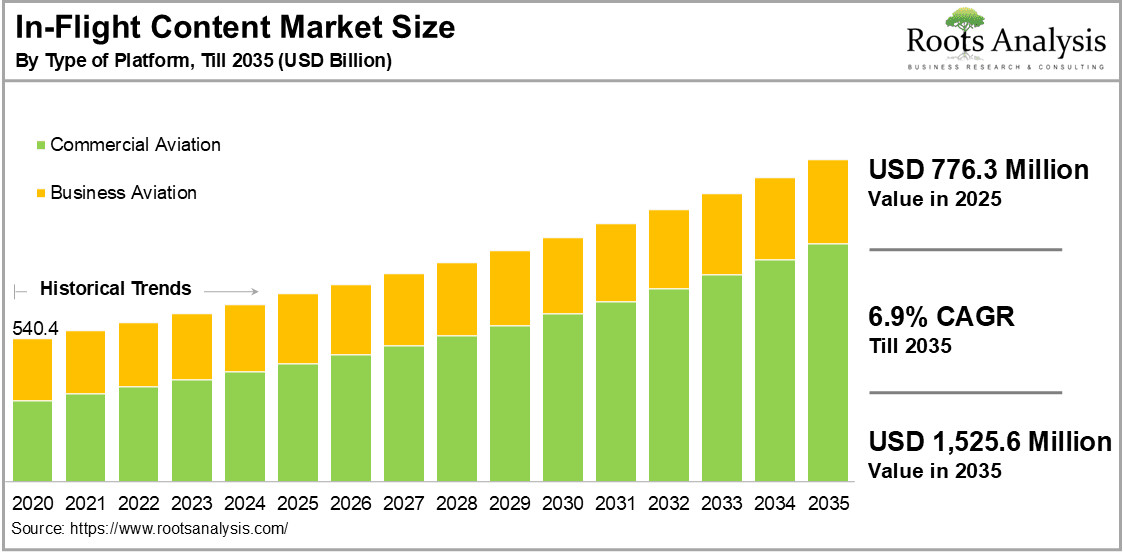
The global in-flight content market is estimated to reach USD 776.3 million in 2025 and is projected to reach USD 1,164.4 million by 2030, and USD 1,525.6 million by 2035, representing a CAGR of 6.9% during the forecast period.
To learn more about this report, request a free sample copy
The new research study consists of global in-flight content market analysis, mega trends, patent analysis, porter five forces, SWOT analysis, value chain analysis and other strategic frameworks.
The in-flight content market is a dynamic and rapidly evolving sector in the aviation industry, which is set to transform the way passengers experience air travel with the help of entertainment and media offerings. This market contains a wide range of content types including in-flight movies and TV shows, music, games etc.
This market is witnessing tremendous growth, driven by technological advancements and the ever-changing landscape of passenger expectations. With easy and increased access to high-speed in-flight internet and personal devices, airlines are now offering more on-demand and personalized in-flight entertainment.
The credit for this transition can be bestowed upon the increasing demand for more engaging and interactive passenger experience, including streaming services, live TV, and diverse airline entertainment platforms. Following this, airlines are actively exploring partnerships with streaming platforms and in-flight content providers to enhance their offerings and give them an edge in a competitive market. Additionally, the involvement and evolution of AI and data analytics in in-flight entertainment is allowing airlines to tailor content recommendations. This is further improving passenger satisfaction and consequently fueling the market growth of in-flight content industry.
In-flight Content Market Share Insights
The in-flight content market report presents an in-depth analysis of the various companies that are involved in offering airline content solutions, across different segments, as defined in the table below:
In-flight Content Market: Report Attributes / Market Segmentations
| Key Report Attributes | Details | |
| Historical Trend | Since 2020 | |
| Forecast Period | Till 2035 | |
| Market Size in 2025 | $ 776.3 Million | |
| Market Size in 2035 | $ 1,525.6 Million | |
| CAGR (Till 2035) | 6.9% | |
| By Type of Content |
|
|
| By Access |
|
|
| By Operation |
|
|
| By Platform |
|
|
| By Type of Passenger Class |
|
|
| By Type of Enterprise |
|
|
| By Geographical Regions |
|
|
| Leading In-flight Content Providers |
|
|
| PowerPoint Presentation (Complimentary) | Available | |
| Customization Scope | 15% Free Customization | |
| Excel Data Packs (Complimentary) |
|
|
In-flight Content Market Segmentation
Which Type of Content Will Dominate the In-flight Content Market?
When it comes to the global in-flight content market, by type of content, the movie sub-segment is set to take the lead, holding a significant market share of over 35.21% of the market.
This growth can be attributed to the fact that movies are a major part of the entertainment package offered by the airlines to enhance customers’ travel experiences due to their ability to keep passengers entertained during long flights. Hence, airlines offer a diverse range of titles, including classics, new releases, documentaries and more to top the customer satisfaction charts.
How is the Seatback Display Unit Segment Dominating Types of Access?
When we look at the type of access of in-flight content market, it’s segmented into portable device, and seatback display unit. Among these, the seatback display unit sub-segment really stands out as the dominant type. In fact, it’s likely to hold a market share of 75.77% during the forecast period.
This growth is due to the widespread accessibility and reliability of seatback display units. These screens offer the advantage of delivering rich, high-quality and personalized content with large storage capacity, creating an engaging and interactive in-flight experience for every passenger. They also ensure access to entertainment and flight information even when passengers do not have access to their personal electronic devices.
Which Type of Operation Will have the Fastest CAGR?
When it comes to the global in-flight content market, the streamed segment is set to witness the fastest CAGR (8.7%) during the forecasted period. This substantial growth can be attributed to the revolutionizing effect streaming has on in-flight entertainment as it allows passengers to access a vast array of digital media in real time over the internet.
In comparison to stored content, which is technically preloaded content on the aircraft servers, streamed content relies on in-flight internet/wi-fi connectivity. This provides passengers with access to live TV, streaming video services, and other internet-based entertainment options.
Which Type of Platform is Gaining the Most Traction in In-flight Content Market?
When it comes to the in-flight content platforms, the commercial aviation sub-segment is set to take the lead, holding a significant market share of over 79.21% of the market. This market growth is largely a result of passenger influx and their increasing demand for enhanced travel experiences.
With millions of people flying daily on commercial airlines, airline companies are being met with a dire need for providing vast assortments of commercial aviation content. This not only helps them to get differentiated between airlines but also helps in staying relevant in the competitive market.
Why is North America Leading the In-flight Content Market?
According to our in-flight content market by region analysis, the North America in-flight content market currently exhibits dominance with 49.86% of the overall market share. This is mainly because of the region’s rapid technological advancements, significant investments in aviation innovation as well as a large number of frequent flyers.
In fact, according to a 2025 Press Release by Airbus, North America currently has 163 million connected airline passengers, the highest among all regions, with approximately 80% of its fleet already equipped for real-time connectivity, showcasing both technological leadership and a robust, frequent flyer base.
The region’s airlines are rapidly adopting cutting-edge in-flight passenger entertainment systems, to meet the needs of a competitive market, prioritizing passenger experience enhancement and satisfaction.
Market Drivers and Trends
What are the Key Drivers for Demand in the In-flight Content Industry?
The in-flight content market is experiencing significant growth due to several key drivers.
- Emphasis on Passenger Experience: Airline are recognizing that a satisfied passenger is the key to high ratings and relevancy in the competitive market. Hence, they are putting more effort and emphasis on passenger satisfaction by recognizing in-flight content as a necessity rather than an amenity.
- High Passenger Expectations from In-Flight Content: Modern travelers expect the quality of in-flight content to surpass that of the content available to them on their own personal devices at home. This includes access to the latest movies, TV shows, music, games and even live updates across various platform / Operation.
- Global Air Traffic and Commercial Aviation Growth: The expansion of global air travel is significantly increasing the in-flight entertainment content demand. As worldwide passenger traffic continues to grow, airlines are investing in updated in-flight entertainment systems to enhance the travel experience and meet rising passenger expectations for connectivity and digital services.
What Are the Challenges Faced by Airlines in Managing In-Flight Content Libraries?
The in-flight content market, despite its rapid growth potential, is likely to face challenges, which might hinder the market’s growth.
- Change of Preference According to Passenger Characteristics: Keeping up with the evolving tastes of passengers, such as expecting on-demand, high-quality and personalized entertainment similar to the ones at home, along with providing relevant content according to passenger characteristics, including age and gender requires airlines to frequently be on their toes in updating and diversifying their content libraries.
- High Infrastructure and Maintenance Costs: Airlines require a significant amount of capital investment to install, maintain, and upgrade in-flight content. This includes maintaining seatback entertainment systems, control units, and connectivity hardware where airlines are needed to frequently update both software and hardware.
- Bandwidth and Connectivity Limitations: Delivering high-quality, on-demand content demands robust in-flight connectivity. Limited bandwidth and high costs for satellite-based internet can restrict the variety and quality of content available to passengers, particularly on long-haul or high-traffic routes.
In-flight Content Market Key Insights
The “In-flight Content Market, Till-2035: Industry Trends and Global Forecasts” report features an extensive study of the current market landscape, market size, how to evaluate the growth of the in-flight content market and future opportunity within the in-flight content market forecast period. The market report highlights the efforts of several stakeholders involved in this rapidly emerging segment of the service providers industry. Key takeaways of the market report are briefly discussed below.
What are the Benefits of Offering Personalized and On-Demand Content for Airline Passengers?
- Enhanced passenger experience through tailored entertainment, dining, and app-based preferences.
- Strengthened customer relationship due to the customized offers and services, based on passenger preferences, throughout the travel journey.
- Data-driven insights to refine services and boost conversion rates.
- Reduced data privacy and ethical concerns as passengers control their content choices, enhancing brand reputation and compliance.
- Improved operational efficiency as a result of optimized inventory and service delivery.
What is the Guide to Selecting In-Flight Content Providers for Airlines?
- Assess content diversity and quality
- Evaluate licensing and compliance expertise
- Prioritize accessibility and inclusivity
- Review data analytics and personalization capabilities
- Ensure Operational Efficiency
What are the Key Strategies Used by Companies to Gain Competitive Edge in the In-Flight Content Market?
Leading in-flight content companies, like Air India, Collins Aerospace, and Lufthansa Systems, are focusing on market opportunities in emerging economies by using smart strategies to stay ahead and gain a competitive edge. The companies are opting for various strategic airline partnerships with content providers, acquisitions, joint ventures, and technological innovations to strengthen their position in the in-flight content industry’s competitive landscape 2025. Further, the increasing R&D investment is helping them capture more market share and bring novel products to the market.
For instance, in December 2024, Air India launched Vista Stream, an inflight Wi-Fi system for all their flights. The initiative enabled Air India to gain an edge over the other domestic peers. In context to this, Rajesh Dogra - Chief Customer Experience Officer of Air India stated that as a continuous attempt of transforming Air India into a world class airline, the airline has introduced Vista Stream which enables guests to access digital entertainment content on their personal devices during a flight. This service is available throughout their domestic and international network.
Recent Developments in In-flight Content Market
- In June 2025, United Airlines launched an in-flight partnership with Spotify, providing customers more than 450 hours of Spotify-curated playlists, podcasts, and audiobooks can be enjoyed for free from over 130,000+ seatback screens.
- In May 2025, JetBlue and United Airlines launched a new revolutionary Blue Sky partnership, connecting customers to personalized advertising, content, and brand experiences.
- In April 2025, Intelsat recently launched high-speed, reliable inflight connectivity service on Thai Airways International’s Airbus A330-300s.
- In January 2025, Delta unveiled its YouTube partnership, Delta Sync, allowing SkyMiles Members to enjoy their favorite content ad-free on most flights. Along with this, its also set to launch cloud-based seatback experience and personalized features.
Glossary for In-flight Content Market
- Cloud-based Delivery: Remote content management systems that update libraries globally, eliminating physical hardware swaps and enabling real-time curation.
- Patron: Refers to the passenger who uses in-flight entertainment services, driving demand for personalized, high-quality content tailored to diverse preferences and device access (BYOD or seatback systems).
- Seatback Display Unit: A screen embedded in the back of an airplane seat, offering passengers direct access to curated entertainment (movies, TV, and games) and flight information. Dominates the market due to standardized reliability and premium cabin adoption
In-flight Content Market Report Coverage
The market report presents a guide to understanding different types of in-flight content, highlighting the capabilities of various companies engaged in this domain, across different segments. Amongst other elements, the market report includes:
- A preface providing an introduction to the full report, in-flight content market, 2020-2024 (Historical Trends) and 2025-2035 (Forecasted Estimates).
- An outline of the systematic research methodology adopted to conduct the study on the in-flight content market, providing insights on the various assumptions, methodologies, and quality control measures employed to ensure the accuracy and reliability of our findings.
- An overview of economic factors that impact the overall in-flight content market, including historical trends, currency fluctuation, foreign exchange impact, recession, and inflation measurement.
- An executive summary of the insights captured during our research. It offers a high-level view of the current state of the in-flight content market and its likely evolution in the mid-long term.
- A detailed assessment of the in-flight content market landscape, based on several relevant parameters, including year of establishment, company size, location of headquarters, and ownership structure.
- Elaborate profiles of prominent players engaged in the in-flight content market, featuring information on their year of establishment, location of headquarters, company size, company mission, company footprint, management team, contact details, financial information, operating business segments, in-flight content market portfolio, moat analysis, recent developments, and an informed future of in-flight content systems.
- A qualitative assessment of the various megatrends ongoing in the in-flight content market, including AI-driven personalization, interactive and gamified experiences, and high-definition streaming & connectivity.
- An analysis highlighting the key unmet needs across in-flight content market industry, featuring market research on in-flight content industry insights generated from real-time data on unmet needs as identified from social media posts, recent publications, industry blogs and the views of key opinion leaders expressed on online platforms.
- An in-depth analysis of various patents that have been filed / granted related to in-flight content market and its components, based on various parameters, such as type of patent, patent publication year, patent age and leading players
- A detailed analysis of recent developments in the in-flight content market domain, based on relevant parameters such as year of initiative, type of initiative (partnerships and collaborations, expansions, funding and product launches), geographical distribution and most active players (in terms of number of recent developments).
- Key winning strategies framework that helps in analyzing the level of competition within an industry, by tracing the key market activities including partnership, funding, expansion of leading players
- A qualitative analysis, highlighting the five competitive forces prevalent in in-flight content market industry, including threats for new entrants, bargaining power of suppliers, bargaining power of customers, threats of substitution and rivalry among existing competitors.
- A discussion on affiliated global in-flight content market trends, key drivers and challenges, under a SWOT framework, which are likely to impact the industry’s evolution, along with a Harvey ball analysis, highlighting the relative effect of each SWOT parameter on the overall in-flight content market.
- A value chain analysis featuring a discussion on various stakeholders involved in the development of the in-flight content market, from suppliers to end-users.
- A detailed estimate of the current market size and the potential growth future of in-flight content market initiatives over the next decade. Based on multiple parameters we have provided an informed estimate on the market evolution during the forecast period 2025-2035. The report also features the likely distribution of the current and forecasted opportunity within the in-flight content market. Further, in order to account for future uncertainties and to add robustness to our model, we have provided three forecast scenarios, namely conservative, base, and optimistic scenarios, representing different tracks of the industry’s growth.
- Detailed projections of the current and future market across different type of content, such as games, magazines, movies, music, news and TV shows.
- Detailed projections of the current and future market across different access, such as portable devices, and seatback display units.
- Detailed projections of the current and future market across different of operation, such as stored and streamed.
- Detailed projections of the current and future market across different of platform, such as business aviation, and commercial aviation.
- Detailed projections of the current and future market across different type of passenger class, such as business, economy, and first.
- Detailed projections of the current and future market across different types of enterprises, such as large enterprises and small and medium enterprises.
- Detailed projections of the current and future in-flight content market across different geographical regions, such as North America (US, Canada, Mexico and other North American countries), Europe (Austria, Belgium, Denmark, France, Germany, Ireland, Italy, Netherlands, Norway, Russia, Spain, Sweden, Switzerland, UK and other European countries), Asia (China, India, Japan, Singapore, South Korea and other Asian countries), Middle East and North Africa (Egypt, Iran, Iraq, Israel, Kuwait, Saudi Arabia, UAE and other MENA countries), Latin America (Brazil, Chile, Colombia, Venezuela and other Latin American countries) and rest of the world (Australia, New Zealand and other countries).
About Authors
Lead Author: Anmol Bali
Lead Reviewer: Yash Tyagi
Chief Editor: Ronit Sharma
Customization Opportunities
At Roots Analysis, we genuinely care about your success and understand that your business requirements are unique. While our in-flight content market research reports provide valuable insights, we recognize that they might not cover every aspect you need to make well-informed strategic decisions. To account for that, we offer 15% free report customization tailored to your specific needs. Whether you require additional quantitative analysis, qualitative insights, or any other information related to the in-flight content market, reach out us today at: support@rootsanalysis.com