IBD Treatment Market: Leading Drug Developers and Emerging Therapies

.png)

Published: August 2026
Inflammatory bowel disease represents a group of chronic, relapsing inflammatory disorders of the gastrointestinal tract, primarily encompassing Crohn's disease and ulcerative colitis. These conditions arise from a complex interplay of genetic, environmental, and immune factors, where the body’s immune system mistakenly attacks the intestinal lining, leading to recurrent flares of inflammation. Notably, beyond gastrointestinal tract effects, inflammatory bowel disease also doubles the risk of intestinal and extraintestinal cancers, necessitating lifelong clinical monitoring.
The treatment for inflammatory bowel involves a multidisciplinary approach that incorporates lifestyle changes and ongoing management preventing severe complications through regular monitoring and patient education. Currently, the available treatment for inflammatory bowel disease fails to produce durable remission for a substantial number of patients and often lose effectiveness with time. Several efforts are underway to target new pathways, while drugs focusing on IL-23 inhibition, S1P receptor modulation, JAK1 selectivity, and TL1A inhibition continue as foundational therapies that can reduce mortality rate.
Roots Analysis has conducted an exhaustive study on Inflammatory Bowel Disease Treatment Market featuring the current landscape and future opportunity for the companies engaged in the inflammatory bowel disease domain. In this article, we have highlighted key players focused on development of inflammatory bowel disease drugs that are likely to shape the evolution of biopharmaceutical sector during the forecast period.
Top Five Companies Developing IBD drugs
- AbbVie
- Eli Lilly and Company
- Janssen Biotech
- Pfizer
- Takeda
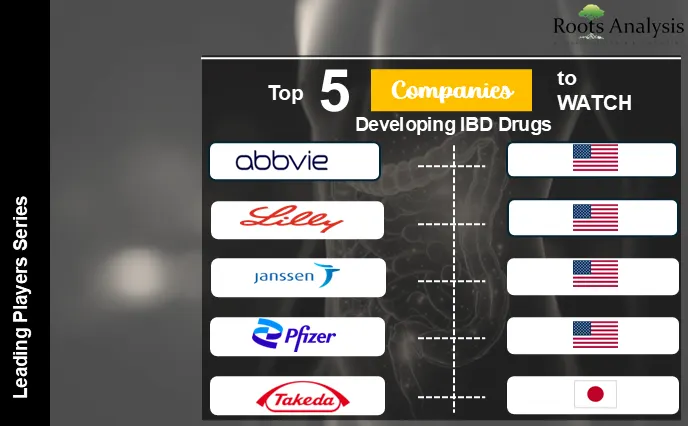
Want to explore more about Inflammatory Bowel Disease Market?
Discover Below the Details on Top 5 Companies Developing IBD Drugs
1. AbbVie
AbbVie is a US-based biopharmaceutical company formed as a spin-off from Abbott Laboratories. The company specializes in developing innovative medicines and solutions that address complex health challenges, with particular expertise in immunology, oncology, neuroscience, aesthetics, and eye care. Moreover, the company’s portfolio includes leading therapies, such as Skyrizi and Rinvoq. Committed to scientific excellence and measurable patient impact, AbbVie drives sustainable growth through significant R&D investment and strategic partnerships.
AbbVie: Company Overview
 |
Company Name | Year of Establishment | Headquarters | Number of Employees |
| AbbVie | 2013 | US | 10,000+ |
2. Eli Lilly and Company
Eli Lilly, headquartered in Indiana, is a global pharmaceutical leader. The company discovers, develops, manufactures, and markets human pharmaceuticals across oncology, diabetes and metabolic care, immunology, and neuroscience. It is important to mention that Eli Lilly focuses on key therapeutic areas, including diabetes (Mounjaro, Zepbound, Humalog), oncology (Verzenio, Alimta), immunology (Taltz, Omvoh), and neuroscience. The company has recently expanded its inflammatory bowel disease portfolio through Omvoh (approved for ulcerative colitis in 2023) and a USD 3.2 billion acquisition of Morphic Holding in 2024 to advance oral IBD treatments.
Eli Lilly and Company: Company Overview
 |
Company Name | Year of Establishment | Headquarters | Number of Employees |
| Eli Lilly and Company | 1876 | US | 10,000+ |
3. Janssen Biotech
Janssen Biotech is a US-based biopharmaceutical company that specializes in discovering, developing, manufacturing, and commercializing innovative biologic therapies, with strategic focus on oncology and immunology, alongside neuroscience, infectious diseases, and cardiovascular / metabolic disorders. Its flagship immunology portfolio includes Stelara (ustekinumab), a cornerstone treatment for inflammatory bowel disease coupled with other approved and pipeline assets targeting Crohn’s disease and ulcerative colitis. Moreover, the company leverages global R&D capabilities and GMP manufacturing to deliver science-driven therapies addressing unmet medical needs in IBD and related immune-mediated conditions.
Janssen Biotech: Company Overview
 |
Company Name | Year of Establishment | Headquarters | Number of Employees |
| Janssen Biotech | 2010 | US | 10,000+ |
4. Pfizer
Pfizer claims to be leading global biopharmaceutical company headquartered in New York. Notably, the company has all the required capabilities to discover, develop, manufacture, and commercialize medicines and vaccines across the world for a wide array of disorders. Moreover, it is important to highlight that the company maintains a robust pipeline of ~30 projects, including PF-07261271, a Phase I bi-specific antibody targeting p40/TL1 for inflammatory bowel disease (IBD), demonstrating its commitment to advancing next-generation IBD therapies through JAK inhibitors and TL1A blockade.
Pfizer: Company Overview
 |
Company Name | Year of Establishment | Headquarters | Number of Employees |
| Pfizer | 1849 | US | 10,000+ |
5. Takeda
Takeda Pharmaceutical is a research and development driven and patient-focused company, specializing in therapeutic areas, including gastroenterology, rare diseases, plasma-derived therapies, oncology, neuroscience, immunology, and vaccines. By leveraging nearly four decades of experience in inflammatory bowel disease domain, the companies have all the required capabilities to treat Crohn's disease and ulcerative colitis. Moreover, the company’s mission is to discover and deliver life-transforming treatments by translating science into highly innovative medicines.
Takeda: Company Overview
 |
Company Name | Year of Establishment | Headquarters | Number of Employees |
| Pfizer | 1781 | Japan | 10,000+ |
Conclusion
Owing to the rising disease prevalence and lack of selective treatment approaches, several researchers and industry stakeholders are prioritizing the development of different types of targeted inflammatory bowel disease drugs. Currently, various preclinical as well as clinical-stage therapies for the treatment of inflammatory bowel diseases are being evaluated by both start-ups and well-established players across different geographies. Various biologics, such as infliximab, inhibit tumor necrosis factor-α, thereby reducing inflammation and promoting mucosal healing. Meanwhile, vedolizumab blocks integrin-mediated lymphocyte trafficking to the gastrointestinal tract, offering sustained remission in both ulcerative colitis and Crohn’s disease. Additionally, Janus Kinase inhibitors offer oral alternatives by intracellularly blocking cytokine signaling pathways. These therapies collectively represent a paradigm shift towards precision medicine in inflammatory bowel disease management, addressing diverse inflammatory mechanisms to improve clinical outcomes.
Browse our full report on IBD Treatment Market: https://www.rootsanalysis.com/reports/inflammatory-bowel-disease-treatment-market.html
Sources: