Monoclonal Antibody Contract Manufacturing Market Trends


Published:
The monoclonal antibody contract manufacturing landscape represents one of the most established and rapidly evolving segments of the biopharmaceutical outsourcing industry. Monoclonal antibodies have emerged as an important class of biologic therapeutics owing to their high target specificity and broad applicability across oncology, autoimmune disorders, infectious diseases and other therapeutic areas. However, the development and manufacturing of these complex biologics require specialized infrastructure, sophisticated cell culture and purification technologies, stringent quality control systems and extensive regulatory expertise.
The growing number of monoclonal antibody candidates entering clinical development, coupled with the increasing commercialization of antibody-based therapies, has resulted in rising demand for contract manufacturing services. Biopharmaceutical companies, particularly emerging and mid-sized developers, are increasingly partnering with contract development and manufacturing organizations to access manufacturing capacity, specialized expertise and scalable production capabilities without making substantial investments in dedicated infrastructure.
At present, antibody contract manufacturing encompasses a broad range of services, including cell line development, process development and optimization, upstream and downstream processing, drug substance manufacturing, drug product manufacturing, analytical testing and technology transfer. The increasing adoption of outsourcing has encouraged CDMOs to expand their manufacturing capacities and develop integrated platforms capable of supporting antibody programs from early development through commercial production.
Roots Analysis has conducted an exhaustive study of the Antibody Contract Manufacturing Market trends featuring the current market landscape and future opportunities for developers engaged in healthcare, over the span of next 9 years. In this article, we have highlighted some of the monoclonal antibody contract manufacturing market trends that are likely to shape the evolution of this industry.
Want to Explore Competitive Landscape and Antibody Contract Manufacturing Market Trends?
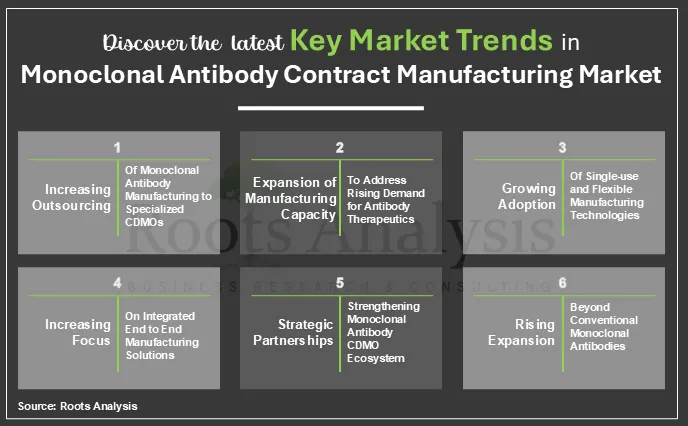
Latest Trends in Monoclonal Antibody Contract Manufacturing Market That Are Likely to Shape the Market
1. Increasing Outsourcing of Monoclonal Antibody Manufacturing to Specialized CDMOs
The growing complexity of monoclonal antibody development and manufacturing is encouraging biopharmaceutical companies to outsource different stages of production to specialized CDMOs. Setting up and maintaining large-scale mammalian cell culture facilities require high investment, technical expertise, and strong regulatory capabilities. Outsourcing allows companies to use existing manufacturing facilities and expertise without making major investments in their own infrastructure. CDMOs are also increasingly providing end-to-end services, including cell line development, process optimization, clinical manufacturing, and commercial-scale production. This integrated approach can reduce the need for multiple technology transfers and support a smoother transition from development to commercial manufacturing.
This trend is especially important for emerging biotechnology companies, which may have promising antibody candidates but limited manufacturing capabilities. At the same time, large pharmaceutical companies are also working with CDMOs to increase manufacturing capacity, meet production needs, and build more geographically diversified supply chains.
For example, in April 2026, LOTTE Biologics entered into collaboration with US based oncology biotechnology company covering antibody drug substance manufacturing and process development. The collaboration is intended to support late-stage clinical development and potential future commercialization, illustrating the increasing role of CDMOs in supporting antibody programs beyond early-stage clinical manufacturing.
2. Expansion of Global Manufacturing Capacity to Address Rising Demand for Antibody Therapeutics
The growing number of commercial and late stage monoclonal antibody programs is encouraging CDMOs to expand their manufacturing capacity. These investments include building new facilities, expanding existing sites, adding larger bioreactors, and adopting flexible single-use manufacturing systems. These capacity expansions are important because drug developers increasingly prefer CDMO partners that can support products from early development through commercial manufacturing. Having manufacturing facilities in different regions also allows CDMOs to provide local services and reduce supply-chain risks.
For example, in March 2026, Samsung Biologics completed the acquisition of a manufacturing facility in Rockville, Maryland, from GSK. The facility added 60,000 liters of drug substance manufacturing capacity, increasing Samsung Biologics total global capacity to 845,000 liters. The company also plans additional investments at the site to expand its capabilities and strengthen its US manufacturing operations.
3. Growing Adoption of Single-use and Flexible Manufacturing Technologies
Technological advancements in bioprocessing are changing the way monoclonal antibodies are manufactured. In particular, single-use bioreactors and disposable equipment are becoming increasingly popular among CDMOs because they offer greater manufacturing flexibility, reduce cleaning requirements, and lower the risk of cross-contamination. Single-use technologies can also help reduce facility turnaround time and allow manufacturers to handle multiple customer programs within the same facility. This is especially useful for CDMOs that manage several clinical-stage antibody programs with different manufacturing needs.
At the same time, CDMOs are adopting automation, high-throughput process development, advanced analytical tools, and data-driven manufacturing to improve production efficiency, consistency, and overall process performance. The use of modular and flexible manufacturing facilities is also becoming more important.
4. Increasing Focus on Integrated End to End Manufacturing Solutions
The monoclonal antibody contract manufacturing industry is increasingly moving from standalone manufacturing services toward integrated CDMO models. Under these models, CDMOs provide several stages of antibody development and manufacturing through a single platform. These services may include cell line development, upstream and downstream process development, analytical testing, GMP drug substance manufacturing, fill-finish, and regulatory support. This integrated approach can reduce the need for multiple technology transfers between different service providers and make project management easier for sponsors. It also allows CDMOs to support products across different stages of development, from early research to commercial manufacturing.
At the same time, CDMOs are expanding their capabilities beyond traditional monoclonal antibodies to include multispecific antibodies, antibody fragments, and antibody-drug conjugates. By offering antibody manufacturing together with conjugation and drug product services, CDMOs can support the development of more complex biologic products.
For example, LOTTE Biologics is developing integrated capabilities for monoclonal and multispecific antibodies, antibody drug conjugates, and bioconjugation. Its Syracuse Bio Campus provides drug substance manufacturing and ADC-related capabilities, while the company is also developing additional large-scale manufacturing capacity in South Korea.
5. Strategic Partnerships are Strengthening the Monoclonal Antibody CDMO Ecosystem
Partnerships and long-term manufacturing agreements are becoming increasingly important in the monoclonal antibody CDMO industry. These agreements allow CDMOs to secure a more stable and recurring demand for their manufacturing services, while biopharmaceutical companies can gain access to specialized facilities, technical expertise, and manufacturing capacity without having to develop these capabilities internally. Such partnerships can also provide greater visibility into future production requirements and help CDMOs plan their capacity and investments more effectively.
These collaborations are increasingly extending beyond traditional manufacturing contracts and may cover several stages of the product development process, including process development, scale-up, technology transfer, clinical and commercial manufacturing, and production of specialized antibody formats. Working with the same CDMO across multiple stages can reduce the need to transfer processes between different manufacturers and help maintain consistency as the antibody program progresses. For biopharmaceutical companies, long-term relationships can therefore provide greater manufacturing continuity, easier project coordination, and access to additional capacity as products move from clinical development toward commercialization.
6. Expansion Beyond Conventional Monoclonal Antibodies
Although conventional Since monoclonal antibodies continue to represent the largest segment of antibody contract manufacturing, CDMOs are increasingly expanding their services to support more complex antibody-based therapies. These include bispecific and multispecific antibodies, antibody fragments, and antibody- rug conjugates. This expansion allows CDMOs to address the evolving needs of biopharmaceutical companies developing next generation antibody therapeutics.
The greater complexity of these antibody formats creates additional manufacturing requirements, particularly in areas such as expression systems, purification, product characterization, process control, and analytical testing. For example, bispecific and multispecific antibodies may require more complex production and purification processes than conventional monoclonal antibodies, while ADCs require additional capabilities for antibody-drug conjugation and product characterization. As a result, CDMOs with specialized technical and analytical capabilities can support customers across a broader range of antibody development and manufacturing programs.
Conclusion
The monoclonal antibody contract manufacturing landscape is expected to continue evolving as the number of antibody-based therapies entering clinical and commercial development increases. Growing outsourcing, expansion of manufacturing capacity, adoption of single-use technologies and increasing demand for integrated CDMO services are likely to remain important factors shaping the industry.
At the same time, the competitive landscape is expected to become increasingly focused on manufacturing scale, technology platforms, geographic footprint, development capabilities and the ability to support programs from early development through commercialization.
The emergence of next-generation antibody formats is also likely to encourage CDMOs to expand beyond conventional monoclonal antibody manufacturing and develop capabilities for multispecific antibodies, ADCs and other complex biologics. Consequently, contract manufacturers are increasingly positioning themselves as integrated development and manufacturing partners rather than conventional production suppliers.
To know more about antibody contract manufacturing trends, access full report: https://www.rootsanalysis.com/reports/antibody-cmo-market/295.html
Sources:
1. https://chemanager-online.com/en/news/cdmos-cmos-the-key-moves-in-2026
2. https://www.bioprocessintl.com/monoclonal-antibodies/single-use-technology-supports-follow-on-biologics
3. https://pmc.ncbi.nlm.nih.gov/articles/PMC8978586/
4. https://www.pharma-iq.com/events-pharmacontractmanufacturing/blog/building-successful-partnerships-with-cdmos
5. https://pmc.ncbi.nlm.nih.gov/articles/PMC11218797/