Top 5 Allogeneic Cell Therapy Companies

.png)

Published: September 2026
Allogeneic therapies have emerged as a critical component of the global pharmaceutical industry, supporting treatment of a wide range of target indications including, heart failure, type 2 diabetes, Parkinson’s disease and other hematological disorders. Unlike autologous cell therapy, allogeneic therapies are derived from a healthy donor rather than patient’s own cells. Allogeneic therapies are highly scalable as one healthy donor cells can be used to develop hundreds or thousands of cell therapies. Some of the advantages of allogeneic therapy include easy availability, enhanced product quality, less product variability, potential to treat all the eligible patients, scalable manufacturing processes, reduced processing time and cost-effectiveness.
The rising prevalence of chronic and acute diseases, expansion of pharmaceutical pipelines, and continued demand for effective and target-specific cell therapies have significantly accelerated the need for reliable and scalable allogeneic therapies. Different types of cell types are being used for the development of allogeneic therapies which mainly include induced pluripotent stem cells, umbilical cord blood cells, bone marrow and peripheral blood cells. The USFDA has assigned several allogeneic therapies with designations like Fast Track, Orphan Drug and Regenerative Medicine Advanced Therapy. These designations accelerate the approval of breakthrough allogeneic therapies.
The allogeneic therapy market continues to expand rapidly by leveraging innovations in infrastructure for bioreactors, shifting towards automated closed systems and the use of induced pluripotent stem cell therapy (iPSC) master cell banks as the source of cells. However, the field still encounters challenges in reducing chances of host rejection, donor variability and cell damage during the manufacturing process, along with meeting stringent regulatory and quality standards for clinical deployment. Achieving cost efficiency and establishing uniform characterization methodologies remain significant hurdles for widespread adoption. However, expanding applications in solid tumors and hematologic cancers, coupled with the growing investments in precision oncology, are fueling market growth.
Roots Analysis has conducted an exhaustive study of the allogeneic therapy market featuring the current market landscape and future opportunities for developers engaged in healthcare, over the span of next 9 years.
Top 5 Allogeneic Cell Therapy Companies
- Allogene Therapeutics
- Artiva Biotherapeutics
- CRISPR Therapeutics
- Fate Therapeutics
- Mesoblast
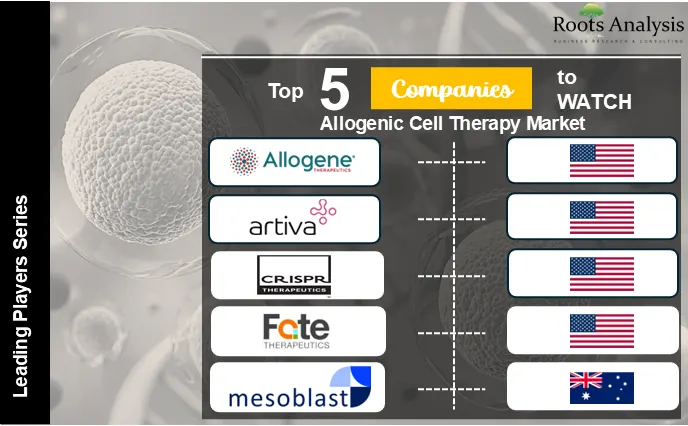
The figure below highlights leading allogeneic cell therapy companies:
Interested in exploring all 150+ allogeneic cell therapy companies, along with their recent initiatives?
Discover Below the Details of Top 5 Allogeneic Cell Therapy Companies:
Let us dive deep into the details of the top 5 allogeneic cell therapy companies. It is essential to note that the selection of top companies can differ substantially according to the defined criteria.
1. Allogene Therapeutics
Company Overview
Allogene Therapeutics specializes in the development of off-the-shelf CAR-T cell therapy in order to treat blood cancers and solid tumors. It is a clinical-stage biotechnology company with a sole focus on pioneering the development of investigational allogeneic chimeric antigen receptor T cell (AlloCAR T) products for cancer and autoimmune disease. Through its 136,000 square-foot facility located in California, US, the company offers clinical and commercial manufacturing, analytical testing and distribution of cell products.
| Company Name | Year of Establishment | Headquarters | Number of Employees | |
 |
Allogene Therapeutics | 2017 | US | 201-500 |
Recent Developments
In July 2026, Allogene Therapeutics announced that the company’s lead pipeline candidate cemacabtagene ansegedleucel (cema-cel) has been granted RMAT and Fast Track Designations for the treatment of B-cell lymphomas. This approval will strengthen the company’s ability to work more effectively, and the clinical trials could be completed at a much faster pace for the therapy to be available for treatments.
To know more about the recent initiatives of Allogene Therapeutics and other allogeneic cell therapy companies, access full report.
2. Artiva Biotherapeutics
Company Overview
Artiva Biotherapeutics focuses on the development of allogeneic NK cell therapies and CAR-NK cell therapies, from umbilical cord blood of healthy donors. The company’s non-genetically modified NK cells are useful in enhancing antibody-dependent cellular cytotoxicity (ADCC) in patients undergoing monoclonal antibody therapy. Further, its genetically modified CAR-NK cell therapies couple the efficacy of CARs with the safety features of NK cells. It is worth mentioning that the firm has established exclusive partnerships with GC Cell and Merck to evaluate novel NK cell therapies in clinical trials.
 |
Company Name | Year of Establishment | Headquarters | Number of Employees |
| Artiva Biotherapeutics | 2019 | US | 51-200 |
Recent Developments
In May 2026, the company announced a secondary public offering of USD 300 Million to accelerate the development of its allogeneic therapies. The funding will be primarily used to carry out phase 3 clinical trials of the AlloNK pipeline candidates.
To know more about the recent initiatives of Artiva Biotherapeutics and other allogeneic cell therapy companies, access full report.
3. CRISPR Therapeutics
Company Overview
CRISPR Therapeutics is a research-stage company advancing gene editing programs that has evolved into a leading player for the development of CRISPR-based therapies. The Company has a diverse portfolio of product candidates across a broad range of disease areas including hemoglobinopathies, oncology, regenerative medicine, cardiovascular, autoimmune, and rare diseases. The company serves pharmaceutical and biotechnology companies through clinical research of various allogeneic therapies.
 |
Company Name | Year of Establishment | Headquarters | Number of Employees |
| CRISPR Therapeutics | 2013 | US | 201-500 |
Recent Developments
In May 2026, the company announced that members of its senior management team are going to participate in the upcoming investor conferences which may help the company in gaining attention of the stakeholders in the healthcare sector.
To know more about the recent initiatives of CRISPR Therapeutics and other allogeneic cell therapy companies, access full report.
4. Fate Therapeutics
Company Overview
Fate Therapeutics is a clinical-stage biopharmaceutical firm, focusing on the development of induced pluripotent stem cell (iPSC)-derived cellular immunotherapies to treat autoimmune and oncological disorders. As per the company website, the company’s iPSC platform is supported by an intellectual property portfolio of more than 400 issued patents and 450 pending patent applications. Further, it is currently evaluating various allogeneic NK cell therapy as monotherapy or in combination with other anti-cancer agents (such as monoclonal antibodies).
 |
Company Name | Year of Establishment | Headquarters | Number of Employees |
| Fate Therapeutics | 2007 | US | 501-1,000 |
Recent Developments
In August 2026, the company highlighted the initiation of Potentially Registrational RECLAIM-LN Clinical Trial of FT819, for the treatment of Lupus Nephritis. FT819 is an off-the-shelf allogeneic therapy which has been engineered to improve safety and efficacy of CAR-T cell therapies.
To know more about the recent initiatives of Fate Therapeutics and other allogeneic cell therapy companies, access full report.
5. Mesoblast
Company Overview
Mesoblast develops and commercializes allogeneic therapies used for the treatment of serious and challenging inflammatory diseases which have significant unmet needs. The company employs proprietary manufacturing processes to produce industrial scale, cryopreserved, off-the-shelf, cellular medicines. These cell therapies have defined pharmaceutical release criteria and are designed in a way that they are readily available to patients worldwide.
 |
Company Name | Year of Establishment | Headquarters | Number of Employees |
| Mesoblast | 2004 | Australia | 51-200 |
Recent Developments
In August 2026, the company announced the successful completion of pivotal phase-3 clinical trials of rexlemestrocel-L for the treatment of chronic low back pain.
To know more about the recent initiatives of Mesoblast and other allogeneic cell therapy companies, access full report.
What About Other Allogeneic Cell Therapy Companies Around the World?
The above article features the top 5 allogeneic cell therapy companies selected from a pool of over 150 developers that we have compiled. If you're interested, you can download the Sample Report on this topic by Roots Analysis. For personalized assistance in identifying the most relevant solutions based on your specific criteria, please don't hesitate to reach out to us at sales@rootsanalysis.com.
Sources:
- https://ir.allogene.com/news-releases/news-release-details/allogene-therapeutics-receives-fda-regenerative-medicine-0
- https://investors.artivabio.com/News-and-Events/news/news-details/2026/Artiva-Biotherapeutics-Announces-Pricing-of-300-Million-Underwritten-Offering-of-Common-Stock-and-Pre-Funded-Warrants/default.aspx
- https://crisprtx.com/about-us/press-releases-and-presentations/crispr-therapeutics-to-participate-in-upcoming-investor-conferences-21
- https://ir.fatetherapeutics.com/news-releases/news-release-details/fate-therapeutics-initiates-potentially-registrational-reclaim
- https://investorsmedia.mesoblast.com/static-files/02a9f59b-bd78-4646-a051-3e17e3013832