


 Download Free Sample
 Buy Now
Market Size
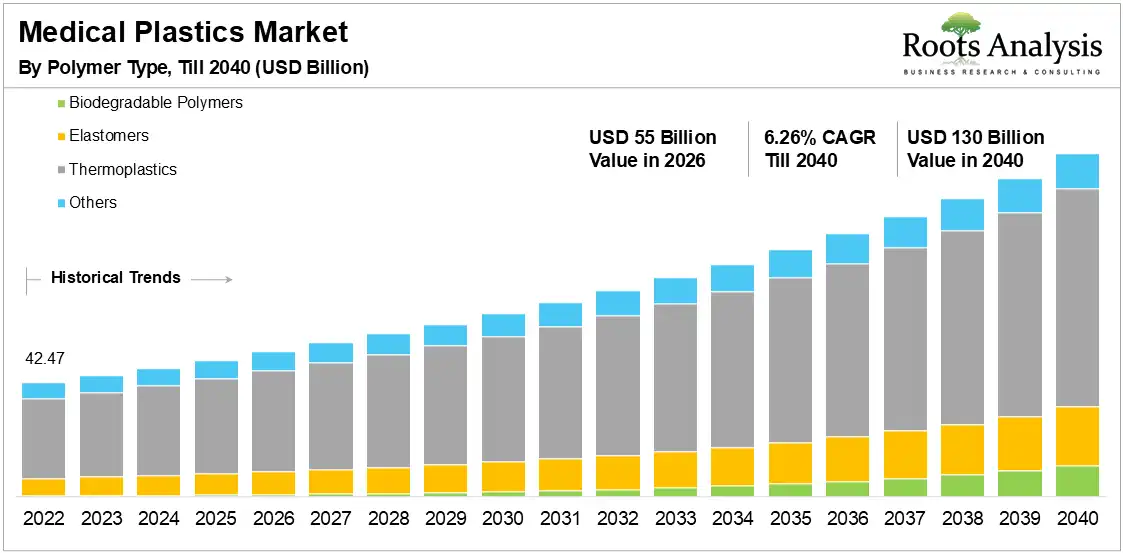
The global medical plastics market was valued at USD 55 billion in 2026 and is projected to reach USD 130 billion by 2040, growing at a CAGR of 6.26% during the forecast period 2026-2040.
See What’s in the Full Report – Request Your Complimentary Insights!
Market Report: Key Takeaways
- In terms of product, the engineering plastics sub-segment secures 38.45% of the overall revenue share of the global market.
- In terms of polymer type, the thermoplastics sub-segment holds the largest share (68.43%) of medical plastics market.
- North America dominates the medical plastics market, commanding a substantial 36.79% market share.
- The market is experiencing robust growth, driven primarily by escalating demand for medical-grade plastics in critical healthcare applications, such as disposable syringes and tubing. This momentum is further reinforced by sustained investments in healthcare infrastructure and expanding medical device manufacturing capabilities.
Market Overview
Medical plastics are high-performance polymeric materials designed for biocompatibility, durability, and sterilization tolerance, making them indispensable in modern healthcare. Their use spans from single-use medical disposables, such as plastics for syringes and catheters to durable products, including prosthetics, diagnostic equipment housings, and biocompatible medical plastics for implantable devices.
Advancements in polymer engineering have enabled lightweight, flexible, and high-precision designs, driving innovations in medical plastics for minimally invasive devices. These enhancements improve surgical precision, reduce patient trauma, and accelerate recovery. Meanwhile, the emergence of 3D printed medical plastics has transformed production by enabling custom-fit implants, patient-specific prosthetics, and complex diagnostic tools, enhancing both functionality and treatment outcomes.
The robust growth of the healthcare plastics market is driven by factors such as the rising global demand for aging populations, the expansion of home healthcare, and the relentless pursuit of infection control standards.
As James Dandeneau, CEO of Putnam Plastics, notes, “We’ve prided ourselves on pushing the limits of plastic technology for the last several decades and strive to continue to do so. Things like TIE tubing, tri-layer, reel to reel lined multi-lumen catheters, large thin-walled polyurethanes, Rilslix™, clean PI, NMP free PI to name just a few.” These ongoing developments in polymer science underscore the industry’s commitment to safer and smarter healthcare solutions.
The healthcare plastics market continues to grow steadily, driven by aging populations and increasing demand for medical disposables. Advances in antimicrobial, bioresorbable, and recyclable medical plastics further align the industry with global standards, reinforcing its pivotal role in shaping next-generation healthcare.
Pay Only for What You Need – The Best Way to Optimize
Recent Developments in Medical Plastics
- In January 2026, Kraton highlighted its hydrogenated styrenic block copolymer (HSBC) solutions for PVC-free medical tubing, positioning them as safer, plasticizer-free alternatives that meet strict healthcare regulatory standards and support recyclability in medical applications.
- In August 2025, Brightmark and Lewis Salvage surpassed recycling over 1 million pounds of difficult-to-recycle medical plastics, transforming healthcare waste into circular products. This milestone highlights advances in sustainable recycling technology and environmental stewardship in the healthcare plastics market.
- In July 2025, Arterex, a leading global medical device developer, expanded its portfolio of medical device manufacturing companies with the acquisition of Xponent Global, an ISO 9001:2015 certified producer of extruded tubing for the medical industry.
- In April 2025, Sweden’s Karnell Group acquired Warwick, a manufacturer of reusable medical plastics, to diversify and strengthen its portfolio by entering the healthcare sector.
- In October 2024, TekniPlex Healthcare introduced bio-based compounds for medical plastics applications with the aim to reduce CO2 output and emissions by up to 90% compared with conventional PVC resins.
Medical Plastics Market Dynamics
Key Market Drivers
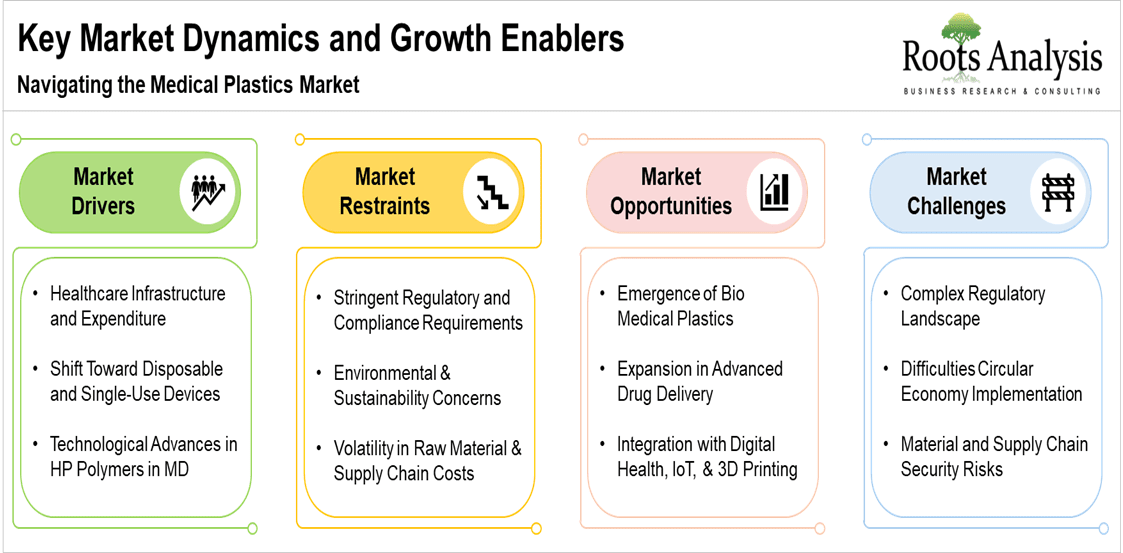
- Healthcare Infrastructure and Expenditure: The demand for medical-grade plastics in disposable syringes and tubing is rapidly increasing due to ongoing investments in the healthcare sector. This has fueled a steady growth of the disposable medical plastics market.
- Shift Toward Disposable and Single-Use Devices: COVID-19 accelerated the adoption of single-use plastics in surgical instruments, personal protective equipment (PPE), and diagnostic consumables.
- Technological Advances in High-Performance Polymers in Medical Devices: The development of advanced polymer composites for surgical instruments with enhanced biocompatibility, have made these materials a preferred choice for increasingly complex and minimally invasive medical device and implants.
Market Challenges
- Complex Regulatory Landscape: Regulatory differences across regions often limit global market access, as different regions have specific tailored chemistry, documentation, and risk assessment requirements.
- Difficulties in Circular Economy Implementation: Due to the contents of medical plastics being biohazardous or mixed materials, recycling these plastics is technically and legally challenging.
- Material and Supply Chain Security Risks: Supply disruptions or quality issues can occur in medical-grade plastic resin and additives. This can lead to interruption in manufacturing, especially for high-performance thermoplastics for hospital equipment.
Market Segmentation
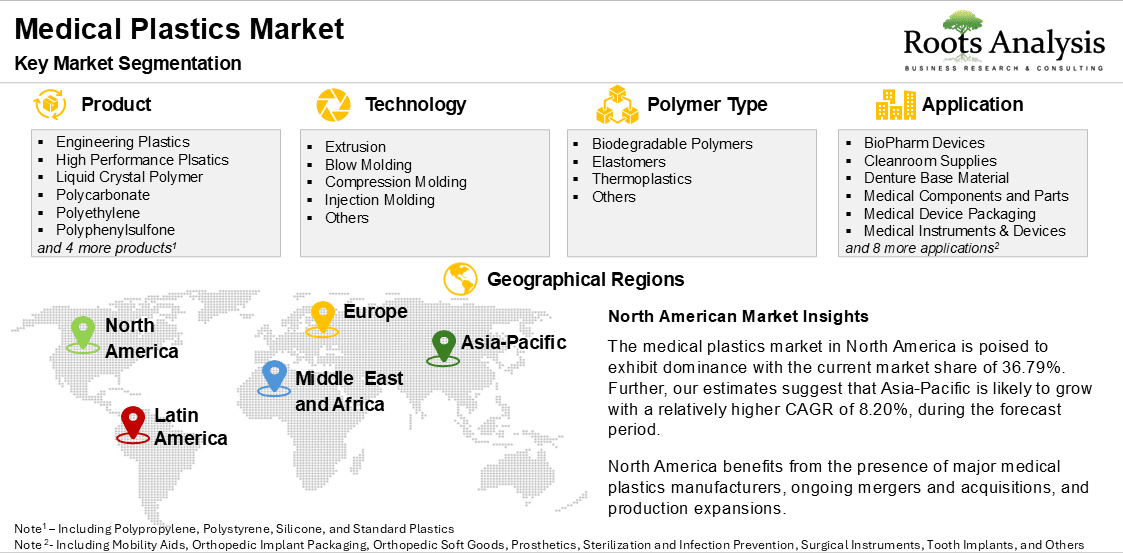
The medical plastics market report presents an in-depth analysis of the various companies that are involved in offering sustainable medical plastics solutions, across different segments, as in the figure below:
Market Share Insights
Engineering Plastics Sub-Segment to Hold a Significant Market Share
Our medical plastics market forecast estimates suggest that the engineering plastics sub-segment is set to take the lead, currently holding a market share of 38.45%. Meanwhile, the polyphenylsulfone sub-segment is projected to grow with a relatively higher CAGR during the forecast period 2025 to 2035.
The growth of engineering plastics is largely a result of their advantages, such as high ductility, faster production times, low weight, high impact, resistance to fire and chemicals, and a greater resistance to friction, over standard plastics. Evolving regulatory compliance for medical plastics and laws, which mandate the use of high-quality plastics, further reinforce the dominance of engineering plastics in the global medical plastics industry.
Thermoplastics to Dominate Market Share by Polymer Type
The thermoplastics sub-segment dominated the medical plastics market in 2025, holding a 68.43% share due to its exceptional versatility, cost-efficiency, and widespread use in medical device manufacturing. Preferred medical polymers such as, PVC, PE, PP medical plastics are favored for their ease of processing, chemical resistance, and ability to withstand sterilization, making them essential in producing reliable medical devices.
Conversely, biodegradable polymers are projected to register the fastest CAGR of 8.8% over the forecast period, driven by increasingly stringent regulations for medical plastics in healthcare applications. Further, the rising demand for sustainable solutions in healthcare is accelerating this shift.
Biodegradable polymers, such as polylactic acid (PLA) and polycaprolactone (PCL) are gaining traction not only in drug delivery systems but also in surgical implants and tissue engineering, thanks to their biocompatibility and natural degradation properties. These medical plastics market trends in drug delivery systems position them as a pivotal growth segment within the expanding healthcare plastics market, underlining the industry's move toward eco-friendly, regulatory-compliant innovations.
North America Dominates Global Medical Plastics Industry with Advanced Healthcare & R&D
North America is the leading region in the medical plastics market in 2025, holding a dominant share of 36.79%, driven by its advanced healthcare infrastructure, high expenditure on healthcare, and strong presence of medical device manufacturers.
The region’s growth is boosted by significant investments in R&D, rapid adoption of innovative technologies, such as minimally invasive devices and 3D printed medical plastics, and stringent regulatory standards demanding high-performance, biocompatible plastics. The presence of professional pharmacy chains and government initiatives expanding over the counter (OTC) medicine availability further stimulate demand.
The US leads the market with the highest CAGR, fueled by cutting-edge polymer technologies like PVC, widely used in surgical instruments and diagnostic devices due to their strength and biocompatibility. North America’s emphasis on sustainable practices and innovation in polymer formulations positions it as the key driver of growth in the global healthcare plastics market.
Want Information on Specific Region / Segment?
Key Market Insights
Competitive Landscape of Leading Players in the Medical Plastics Industry
Leading medical plastics manufacturers shaping the competitive landscape include Arkema, Avantor, BASF SE, Celanese, Covestro, Dow, DuPont, Eastman Chemical Company, Evonik Industries, Lubrizol, Nolato, Orthoplastics, Röchling, SABIC, Saint-Gobain Performance Plastics, Solvay, Tekni-Plex, and Trelleborg. These companies are recognized for driving innovation and supplying advanced polymer solutions across the global healthcare sector.
To expand their market share, these leaders are investing aggressively in R&D for biocompatible and sustainable materials, forming strategic partnerships, expanding product portfolios, and achieving certifications specific to niche medical grade plastics markets. Notably, DuPont’s acquisition of Donatelle Plastics in July 2024 has enhanced its healthcare offerings, while Covestro’s inauguration (in March 2024) of a new polycarbonate copolymer plant in Belgium highlights a shift toward high-quality, solvent-free and medical-grade plastics production.
Industry advancements include launches of medical-grade TPEs and eco-friendly copolymers, alongside recycling-focused agreements aimed at sustainability. By emphasizing cutting-edge material science and proactive collaborations, top players are well-positioned to meet the evolving requirements of the healthcare plastics market, setting benchmarks for safety, regulatory compliance, and sustainable manufacturing practices.
Role of Antimicrobial Additives in Medical Plastic Products
Antimicrobial additives are incorporated into medical plastics to inhibit / kill the bacteria, fungi, and other microbial colonies, enhancing hygiene and safety. Common additives include silver, copper, and zinc compounds known for broad-spectrum efficacy and durability.
Antimicrobial medical plastics are used in medical devices, hospital equipment, textiles, and packaging to reduce infection risk. The adoption of antimicrobial additives in plastics is growing rapidly, due to increased demand for sterilizable plastics for healthcare and regulatory focus on infection control, with innovations in nano-formulations and controlled-release technologies.
Sustainable and Recyclable Plastics for Medical Packaging
The medical plastics sector is increasingly adopting sustainable and recyclable plastics to reduce environmental impact, further growing the biocompatible plastics market. Innovations include the use of bioplastics, polymer blends designed for recyclability, and solvent-free manufacturing processes.
Regulations and consumer demand are pushing companies to integrate circular economy principles by improving material recovery, reducing single-use plastic waste, and choosing eco-friendly materials that maintain sterility and barrier properties.
Use of Medical Plastics in Wearable Health Monitoring Devices
Medical plastics are increasingly being used in wearable health devices. Advanced polymers, such as thermoplastic elastomers (TPEs) and polycarbonate copolymers are preferred for their skin-friendly properties and resistance to sweat and sterilization processes. These materials enable lightweight, ergonomic designs critical for continuous patient monitoring and remote healthcare.
The key advantage of medical plastics in wearables is their ability to shield delicate electronics while maintaining flexibility and breathability. This combination promotes user comfort and device reliability, driving adoption in chronic disease management, fitness tracking, and fueling growth in the medical device plastics market.

Medical Plastics Market: Scope of the Report
| Key Report Attributes | Details | |
| Historical Trend | Since 2022 | |
| Forecast Period | Till 2040 | |
| Market Size 2026 | USD 55 Billion | |
| Market Size 2040 | USD 130 Billion | |
| CAGR (Till 2040) | 6.26% | |
| Segments Covered |
|
|
Your Business is Unique – Why Shouldn’t Your Report Be?
Market Segments
Based on research, we have segmented the medical plastics market into product, technology, polymer type, application, geographical regions, and key players.
Medical Plastics Market, by Product
- Engineering Plastics
- High Performance Plastics
- Liquid Crystal Polymer
- Polycarbonate
- Polyethylene
- Polyethylenimine
- Polymethyl Methacrylate
- Polyphenylsulfone
- Polypropylene
- Polystyrene
- Silicone
- Standard Plastics
Medical Plastics Market, by Technology
- Extrusion
- Blow Molding
- Compression Molding
- Injection Molding
- Others
Medical Plastics Market, by Polymer Type
- Biodegradable Polymers
- Elastomers
- Thermoplastics
- Others
Medical Plastics Market, by Application
- Biopharma Devices
- Cleanroom Supplies
- Denture Base Material
- Medical Components and Parts
- Medical Device Packaging
- Medical Instruments & Devices
- Mobility Aids
- Orthopedic Implant Packaging
- Orthopedic Soft Goods
- Prosthetics
- Sterilization and Infection Prevention
- Surgical Instruments
- Tooth Implants
- Others
Medical Plastics Market, by Geographical Regions
- North America
- US
- Canada
- Mexico
- Rest of North America
- Europe
- Austria
- Belgium
- Denmark
- France
- Germany
- Ireland
- Italy
- Netherlands
- Norway
- Russia
- Spain
- Sweden
- Switzerland
- UK
- Rest of Europe
- Asia-Pacific
- Australia
- China
- India
- Japan
- New-Zealand
- Singapore
- South Korea
- Rest of Asia-Pacific
- Latin America
- Brazil
- Chile
- Colombia
- Venezuela
- Rest of Latin America
- Middle East and Africa (MEA)
- Egypt
- Iran
- Iraq
- Israel
- Kuwait
- Saudi Arabia
- UAE
- Rest of MEA


